Content Menu
● 1. What Are the Main Types of Wood Doors with Glass?
● 2. What Performance Criteria Matter for Wood Doors with Glass?
● 3. How to Evaluate Wood Door with Glass Suppliers
● 4. Key Quality Indicators for Buyers
● 5. What Industry Standards Apply to Wood Doors with Glass?
● 6. How Are Wood Doors with Glass Manufactured?
● 7. What Customization Options Are Available for OEM and ODM Orders?
● 8. What Are the MOQ, Lead Time, and Shipping Options?
● 9. Why Factory-Direct Supply Matters
● 10. Client Applications and Case Scenarios
12 min read
When a procurement manager opens the first sample box from a new supplier, the initial check is rarely about the glass. They run a finger along the stile edge, inspect the joinery, and hold the door up to the light to see if the panel sits flush. Glass can be replaced. Warped wood cannot. That distinction shapes how serious buyers evaluate a wood door with glass — not as a single product, but as an assembly of materials, tolerances, and performance claims that must survive ocean freight, site storage, and years of daily use.
This guide covers the product categories, technical specifications, and supplier evaluation criteria needed to source wood doors with glass for residential, commercial, and hospitality projects. It focuses on what to verify before placing an order, not just what to specify.
What Are the Main Types of Wood Doors with Glass?
A wood door with glass falls into three broad categories: solid wood stile-and-rail, engineered wood (hollow or solid core), and wood-clad aluminum hybrids. Each serves a different budget and performance tier.
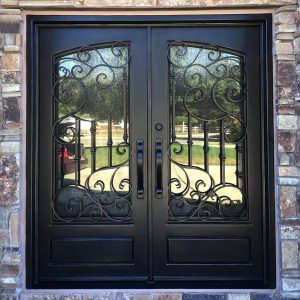
Solid wood stile-and-rail doors use full timber components — typically oak, mahogany, walnut, or maple — assembled with mortise-and-tenon joinery. The glass panel sits within a frame of wood stiles and rails, held by glazing beads. These doors carry a premium aesthetic and are common in high-end residential and boutique commercial projects. They are also heavier and more sensitive to humidity changes than engineered alternatives.
Engineered wood doors use a hollow or solid core wrapped in veneer. Hollow core doors are lightweight and inexpensive, making them common in multi-unit residential buildings and interior applications. Solid core doors use particleboard or medium-density fiberboard (MDF) cores, offering better sound insulation and dimensional stability. Both accept glass lites during manufacturing, though the glazing pocket depth and edge sealing requirements differ from solid wood.
Wood-clad aluminum doors combine a timber interior with an aluminum exterior frame. The aluminum carries the structural load and weather resistance, while the wood provides interior aesthetics. These are increasingly specified for villas and patio entrances where thermal performance matters more than pure material consistency.
The glass itself adds another layer of specification. Single glazing offers basic transparency at low cost. Double and triple glazing improve thermal insulation (lower U-values) and reduce sound transmission (higher STC ratings). Tempered or laminated safety glass is mandatory in most code jurisdictions for doors — in the United States, safety glazing requirements appear in 16 CFR 1201 and the International Building Code (IBC). Decorative options include frosted, tinted, low-E coated, and patterned glass for privacy without sacrificing natural light.
What Performance Criteria Matter for Wood Doors with Glass?
Performance testing distinguishes a building component from a decorative object. For exterior wood doors with glass, three metrics dominate: thermal transmittance, air leakage, and water penetration resistance.
Thermal performance is measured by U-value — the rate of heat transfer through the assembly. Lower U-values indicate better insulation. Energy codes such as ASHRAE 90.1 set maximum U-value thresholds depending on climate zone. A wood door with double glazing and a thermal break in the frame typically achieves U-values between 0.30 and 0.50, depending on the glass specification and frame design. The National Fenestration Rating Council (NFRC) provides certified ratings in North America; European buyers reference CE marking under EN 14351-1.
Air leakage (AL) measures how much air passes through the closed assembly. Weather-stripping around the perimeter and at the threshold determines this rating. Poor air sealing leads to energy loss, drafts, and moisture infiltration. AAMA/WDMA/CSA 101/I.S.2/A440 is the North American standard for rating windows and doors; European equivalents appear under EN 12207.
Water penetration resistance matters most in hurricane-prone and high-rainfall regions. The design pressure (DP) rating indicates the assembly’s ability to withstand wind loads without structural failure or water intrusion. Laminated glass is often required in these applications because it holds together when shattered. Testing per AAMA 101 or the Chinese GB/T 7106 standard verifies watertightness under simulated rain and wind conditions.
One honest caveat: a wood door with glass is structurally weaker than the same door without a glass opening. The glazing pocket interrupts the continuous wood frame. That is why frame joinery and glazing bead depth are not cosmetic details — they determine whether the assembly holds up under wind load or begins to leak after a few seasons.
How to Evaluate Wood Door with Glass Suppliers
Supplier evaluation should follow a structured framework. The goal is not to find the cheapest quote but to identify a factory capable of consistent production at scale.
Step 1: Audit manufacturing capability. Ask whether the factory produces doors in-house or sources from subcontractors. In-house production means better quality control and shorter lead times. Request a factory floor video or schedule a virtual tour. Look for CNC machining centers, calibrated glazing equipment, and finishing lines with controlled humidity.
Step 2: Verify testing equipment. A serious manufacturer maintains its own testing chambers for air-tightness, water-tightness, and wind resistance. If the supplier cannot demonstrate in-house testing, they are likely shipping untested product or relying on third-party labs for design certification only — not batch verification.
Step 3: Review export documentation proficiency. For international buyers, the supplier must provide a packing list, proforma invoice, and full customs documentation. Missing or incorrect paperwork delays shipments and adds cost. Ask for samples of these documents during the vetting phase.
Step 4: Request pre-shipment inspection. For large orders, third-party inspection (SGS, BV, or similar) provides independent verification. Alternatively, ask the supplier to share video evidence of the actual units being tested before loading. This is non-negotiable for exterior doors where performance claims affect building code compliance.
Step 5: Check building code adaptation capability. A wood door with glass manufactured for the Chinese domestic market will not automatically meet Australian AS2047, European EN 14351-1, or North American AAMA standards. The supplier must be willing to adjust profile structures and fittings to match your target market’s requirements. This is not a minor adjustment — glazing depth, weather-stripping profile, and hardware ratings all change.
Red Flags to Avoid
- No testing data available. A supplier who cannot show test reports for air-tightness, water-tightness, or wind resistance is not producing code-compliant exterior doors.
- Unwillingness to customize. If the factory insists on standard sizes only, they lack the flexibility required for architectural projects.
- Vague lead times. A supplier who cannot specify production time separately from shipping time does not control their own manufacturing schedule.
- No moisture content data. Wood doors must be manufactured at appropriate moisture content — typically 6–9% for interior, 10–12% for exterior in temperate climates. Suppliers who cannot state their wood’s moisture content range risk delivering doors that warp.
Key Quality Indicators for Buyers
Beyond test certificates, several physical indicators reveal manufacturing quality.
Joinery inspection. Mortise-and-tenon joints should be tight with no visible gaps. Dowel-reinforced joints are acceptable but generally less strong than through-tenons for heavy glass panels.
Glazing bead fit. Beads should seat flush against the wood frame with consistent gaps. Uneven bead lines indicate poor machining tolerance.
Finish consistency. Factory-applied UV-cured finishes offer better consistency than field finishing. Check for uniform color and coverage, especially around glass contact points.
Hardware weight rating. A door with heavy glass panels requires hinges rated for the total weight. Standard residential hinges may fail within months on a solid wood door with double glazing. Confirm the hinge specification matches the door weight.
Weather-stripping compression. When the door closes, weather-stripping should compress evenly along the full perimeter. Gaps at corners lead to air and water infiltration.
What Industry Standards Apply to Wood Doors with Glass?
| Standard | Region | Scope |
|---|---|---|
| AAMA/WDMA/CSA 101/I.S.2/A440 | North America | Performance rating for windows and doors |
| NFRC 100 | North America | U-value and thermal performance rating |
| 16 CFR 1201 | United States | Safety glazing requirements |
| EN 14351-1 | Europe | CE marking for doors and windows |
| AS2047 | Australia | Performance of windows and doors |
| GB/T 7106 | China | Air permeability, watertightness, wind resistance |
| ASTM E90 | International | Sound transmission loss rating |
The applicable standard depends on the project location. A buyer sourcing for a Miami high-rise needs DP ratings verified per AAMA 101. A buyer shipping to Frankfurt needs CE marking per EN 14351-1. A manufacturer who claims “international standards” without naming specific ones is not providing useful information.
How Are Wood Doors with Glass Manufactured?
The production process determines the final quality. Understanding it helps buyers ask the right questions.
Step 1: Wood selection and conditioning. Timber arrives as rough lumber and undergoes kiln drying to achieve target moisture content. The drying schedule matters — too fast causes checking and warping. After drying, boards are graded for defects and cut to dimension.
Step 2: Frame assembly. Stiles and rails are machined with mortise-and-tenon joints or dowel holes. The frame is dry-assembled, checked for squareness, then glued and clamped. For exterior doors, waterproof adhesives are essential. The glass opening is machined during this stage.
Step 3: Glass preparation. Glass is cut to size, edge-worked, and tempered or laminated as specified. For double glazing, two panes are separated by a spacer and sealed to create an insulating glass unit (IGU). Low-E coatings are applied before assembly.
Step 4: Glazing. The glass is set into the frame with setting blocks, then secured with glazing beads. Sealant is applied to prevent water infiltration. The quality of this step determines the door’s water resistance.
Step 5: Finishing. The assembled door moves to the finishing line. UV-cured primers and topcoats are applied in controlled conditions. Hardware — hinges, locks, handles — is installed or packaged separately.
Step 6: Testing and inspection. Representative units undergo air-tightness, water-tightness, and wind resistance testing. Visual inspection checks glass clarity, wood grain consistency, and hardware operation. Approved units are wrapped for shipping.
What Customization Options Are Available for OEM and ODM Orders?
Customization falls into two models. Under OEM (Original Equipment Manufacturing), the buyer provides drawings and specifications, and the factory manufactures to those exact dimensions and tolerances. This suits large construction projects with strict architectural drawings.
Under ODM (Original Design Manufacturing), the factory provides designs from existing templates, which the buyer can modify. This suits developers who need proven designs with faster lead times and lower engineering costs.
Private label options include custom logo placement, custom ID tags, and rebrandable technical submittal sheets. Professional suppliers provide installation manuals and specification documents that can be rebranded for the buyer’s client-facing documentation.
For a wood door with glass, customization typically covers:
- Dimensions (width, height, thickness)
- Wood species and finish color
- Glass type (clear, frosted, tinted, low-E, laminated)
- Lites pattern (single large panel, multiple smaller panels, fan-lite)
- Hardware schedule (hinges, locks, handles, smart lock compatibility)
- Fire-rating requirements (if applicable)
What Are the MOQ, Lead Time, and Shipping Options?
Minimum order quantities vary by product type. Standard engineered wood doors with glass may have lower MOQs (20–50 units), while fully customized solid wood doors typically require larger commitments. A supplier who cannot state their MOQ clearly likely does not have stable production planning.
Production lead times range from 2–4 weeks for standard sizes with common glass options, to 4–8 weeks for fully customized orders with specific wood species and hardware. Shipping time is additional and depends on the destination port.
FCL (Full Container Load) suits large orders where the container is filled to capacity. Per-unit shipping costs are lower, and the risk of damage from handling at consolidation hubs is reduced. LCL (Less than Container Load) suits smaller orders but carries higher per-unit costs and longer transit times. Direct delivery from the factory avoids the extra handling that often damages doors at consolidation warehouses.
Packaging for ocean freight requires crate construction, protective film on glass, and moisture-barrier wrapping. Poor packaging causes more damage than rough handling — humidity inside a container can ruin an entire shipment of unfinished wood doors.
Why Factory-Direct Supply Matters
The industry standard for serious procurement is factory-direct supply. Here is how that works in practice — and how it addresses the concerns discussed above.
As a manufacturing facility, Jusen Door and Windows produces wood doors with glass and related fenestration products from our China factory. Direct supply eliminates the middleman markup, so the price reflects materials, labor, and logistics — not intermediary commissions. For buyers placing bulk orders, this cost transparency matters more than a single-unit discount.
Our customization capability covers size, color, glass type, and hardware accessories. Whether you need OEM production to your exact drawings or ODM selection from proven designs, the factory adjusts to the project’s requirements. This is not a catalog of fixed products — it is a manufacturing line that adapts.
Quality control follows the standards discussed throughout this guide. Our pre-shipment inspection includes air-tightness, water-tightness, and wind resistance testing. The units tested are the units shipped — not a design prototype from a certification file. This distinction matters when a door fails on site and the contractor asks whether the factory actually verified the product.
With established foreign trade experience, we provide packing lists, proforma invoices, and full customs documentation. Both FCL and LCL shipments are handled directly from our factory. For international projects, we adjust profile structures and fittings to match local building codes — whether that means AS2047 for Australia, EN 14351-1 for Europe, or AAMA standards for North America.
Client Applications and Case Scenarios
Hospitality sector: A beachfront resort requires exterior wood doors with glass that meet hurricane wind-load codes. The glazing package is adjusted to include laminated glass, and the frame joinery is reinforced to achieve the required DP rating. The factory provides test reports verifying performance before shipment.
High-end residential: A custom home builder needs a wood door with glass in a specific hardwood species to match interior millwork. The OEM process matches color and grain across the entire order, with factory-applied UV-cured finish for consistency.
Commercial offices: An interior door with a glass panel provides natural light transmission while meeting fire-rating requirements. Fire-rated glass and door assemblies are specified, with documentation provided for building code approval.
Choose a factory-direct supplier if: your project involves bulk orders, requires customization, and depends on documented performance testing.
Choose a distributor if: you need immediate delivery of standard sizes, have no customization requirements, and accept higher per-unit costs for convenience.
Questions to Ask Before Ordering
- What is your standard production lead time for a wood door with glass in [your size and specification]?
- Can you provide test reports for air-tightness, water-tightness, and wind resistance for this specific door model?
- What is your MOQ for OEM orders with custom dimensions?
- How do you package doors for ocean freight — what protective measures are used on the glass?
- Can you adjust the door profile and fittings to meet AS2047 / EN 14351-1 / AAMA standards for our target market?
- What is the moisture content range of the wood used in your exterior doors?
- Can you provide a Bill of Materials (BOM) breakdown with the quotation?
References
- National Fenestration Rating Council. “NFRC 100: Thermal Performance Ratings.” https://www.nfrc.org/
- American Architectural Manufacturers Association. “AAMA/WDMA/CSA 101/I.S.2/A440.” https://www.aamanet.org/
- U.S. Consumer Product Safety Commission. “16 CFR Part 1201 — Safety Glazing Materials.” https://www.ecfr.gov/
- European Committee for Standardization. “EN 14351-1: Windows and Doors.” https://www.cen.eu/
- Standards Australia. “AS2047: Windows and Doors — Performance.” https://www.standards.org.au/
- ASTM International. “ASTM E90: Sound Transmission Loss.” https://www.astm.org/
Ready to source a wood door with glass for your next project? Discuss your specifications with our team for a detailed quotation and technical consultation.
https://doorwoodendoors.com/contact-us/” style=”display:inline-block;padding:12px 24px;background:#2563eb;color:#fff;text-decoration:none;border-radius:6px;font-weight:600″>Get a Free Quote