Key Takeaways: What You Need to Know Before Starting a Window and Door Project
The success of a window and door project hinges on two decisions: the product specification and the manufacturer you source from. Getting the first wrong means performance issues; getting the second wrong means delays, cost overruns, and compliance headaches.
Before you request a single quote, understand these core facts:
- Material choice drives everything. Aluminum, uPVC, and wood have different cost profiles, thermal performance, and maintenance needs. There is no universal “best” — only what fits your climate, building type, and budget.
- Quality is verified by testing, not promises. Air-tightness, water-tightness, and wind resistance tests are the industry benchmarks. Ask which standards your manufacturer tests against and request the reports.
- Customization is a capability, not a checkbox. True customization covers profile structure, glass specifications, hardware, and color — not just size adjustments. Verify the factory can actually produce what you spec.
- Logistics cost more than the product. For international buyers, shipping, customs documentation, and lead times can add significant cost and risk. Factor these into your budget from day one.
Types of Windows and Doors: A Detailed Breakdown
The three dominant material categories cover the vast majority of commercial and residential projects. Each has distinct trade-offs.
Aluminum Windows and Doors
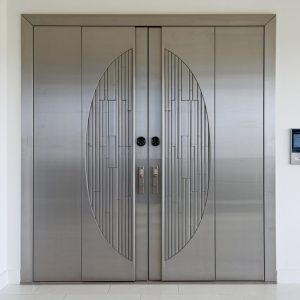
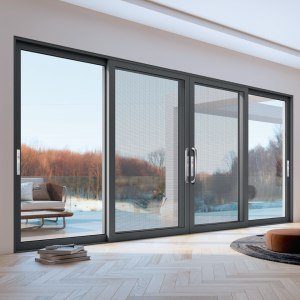
Aluminum is the default choice for commercial projects and modern residential builds. Its strength-to-weight ratio allows for slimmer frames and larger glass panes, which translates to more natural light and better views. Extruded aluminum profiles are dimensionally stable — they do not warp, rot, or swell.
The main drawback is thermal conductivity. Untreated aluminum transfers heat and cold readily. This is solved with thermal-break technology, where a polyamide strip separates the interior and exterior frames. A thermal-break aluminum window performs dramatically better than a non-thermal-break equivalent in both hot and cold climates. When comparing quotes, always confirm whether the profile includes a thermal break — it is a significant cost differentiator.
For coastal or high-humidity environments, aluminum’s corrosion resistance (especially with powder-coated finishes) makes it a low-maintenance option. It also offers the widest range of color finishes.
uPVC Windows and Doors
uPVC (unplasticized polyvinyl chloride) is the value leader. It is inexpensive, naturally insulating, and requires almost no maintenance — no painting, no sealing, no staining. The multi-chambered profile design traps air, providing good thermal performance at a lower cost than aluminum.
The trade-offs are structural. uPVC is not as rigid as aluminum, so it requires steel reinforcement inside the frame for larger spans. This limits maximum sash sizes. Color options are improving, but the finish is less premium than anodized or powder-coated aluminum. For budget-conscious residential projects or buildings where large glass areas are not a priority, uPVC is a practical choice.
Solid Wood Windows and Doors
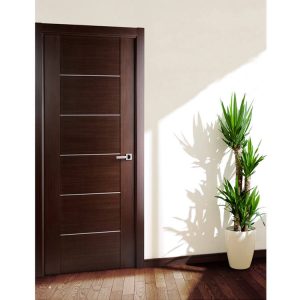
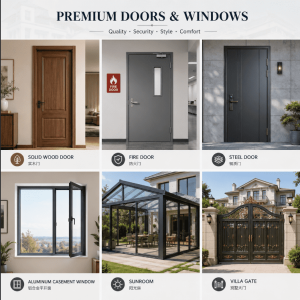
Wood offers the highest aesthetic value and natural insulation. It is the preferred material for heritage renovations, high-end villas, and projects where the door or window is a design statement. Solid wood, when properly treated and finished, is durable and repairable — scratches and dents can be sanded out, unlike aluminum or uPVC.
The downsides are cost and maintenance. Quality wood is expensive, and the finish must be maintained every few years to prevent moisture damage. Wood is also more dimensionally sensitive to humidity changes than aluminum. If you choose wood, confirm the species, the moisture content treatment, and the type of finish applied at the factory.
For large-scale commercial projects, wood is rarely the primary material. It is more often used for entrance doors or accent features.
Comparison Table: Materials, Costs, and Durability
| Material | Relative Cost | Thermal Performance | Durability & Maintenance | Customization Options | Best Fit Scenarios |
|---|---|---|---|---|---|
| Aluminum (thermal-break) | High | Excellent when thermally broken; poor without | Very high; minimal maintenance, corrosion-resistant | Extensive: color, profile shape, hardware, glass | Commercial buildings, large spans, coastal areas, modern architecture |
| uPVC | Low to Medium | Good to Very Good | High; low maintenance, but can become brittle in extreme cold | Limited: colors are restricted, size limited by reinforcement needs | Residential projects, budget-conscious builds, standard window sizes |
| Solid Wood | High to Very High | Good | Moderate; requires periodic refinishing, repairable | High: custom profiles, stains, and finishes | Heritage homes, luxury villas, entrance doors, design-led projects |
| Aluminum (non-thermal-break) | Medium | Poor | Very high | Moderate | Interior partitions, warm climates, utility applications |
How to Choose the Right Manufacturer: A Step-by-Step Guide
Step 1: Define Your Performance Requirements
Before evaluating manufacturers, define what your project needs. What is the local climate? What are the building code requirements for energy efficiency and wind load? What is the noise level of the surrounding area?
Write down specific numbers: U-values for thermal performance, water-tightness classification, air permeability rating, and wind load resistance. These are measurable standards you can present to any supplier. A manufacturer that cannot discuss these metrics in concrete terms lacks the technical depth your project requires.
Step 2: Evaluate Material and Profile Systems
Ask what profile systems the manufacturer offers. Does the aluminum system have a thermal break? What is the width of the polyamide strip? Is the uPVC reinforced with galvanized steel? What wood species is available?
For aluminum, check the profile’s wall thickness. Industry-standard profiles use between 1.4mm and 2.0mm wall thickness, depending on the application. Thinner profiles are cheaper but may not meet wind-load requirements for high-rise or coastal installations.
Step 3: Verify Customization Capabilities
Full customization means the factory can adjust:
- Profile structure — to match local building codes and installation methods
- Size — beyond standard dimensions, without compromising structural integrity
- Glass — double, triple, laminated, tempered, or low-E coatings
- Color — both frame color and finish type (anodized, powder-coated, wood-grain foil)
- Hardware — locks, hinges, handles from different brands and specifications
Ask for drawings or samples of previous custom work. A factory that only assembles standard units is not a true manufacturer.
Step 4: Scrutinize Quality Assurance and Testing
A reliable manufacturer tests its products — not just at random, but as a standard part of production. The three critical tests are:
- Air-tightness: Measures the amount of air leaking through the assembly. Poor air-tightness leads to drafts and energy loss.
- Water-tightness: Measures resistance to water penetration under pressure. Critical for buildings in rain-heavy or coastal regions.
- Wind resistance: Measures the frame’s ability to withstand wind load without permanent deformation. Non-negotiable for high-rise or exposed sites.
Ask for the test reports. If the manufacturer cannot provide them, or uses vague terms like “we do internal testing,” ask which standard they test to (such as EN 12207, EN 12208, or ASTM equivalents). A pre-shipment inspection that includes these tests is the industry best practice.
Step 5: Assess Logistics and Shipping Capabilities
For international buyers, logistics is a core part of the purchase. Key questions:
- Can the manufacturer handle both FCL (Full Container Load) and LCL (Less than Container Load) shipments?
- Do they provide complete customs documentation — packing lists, proforma invoices, and certificates of origin?
- What is the lead time from order confirmation to shipment?
- How is the product packed for ocean freight? Is there adequate protection against moisture and impact?
A manufacturer with foreign trade experience will have streamlined these processes. Inexperienced factories can cause weeks of delays at customs.
Step 6: Check Credibility and Track Record
Look for evidence beyond the sales pitch. Ask for references from projects in your region or climate zone. Check if the manufacturer’s profiles and fittings are adjustable to match local building codes — this indicates they have experience with international standards, not just their domestic market.
Request a sample or a small trial order before committing to a large volume. A manufacturer confident in their product will accommodate this.
Additional Considerations: Customization, Logistics, and Compliance
The “MI Windows and Doors” Factor
When searching for “window and door jobs” or “MI windows and doors jobs,” you may encounter large brand names like MI Windows and Doors. These are established manufacturers with strong distribution networks. The question for a buyer is not whether these brands are good — it is whether they fit your specific project requirements.
Large brands often have standardized product lines. They may be less flexible on custom sizes, unusual glass specifications, or non-standard hardware. For a project that requires specific dimensions or performance characteristics, a factory-direct manufacturer with full customization capabilities may be a better fit.
Cost Planning Beyond the Unit Price
The price per unit is only part of the total cost. Include these in your budget:
- Shipping and freight — varies significantly by container type and destination port
- Customs duties and taxes — depends on your country’s import regulations
- Installation labor — skilled installers charge a premium, and proper installation is critical for performance
- Hardware upgrades — multi-point locking systems and high-end handles add cost
- Glass specifications — double glazing, low-E coatings, and laminated glass each add incremental cost
Compliance and Building Codes
Building codes vary significantly by region. A window that meets European standards may not meet US hurricane codes or Australian bushfire regulations. When you source from a manufacturer, confirm that their profile structure and fittings can be adjusted to match your local codes. This is not a minor detail — it can determine whether your project passes inspection.
Frequently Asked Questions About Window and Door Jobs
What are the main types of windows and doors for commercial projects?
For commercial projects, aluminum is the dominant material due to its strength, slim sightlines, and durability. Casement windows, sliding doors, and curtain wall systems are common. uPVC is used where budget is a constraint. Wood is reserved for entrance doors or architectural accents.
How do I compare manufacturers for window and door jobs?
Compare on five dimensions: material quality and profile system, customization capability, testing and quality assurance, logistics and shipping support, and track record. Request test reports, references, and a sample before committing.
What customization options should I look for?
Look for a manufacturer that can adjust profile structure, size, color, glass type, and hardware. The ability to modify the profile structure to match local building codes is a strong indicator of manufacturing depth.
What quality tests should a reliable manufacturer perform?
The three essential tests are air-tightness, water-tightness, and wind resistance. These should be performed per recognized standards, and the reports should be available to you. A pre-shipment inspection that includes these tests is the industry benchmark.
How do logistics and shipping affect my procurement?
Logistics affect cost, lead time, and product condition upon arrival. Confirm whether the manufacturer can handle FCL and LCL shipments, provides full customs documentation, and has experience packing for ocean freight. Poor packing leads to damage; poor documentation leads to customs delays.
What are common mistakes to avoid when sourcing?
The most common mistakes are: choosing based on price alone without verifying material specs, failing to confirm thermal-break construction in aluminum, skipping test report verification, underestimating shipping and customs costs, and not ordering a sample before a bulk purchase.
How We Meet These Standards: A Manufacturer’s Perspective
The framework above describes what a professional buyer should look for. As a window and door manufacturer, this is how we align with those standards.
We operate as a direct factory supplier, which means the price you see does not include a middleman markup. Our business model is built around full customization — size, color, glass, and hardware accessories are all configurable to your project requirements. This is not a standard product line with minor adjustments; our profile structure and fittings are adjustable to match the building codes of your target market.
Quality assurance is a defined process, not a slogan. Every order undergoes pre-shipment inspection that includes air-tightness, water-tightness, and wind resistance testing. We do not ship without verifying these performance metrics.
On the logistics side, we handle both FCL and LCL shipments with direct delivery from our factory. We provide complete customs documentation — packing lists, proforma invoices, and full export paperwork — because we have extensive experience in foreign trade. This matters when your schedule depends on a smooth customs clearance.
If you are evaluating manufacturers for an upcoming project, we would be glad to discuss how our capabilities match your specifications.
For more details on sizing and pricing, review our size guide or visit our contact page to discuss your project directly.