Content Menu
● 1. Double Doors Supply Chain: Why Factory-Direct Matters
● 2. Our Double Door Product Range: From Solid Wood to Thermal Break Aluminum
● 3. OEM & ODM Partnerships: Building Your Brand with Our Double Doors
● 4. Competitive Pricing & Flexible Logistics for Global Buyers
● 5. Quality Assurance: Pre-Shipment Testing on Every Double Door
● 6. Who We Supply: Case Studies for Double Door Projects
● 7. Frequently Asked Questions
16 min read
A container of double doors leaves our workshop in Foshan about every ten days. The destination changes—sometimes Melbourne, sometimes Vancouver, sometimes Doha—but the loading process looks the same. Our QC team walks the length of each door with a torch, checking the veneer for blemishes, testing the hinge alignment with a feeler gauge, and verifying the seal compression with a digital manometer. This is the last time anyone inside our factory touches those doors. What happens after they arrive at your site is your problem—and ours, if we did our job wrong.
That is the reality of bulk supply. You are not buying a single door for a renovation. You are buying a promise that dozens, or hundreds, of units will perform identically on different walls, under different weather, and in front of different inspectors. The door that looked perfect in a showroom photo will not help you if the batch shows up with bowed stiles or locks that bind in humid conditions.
We have been building double doors since before the export paperwork became digital. Here is how we handle the supply problem—and why contractors and developers keep reordering from us.
Double Doors Supply Chain: Why Factory-Direct Matters
The first question from any serious buyer is not “what is your price?” It is “who else touches this order before it reaches me?”
When you buy double doors through a trading company, the chain looks like this: you place an order, the trading company sends it to a factory, the factory produces it, the trading company marks up the price and handles the paperwork. That markup is not free—you are paying for someone to hold your hand. But you are also paying for a layer of communication that can distort your technical requirements. We have seen orders where the trading company simplified a wind-load specification to “make it strong,” and the result failed a third-party inspection on site.
Our model removes that layer. We are the factory. When you send us a drawing with a specific profile depth or a particular gasket hardness, the person who reads it sits in the same building where the extrusion line runs. There is no telephone game. There is just the drawing, the engineering review, and the production schedule.
Eliminating the Middleman for Better Margins
The price difference is not trivial. Trading companies typically operate on a 10–20% margin. For a hotel project ordering 200 sets of double doors, that margin translates to tens of thousands of dollars that could have gone toward better hardware or a premium finish. When you work with us directly, that money stays in your budget.
But direct pricing only matters if the quality holds. A cheaper door that fails inspection costs more than a well-priced door that passes. Our cost advantage comes from vertical integration—we extrude our own aluminum profiles, we operate our own wood-drying kilns, and we employ our own finishing line staff. We are not buying components from a wholesaler and assembling them. We control the process from billet to box.
Stable Output for Large-Scale Projects
Consistency at scale is the hardest part of manufacturing double doors. A single door can be babied by a craftsman. A hundred doors require jigs, calibrated presses, and a QC checklist that does not get skipped when the deadline looms.
Our production line is set up for batch consistency. We use CNC machining centers for hinge mortises and lock prep, which means the tolerances do not drift between the first unit and the fiftieth. For double doors, this matters enormously—the meeting stile gap must be uniform across every set, or the astragal will not seal correctly on half the units.
We maintain a production capacity of roughly 1,000 sets of double doors per month across our solid wood and aluminum lines. For FCL orders, we typically need 25–35 days from drawing approval to container loading. That schedule is not a hope—it is a commitment written into our production planning system, and we report progress weekly with photos and video updates.
Raw Material Control
Double doors are heavy. A solid wood pair can weigh 80 kilograms or more, and the frames must carry that weight without sagging over time. We source our timber from suppliers we have worked with for over a decade—primarily from Southeast Asia and North America—and we reject any boards with active insect damage or excessive sapwood.
For aluminum double doors, the alloy composition matters. We use 6063-T5 for most profiles, which offers a good balance of strength and corrosion resistance. For coastal projects with high salt exposure, we can switch to T6 temper or add anodized finishes that resist pitting. The point is, we make these decisions with you, not for you. You tell us the site conditions, and we recommend the material specification.
Our Double Door Product Range: From Solid Wood to Thermal Break Aluminum
Not all double doors should be built the same way. A villa entrance in a temperate climate calls for different materials than a commercial storefront in a desert city. We build both—and several options in between.
Solid Wood Double Doors for Villa & Hospitality
Our solid wood double doors are the most requested product for luxury residential projects. We work with oak, mahogany, walnut, and sapele, and we offer both traditional joinery and modern flush designs. The wood is kiln-dried to 8–12% moisture content before machining, which minimizes the risk of warping or cracking after installation.
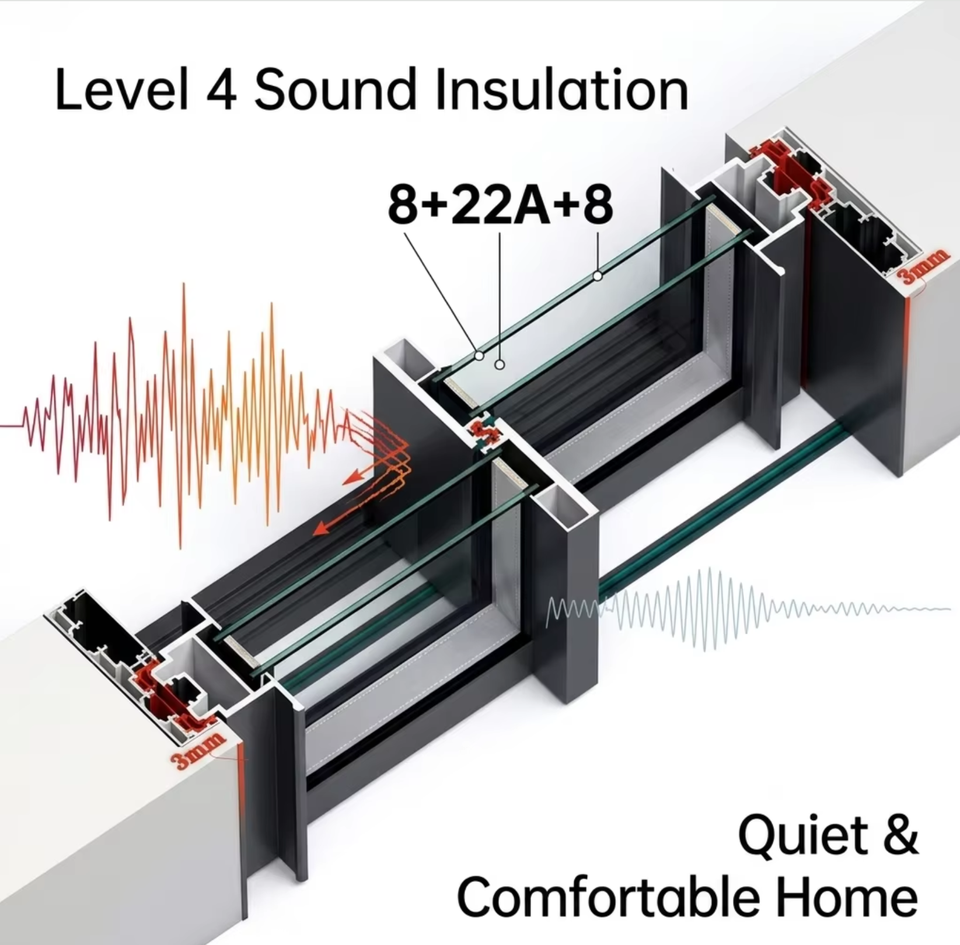
For hospitality clients, we often add acoustic sealing packages. A double door at the end of a hotel corridor needs to block noise from the elevator lobby. Our solid wood doors with perimeter seals achieve Rw ratings of 32–35 dB depending on the configuration—tested in our own acoustic chamber.
Customization is not a special request; it is the standard. We carve logos, we match RAL colors on the frame, and we build to metric or imperial dimensions depending on your market. If your architect draws it, we can build it—within the physical limits of the wood itself.
Thermal-Break Aluminum Double Doors for Commercial Use
For commercial projects, thermal-break aluminum is often the better choice. The polyamide strips separate the interior and exterior aluminum skins, reducing heat transfer and preventing condensation on the frame surfaces.
Our thermal-break double doors are tested to EN 13830 for curtain walling and EN 14351-1 for windows and doors. The profiles are 42mm to 65mm deep, depending on the structural requirements, and we can reinforce the mullions for large-span installations.
The structural challenge with double doors is the unsupported span at the meeting stile. When both leaves are closed, the top and bottom bolts transfer load to the frame. When one leaf is active and the other is fixed, the active leaf must carry all the wind load on its hinge side. We handle this with heavy-duty hinges rated for 150 kg per leaf, and we test every prototype for deflection under load.
Custom Sizes and Configurations
We do not have a “standard size” catalog that you must choose from. Double doors are inherently custom—they are sized to fit an opening, not the other way around. Our engineers work from your architectural drawings and provide shop drawings for approval before production begins.
Glass options include double glazing with low-E coatings, tempered or laminated safety glass, and even switchable privacy glass for high-end interior applications. Hardware can be matched to your specification: mortise locks, panic bars, concealed hinges, or floor springs. The hardware brand is your choice, though we will be honest about which components perform well in high-traffic applications.
OEM & ODM Partnerships: Building Your Brand with Our Double Doors
Some buyers do not want to sell “Jusen” double doors. They want to sell their own brand, with their own warranty and their own service network. We support that model fully through our OEM and ODM programs.
Private Label Manufacturing
Private label means the double doors carry your logo, your packaging, and your model numbers. We remove our branding from the door hardware, the frame extrusions, and the cartons. You present the product as your own, and we remain invisible in the background.
This works particularly well for importers who already have a customer base and want to expand their product line without building a factory. The economics make sense: you avoid the capital investment in extrusion lines, CNC machines, and finishing booths, while still getting a product that meets your quality standards.
Custom Engineering for Local Building Codes
Building codes vary significantly between markets. A double door certified for California’s seismic zones may not satisfy Europe’s wind-load requirements or Australia’s bushfire regulations. Our engineering team reviews the local codes for each target market and adjusts the profile structure, glass thickness, and hardware specifications accordingly.
For example, the UAE requires aluminum doors to withstand significant positive and negative wind pressure on high-rise facades. We responded by reinforcing the interlock between the active and passive leaves, and by specifying a stronger hinge plate. The design passed the required testing and the client received their certification with the documentation we provided.
Prototyping and Technical Drawings
Before mass production, we provide CAD drawings and, when requested, a physical prototype. This is not a formality. It is the stage where problems get caught—a handle placement that interferes with the astragal, a threshold height that creates a tripping hazard, a glass unit that exceeds the profile’s capacity. Catching these issues on a prototype costs days. Catching them after 100 doors are produced costs months.
We do not charge for the first round of shop drawings for qualified orders. If you are serious about the project, we are serious about the design.
Competitive Pricing & Flexible Logistics for Global Buyers
Price is a function of specification, quantity, and timeline. We are honest about that. A simple aluminum double door with standard hardware costs less than a solid mahogany pair with custom bronze hardware. But within a given specification, we are consistently competitive because we do not have a middleman’s margin to protect.
Transparent Costing and Proforma Invoices
When we send a proforma invoice, it lists every component with its price: the profiles, the glass, the hardware, the packaging, the freight. You can see what you are paying for, and you can adjust the specification to hit a target price. If you want to swap the hinges to a lower-cost brand, we tell you what that saves. If you want to upgrade the glass to triple glazing, we tell you what that adds.
This transparency is rare in the industry. Most suppliers send a single line item: “Double doors, $850/set.” We send a detailed breakdown because it helps you make informed decisions—and it builds trust.
FCL & LCL Shipping Solutions
We ship both full container loads and less-than-container loads. For LCL orders, we consolidate your double doors with other cargo at our warehouse and handle the export paperwork. For FCL orders, we coordinate the container booking, the trucking to the port, and the customs clearance documents.
Our export documentation includes the commercial invoice, packing list, bill of lading, and certificates of origin. We have shipped to over 40 countries, so we are familiar with the documentation requirements for most major markets. If your destination has specific requirements—like a fumigation certificate for wooden packaging—we arrange it in advance.
Meeting Project Deadlines
Construction projects run on schedules, and doors are often on the critical path. A delay in door delivery can hold up the entire building handover. We protect your timeline by locking in production slots early and by communicating proactively if any issue arises.
We had a project in Saudi Arabia where the client’s site was delayed by three months due to foundation work. They asked us to hold their double doors in our warehouse until the site was ready. We did—at no additional storage charge—because we had the space and the relationship mattered more than the small cost of warehouse occupancy.
Quality Assurance: Pre-Shipment Testing on Every Double Door
The phrase “quality control” gets thrown around a lot. Here is what it actually means on our floor.
Air-Tightness and Water-Tightness Tests
Every batch of double doors is sampled for air permeability and water tightness testing. We use a test chamber that applies differential pressure across the door assembly while spraying water at controlled rates. The results determine the door’s classification under EN 12207 for air permeability and EN 12208 for water tightness.
For double doors, the meeting stile is the critical area. If the astragal does not compress evenly, air will whistle through the gap and water will find its way in during heavy rain. We check this on every sample, not just the first one off the line.
Wind Resistance Verification
Wind resistance is about structural integrity under load. We test our double doors to EN 12211, applying positive and negative pressure cycles that simulate storm conditions. The door must not deflect beyond specified limits, and it must return to its original shape after the load is removed.
This test is particularly important for high-rise installations, where the wind loads are significantly higher than at ground level. We publish the test results for each profile system, so you can verify that the door meets your project’s requirements before you order.
Hardware and Finish Inspection
The final inspection covers the visible details: the alignment of the stiles, the finish consistency on the wood veneer or aluminum coating, the smooth operation of the locks and hinges. We reject any unit with scratches, dents, or finish defects that would be visible after installation.
The inspection report is included with every shipment. It lists the batch number, the test results, and the inspector’s name. If you have a third-party inspector, they are welcome to visit our factory during production and do their own checks. We have nothing to hide.
Who We Supply: Case Studies for Double Door Projects
Over the past decade, we have supplied double doors for a range of project types. Here is what that looks like in practice.
Luxury Villa Communities
Developers building high-end villa communities face a challenge: they need a consistent product across dozens of units, but each villa may have slightly different opening dimensions. Our custom manufacturing handles this easily. We produce double doors in batch runs, with variations in width or height handled by adjusting the frame profiles rather than the door leaves.
One developer in the Philippines ordered 120 sets of solid mahogany double doors for a beachfront villa community. The salt air required a finish that could withstand corrosion, so we applied a marine-grade polyurethane coating. The doors were installed in 2022 and the developer has ordered 60 more sets for the second phase.
Commercial Complexes and Storefronts
Retail storefronts need double doors that can handle heavy foot traffic while maintaining a clean appearance. Our thermal-break aluminum double doors with panic bars are a common choice for this application. The aluminum surface is easy to clean, the hardware is rated for high-cycle use, and the thermal break prevents condensation on the frame during cold weather.
A shopping mall in Kazakhstan installed our aluminum double doors at the main entrances. The winter temperatures drop below -30°C, and the doors must maintain their seal despite the extreme temperature difference between inside and outside. Our thermal-break profiles with double glazing have performed without complaints for two winters.
Hospitality and Resort Entrances
Resort entrances are about first impressions. A grand double door sets the tone for the entire property. We have supplied solid wood double doors with custom carvings for resorts in Southeast Asia and the Caribbean, and we have supplied frameless glass double doors for a boutique hotel in Europe.
The hospitality sector also demands durability—doors in hotels get abused by luggage carts, housekeeping staff, and guests who treat the hardware roughly. We specify commercial-grade hinges and locks for all hospitality projects, even if it adds cost. The alternative is callbacks and unhappy owners.
Frequently Asked Questions
Q1: What is the MOQ for custom double doors?
Our standard MOQ is 20 sets for a standard specification, but we have shipped smaller quantities for high-end residential projects. For FCL orders, the container capacity depends on door size—typically 60–100 sets per 40-foot container. We are flexible on MOQ if the specification is straightforward and the timeline is realistic. Send us your requirements and we will tell you what works.
Q2: Can you customize the size and hardware of the double doors?
Yes, fully. Size, color, glass type, hardware brand—all of it can be customized to your specification. Our engineering team will review your drawings and provide a quotation within 48 hours. If you need a specific hardware brand that we do not stock, we will source it for you.
Q3: Do you provide OEM or Private Label services for double doors?
Yes. We manufacture double doors under your brand name, with your packaging and your documentation. This is a popular option for importers who want to expand their product range without investing in manufacturing infrastructure. We can also provide ODM services if you have a design concept but need our engineering team to develop it into a manufacturable product.
Q4: How do you ensure the quality of double doors before shipping?
Every batch undergoes pre-shipment inspection, including air-tightness, water-tightness, and wind resistance tests on sampled units. We also do a visual inspection on every single door for finish defects and hardware operation. The inspection report is included with the shipment. We welcome third-party inspectors to our factory—we have an open-door policy for serious buyers.
Q5: What shipping documents do you provide?
We provide a full set of export documents: commercial invoice, packing list, bill of lading, and certificate of origin. Depending on your destination and product type, we can also provide fumigation certificates, material test certificates, or other documentation required by your customs authority. Our export team handles the documentation process and can guide you through the requirements.
Q6: How long does production take?
For standard double doors with no custom glass or hardware, production takes 20–25 days. For fully custom doors with special profiles or finishes, allow 30–40 days. We provide weekly progress updates with photos, so you always know where your order stands.
Q7: Can you help with installation guidance?
We provide installation manuals and videos with every order. Our technical support team is available by email or video call to answer questions during installation. For large projects, we can arrange for one of our engineers to visit the site—travel costs are covered by the buyer, but the consultation is free.
Q8: What about after-sales issues?
If a door arrives damaged, we need photos within 7 days of receipt to file a claim with the shipping company. If the damage is due to manufacturing defects, we will replace the affected units. If the issue is installation-related, we will provide technical guidance to resolve it. We stand behind our product, but we also expect buyers to follow the installation instructions—most field issues trace back to incorrect installation, not manufacturing problems.
Choosing the Right Double Door Supplier
Here is a decision guide based on what we have learned from thousands of orders:
Choose a factory-direct partner like us if:
- You are ordering 20 or more sets and want the best price
- You need custom sizes or specifications that require engineering input
- You want to build your own brand through private label manufacturing
- You value direct communication with the people who actually build the product
- You need reliable documentation for customs clearance in your country
Choose a local distributor or trading company if:
- You need only one or two doors and the shipping cost outweighs the factory price advantage
- You need local installation support and cannot manage the logistics yourself
- You are not comfortable with the lead time for international shipping
- You have a relationship with a local supplier that you trust and value
There is no universal right answer. But for bulk double door projects, the factory-direct model consistently delivers better value—provided you choose a factory that can actually deliver on its promises.
Our factory has been building doors and windows for over a decade. We have shipped to 40+ countries, we test every batch before it leaves our workshop, and we treat our buyers as long-term partners rather than one-time transactions. If you are planning a project that needs double doors, we would like to hear about it.
Or Contact Our Team to discuss your specifications in detail.
References
[1] European Committee for Standardization. “EN 14351-1:2006+A2:2016 – Windows and doors – Product standard, performance characteristics.” CEN, 2016. https://standards.cen.eu/
[2] European Committee for Standardization. “EN 12207:2016 – Windows and doors – Air permeability – Classification.” CEN, 2016. https://standards.cen.eu/
[3] European Committee for Standardization. “EN 12208:2000 – Windows and doors – Water tightness – Classification.” CEN, 2000. https://standards.cen.eu/
[4] European Committee for Standardization. “EN 12211:2016 – Windows and doors – Resistance to wind load – Test method.” CEN, 2016. https://standards.cen.eu/
[5] International Code Council. “IBC 2021 International Building Code.” ICC, 2020. https://codes.iccsafe.org/
[6] Aluminum Association. “6063 Aluminum Alloy Properties.” https://www.aluminum.org/