Content Menu
● 1. ## 1. Understanding White Patio Doors: Types and Applications
● 2. ## 2. White Patio Doors Quality and Performance Factors
● 3. ## 3. Glass and Hardware: Components That Define Performance
● 4. ## 4. How to Evaluate White Patio Doors Suppliers
● 5. ## 5. Key Quality Indicators for White Patio Doors Buyers
● 6. ## 6. Our Manufacturing Capabilities
● 7. ## 7. Production Process: From Raw Material to Finished Door
● 8. ## 8. Quality Control: Our Multi-Stage Inspection Process
● 9. ## 9. Customization and OEM/ODM Options
● 10. Ordering Process: MOQ, Lead Time, and Shipping
● 11. Certifications and Industry Standards
11 min read
A distributor in Toronto once asked us a question that stopped the conversation. He had been importing white patio doors for two years from three different suppliers. Every batch had the same problem — the white finish on the aluminum frames yellowed within eighteen months. His clients noticed. His warranty claims were climbing.
The issue wasn’t the color. It was the coating chemistry and the supplier’s willingness to spec the right material for his climate. White patio doors look identical on a spec sheet. They perform very differently on a building.
This guide covers what procurement teams need to know before placing a container order: material categories, finish durability, glass and hardware specifications, cost benchmarks, and how to evaluate a factory that can deliver consistently at scale.
## 1. Understanding White Patio Doors: Types and Applications
White patio doors fall into three main construction types. Each serves a different building context, and each carries distinct procurement considerations.
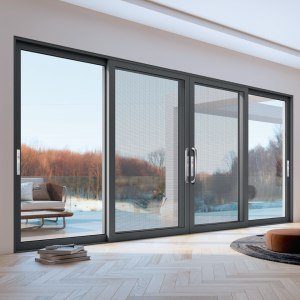
Sliding patio doors operate on a multi-track system with rollers. One panel typically remains fixed while the other slides horizontally. These are the most common specification for high-rise apartments, villa balconies, and commercial storefronts because they require no swing clearance. White powder coating is standard on aluminum sliding doors because white reflects solar radiation, reducing thermal expansion in the frame — a real concern in climates with wide temperature swings.
Casement and French-style patio doors are hinged and swing open. They use multi-point locking systems and offer wider clear openings than sliders. In solid wood construction, white paint protects the substrate from UV degradation. In aluminum-clad versions, the exterior white finish shields the wood core from moisture. White is not merely aesthetic here — it is a protective layer.
Multi-fold (bi-fold) patio doors consist of multiple hinged panels that fold to one side. Demand has grown in luxury residential and hospitality projects. These systems require heavy-duty tracks, reinforced frames, and larger glass panes. White frames help visually minimize the profile, making the opening feel larger — a design trick that matters in spaces where indoor-outdoor flow is the selling point.
## 2. White Patio Doors Quality and Performance Factors
### 2.1 Finish Technology: Why White Is a Coating Decision
White aluminum frames are typically finished with powder coating. The standard thickness range is 60–120 microns. The coating type determines longevity:
- Polyester powder coating — the baseline option. Cost-effective, decent UV resistance, but prone to chalking (a chalky residue on the surface) after 3–5 years in intense sun.
- PVDF (polyvinylidene fluoride) coating — the premium option. Costs 15–25% more than polyester but resists yellowing and chalking for 10–20 years. The molecular structure holds up against UV radiation far better than polyester.
Anodizing is rarely used for white — the process produces limited color ranges (mostly silver and bronze) and cannot achieve the opaque white finish buyers expect.
For painted white wood doors, the system matters: a proper primer, an intermediate coat, and a UV-resistant top coat. Exterior white wood doors in coastal climates need marine-grade paint systems; otherwise, moisture penetration causes blistering within two seasons.
### 2.2 Performance Under Stress
White surfaces reflect 70–80% of solar radiation. This is a measurable benefit — it reduces frame warping in aluminum and slows paint degradation on wood.
Yellowing resistance depends entirely on the resin system. PVDF coatings hold their whiteness because the fluoropolymer resin does not absorb UV radiation the way polyester resins do. Buyers specifying white doors for south-facing installations in high-UV regions should insist on PVDF.
White shows dirt. This is a fact. Textured finishes hide smudges better than smooth finishes, but textured surfaces trap grime. For commercial projects with maintenance contracts, smooth PVDF is the practical choice because it cleans easily and resists staining.
### 2.3 Matching White to Local Codes
Some HOAs and historic districts restrict exterior colors. Manufacturers offer white shades beyond pure white — off-white (RAL 9001), ivory (RAL 1015), and traffic white (RAL 9016). Buyers should confirm the RAL code with the project architect before ordering.
## 3. Glass and Hardware: Components That Define Performance
### 3.1 Glazing Options
Double glazing with a U-value around 1.1 W/m²K is the baseline for modern energy codes. Triple glazing drops this to approximately 0.8 W/m²K but adds 20–35% to glass cost.
Low-E coatings and argon gas fills are standard for code compliance in most North American and European markets. Tempered glass is required for safety in sliding and bi-fold doors; laminated glass is specified where impact resistance matters — hurricane zones, ground-floor installations, and commercial storefronts.
### 3.2 Hardware Compatibility
White frames accept silver, black, or white hardware. The choice affects both aesthetics and function:
- Multi-point locking systems — essential for security. A single-point lock on a sliding door is a vulnerability.
- Roller quality — stainless steel rollers with a load capacity of 100–150 kg per roller outperform nylon rollers in high-use commercial settings. Nylon wears, and worn rollers cause the door to sag on its track.
### 3.3 Pre-Shipment Testing Buyers Should Request
Ask for test reports on:
- Air-tightness (EN 12207 or ASTM E283)
- Water-tightness (EN 12208 or ASTM E547)
- Wind load resistance (EN 12210 or ASTM E330)
- Cycle testing — 10,000–20,000 open/close cycles for sliding doors
- Glass impact tests for safety-rated applications
A factory that cannot produce these reports for a specific door model is not spec-ready.
## 4. How to Evaluate White Patio Doors Suppliers
### 4.1 Factory vs. Trading Company
The difference matters more than most buyers realize. Trading companies add 15–30% to the factory price and cannot control production quality. They also cannot resolve issues on the factory floor when problems arise.
Red flags that indicate a trading company:
- No factory address verifiable via video call
- No production line photos or videos
- No flexibility on MOQ
- Vague answers about raw material sourcing
Verification steps: request a live video walkthrough of the production floor, ask for raw material purchase invoices (aluminum billet, glass, powder coating), and ask for the factory’s export license.
### 4.2 Customization Capabilities
A factory that only produces standard sizes is a limitation. Verify:
- Custom sizes — can the factory adjust profile lengths without retooling?
- Color matching — RAL or custom Pantone matching for white shades
- Hardware substitution — will the factory install buyer-specified locks, hinges, or rollers?
- OEM/ODM — private labeling and custom packaging
### 4.3 Quality Control Protocols
In-process inspection matters more than final inspection. A factory that checks quality at each production stage catches defects before they become expensive rework. Final random inspection is standard, but buyers should ask whether the factory accommodates third-party inspectors (SGS, BV, TÜV) at the buyer’s expense.
### 4.4 Logistics and Documentation
FCL (full container load) versus LCL (less than container load) affects unit cost. MOQs for FCL orders typically range from 50–100 units per size. Export documentation should include packing list, proforma invoice, bill of lading, and certificate of origin. Production time runs 15–30 days; total door-to-door time is typically 35–60 days depending on destination.
## 5. Key Quality Indicators for White Patio Doors Buyers
### 5.1 The Procurement Checklist
Before ordering, confirm:
- Frame material grade (aluminum alloy 6063-T5 is the industry standard for patio door frames)
- Profile wall thickness (1.4 mm minimum for sliding doors; 1.8 mm for bi-fold and casement)
- Coating type and thickness (PVDF vs. polyester; 60–120 microns)
- Glass configuration (double vs. triple; Low-E coating; gas fill)
- Hardware brand and grade (imported German vs. domestic)
- Test certifications for air, water, and wind resistance
- MOQ and lead time
- Export packaging specifications (wooden crates vs. cartons)
### 5.2 Cost Drivers and Price Benchmarking
Wholesale (FOB) price ranges for white patio doors:
| Door Type | Specification | Price Range (FOB) |
|---|---|---|
| Standard aluminum sliding door | 5′ x 6’8″, double glazing, polyester coating | $180–$350 |
| Thermal-break aluminum casement door | 5′ x 6’8″, double glazing, PVDF coating | $350–$600 |
| Solid wood painted French door | 5′ x 6’8″, double glazing, marine-grade paint | $500–$900 |
Retail prices typically double these figures. The cost drivers are glass configuration (20–35% premium for triple glazing), finish type (15–25% premium for PVDF), and hardware grade (German hardware costs roughly 2x domestic Chinese hardware).
### 5.3 Red Flags: Avoid Suppliers Who…
- Cannot provide test reports for air, water, or wind resistance
- Quote prices significantly below market — the savings come from thinner profiles or lower-grade coatings
- Refuse third-party inspection
- Cannot explain their raw material sourcing
- Offer no MOQ flexibility for trial orders
Choose a factory-direct manufacturer if you need bulk pricing, consistent quality control, or custom specifications. Choose a trading company if you need small quantities across multiple product categories and cannot consolidate suppliers yourself — but expect to pay a 15–30% premium.
## 6. Our Manufacturing Capabilities
Here is how the industry works: buyers need consistent quality, on-time delivery, and documentation that clears customs without delays. The factories that deliver this consistently are those that control the entire production process — from raw material to finished door — and test every batch, not just samples.
Here is how we meet these standards. As a manufacturing partner, we operate a direct-supply model from our China factory. Our pre-shipment inspection covers air-tightness, water-tightness, and wind resistance on every batch. We provide full export documentation — packing list, proforma invoice, and customs paperwork — to ensure smooth clearance at your port.
Our customization capabilities cover custom sizes, RAL color matching, and hardware selection. For distributors entering new markets, we adjust profile structures and fittings to comply with local building codes, so you don’t have to re-engineer the product on your end.
## 7. Production Process: From Raw Material to Finished Door
The production cycle for a white aluminum patio door follows a predictable sequence:
- Aluminum extrusion — billets are heated and extruded through dies to create profile shapes. Alloy 6063-T5 is standard for patio door frames.
- Cutting and machining — profiles are cut to length and machined for drainage holes, hardware attachment points, and corner joints.
- Surface treatment — frames are cleaned, chemically pretreated, and powder coated. PVDF coatings require a primer layer before the top coat.
- Fabrication — frames are assembled with corner keys and sealant. Hardware is installed.
- Glazing — glass units are fitted with spacers and sealant. For insulated glass, the seal must be airtight to prevent condensation between panes.
- Final assembly and inspection — doors are tested for operation, sealing, and finish quality before packaging.
Each stage has quality checkpoints. A factory that skips steps in this sequence cuts costs — and the buyer inherits the consequences in the field.
## 8. Quality Control: Our Multi-Stage Inspection Process
Our inspection protocol follows three stages:
Incoming materials — aluminum billets, glass, and powder coating are verified against specifications upon delivery.
In-process checks — during extrusion, cutting, and assembly, inspectors verify dimensional accuracy and surface finish. This catches defects before they become expensive rework.
Pre-shipment testing — every batch undergoes air-tightness, water-tightness, and wind resistance testing. We also conduct cycle testing on sliding doors to verify roller durability.
Buyers are welcome to arrange third-party inspection (SGS, BV, TÜV) at their expense before shipment.
## 9. Customization and OEM/ODM Options
Customization is not a premium add-on in our model — it is the standard operating procedure.
- Custom sizes — any dimension within profile limits, without tooling changes
- Color matching — RAL or custom Pantone shades, including off-white and ivory
- Hardware substitution — we install buyer-specified locks, hinges, and rollers
- Private labeling — your brand on the product and packaging
- OEM/ODM — we manufacture to your drawings or adapt our existing designs
For distributors testing a new market, we recommend starting with a small pilot order — 20–50 units — to validate the product locally before committing to a full container.
Ordering Process: MOQ, Lead Time, and Shipping
Standard MOQs are 50–100 units per size for FCL orders. Mixed-size LCL orders are available for trial quantities. Production time is 15–30 days depending on order size and customization level. Sea freight from China to the US West Coast takes 15–20 days; to Europe, 25–35 days. Total lead time from order confirmation to port arrival is typically 35–60 days.
We ship both FCL and LCL. Export packaging uses wooden crates for glass protection and cartons for hardware and accessories.
Certifications and Industry Standards
We manufacture to EN and ASTM standards for air-tightness, water-tightness, and wind resistance. ISO 9001 quality management systems govern our production processes.
What certifications should you look for in any white patio door supplier?
- ISO 9001 — quality management system certification
- CE marking — required for European markets
- ASTM or EN compliance — for air/water/wind resistance testing
- NFRC or ENERGY STAR — energy performance ratings, required in some US states
Frequently Asked Questions
What is the best quality patio door brand?
“Best” depends on your market and budget. Pella and Andersen are well-regarded in North American retail. For B2B buyers sourcing at scale, the best supplier is one that offers consistent quality, customization, and factory-direct pricing. Evaluate suppliers on test certifications, material specifications, and production capacity — not just brand recognition.
What is the average cost of a new patio door?
Wholesale ranges: standard white aluminum sliding doors run $180–$350 per unit (FOB). Thermal-break models run $350–$600. Solid wood French doors with white paint finish are $500–$900. Retail prices are typically double these figures.
Who makes a better patio door, Pella or Andersen?
Pella is known for wood interior options and broad customization. Andersen is recognized for Fibrex composite frames and energy efficiency. For B2B buyers needing private labeling, custom sizes, or bulk pricing, a factory-direct manufacturer can match material specs at a 20–40% lower unit cost.
What’s cheaper, patio doors or French doors?
Sliding patio doors are generally cheaper. A sliding door uses one fixed panel and one sliding panel, requiring less hardware and simpler installation. French doors cost 15–25% more due to additional hinges, locks, and structural reinforcement.
Can I get custom white shades?
Yes. Most factories offer RAL color matching and custom powder coating. Standard white (RAL 9016) is usually available without MOQ penalties. Custom shades may require a minimum color run.
If you’re planning a bulk order or need a custom white patio door specification, reach out to our team with your project details — we’ll respond with a detailed quotation and production timeline.
References
- EN 12207:2016 — Windows and doors. Air permeability. Classification. https://www.en-standard.eu
- EN 12208:2000 — Windows and doors. Watertightness. Classification. https://www.en-standard.eu
- EN 12210:2016 — Windows and doors. Wind load resistance. Classification. https://www.en-standard.eu
- ASTM E283 — Standard Test Method for Determining Rate of Air Leakage Through Exterior Windows, Skylights, and Doors. https://www.astm.org
- ASTM E547 — Standard Test Method for Water Penetration of Exterior Windows, Skylights, Doors. https://www.astm.org
- ASTM E330 — Standard Test Method for Structural Performance of Exterior Windows, Doors, Skylights. https://www.astm.org
- ISO 9001:2015 — Quality management systems. https://www.iso.org