Vinyl Sliding Doors at a Glance: Key Takeaways
For exterior applications, vinyl sliding doors are a practical choice when your priorities are thermal efficiency, minimal maintenance, and cost control over the building’s lifecycle. They outperform aluminum in insulation without thermal breaks and undercut wood on long-term upkeep, though they offer less design flexibility in color and structural depth.
Before you evaluate suppliers, understand these five points:
- Performance is determined by the glass package, not just the frame. The frame matters, but the insulating glass unit (IGU) — its U-factor, solar heat gain coefficient, and spacer quality — drives most of the energy performance.
- Patio and exterior doors are not interchangeable categories. The terms overlap, but exterior entry doors face stricter wind load and air infiltration requirements than a sheltered patio door.
- Black vinyl is a finish, not a different material. It performs identically to white vinyl in insulation, but the darker surface absorbs more heat, which affects thermal expansion and finish warranty in hot climates.
- The lowest quote is rarely the lowest cost. Installation method, shimming, flashing, and hardware quality determine whether the door performs to its rated specifications.
- Supplier evaluation should focus on test data, not marketing claims. Ask for NFRC-certified ratings and ASTM test reports before comparing prices.
This guide walks through the types of vinyl sliding doors, how they compare to aluminum and wood, a selection checklist for exterior use, and what to look for in a manufacturer.
Types of Vinyl Sliding Doors: Patio, Exterior, and Black Finishes
The vinyl sliding door category breaks down into a few functional types. Understanding the distinctions helps you specify the right product for the opening and climate.
Patio Vinyl Sliding Doors
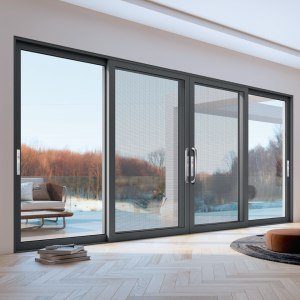
Patio vinyl sliding doors are the most common configuration. They typically use a two-panel design where one panel is fixed and the other slides, or a four-panel configuration with two fixed and two sliding panels. These doors are designed for large openings, often 6 to 16 feet wide, and are installed in living spaces that open to a deck, porch, or backyard.
For patio applications, the primary performance criteria are:
- Air infiltration resistance — the door should meet or exceed the performance class required by your local code, typically measured in cubic feet per minute per square foot of area.
- Water penetration resistance — the sill and frame drainage system must handle wind-driven rain without leaking.
- Operating force — a well-designed sliding door should move smoothly with minimal effort, indicating proper roller alignment and track tolerance.
Patio doors are generally not the primary entry point to a building, so security hardware and forced-entry resistance are secondary to weather performance.
Exterior Vinyl Sliding Doors
Exterior vinyl sliding doors serve as primary entry points — for example, a sliding door leading from a mudroom to a backyard, or a commercial storefront application. These doors face stricter requirements:
- Higher wind load ratings — the frame must be reinforced, often with internal steel or aluminum stiffeners, to resist deflection under pressure.
- Enhanced locking hardware — multi-point locking systems with reinforced strike plates are standard for entry doors.
- Better thermal performance — since they are part of the building envelope, they must meet more stringent U-factor requirements in most climate zones.
When a manufacturer markets a door as “exterior rated,” it typically means the product has passed ASTM E330 (wind load) and ASTM E547 (water penetration under cyclic pressure) testing at higher pressure differentials than a standard patio door.
Black Vinyl Sliding Doors
Black vinyl sliding doors have grown in popularity for modern architectural styles. The black finish is achieved through one of two methods:
- Co-extrusion — black color is mixed into the vinyl compound itself, making the color consistent throughout the profile.
- Lamination or foil coating — a black film is applied to the surface of a white or light-colored profile.
Co-extruded black vinyl is more durable, as scratches and cuts do not reveal a lighter substrate underneath. Laminated finishes are less expensive but can delaminate over time, especially in high-UV exposure.
One important consideration: black vinyl absorbs more solar heat than white. In hot climates, the surface temperature of a black frame can be significantly higher, which increases thermal expansion. This affects two things:
- Installation tolerances — the door needs slightly larger shim gaps and clearance to accommodate expansion without binding.
- Finish warranty — some manufacturers limit warranties on dark colors in extreme heat zones, so verify the warranty terms for your specific climate.
Black vinyl is not a structural upgrade or downgrade — it is purely aesthetic. If you choose black, ensure the supplier uses co-extruded profiles and provides installation guidelines that account for thermal expansion.
Vinyl Sliding Doors vs. Other Materials: A Comparison Table
The material decision is usually between vinyl, aluminum, and wood. Each has strengths that suit different project priorities.
| Attribute | Vinyl (PVC) | Aluminum (Thermal-Break) | Wood |
|---|---|---|---|
| Thermal insulation (frame) | Excellent — PVC is naturally low-conductivity | Good only with thermal break; poor without | Good, but depends on species and finish |
| U-factor (typical, with double glazing) | 0.28–0.35 | 0.35–0.50 (with thermal break) | 0.30–0.45 |
| Durability | High — does not rot, corrode, or peel | High — corrosion-resistant with proper coating | Moderate — requires painting/staining every 2–5 years |
| Maintenance | Very low — occasional cleaning | Low — periodic hardware lubrication | High — regular refinishing needed |
| Cost (installed, per square foot) | Low to mid | Mid to high | High |
| Color options | Limited — white, beige, black, wood-grain laminates | Wide — powder coating in any RAL color | Natural wood tones, stainable |
| Structural strength | Moderate — may need reinforcement for large spans | High — excellent for large openings | High — strong, but can warp with moisture |
| Lifespan | 20–30 years | 30–40 years | 20–40 years with maintenance |
| Recyclability | Recyclable, but often downcycled | Highly recyclable | Biodegradable, but finishes complicate recycling |
The trade-off summary:
- Choose vinyl if you want the best balance of insulation, low maintenance, and cost. It is the strongest candidate for residential and light commercial exterior doors in most climates.
- Choose aluminum if you need large spans (over 10 feet), slim sightlines, or specific color matching. Aluminum is the material of choice for commercial storefronts and modern architecture where frame visibility must be minimized.
- Choose wood if the project demands natural aesthetics, historical accuracy, or a premium interior finish. Wood requires a commitment to maintenance that many building owners underestimate.
Note that the R-value and U-factor figures above are typical for complete door assemblies (frame plus glazing) and vary with glass type, frame design, and testing conditions. Always request NFRC-certified ratings from the manufacturer for the exact configuration you plan to use.
How to Choose the Right Vinyl Sliding Door: A Buyer’s Checklist
For exterior applications, the selection process should be systematic. Work through these criteria in order.
1. Glass Package
The glass accounts for roughly 80% of the door’s surface area and determines most of its thermal and acoustic performance. Specify the following:
- Dual or triple glazing — dual-pane is standard; triple-pane is worth the upgrade in cold climates (IECC zones 5 and higher) where the U-factor improvement offsets heating costs.
- Low-E coating — a low-emissivity coating reflects infrared radiation, keeping heat inside in winter and outside in summer. Specify the correct coating orientation for your climate.
- Argon or krypton fill — inert gas between panes reduces heat transfer. Argon is cost-effective; krypton performs better but costs more.
- Spacer type — warm-edge spacers (stainless steel or polymer) reduce condensation at the glass edge and improve the overall U-factor.
- Glass thickness — for exterior doors exposed to wind, 3/16″ or 1/4″ glass is appropriate. Thicker glass also improves acoustic insulation.
- Tempered or laminated glass — building codes require tempered glass in doors and adjacent sidelites. Laminated glass adds security and sound reduction.
2. Frame Profile and Reinforcement
The frame profile determines structural performance and installation tolerance:
- Wall thickness — vinyl profiles are classified by wall thickness (A, B, or C). For exterior doors, use at least a B-class profile (0.060″ wall) or C-class (0.070″) for larger openings.
- Internal reinforcement — steel or aluminum inserts in the header and jamb provide rigidity and improve wind load resistance. Verify that the reinforcement extends the full length of the member.
- Sill design — the sill should have a sloped exterior surface for drainage, a thermal break, and a compression seal where the panel meets the sill.
3. Hardware and Security
Sliding doors are vulnerable at the lock point and the roller track. Specify:
- Multi-point locking — at least two locking points, ideally three, that engage into the frame at multiple locations.
- Anti-lift device — a clip or block in the top track that prevents the sliding panel from being lifted off the track from outside.
- Roller quality — stainless steel or nylon rollers with sealed bearings. Adjustable rollers are essential for proper alignment and smooth operation.
- Handle and lock type — for exterior doors, choose a keyed lock or a handle with an integrated deadbolt, rather than a simple latch.
4. Weather Resistance and Testing
For exterior applications, ask the supplier for test data that matches your project’s requirements:
- Air infiltration — ASTM E283. Look for a rating of 0.3 cfm/ft² or lower.
- Water penetration — ASTM E547 or E331. The door should resist water penetration at a test pressure of at least 6.24 psf (equivalent to wind-driven rain at about 50 mph).
- Wind load — ASTM E330. The design pressure (DP) rating should be at least 35 psf for most residential exterior doors, and higher in coastal or high-wind zones.
5. Installation and Building Code Compliance
The best door will fail if installed incorrectly. Ensure your installer:
- Checks rough opening dimensions — the door must have proper shim space (typically 1/4″ to 3/8″ on each side) for expansion and leveling.
- Uses proper flashing — the sill flange must be integrated with the building’s weather-resistive barrier to prevent water intrusion.
- Follows the manufacturer’s shimming pattern — improper shimming voids warranties and can cause the frame to rack, leading to air and water leaks.
- Accounts for thermal expansion — vinyl expands and contracts more than aluminum or wood. The installation must allow for this movement, particularly in climates with wide temperature swings.
6. Cost Factors and Budget Planning
Vinyl sliding door costs vary significantly with size, glass package, hardware, and installation complexity. Plan your budget with these variables in mind:
| Cost Component | Low Range | Mid Range | High Range |
|---|---|---|---|
| Door unit (materials only) | $400–$700 per panel | $700–$1,200 per panel | $1,200–$2,000+ per panel |
| Installation labor | $300–$500 | $500–$800 | $800–$1,500 |
| Glass upgrade (triple-pane, laminated) | +$150–$300 per panel | +$300–$500 per panel | +$500–$800 per panel |
| Rough opening preparation | $200–$400 | $400–$700 | $700–$1,200 |
These are planning estimates, not quotes. Regional labor rates, site conditions, and door size move these numbers substantially. For a project budget, add 15–20% contingency for unforeseen framing or flashing work.
Frequently Asked Questions About Vinyl Sliding Doors
Are vinyl sliding doors energy efficient?
Yes, when properly specified. A vinyl frame with dual-pane low-E glass achieves a U-factor around 0.30, which meets ENERGY STAR requirements for most climate zones. The weak point is not the frame material but the glass-to-frame seal and the sill. Verify that the supplier uses a compression seal at the sill and a proper glazing gasket system.
How long do vinyl sliding doors last?
A quality vinyl sliding door should last 20–30 years with minimal maintenance. The vinyl itself does not rot or corrode, but hardware (rollers, locks) will need periodic adjustment and eventual replacement. The glass seal will eventually fail, causing fogging — expect 15–25 years for the seal life depending on climate and sun exposure.
Do vinyl sliding doors fade or warp?
Vinyl is UV-stabilized, but all plastics degrade with prolonged sun exposure. White vinyl is the most stable; dark colors fade faster and absorb more heat. Warping is rare with proper installation and reinforcement, but it can occur if the door is installed with insufficient expansion clearance or if the frame is not properly reinforced for its size.
Are vinyl sliding doors secure?
They can be, but only with the right hardware. A standard single-point latch is easy to defeat. Specify multi-point locking with an anti-lift device, and consider laminated glass for added forced-entry resistance. The sliding panel should also have a security bar or a pin that prevents it from being opened even if the lock is compromised.
What sizes do vinyl sliding doors come in?
Standard widths range from 5 feet to 16 feet in two, three, or four-panel configurations. Heights are typically 6’8″ to 8 feet. Custom sizes are common, but each custom dimension affects cost and lead time. For exterior applications, verify that the frame reinforcement is adjusted for the actual size — a 12-foot door needs more steel than an 8-foot door.
Can I install a vinyl sliding door myself?
For a professional buyer, the answer is: only if you have the right skills and tools. The door unit itself is manageable, but the flashing, shimming, and air-sealing details determine performance. Most manufacturer warranties require professional installation. For a building project, hire a licensed installer who can provide a workmanship warranty.
How do I maintain vinyl sliding doors?
Clean the tracks and rollers annually, lubricate the rollers with a silicone-based spray, and check the weatherstripping for wear. Do not paint vinyl frames — the paint will not adhere properly and can void the warranty. Use a mild soap and water solution for cleaning; avoid abrasive cleaners or solvents.
Additional Considerations: Customization, Quality, and Supplier Selection
For B2B buyers — contractors, builders, architects, and distributors — the product spec is only half the decision. The supplier’s manufacturing capability, quality control, and willingness to customize determine whether the product meets your project’s requirements.
Customization Options That Matter
Vinyl sliding doors are not a commodity product. The degree of customization available from a manufacturer directly affects your ability to match local building codes and architectural requirements:
- Size — most projects need non-standard widths or heights. A manufacturer that can produce custom sizes without excessive lead time is valuable.
- Color — beyond standard white and beige, consider co-extruded black, wood-grain laminates, or custom colors. Verify that the color option is available for the entire frame, not just the interior or exterior face.
- Glass — the glass package should be configurable: different low-E coatings, glass thicknesses, spacer types, and even decorative patterns or grids.
- Hardware — lock types, handle styles, and roller quality should be selectable. Multi-point locks, keyed entry sets, and commercial-grade hardware should be available options.
- Reinforcement — for high-wind zones, the frame should be reinforceable to meet local design pressure requirements.
Quality Standards and Testing
A manufacturer that cannot provide test data is a risk. For exterior vinyl sliding doors, request:
- NFRC-certified U-factor and SHGC ratings for the specific configuration you plan to use.
- ASTM test reports for air infiltration, water penetration, and wind load resistance — not a summary, but the actual test report with the tested size and pressure.
- AAMA or other third-party certification if available, which indicates the product meets industry performance standards.
- Pre-shipment inspection procedures — how does the manufacturer verify quality before the product leaves the factory?
The testing matters because it translates into real-world performance. A door rated at 0.3 cfm/ft² air infiltration will not leak drafts; a door rated at 0.9 cfm/ft² will. The difference is measurable in energy cost and occupant comfort.
Warranty Terms: What Voids Them
Warranty terms vary, but most manufacturers void coverage for the same reasons. Understand these before installation:
- Improper shimming — shims placed at the wrong locations or over-tightened cause frame distortion.
- Painting the frame — paint adheres poorly to vinyl and can cause warping or finish failure.
- Use of harsh cleaners — solvents, acetone, or abrasive pads damage the vinyl surface.
- Lack of expansion clearance — if the frame is forced into a too-tight opening, thermal expansion will cause buckling.
- Unauthorized modifications — drilling holes for hardware or adding attachments not specified by the manufacturer.
How We Meet These Standards
As a door and window manufacturer, our approach to vinyl sliding doors is built around the requirements outlined above. We are not a distributor or a middleman — we produce the doors directly, which affects how we handle the two things that matter most to B2B buyers: customization and quality control.
First, on customization: every order we produce is made to the project’s specifications. Size, glass package, color (including co-extruded black), hardware, and frame reinforcement are all configurable. If your project requires a specific wind load rating or a particular glass performance value, we adjust the profile structure and fittings to match the local building codes of your target market. We do not force you to choose from a fixed catalog.
Second, on quality: before any shipment leaves our factory, we run air-tightness, water-tightness, and wind resistance tests on the production units. This is not a sample or a batch test — it is a pre-shipment inspection on the actual product you receive. For overseas buyers, we provide the packing list, proforma invoice, and full customs documentation, and we handle both FCL and LCL shipments directly from our factory.
If you are evaluating suppliers for a project that requires vinyl sliding doors, the key questions to ask are: can you provide test data for the exact configuration I need, and can you customize the product to meet my local code requirements? If the answer to either is uncertain, keep looking. The right supplier will be able to answer both with documentation, not just promises.
For a quote on your specific project requirements, contact our team directly. We will work through your specifications, confirm the test data, and provide a detailed quotation.