Why uPVC Doors Are a Smart Choice for Your Business
uPVC doors have become the default specification for many commercial and residential projects because they solve the problems that wood and aluminum create at scale: rot, corrosion, thermal bridging, and high maintenance labor. For a door business, uPVC offers a predictable product line with consistent performance, which simplifies quoting, installation scheduling, and after-sales service.
The material itself — unplasticized polyvinyl chloride — is rigid, moisture-resistant, and does not require painting or staining. Modern uPVC profiles use multi-chamber internal structures that trap air, which is what gives the doors their insulation value. When you compare uPVC against alternatives for a business context, the decision usually comes down to three things: total cost of ownership, installation speed, and how many callbacks you can avoid.
uPVC Door Types Explained: Casement, Sliding, and Multislide
Not all uPVC doors perform the same way, and choosing the wrong type for an application creates problems that surface months after installation. Here is how the three main configurations differ.
Casement uPVC Doors
Casement doors hinge on the side and swing outward or inward. They are the most common uPVC door type because they offer the best sealing performance. The compression seal around the perimeter compresses against the frame when closed, which gives excellent air-tightness and water-tightness.
For a door business, casement doors are the safest recommendation for standard openings. They work well in both residential and light commercial settings, and they accept a wide range of locking hardware. The trade-off is that the swing arc requires clearance space, so they are not ideal for tight hallways or high-traffic commercial entrances.
Sliding uPVC Doors
Sliding doors run on tracks and move horizontally. They save space because no swing arc is needed, which makes them the default choice for patios, balconies, and commercial spaces where floor area is valuable.
The trade-off is sealing performance. Sliding doors rely on brush seals and weatherstripping along the track, which are less effective than the compression seals on casement doors. In areas with heavy rain or strong wind, sliding doors can allow more air and water infiltration. They also have a lower maximum width than casement or multislide configurations.
Multislide uPVC Doors
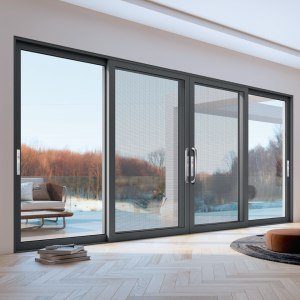
A multislide door — sometimes called a multi-sliding or parallel-sliding door — is a more engineered version of the sliding concept. Instead of panels that slide past each other on a single track, multislide doors use multiple tracks and panels that stack neatly to one side. This allows much wider openings, often spanning 5 to 8 meters or more.
The key difference from standard sliding doors is that multislide panels can be configured to open fully, creating a nearly unobstructed opening. Some systems also allow panels to slide and then swing inward for ventilation or cleaning access. For commercial applications like restaurants, showrooms, or spaces that need flexible indoor-outdoor flow, multislide doors are the appropriate choice.
However, multislide systems are heavier, require more precise installation, and cost significantly more than standard sliding doors. The hardware — rollers, tracks, and locking mechanisms — must be industrial grade, because the panels are large and heavy. If you are sourcing multislide doors for a project, verify the maximum panel weight the hardware is rated for.
uPVC vs. Aluminum vs. Wood: A Quick Comparison
Each material has a legitimate place in the market. The right choice depends on the project’s performance requirements, budget, and aesthetic expectations.
| Factor | uPVC | Aluminum (Thermal Break) | Wood |
|---|---|---|---|
| Thermal insulation | Excellent with multi-chamber profiles | Good with thermal break, varies by design | Moderate, depends on species and construction |
| Maintenance | Minimal — wipe clean, no painting | Low — anodized or powder-coated finish | High — periodic painting, staining, sealing |
| Durability | 20–30 years typical, no rot or corrosion | Very high, but susceptible to condensation in cold climates | Vulnerable to moisture, insects, and warping |
| Cost | Lowest upfront, lowest lifetime cost | Moderate to high, especially thermal break | Highest for quality hardwood |
| Customization | Good — color foils, glazing options | Excellent — slim profiles, many finishes | Excellent — natural wood grain, custom millwork |
| Weight | Light to moderate | Light | Heavy |
| Environmental impact | Recyclable, but PVC production has concerns | Recyclable, high embodied energy | Renewable, but sourcing must be verified |
For a door business, the practical question is not which material is “best” but which material fits the project’s constraints. uPVC wins when budget, thermal performance, and low maintenance are the priorities. Aluminum wins when slim sightlines and structural strength matter more than insulation. Wood wins when the project demands a premium natural aesthetic and the client accepts ongoing maintenance.
Key Factors to Evaluate Before You Buy
When you compare uPVC door options for a business purchase, these are the criteria that separate a reliable product from a problem product.
Profile Quality and Wall Thickness
The profile is the backbone of the door. Quality uPVC profiles have a wall thickness of at least 2.5 mm for structural sections, and they use multi-chamber designs — typically five to seven chambers — for thermal performance. Cheap profiles often have thinner walls and fewer chambers, which means they flex, warp, and lose their sealing ability over time.
You can check profile quality by examining the cross-section. Look for steel reinforcement inside the main frame and sash sections, especially for larger doors. Without steel reinforcement, a tall casement door will sag and the locks will misalign.
Glazing and U-Values
The glass is responsible for most of the door’s thermal performance. A uPVC door with single glazing will perform poorly regardless of how good the profile is. For commercial projects, double or triple glazing with low-emissivity (low-E) coatings and argon gas fill is the standard.
The U-value measures how much heat transfers through the entire door unit. Lower is better. A good uPVC door with double glazing should achieve a U-value around 1.3 to 1.6 W/m²K, depending on the profile and glass specification. Triple glazing can bring this down to 0.8 to 1.0 W/m²K, but the added weight and cost must be justified by the project’s energy requirements.
Security Hardware and Ratings
uPVC doors are only as secure as their locking system. Multi-point locking systems — which engage bolts at multiple points along the door edge — are the minimum standard for any commercial application. Look for hardware that meets recognized security standards. In the UK, PAS 24 and Secured by Design are the relevant certifications. In other markets, verify the local equivalent.
Check the cylinder lock quality as well. A cheap cylinder can be snapped or picked, compromising the entire door. Specify anti-snap, anti-pick, and anti-bump cylinders for commercial installations.
Weather Performance
Air-tightness and water-tightness are measured under test conditions. A door that leaks air will waste energy, and a door that leaks water will damage interior finishes. Look for products that have been tested to recognized standards, such as EN 12207 for air permeability and EN 12208 for water-tightness. The test results should be available from the manufacturer.
Hardware Grade
Hinges, rollers, handles, and locks are the moving parts that fail first. For casement doors, hinges should be rated for the door weight and expected cycle count. For sliding and multislide doors, the roller quality determines how smoothly the door operates and how long it lasts. Specify hardware from established manufacturers, and check the warranty terms on the hardware separately from the profile.
Comparison Table: uPVC Door Options at a Glance
This table summarizes the key differences between the three main uPVC door types for procurement planning.
| Feature | Casement | Sliding | Multislide |
|---|---|---|---|
| Best for | Standard openings, high thermal performance | Space-saving, patios, balconies | Wide openings, indoor-outdoor flow |
| Maximum width | Up to 1.2 m per sash typical | Up to 3 m per panel typical | Up to 8 m or more total opening |
| Sealing performance | Excellent — compression seals | Good — brush seals | Good to excellent, depends on system |
| Operating mechanism | Hinged swing | Horizontal track | Multiple tracks, stacking panels |
| Space requirement | Requires swing clearance | No swing clearance needed | No swing clearance needed |
| Relative cost | Lowest | Moderate | Highest |
| Installation complexity | Standard | Moderate | High — requires precise leveling |
| Typical applications | Residential, offices, small commercial | Residential, hospitality | Restaurants, showrooms, large commercial |
How to Choose the Right Supplier for Your Door Business
The product quality matters, but the supplier determines whether you actually receive what you specified. Here are the criteria that matter when evaluating a uPVC door manufacturer.
Quality Control and Testing
A manufacturer that tests its products — air-tightness, water-tightness, wind resistance — before shipping is demonstrating that it understands the standards. Ask for test reports and verify that the results match the product you are buying. If a supplier cannot provide test documentation, treat that as a red flag.
Customization Capability
Commercial projects rarely use standard sizes. A supplier that can customize dimensions, colors, glazing, and hardware without long lead times is more valuable than one that only sells fixed configurations. This is especially important for renovation projects where existing openings vary.
Shipping and Logistics
For international sourcing, the supplier’s ability to handle export logistics directly affects your cost and timeline. A supplier that provides proper packing lists, proforma invoices, and customs documentation reduces friction. Whether you need full container load (FCL) or less than container load (LCL) shipping, the supplier should be able to accommodate both.
Compliance with Local Building Codes
Building codes vary significantly between countries and even regions. A supplier that understands this and can adjust profile structures and fittings to match local requirements saves you from costly rework. Ask specifically about how the supplier handles code compliance for your target market.
Common Mistakes to Avoid When Sourcing
The most common sourcing mistakes are predictable. Buyers who focus only on unit price often end up with thin profiles, poor hardware, and doors that fail inspection. Buyers who skip the testing documentation take on liability for performance they cannot verify. And buyers who do not confirm customization capabilities upfront face delays when they need non-standard sizes.
Here Is How We Meet These Standards
As a uPVC door manufacturer, we operate differently from a trading company or a middleman. We run the factory, which means the price you see is the factory price — there is no markup added by an intermediary. When you compare our quotes against those from trading companies, the difference is not just cost; it is accountability.
On customization, we handle the full range: size, color, glass specification, and hardware accessories. If your project needs a specific profile configuration to meet local building codes, we adjust the profile structure and fittings accordingly. This is not a special request; it is how we work on every order.
Our pre-shipment inspection covers the three tests that matter for door performance: air-tightness, water-tightness, and wind resistance. You receive test documentation with your order, so you have the evidence you need to satisfy your own clients or building inspectors.
For logistics, we handle both FCL and LCL shipments, and we provide the full export documentation package — packing list, proforma invoice, and customs paperwork. This is standard practice for us because most of our business is international.
If you are evaluating suppliers for your door business, we are happy to discuss your project requirements and provide a quote. Contact our team to discuss your specifications.
Frequently Asked Questions About uPVC Doors
What are the main advantages of uPVC doors?
The main advantages are durability, low maintenance, and thermal efficiency. uPVC does not rot, corrode, or require painting. Multi-chamber profiles provide consistent insulation, and the material is inherently moisture-resistant. For a door business, this translates to fewer callbacks and lower warranty costs.
How do multislide doors differ from standard sliding doors?
Multislide doors use multiple tracks and stacking panels to create much wider openings than standard sliding doors. While a standard sliding door typically has two to four panels with one or two moving, a multislide system can span 8 meters or more and allows all panels to stack to one side. The hardware is heavier and the installation is more complex, but the result is a nearly unobstructed opening.
What should a door business look for in a uPVC door supplier?
Evaluate the supplier on four criteria: quality control documentation, customization capability, logistics competence, and compliance knowledge. Ask for test reports on air-tightness, water-tightness, and wind resistance. Confirm that the supplier can handle custom sizes and hardware. Verify that they can manage FCL and LCL shipping with proper export documentation. And ask how they handle local building code compliance.
Are uPVC doors suitable for commercial projects?
Yes, when specified correctly. uPVC doors are suitable for offices, retail spaces, hospitality venues, and light industrial buildings. For high-traffic commercial entrances, choose commercial-grade profiles with steel reinforcement and industrial hardware. Verify the door’s cycle rating — the number of open-close cycles it is designed to withstand — and match it to the expected usage.
What is the typical lifespan of uPVC doors?
A well-manufactured uPVC door with quality hardware should last 20 to 30 years. The profile itself is very durable, but the hardware — hinges, rollers, locks — will likely need replacement during that period. The lifespan depends on the profile wall thickness, the quality of the steel reinforcement, and the grade of the hardware. Cheaper products may show problems within 5 to 10 years.