Content Menu
● 1. What Are Traditional Double Front Doors?
● 2. Types and Applications of Traditional Double Front Doors
● 3. Construction and Engineering: What Separates a Quality Double Door
● 4. How to Evaluate Traditional Double Front Doors Suppliers
● 5. Key Quality Indicators for Buyers
● 6. Relevant Industry Standards and Certifications
● 7. Production Process: From Raw Material to Finished Doors
● 8. Customization and OEM/ODM Options
● 9. Ordering Process: MOQ, Lead Time, and Shipping
● 10. Quality Control: The Multi-Stage Inspection Process
12 min read
When a buyer orders their first container of traditional double front doors, the question they ask is rarely about price. It is about whether the factory can reproduce the sample quality across 50 units. That gap — between a polished showroom sample and a production run — is where most procurement relationships fail.
This guide covers what architects, contractors, and distributors need to know before sourcing traditional double front doors: material science, construction methods, quality benchmarks, and the procurement frameworks that separate reliable suppliers from trading companies.
What Are Traditional Double Front Doors?
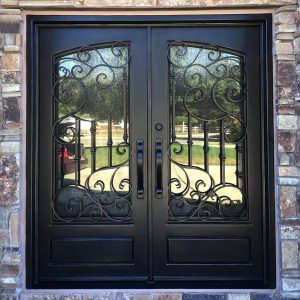
Traditional double front doors are a pair of side-by-side door panels installed in a single opening, designed with classic architectural styling such as raised panels, divided lites, or transoms. They are commonly specified for luxury residences, boutique hotels, churches, and civic buildings where a grand entrance is part of the architectural language.
The “traditional” classification refers to style, not material. These doors can be manufactured from solid wood, aluminum-clad wood, steel, or fiberglass. The term “double doors” means two door leaves — one active (operable) and one passive (fixed or operable) — sharing a single frame. Standard widths range from 5’0″ to 6’0″ (60–72 inches), with heights from 6’8″ to 8’0″ for grander entrances.
Types and Applications of Traditional Double Front Doors
Solid Wood Double Doors
Solid wood remains the benchmark for traditional aesthetics. Mahogany, oak, walnut, and cherry are the most specified species.
- Mahogany: Excellent dimensional stability and natural rot resistance. Common choices include Sapele, Khaya, and genuine Honduran mahogany. Sapele is a cost-effective alternative with similar grain patterns.
- White Oak: High hardness, prominent grain, and good moisture resistance when properly sealed. Often specified for craftsman and mission styles.
- Black Walnut: Rich chocolate color, prestigious appearance, but softer than oak and more expensive.
Solid wood doors require kiln-drying to 8–12% moisture content for interior use and 10–14% for exterior applications, depending on the climate zone. Improperly dried wood will warp, twist, or develop surface checks within the first year.
Aluminum-Clad Wood Double Doors
This hybrid construction pairs a wood interior (visible from inside) with an exterior aluminum shell. The aluminum protects the wood from UV radiation and rain, eliminating the need for periodic repainting.
Thermal break technology is critical here. Polyamide strip thermal breaks separate the interior and exterior aluminum profiles, reducing heat transfer. Buyers should compare U-factor (thermal transmittance) and SHGC (solar heat gain coefficient) values when evaluating performance. Quality aluminum-clad units achieve U-factors between 0.20 and 0.35 depending on glazing.
Steel and Fiberglass Double Doors
Steel doors offer superior security and dent resistance but are limited in traditional panel profiles. Fiberglass doors mimic wood grain and require minimal maintenance, though thermal expansion can be a concern in extreme climates.
The trade-off is straightforward: wood and aluminum-clad wood deliver the authentic traditional look with higher maintenance. Steel and fiberglass offer practicality but sacrifice some design fidelity.
Material Comparison Table
| Material | Aesthetic Fidelity | Durability | Maintenance | U-Factor Range (with IGU) | Cost Index | Typical Lead Time |
|---|---|---|---|---|---|---|
| Solid Mahogany | Excellent | High | High (re-finish every 2–3 yrs) | 0.25–0.35 | $$$$ | 6–10 weeks |
| Solid Oak | Excellent | High | High | 0.25–0.35 | $$$ | 6–10 weeks |
| Aluminum-Clad Wood | Very Good | Very High | Low | 0.20–0.30 | $$$$ | 8–12 weeks |
| Steel | Moderate | Very High | Low | 0.30–0.45 | $$ | 3–5 weeks |
| Fiberglass | Good | High | Low | 0.25–0.35 | $$ | 3–5 weeks |
Construction and Engineering: What Separates a Quality Double Door
Stile-and-Rail vs. Slab Construction
Traditional double front doors should use stile-and-rail construction, where vertical stiles and horizontal rails frame individual panels. This method accommodates natural wood movement better than slab construction and allows for panel replacement if damaged. Mortise-and-tenon joinery is the industry standard for structural integrity — dowel joints are cheaper but fail sooner under repeated opening and closing stress.
Glazing and Insulated Glass Units
When glass is specified, buyers should require insulated glass units (IGUs) with low-E coatings and argon gas fill. Double-glazed IGUs typically achieve U-factors of 0.25–0.30, while triple-glazed units can reach 0.15–0.20. For traditional designs, simulated divided lites offer the visual of true divided lites at lower cost and better energy performance.
Weather Performance Standards
Double doors create a larger sealing challenge than single doors. The critical metrics are:
- Air-tightness: EN 12207 classifies air permeability from 1–4 (4 is best). ASTM E283 is the North American equivalent.
- Water-tightness: EN 12208 classifies from 1A–9A. ASTM E547 measures water penetration resistance.
- Wind load resistance: EN 12211 and ASTM E330 test structural integrity under pressure.
For a 6-foot-wide double door, wind load resistance is especially critical because the span is wider and the door catches more force. A quality unit should achieve a minimum Class 3 (600 Pa) under EN 12211.
Hardware Integration for Double Doors
Multi-point locking systems are not optional for double doors. The passive door needs top and bottom flush bolts, and the active door should have at least 3–5 locking points. This prevents warping and improves security.
Hinges must be ball-bearing units rated for the door weight. A solid mahogany double door leaf weighing 150–250 lbs requires three hinges per leaf — two is insufficient for tall doors.
Prehung vs. Slab Doors: A Sourcing Decision
A prehung unit includes the door leaves, frame, hinges, weatherstripping, and threshold pre-assembled at the factory. A slab door is just the door panel — the frame and hardware are installed on-site.
Prehung advantages:
- Factory-aligned fit eliminates on-site alignment errors
- Installation time reduced by 30–50%
- Consistent weather sealing
Prehung disadvantages:
- Higher shipping costs (bulkier packaging)
- Less flexibility for non-standard rough openings
- Risk of frame damage in transit
Slab advantages:
- Lower freight costs
- Flexibility for custom frames
Slab disadvantages:
- On-site fitting risks
- Potential for misalignment
Prehung units typically add 15–30% to product cost but reduce installation labor significantly. For multi-unit projects, prehung is almost always the correct choice.
How to Evaluate Traditional Double Front Doors Suppliers
The evaluation framework below applies whether you are sourcing from China, Europe, or North America. It is designed to separate genuine manufacturers from trading companies.
Checklist: Questions to Ask Before Ordering
- Do you manufacture in-house, or do you outsource production? In-house manufacturing means better quality control and shorter lead times. Trading companies cannot modify designs or fix defects as easily.
- Can you provide test reports for air-tightness, water-tightness, and wind load resistance? These should come from an independent laboratory, not the factory’s own testing. Ask for the report number and the issuing body.
- What is your current monthly production capacity? A factory producing 500 doors per month cannot suddenly handle a 5,000-door order without quality degradation.
- Which markets do you export to? Export experience to your region matters because building codes differ. A supplier shipping to Europe knows EN standards; one selling to North America should understand ASTM and local energy codes.
- What is your MOQ? Standard configurations may have low MOQs (10–20 units). Custom sizes and finishes often require higher minimums.
- Can you provide a pre-production sample? Yes is a good sign. No is a red flag.
Avoid Suppliers Who…
- Cannot show you their factory or production lines (video walkthrough is acceptable for overseas buyers)
- Quote prices significantly below the market average for the material specified — it means grade substitution
- Have no documentation of export experience (packing lists, customs clearance records)
- Refuse to provide test reports or claim “we test internally”
- Offer unlimited customization without engineering review — every custom size needs structural verification
Choose A if… Choose B if…
Choose a full-service manufacturer (OEM/ODM capability) if your project involves non-standard sizes, specific wood species, or unique hardware requirements. Choose a stock supplier if you need standard sizes with quick delivery and lower cost per unit.
Key Quality Indicators for Buyers
Beyond test reports, these indicators reveal actual production quality:
- Moisture content: For solid wood doors, ask for the factory’s moisture meter readings at time of shipment. Acceptable range is 10–12% for exterior doors.
- Joinery quality: Mortise-and-tenon joints with waterproof adhesive are superior to dowel or biscuit joints.
- Finish system: Exterior doors need a UV-resistant finish system — typically 3–5 coats of marine-grade varnish or a UV-cured acrylic. Ask for the specific product brand and number of coats.
- Weatherstripping quality: EPDM (ethylene propylene diene monomer) rubber is more durable than foam or vinyl. Magnetic weatherstripping, similar to refrigerator seals, provides the best air-tightness for double doors.
- Glass certification: IGUs should carry a certification mark (e.g., IGCC in North America, CE in Europe) confirming sealed-unit integrity.
Relevant Industry Standards and Certifications
- EN 12207 — Air permeability classification
- EN 12208 — Water-tightness classification
- EN 12211 — Wind load resistance classification
- ASTM E283 — Air leakage testing (North America)
- ASTM E547 — Water penetration testing (North America)
- ASTM E330 — Structural performance testing (North America)
- NAFS (North American Fenestration Standard) — Combined performance rating for windows and doors
For fire-rated applications, double doors can achieve ratings up to 90 minutes with the correct frame, seals, and hardware. Fire-rated double doors require specific astragal and hardware configurations — this is not a modification you can make on-site.
Production Process: From Raw Material to Finished Doors
Understanding the production timeline helps buyers set realistic expectations and identify where delays occur.
- Lumber selection and kiln-drying — Raw lumber is sorted by grade, then kiln-dried to the target moisture content. This takes 2–4 weeks for hardwood.
- Machining and joinery — Stiles, rails, and panels are cut to size. Mortise-and-tenon joints are cut and dry-fitted. 3–5 days.
- Panel assembly — Panels are installed into the frame with floating joinery to accommodate wood movement. 2–3 days.
- Sanding and surface preparation — Multiple sanding passes (80 to 220 grit). 1–2 days.
- Finishing — Stain, sealer, and topcoats applied in a controlled environment. Each coat requires curing time. 3–7 days depending on the system.
- Glazing — IGUs installed with structural silicone or glazing beads. 1–2 days.
- Hardware installation — Hinges, locks, flush bolts, and astragal fitted. 1 day.
- Final inspection and packaging — Air-tightness and water-tightness spot checks, then crating with moisture barriers. 1–2 days.
Total production time for custom solid wood double doors: 4–8 weeks. Aluminum-clad wood doors take longer due to the aluminum extrusion and assembly steps.
Customization and OEM/ODM Options
Full customization for traditional double front doors covers:
- Size: Non-standard widths, heights, and asymmetrical configurations. Oversized doors (over 8 feet tall) require structural reinforcement, heavier hinges, and sometimes steel reinforcement within the stiles.
- Wood species: Any commercially available hardwood can be specified, though availability affects lead time and cost.
- Glass: Clear, low-E, frosted, beveled, leaded, or stained glass. Divided lite patterns can match historical designs.
- Color and finish: Stains range from transparent to opaque. Aluminum cladding can be powder-coated in custom RAL colors.
- Hardware: Handlesets, deadbolts, smart locks, hinges, and decorative accessories from multiple brands.
OEM (Original Equipment Manufacturing) means the buyer’s brand is applied to the product. ODM (Original Design Manufacturing) means the manufacturer’s existing designs are adapted to the buyer’s specifications. Both models are common in the door industry.
Ordering Process: MOQ, Lead Time, and Shipping
MOQ
Standard configurations typically have an MOQ of 10–20 units. Custom sizes and finishes may require 30–50 units. Some manufacturers accept lower MOQs at a price premium — this is usually worth it for testing a new supplier relationship.
Lead Time
- Stock configurations: 2–4 weeks production
- Custom solid wood: 4–8 weeks production
- Custom aluminum-clad wood: 6–10 weeks production
- Sea freight: 2–5 weeks depending on destination
Shipping
Double doors are bulky and high-value cargo. Two shipping options exist:
- FCL (Full Container Load): Cost-effective for large orders. A 40-foot container holds approximately 40–60 prehung double doors depending on size and packaging.
- LCL (Less than Container Load): Suitable for smaller orders, but per-unit cost is higher and transit times are longer due to consolidation.
Packaging for international shipment should include: individual protective wrapping, foam edge protectors, moisture barrier film, and wooden crating for high-value units. Ask for photos of the packaging before shipment.
Incoterms
- FOB (Free On Board): Buyer takes responsibility once goods are loaded on the vessel. Best for experienced importers.
- CIF (Cost, Insurance, Freight): Seller covers freight and insurance to the destination port.
- DDP (Delivered Duty Paid): Seller handles everything, including customs clearance and duty payment. Simplest for the buyer but more expensive.
Quality Control: The Multi-Stage Inspection Process
A reliable manufacturer should have inspection checkpoints at each production stage, not just a final check. The key stages are:
- Incoming material inspection — Lumber grade verification, moisture content check, aluminum profile dimensional checks
- In-process inspection — Joinery quality, panel fit, sanding quality
- Pre-finishing inspection — Surface defects, grain matching, color consistency
- Final assembly inspection — Hardware function, alignment, weatherstripping continuity
- Pre-shipment inspection — Air-tightness and water-tightness spot testing, packaging verification, container loading supervision
The air-tightness and water-tightness tests should be performed on a representative sample of the actual production run, not on a separate “showroom” unit. Ask for the test results and the date of testing.
Our Manufacturing Capabilities
The standards above are demanding. As a manufacturer of traditional double front doors, we built our production system around meeting them — not by adding inspections after the fact, but by designing the process to comply from the start.
Factory-Direct Supply
We manufacture solid wood doors, aluminum-clad wood doors, and thermal-break aluminum systems in our own facility. Because we supply directly to contractors, distributors, and developers, there is no intermediary markup between the factory floor and your project. This structure allows competitive pricing without compromising on material grade.
Full Customization and Engineering Support
Our engineering team works from your architectural drawings to produce doors that match your specification exactly — including adjustments to profile structures and fittings to align with local building codes in your target market. We support OEM and ODM projects, accommodating custom sizes, wood species, glass configurations, colors, and hardware selections.
Quality Assurance and Export Compliance
Before every shipment, our quality control team performs pre-shipment inspections covering air-tightness, water-tightness, and wind resistance. Our foreign trade team provides complete documentation — packing lists, proforma invoices, and customs clearance paperwork — and we ship via FCL or LCL directly from our factory in China. Packaging is engineered for safe transit, with moisture barriers and edge protection standard on all double door orders.
—
How much should a traditional double front door cost?
For prehung double units, expect to pay $2,400–$8,000 for solid wood, $3,000–$9,000 for aluminum-clad wood, and $1,200–$3,500 for steel or fiberglass. Custom sizes and decorative glass add 20–50%.
What is a prehung front door?
A prehung front door comes with the door slab already mounted into a frame, complete with hinges, weatherstripping, and threshold installed at the factory. This ensures factory-aligned fit and faster on-site installation. For double doors, prehung units include both active and passive leaves with the astragal pre-installed.
What are the disadvantages of a prehung exterior door?
Higher shipping costs due to bulkier packaging, less on-site flexibility for non-standard rough openings, and potential frame damage during transit. Prehung units also require more storage space at the job site.
What is the difference between a prehung door and a regular door?
A regular door (slab) is just the panel, requiring the frame, hinges, and hardware to be installed on-site. A prehung door includes the frame, hinges, weatherstripping, and threshold pre-assembled at the factory, reducing installation time and alignment errors.
How do I ensure the doors meet local building codes in my market?
Request test reports for air-tightness, water-tightness, and wind load resistance from the manufacturer. Provide your local code requirements during the inquiry stage. A manufacturer with export experience can adjust profile structures and fittings to comply with your market’s regulations.
—
The three pillars of successful double door procurement are material selection, construction quality, and supplier verification. Get those right, and the project delivers. Get them wrong, and you will be managing warranty claims for years.
If you have a project that requires traditional double front doors — whether it is a single custom residence or a multi-unit development — send us your architectural drawings and specifications. Our engineering team will review them and provide a detailed quotation with production timelines and shipping options.
References
- EN 12207:2016 — Windows and doors. Air permeability. Classification. https://www.en-standard.eu/bs-en-12207-2016-windows-and-doors-air-permeability-classification/
- EN 12208:2000 — Windows and doors. Watertightness. Classification. https://www.en-standard.eu/bs-en-12208-2000-windows-and-doors-watertightness-classification/
- ASTM E283-19 — Standard Test Method for Determining Rate of Air Leakage Through Exterior Windows, Skylights, Curtain Walls, and Doors. https://www.astm.org/e0283-19.html
- ASTM E330/E330M-14 — Standard Test Method for Structural Performance of Exterior Windows, Skylights, Curtain Walls, and Doors by Uniform Static Air Pressure Difference. https://www.astm.org/e0330_e0330m-14.html
- Wood Doors: Species Selection and Moisture Content Guidelines. Architectural Woodwork Institute. https://www.awinet.org/