Core Conclusion: Why Steel Exterior Doors with Steel Frames Are a Smart Choice
Steel exterior doors with steel frames offer the highest strength-to-weight ratio of any common entry door system. Unlike wood doors that can warp or fiberglass units that can crack under impact, a steel door slab combined with a steel frame creates a single, rigid assembly that transfers force directly to the building structure.
The practical benefits are straightforward:
- Security: Steel resists forced entry far better than wood or fiberglass. A steel frame eliminates the weak point where a wooden jamb can be pried apart.
- Durability: Steel does not rot, swell, or split. With proper finishing, it holds up against extreme temperature swings and UV exposure.
- Fire resistance: Steel door assemblies can carry fire ratings that wood and fiberglass units cannot achieve without significant additional construction.
- Low maintenance: A factory-finished steel door requires little more than occasional cleaning and hardware inspection.
The trade-off is thermal performance. Steel conducts heat, so the door’s insulating core and the frame’s thermal break design matter more than with other materials. A cheap steel door with a hollow core and non-thermal-break frame will perform poorly in cold climates. This is the first thing to check when comparing products.
Detailed Breakdown: Sizes, Panel Styles, and Finishes
Door Width: 32-Inch vs 36-Inch
The 36-inch door is the standard for new construction in most regions. It provides a clear opening of roughly 34 inches with hardware, which accommodates furniture, wheelchairs, and building code egress requirements. The 32-inch door is a retrofit or space-constrained option, often found in older homes or side entrances.
When choosing between them, consider:
- Code compliance: Most residential building codes require a minimum clear opening width for egress. A 36-inch door is safer for compliance, but verify your local code.
- Proportions: A 36-inch door on a single-story ranch home can look imposing. A 32-inch door with a sidelight often looks more balanced.
- Frame compatibility: The rough opening (the framed hole in the wall) differs by about 2 inches between these sizes. If you are replacing an existing door, measure the rough opening first, not the old door slab.
Panel Configuration: Six-Panel vs Two-Panel
Panel style is primarily aesthetic, but it also affects how the door reads from the street.
- Six-panel doors are the traditional American style. They suit colonial, craftsman, and farmhouse architecture. The vertical panels add visual height and a sense of formality.
- Two-panel doors feature large, flat upper and lower sections. They look cleaner and more modern, and they offer a larger uninterrupted surface for paint color to show. They are common on contemporary and mid-century homes.
There is no performance difference between panel configurations. The steel gauge, core material, and frame construction matter far more than the number of panels. Choose based on the home’s architectural style.
Black Steel Exterior Doors
Black steel exterior doors have become a defining feature of modern and industrial-style homes. The dark finish creates a strong contrast against light siding, brick, or stucco, and it hides dirt and fingerprints better than white or light gray.
The key consideration with black is finish quality. A poor-quality paint job will fade or chalk within a few years, especially on a south-facing door. Look for:
- Baked-on urethane or polyester finishes applied at the factory, rather than field-painted surfaces.
- UV-stable pigments — some blacks fade to a brownish hue under intense sun.
- Touch-up capability — ask whether the manufacturer provides matching touch-up paint for scratches.
Black also absorbs more heat. On a door with a steel frame that lacks a thermal break, this can lead to condensation issues in winter and heat transfer in summer. If you want black, prioritize a thermally broken frame.
Comparison Table: Sizing, Style, and Finish Options
| Feature | 32-Inch Door | 36-Inch Door | Six-Panel | Two-Panel | Black Finish |
|---|---|---|---|---|---|
| Typical Use | Retrofits, side entries, tight spaces | New construction, main entrances | Traditional architecture | Modern/contemporary homes | Modern, industrial, farmhouse |
| Clear Opening | ~30 inches with hardware | ~34 inches with hardware | N/A | N/A | N/A |
| Style Compatibility | Any, but looks smaller | Best proportion for large facades | Colonial, craftsman, farmhouse | Mid-century, contemporary, minimalist | Best on light-colored exteriors |
| Heat Absorption | Standard | Standard | Standard | Standard | Higher — requires quality finish |
| Maintenance | Same as any steel door | Same as any steel door | Same | Same | Shows less dirt, but scratches are visible |
| Cost | Slightly lower | Slightly higher | Same | Same | Slight premium for quality finish |
Buying Guide: How to Choose the Right Steel Exterior Door
Insulation and Thermal Performance
The R-value of a steel door comes from its core, not the steel skin. Three core types dominate:
- Polyurethane foam — the best insulator, typically used in higher-end doors. It also adds structural rigidity.
- Polystyrene (EPS) — decent insulation, lower cost, but less rigid.
- Honeycomb cardboard — cheap, poor insulation, used in low-end doors. Avoid this for exterior applications.
For the frame, look for a thermal break — a non-metallic material inserted between the interior and exterior sections of the frame. Without a thermal break, the frame becomes a thermal bridge that conducts heat around the insulated door slab. This is especially critical in climates with extreme winter or summer temperatures.
Check the door’s U-factor (lower is better) and SHGC (solar heat gain coefficient) ratings. These are typically listed on the NFRC label. A U-factor of 0.30 or below is good for most climates; below 0.25 is excellent.
Security and Hardware
A steel door is only as secure as its weakest point. On a pre-hung unit, the frame, hinges, and lockset must work together:
- Frame gauge: Look for 16-gauge or 18-gauge steel frames. Thinner 20-gauge frames are easier to bend or pry.
- Hinges: Three hinges are standard for a steel door. Check that they are welded or screwed into the frame with heavy-duty screws that reach the wall framing.
- Strike plate: A reinforced strike plate with screws that penetrate into the wall stud is far more secure than a standard plate.
- Lockset: A single-cylinder deadbolt is the minimum. For higher security, consider a multi-point locking system where the door bolts into the frame at multiple points.
Installation and Compatibility with Steel Frames
The most common installation mistake is assuming a new steel door will fit an existing wooden frame. It will not. Steel doors are almost always sold as pre-hung units — the door slab, frame, and weatherstripping come assembled. You remove the entire existing unit, including the old frame, and install the new one as a complete assembly.
Key installation considerations:
- Rough opening dimensions: Measure the width and height of the framed opening, not the old door. Allow about 1/2 inch to 3/4 inch of clearance around the new unit for shimming.
- Square and plumb: The frame must be installed perfectly square. An out-of-square frame causes binding, air leaks, and premature weatherstripping wear.
- Flashing: Proper flashing around the frame is essential to prevent water intrusion. This is not optional — a poorly flashed steel frame will corrode from the inside out.
- Shimming: Use plastic shims at the hinge and strike locations, not just at the corners. This prevents the frame from flexing when the door is closed.
If you are not confident in your ability to install a pre-hung steel door, budget for professional installation. A poorly installed steel door performs worse than a well-installed wooden door.
Cost Considerations and Budget Planning
Steel exterior doors with steel frames occupy a middle price point — more than basic hollow-core wood doors, but generally less than solid wood or premium fiberglass. The price range is wide because of several variables:
- Core material (polyurethane vs EPS vs honeycomb)
- Steel gauge (heavier gauge costs more)
- Finish (factory finish vs field painting)
- Glass options (single, double, or triple glazing; decorative grilles)
- Frame thermal break (adds cost but improves performance)
- Hardware grade (builder-grade vs commercial-grade)
When budgeting, include the cost of the pre-hung unit, removal of the old door, disposal, flashing materials, and labor. A $500 door can easily end up costing $1,500 installed with all the incidentals.
For commercial or multi-unit projects, buying directly from a manufacturer can significantly reduce per-unit costs. This is where understanding the supply chain matters.
Manufacturer Selection Criteria
When evaluating suppliers for steel exterior doors with steel frames, the criteria go beyond the product itself:
- Customization capability: Can the manufacturer produce non-standard sizes, custom panel configurations, or specific glass layouts? Standard sizes are cheaper, but custom dimensions matter for retrofit projects.
- Compliance documentation: A reputable manufacturer should provide test data and compliance documentation for fire ratings, air infiltration, and water penetration. Ask for the actual test reports, not just a marketing claim.
- Export experience: If you are sourcing internationally, the manufacturer must understand packing, documentation, and shipping logistics. A factory that regularly exports will know how to protect the doors from transit damage.
- Quality control: Ask about pre-shipment inspection procedures. A manufacturer that tests air-tightness, water-tightness, and wind resistance before shipping is far more reliable than one that ships without inspection.
Here is how the industry works in practice: most door brands you see at building supply stores are not manufacturers. They are distributors who source from factories, add their branding, and mark up the price. If you are buying in volume or need specific customization, working directly with a factory eliminates the middleman markup and gives you direct control over specifications.
As a manufacturer of steel doors and windows, our approach at Jusen Door and Windows aligns with this need for direct control. We produce steel exterior doors with steel frames to order, which means we can adjust the profile structure and fittings to match local building codes in your target market. If your project requires a specific fire rating or thermal performance level, we build to that specification rather than offering only off-the-shelf options.
For buyers, the practical advantage of working with us is the ability to customize size, color, glass, and hardware without a distributor layer in between. We also handle the full export process — packing lists, proforma invoices, and customs documentation — so you are not coordinating between a supplier and a freight forwarder. Every unit goes through pre-shipment inspection for air-tightness, water-tightness, and wind resistance before it leaves the factory.
If you are comparing manufacturers, ask each one how they handle these three things:
- Custom sizing — what is the lead time and minimum order quantity for non-standard dimensions?
- Code compliance — can they provide documentation that the door assembly meets the specific fire and energy codes for your region?
- Shipping protection — how are the doors packed to prevent damage in transit, especially for LCL (less-than-container-load) shipments?
Additional Considerations
Existing Frame Replacement
If you are replacing an existing steel or wooden door, measure the rough opening carefully. The rough opening is the interior dimension of the wall framing, not the door size. For a 36-inch door, the rough opening is typically 38 inches wide by 82.5 inches tall, but this varies by manufacturer. Always confirm the required rough opening dimensions with the supplier before ordering.
Glass Options and Energy Efficiency
Many steel exterior doors include glass panels. The glass area affects both aesthetics and thermal performance. Double-glazed units with low-E coating are the minimum for energy efficiency in most climates. Triple glazing is available but adds significant weight — the hinges and frame must be specified to handle it.
Acoustic Insulation
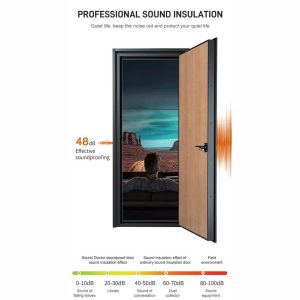
Steel doors with polyurethane foam cores provide reasonable sound insulation, comparable to solid wood doors. However, the frame-to-wall interface is often the weak point. Proper weatherstripping and a well-sealed installation matter more for sound reduction than the door slab itself.
Fire-Rated Assemblies
If your project requires a fire-rated door, the entire assembly — door, frame, hinges, and hardware — must be tested together. You cannot mix a fire-rated door slab with a non-rated frame and expect the assembly to carry a rating. Look for assemblies tested to UL 10C or NFPA 252 standards. The fire label is typically stamped on the edge of the door and the frame.
Frequently Asked Questions
Q: Are steel exterior doors with steel frames worth the cost compared to wood?
A: For security and durability, yes. Steel resists forced entry and does not rot or warp. The main disadvantage is thermal conductivity, which is mitigated by a foam core and thermally broken frame. If you live in a climate with extreme temperatures, prioritize those features.
Q: Can I paint a steel exterior door a different color?
A: Yes, but only if the factory finish is properly prepared. Lightly sand the surface, clean it thoroughly, and use a high-quality exterior metal primer and paint. Factory-baked finishes last longer than field-painted ones, so painting a new door may void the finish warranty.
Q: How long does a steel exterior door last?
A: With proper installation and maintenance, a steel door with a steel frame can last 30 years or more. The most common cause of failure is corrosion at the bottom edge where the door meets the threshold, usually from poor drainage or standing water.
Q: Do steel doors dent easily?
A: Steel doors are resistant to impact, but they are not indestructible. A sharp blow from a heavy object can dent the skin. Dents are difficult to repair — you typically need to fill, sand, and repaint the area. Heavier gauge steel (16-gauge vs 20-gauge) is more dent-resistant.
Q: What is the difference between a steel door and a steel-frame door?
A: A steel door can be hung in a wooden frame. A steel-frame door has both a steel slab and a steel frame, which provides a stronger, more secure assembly. The steel frame also eliminates the wood-to-steel interface that can fail over time.