Content Menu
● 2. What Is a Solid Wood Door with Glass?
● 3. How Does Glass Integration Affect Door Performance?
● 4. What Standards Apply to Glass in Doors?
● 5. How to Evaluate Solid Wood Door with Glass Suppliers
● 6. Key Quality Indicators for Buyers
● 7. Production Process: From Raw Lumber to Finished Door
● 8. MOQ, Lead Time, and Shipping Considerations
● 9. Customization and OEM/ODM Options
● 10. Avoid Suppliers Who Cannot Answer These Questions
● 11. Why Factory-Direct Sourcing Changes the Equation
9 min read
When a hotel developer in Dubai asked for 200 solid wood doors with glass, the first question was not about price.
It was about whether the glass would fog up after two summers of coastal humidity. The second question was about delivery. The third was about documentation.
That sequence — performance, logistics, paperwork — is the real procurement order for solid wood doors with glass. Aesthetic appeal gets the project approved. Engineering keeps it standing. This guide covers the technical specifications, supplier evaluation criteria, and sourcing strategies that matter for B2B buyers.
What Is a Solid Wood Door with Glass?
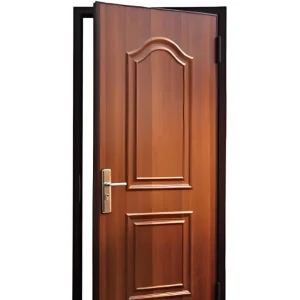
A solid wood door with glass is a door constructed from natural wood components — typically stiles, rails, and panels — with a glazed opening fitted with a glass unit. The term “solid” refers to the wood construction, not a single solid slab of timber. Most solid wood doors use engineered stile-and-rail construction, where pieces of wood are joined around a central panel or glass opening.
This construction method is not a compromise. The frame-and-panel design actually accommodates glass better than a solid slab would. The surrounding wood structure supports the glass unit and prevents stress fractures from building movement or seasonal wood expansion.
Solid Wood vs. Solid Core vs. Hollow Core
| Feature | Solid Wood | Solid Core | Hollow Core |
|---|---|---|---|
| Construction | Natural wood stiles, rails, panels | Wood frame filled with composite material (MDF, particleboard) | Wood frame with cardboard honeycomb interior |
| Weight (36″ x 80″ door) | 60–100 lbs | 50–70 lbs | 20–30 lbs |
| Sound insulation (STC rating) | 30–35 | 28–33 | 20–25 |
| Moisture resistance | High (when properly sealed) | Moderate | Low |
| Cost per unit (wholesale) | $150–$500+ | $80–$200 | $40–$80 |
| Typical use | Entry doors, premium interiors, exterior applications | Interior doors, offices, hotels | Residential interiors, temporary spaces |
The weight difference matters for hardware selection. A solid wood door with glass can weigh 30–50% more than a hollow alternative. Standard hinges rated for 30 lbs will fail. Buyers should specify heavy-duty ball-bearing hinges rated for the actual door weight.
How Does Glass Integration Affect Door Performance?
Adding glass to a solid wood door introduces three engineering challenges: structural integrity, thermal performance, and moisture sealing.
Structural Considerations
The glass opening reduces the amount of wood in the door panel. A correctly engineered stile-and-rail frame compensates for this by using wider stiles around the glass and reinforced joinery at the corners. Mortise-and-tenon joints with waterproof adhesive are the industry standard for load-bearing door frames.
For large glass lites (over 1,000 square inches), internal reinforcement may be necessary. Some manufacturers insert a steel or aluminum channel within the door frame to maintain rigidity.
Glass Types and Their Applications
| Glass Type | Best For | Key Property |
|---|---|---|
| Single-pane tempered | Interior decorative doors | Safety glass, breaks into small granules |
| Double-pane insulated (IGU) | Exterior doors | Two panes with argon gas between, reduces heat transfer |
| Low-E coated | Exterior doors in extreme climates | Reflects infrared radiation, reduces UV damage |
| Laminated | Soundproofing, security | PVB interlayer holds glass together when broken |
| Frosted/obscured | Bathrooms, privacy areas | Acid-etched or sandblasted surface |
| Dual-laminated | High-security entrances | Multiple PVB layers, impact-resistant |
The Glazing Seal: Where Most Failures Occur
The number one cause of premature failure in solid wood doors with glass is not the wood — it is the seal between the glass and the frame. If moisture enters this gap, three problems follow: the glass fogs, the wood rots, and the sealant fails.
Proper glazing requires:
- A glazing bead (wood or aluminum) that holds the glass in place
- A backer rod to fill the gap
- A high-quality sealant (silicone or polyurethane) applied on both sides
- Weep holes at the bottom of the glazing pocket to drain any condensation
Buyers should ask suppliers whether they use structural glazing tape or wet glazing. Both are acceptable, but the choice affects long-term durability and replacement ease.
What Standards Apply to Glass in Doors?
Glass safety standards vary by region, but the major ones are:
- North America: ANSI Z97.1, CPSC 16 CFR 1201
- Europe: EN 12150 (tempered), EN 356 (security glazing)
- China: GB 15763.2 (tempered glass), GB/T 11944 (insulating glass)
For exterior applications, check the local energy code. Many jurisdictions now require U-factors below 0.30 for glazed doors, which typically demands double-pane Low-E glass with argon fill.
How to Evaluate Solid Wood Door with Glass Suppliers
The evaluation process for a glazed wood door supplier differs from a standard door supplier. The glass integration adds a layer of quality control that not every factory handles well.
Factory Audit Checklist
- Moisture content testing: Ask to see the kiln-dried wood moisture readings. Acceptable range is 8–12%. Anything above 14% will likely warp after installation.
- Glass inspection: Does the factory test glass for stress fractures before assembly? Thermal stress testing is critical for large lites.
- Sealant application: Is the glazing done in a controlled environment? Dust or humidity during sealant application compromises the bond.
- Pre-shipment testing: Does the supplier perform water-tightness tests on finished doors? This is especially important for exterior units.
- Packaging: How are glass doors packed for export? A-frame crates with foam separators are the minimum standard.
Red Flags to Watch For
- No moisture content data: If a supplier cannot provide kiln-dried moisture logs, walk away. This is basic documentation.
- Single-pane glass for exterior doors: Any supplier recommending single-pane glass for an exterior application lacks thermal engineering knowledge.
- Vague lead times: A factory that cannot commit to a production schedule for custom glass orders will likely miss delivery dates.
- No test reports: Suppliers should provide glass certification test reports from recognized laboratories.
Key Quality Indicators for Buyers
When comparing quotes for solid wood doors with glass, look beyond the unit price. These indicators separate professional manufacturers from assemblers:
- Wood species consistency: Does the supplier source lumber from a single region? Mixed sources create color and grain variation.
- Joinery method: Mortise-and-tenon with waterproof adhesive beats dowel-and-glue construction.
- Glass edge work: Polished edges are safer and look better. Rough-cut edges indicate lower manufacturing standards.
- Finish system: UV-cured finishes or conversion varnishes outperform lacquer in durability. Ask for the finish warranty.
- Hardware compatibility: Pre-drilled hardware holes should be standard for OEM orders. On-site drilling risks damaging the glass.
Production Process: From Raw Lumber to Finished Door
Understanding the manufacturing process helps buyers identify what they are paying for.
Step 1: Lumber selection and conditioning. Kiln-dried lumber is inspected for defects. Moisture content is verified to 8–12%.
Step 2: Machining. Stiles, rails, and panels are cut to size. The glass opening is routed into the frame pieces.
Step 3: Sanding and assembly. All surfaces are sanded to specification. The frame is assembled with adhesive and clamped until the joint cures.
Step 4: Glass preparation. Glass is cut, edged, and tempered (if required). For double-pane units, the two panes are assembled with a spacer and sealed.
Step 5: Glazing. The glass unit is set into the frame with glazing tape or sealant. The bead is installed and finished.
Step 6: Finish application. The door is primed or stained. For stained finishes, multiple coats are applied with sanding between coats.
Step 7: Hardware installation. Hinges, locksets, and handles are installed if specified. Pre-drilled holes are checked for alignment.
Step 8: Inspection and packaging. Each door is inspected for defects. Glass doors are packed in protective crates designed for export shipping.
MOQ, Lead Time, and Shipping Considerations
Minimum Order Quantities
For factory-direct sourcing, MOQs typically range from 20 to 100 units, depending on the factory and customization level. Standard sizes with standard glass configs allow lower MOQs. Fully custom designs with unique dimensions or specialized glass may require higher minimums.
Lead Times
- Standard sizes, standard glass: 2–4 weeks production
- Custom sizes, standard glass: 3–5 weeks production
- Fully custom design, custom glass: 5–8 weeks production
- Ocean freight from China to North America: 25–35 days
- Ocean freight from China to Europe: 30–40 days
FCL vs. LCL Shipping
Full Container Load (FCL) is almost always the better option for solid wood doors with glass. A 40-foot container holds approximately 120–160 doors, depending on dimensions and packaging. FCL reduces the risk of damage from handling during consolidation and is more cost-effective per unit for orders over approximately 50 doors.
Less than Container Load (LCL) works for smaller orders but adds risk. Doors are handled multiple times, increasing the chance of glass breakage. If LCL is the only option, require suppliers to use A-frame crating with clear “fragile” labeling.
Customs Documentation
A competent export supplier provides:
- Commercial invoice
- Packing list
- Proforma invoice (for letter of credit transactions)
- Bill of lading
- Certificate of origin
- Customs export declaration
Missing documentation delays clearance at the destination port, incurring storage fees that can exceed the cost of the doors themselves.
Customization and OEM/ODM Options
Customization in solid wood doors with glass extends beyond dimensions. The following options are common in B2B projects:
- Wood species: Oak, maple, mahogany, teak, walnut, pine, and engineered alternatives
- Panel configuration: 1-panel, 2-panel, 3-panel, flush, or custom layouts
- Glass style: Clear, frosted, rain, obscure, tinted, or laminated
- Glass type: Single, double, or triple glazing; Low-E; tempered; laminated
- Hardware: Hinges, locksets, handles, closers, and panic devices
- Finish: Primed for painting, stained, or factory-finished with UV-resistant coating
- Pre-drilling: Hardware holes pre-drilled to specification
For OEM orders, a manufacturer should provide samples before mass production. For ODM projects, the manufacturer’s design team can adapt standard models to meet project requirements.
Avoid Suppliers Who Cannot Answer These Questions
Experienced buyers ask the following before placing orders:
- What is the moisture content of your kiln-dried lumber? If the answer is not a specific percentage, the supplier lacks process control.
- What glazing sealant do you use, and what is its expected lifespan? Silicone-based sealants typically last 10–20 years.
- Can you provide glass test certificates? Tempered and laminated glass should have third-party test documentation.
- What is your defect rate on glass breakage during transit? A rate below 1% indicates proper packaging.
- How do you handle warranty claims for damaged goods? Clear policies on replacement parts or units protect the buyer.
Why Factory-Direct Sourcing Changes the Equation
The supply chain structure matters in the final cost. A solid wood door with glass that sells for $300 through a distributor may cost $200–240 direct from the factory. The difference is not just margin — it is also control.
When a buyer works directly with the factory, quality control happens before shipment. The buyer can specify inspection points, request pre-shipment photos, and hold the factory accountable for defects. This direct accountability is the strongest argument for skipping the middleman.
How Jusen Door and Windows Approaches This Product
As a manufacturer, we approach solid wood doors with glass through the lens of production stability. The wood must be properly conditioned. The glass must be correctly specified. The seal must hold for years. Our pre-shipment inspection covers air-tightness, water-tightness, and wind resistance — the three failure points that cause the most on-site issues.
We offer full customization on size, color, glass type, and hardware accessories. Our ODM capability means buyers can request specific panel configurations — a 1-panel shaker with a square top lite, a 3-panel even design, or a flush door with a half-lite opening — without compromising the structural integrity of the door.
For international buyers, our export experience covers the documentation side. We provide packing lists, proforma invoices, and full customs paperwork. Both FCL and LCL shipments are available, with packaging designed to protect glass during ocean transit. We also adjust profile structures and fittings to comply with local building codes in your target market.
The cost advantage is straightforward: buying direct from our factory removes the distributor markup from your door budget.
Choose A if… Choose B if…
- Choose a solid wood door with glass if the project requires premium aesthetics, natural material, and acoustic performance. This is the right choice for hotels, executive offices, and high-end residential developments.
- Choose a solid core door with glass if the budget is tighter and the application is primarily interior. Solid core offers similar acoustic performance at lower cost.
- Choose a hollow core door only for temporary spaces or budget-driven projects where performance requirements are minimal.
References
- American National Standards Institute. ANSI Z97.1-2015: Safety Glazing Materials Used in Buildings. https://webstore.ansi.org/standards/ansi/ansiz97-2015
- European Committee for Standardization. EN 12150: Safety Glass — Thermally Toughened Soda Lime Silicate Safety Glass. https://standards.cencenelec.eu/
- U.S. Consumer Product Safety Commission. 16 CFR Part 1201 — Safety Standard for Architectural Glazing Materials. https://www.ecfr.gov/current/title-16/chapter-II/subchapter-B/part-1201
- International Code Council. 2021 International Energy Conservation Code — Fenestration Requirements. https://codes.iccsafe.org/content/IECC2021P1/chapter-4-re-residential-energy-efficiency
—
Ready to discuss your project requirements or request a detailed quotation? Our team can provide technical specifications, lead times, and pricing for your solid wood door with glass project.
https://doorwoodendoors.com/contact-us/” style=”display:inline-block;padding:12px 24px;background:#2563eb;color:#fff;text-decoration:none;border-radius:6px;font-weight:600″>Get a Free Quote