What You Need to Know About Solid Door Slabs
A solid door slab is a door without the frame, hinges, or pre-drilled hardware — essentially the flat door panel itself. It is installed into an existing jamb or a new frame purchased separately. Solid door slabs are made from either solid wood (one piece or edge-glued staves) or engineered wood (a solid core of MDF or composite with a wood veneer). They are available unfinished or prefinished.
For bulk buyers, the three decisions that matter most are: core material (solid wood vs engineered), finish state (unfinished vs prefinished), and wood species (if solid wood). Each choice affects price, durability, lead time, and how the doors perform in specific building conditions. This guide walks through those decisions with the trade-offs made explicit.
Types of Solid Door Slabs: Solid Wood vs. Engineered Wood
Solid Wood Door Slabs
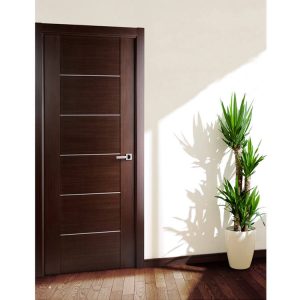
Solid wood slabs are constructed from a single piece of lumber or from multiple staves edge-glued together. Mahogany, oak, walnut, and pine are common species. The entire thickness of the door — typically 1¾ inches (44 mm) for interior doors in North America — is wood, not a hollow core or a thin veneer over a frame.
What solid wood gives you:
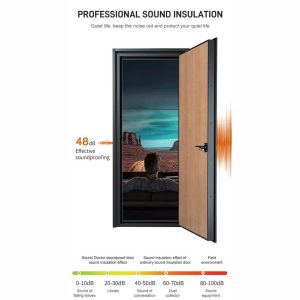
- Acoustic performance. A 1¾-inch solid wood door has a Sound Transmission Class (STC) rating in the range of 30–35, depending on the species, density, and perimeter seals. That is noticeably better than a hollow-core door (STC 20–25) and comparable to a solid-core engineered door. The rating depends heavily on how the door is installed and whether the gaps are sealed; the door panel itself is only part of the system.
- Repairability. Solid wood can be sanded, filled, and refinished multiple times over its service life. A scratched or dented solid wood door can be restored; a veneered engineered door is much harder to repair convincingly.
- Screw-holding strength. Hinges, locksets, and surface-mounted hardware bite into solid wood reliably. This matters for heavy doors or high-traffic commercial applications.
The trade-offs:
- Moisture movement. Solid wood expands and contracts across the grain with changes in humidity. A solid wood door installed in a bathroom or a climate-controlled building with wide seasonal humidity swings can warp, cup, or develop cracks at the joints. This is not a defect; it is the material’s physical behavior. Engineered products exist specifically to mitigate this.
- Cost. Solid wood is more expensive than engineered cores, both in raw material and in the labor required to dry, mill, and finish it properly.
- Weight. A solid wood door is heavy — a 3’0″ x 6’8″ solid mahogany slab can weigh 80–100 lbs (36–45 kg). That requires robust hinges and careful handling during installation.
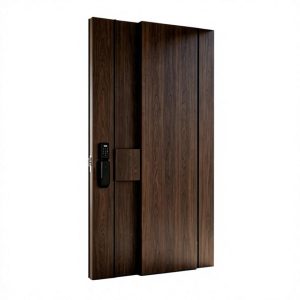
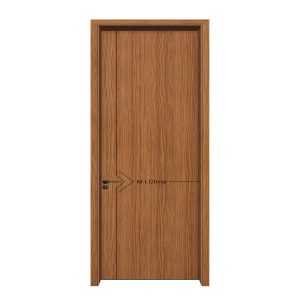
[Image: solid wood door slab]
Engineered Wood Door Slabs
Engineered solid-core slabs have a core of Medium Density Fiberboard (MDF), particleboard, or laminated veneer lumber, faced with a wood veneer (or a rigid thermal foil, in budget segments). The core is solid — not hollow — so the door has mass and acoustic performance close to solid wood.
Where engineered slabs perform well:
- Dimensional stability. MDF and composite cores do not expand and contract like solid wood. An engineered slab is the safer choice for bathrooms, laundry rooms, or any location with high or variable humidity. It will not cup or twist the way a solid wood door can.
- Cost consistency. Engineered slabs are less expensive than solid wood of the same species and finish, because the veneer uses far less of the expensive wood. The price difference is often 30–50% depending on species and core quality.
- Flatness and paintability. MDF cores have a perfectly flat, defect-free surface. If the door is going to be painted rather than stained, an engineered slab with an MDF core is the better canvas. There are no grain raises, knots, or color variations to hide.
The trade-offs:
- Repair limitations. Once the veneer is damaged through to the core, repair options are limited. Filling and repainting is possible; restoring a wood-grain appearance is not.
- Screw-holding in the core. MDF holds screws adequately but not as well as solid wood, especially if the hardware is removed and reinstalled multiple times. For heavy-duty applications, specify reinforced blocking in the core where hinges mount.
- Edge treatment. The edges of an engineered slab are either veneered or painted. Veneered edges are visible on a stained door and can show the core at the seams if the veneer is thin. Painted edges are fine for painted doors but look wrong on a stained finish.
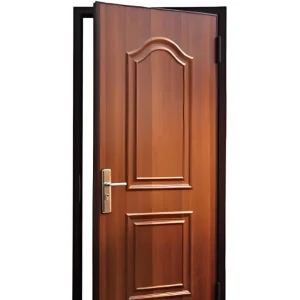
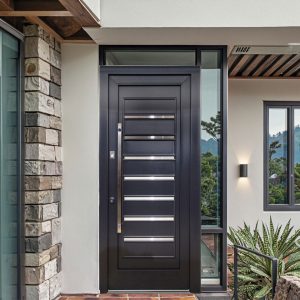
[Image: engineered wood door slab]
Unfinished vs. Prefinished Door Slabs: Pros and Cons
Unfinished Door Slabs
An unfinished door slab arrives with bare wood or a sanded MDF surface, ready for the contractor or buyer to stain, paint, or seal on site.
Why buyers choose unfinished:
- Color matching. On-site finishing allows the door to be matched to trim, cabinetry, or other millwork in the same building. Prefinished doors come in a fixed palette.
- Site-specific durability. You control the finish system. A marine-grade varnish on a coastal project, or a water-based polyurethane for low-VOC requirements, is your choice. Prefinished doors lock you into the factory’s coating.
- Cost per unit. Unfinished slabs are cheaper per door than prefinished equivalents. The finishing labor is paid locally, which may or may not offset the savings depending on your market’s labor rates.
The trade-offs:
- Finishing labor. Someone has to do the work. For a bulk order of 50 or 100 doors, that is a significant amount of shop time, spray equipment, and drying space.
- Finish quality variability. A factory-applied finish is cured in controlled conditions. A site-applied finish depends on the finisher’s skill, the ambient temperature, and humidity during application. For high-end projects, this difference is visible.
- Lead time. If the doors arrive unfinished, the project schedule must include finishing time before installation.
Prefinished Door Slabs
Prefinished slabs come from the factory with a cured finish — typically a UV-cured polyurethane or lacquer — applied to all six sides.
Why buyers choose prefinished:
- Consistency. Every door in the order has the same color, sheen, and film thickness. There is no batch-to-batch variation from on-site mixing.
- Faster installation. The doors are hung and the hardware is installed; no finishing step on site. For commercial projects with tight schedules, this is the decisive factor.
- Better edge and end-grain protection. Factory finishing coats the top and bottom edges of the slab — the areas most exposed to moisture absorption. Site finishers often miss these surfaces, which is a common cause of premature door failure.
The trade-offs:
- Touch-up visibility. If a prefinished door gets scratched during installation, the touch-up will be visible. Unfinished doors can be sanded and refinished to hide the repair.
- Fixed color options. You are limited to the factory’s finish palette. Custom color matching is possible but adds cost and lead time.
- Higher unit price. The factory finishing process adds cost to each door, typically 15–30% over the unfinished slab price depending on the finish system.
Spotlight on Unfinished Mahogany Doors
Mahogany is a specific choice, not a default. It is worth understanding why it commands attention in the door slab market.
What mahogany offers:
- Stability relative to other hardwoods. Genuine mahogany (Swietenia species) has low tangential shrinkage compared to oak or ash. It moves less with humidity changes, which makes it a better candidate for solid wood doors in climates with seasonal moisture swings.
- Workability. Mahogany machines cleanly, takes detail well, and has a consistent, straight grain. It is forgiving for the millworker and the finisher.
- Finish absorption. Mahogany accepts stain and clear finishes evenly, without the blotching that plagues maple or cherry. An unfinished mahogany door is a predictable canvas for a finisher.
- Appearance. The rich, reddish-brown color deepens with age and UV exposure. Unlike many woods, mahogany does not require stain to look premium; a clear finish is sufficient.
What to verify when sourcing unfinished mahogany doors:
- Species authenticity. “Mahogany” is used loosely in the trade. Genuine mahogany (Swietenia macrophylla) is different from African mahogany (Khaya) and meranti, often sold as “Philippine mahogany” — which is not mahogany at all. The three differ in color, grain, and stability. If the species matters to your project, specify it in writing and request documentation.
- Moisture content. The slab should be kiln-dried to 6–9% moisture content for interior use. A door milled from improperly dried stock will move after installation, and the joints will telegraph the movement.
- Joint construction. A solid mahogany slab is typically edge-glued from multiple staves. Check that the staves are matched for grain and color, and that the glue joints are tight with no visible gaps.
An unfinished mahogany door is the right choice when the project calls for a premium stained finish, the building has controlled humidity, and the budget supports the material cost. For painted doors or high-humidity locations, it is the wrong investment.
Solid Door Slab Comparison Table
| Criterion | Solid Wood (Mahogany/Oak) | Engineered Solid Core (MDF) | Unfinished | Prefinished |
|---|---|---|---|---|
| Typical STC rating | 30–35 | 28–33 | Same as finished | Same as unfinished |
| Humidity resistance | Moderate; can cup/warp | High; dimensionally stable | Depends on site finish | Better; edges sealed at factory |
| Repair capability | High; sand and refinish | Low; veneer damage is permanent | High; full control | Low; touch-ups visible |
| Unit cost (relative) | Highest | 30–50% less than solid wood | Lowest per unit | 15–30% more than unfinished |
| Lead time impact | Species-dependent; longer for exotics | Shorter; consistent supply | Add finishing time on site | Ready to install on arrival |
| Best use case | Stained premium interiors, controlled humidity | Painted doors, bathrooms, high-humidity areas | Custom color matching, site-controlled finishes | Commercial schedules, consistent color |
How to Choose the Right Solid Door Slab for Your Project
Thickness and Size
The standard interior door slab thickness in North America is 1¾ inches (44 mm). Exterior doors are typically 1¾ inches as well, though some commercial applications use 2¼ inches (57 mm) for fire ratings or acoustic performance.
Standard nominal widths are 2’0″, 2’4″, 2’6″, 2’8″, and 3’0″ (610, 711, 762, 813, and 914 mm). Standard heights are 6’6″ and 6’8″ (1981 and 2032 mm). Metric markets follow different conventions — 800, 850, and 900 mm widths are common in Europe and Asia.
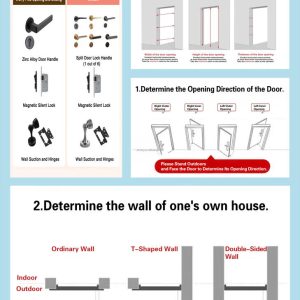
Before ordering slabs, measure the existing jambs or the rough opening for new frames. Three measurement pitfalls cause most ordering errors:
- Jamb depth. The slab thickness must match the jamb’s rebate depth. A 1¾-inch slab will not fit a jamb cut for a 1⅜-inch door.
- Undercut clearance. For interior doors over hard flooring, a ¾-inch undercut is typical. For carpet, the undercut must clear the carpet and pad. If you order slabs pre-cut to a standard height, plan the undercut into your site finishing or specify it at the factory.
- Existing hinge locations. If you are replacing slabs in existing jambs, the hinge positions on the new slabs must match the old ones. Standard hinge placement is 7 inches from the top and 11 inches from the bottom, but this varies. Provide the existing hinge locations to the supplier if the slabs are being pre-mortised.
Core Selection by Location
| Location | Recommended Core | Reason |
|---|---|---|
| Bedrooms, offices | Solid wood or engineered | Acoustic performance, premium feel |
| Bathrooms, laundry rooms | Engineered MDF core | Humidity resistance; solid wood will move |
| Fire-rated openings | Engineered with fire-rated core | Fire door assemblies require specific cores and labels |
| High-traffic commercial | Engineered with reinforced hinge areas | Dimensional stability, consistent appearance |
Fire-Rated Solid Door Slabs
Fire-rated door assemblies are required between garages and living spaces, in certain egress paths, and in commercial buildings per the International Residential Code (IRC) and International Building Code (IBC). A fire-rated door slab is not a standard solid wood or MDF slab — it is a labeled assembly tested to a specific rating (typically 20, 45, 60, or 90 minutes).
If your project requires fire-rated doors, the slab must carry the appropriate label from a recognized testing agency (e.g., Warnock Hersey or Underwriters Laboratories). The label is applied by the door manufacturer and certifies the entire assembly — the slab, the frame, the hinges, and the hardware are all part of the rated system. Replacing a fire-rated door slab with a non-rated slab voids the rating, regardless of how similar the materials look.
Verify the local code requirements for your jurisdiction before ordering. Fire door requirements vary by occupancy type, building height, and proximity to hazards.
Moisture and Humidity Considerations
No door material is warp-proof. Solid wood moves with humidity; engineered cores move less but are not immune. The practical guidance for bulk buyers:
- For interior doors in climate-controlled buildings, solid wood slabs are a reasonable choice in most species, provided the building’s HVAC maintains consistent humidity.
- For bathrooms, laundry rooms, or unconditioned spaces, specify engineered solid-core slabs. The cost premium over solid wood is negative — engineered is cheaper — and the dimensional stability is meaningfully better.
- For exterior door slabs, the exposure is harsher. A solid wood exterior slab needs a fully sealed finish on all six sides, including the top and bottom edges. Many buyers choose engineered slabs for exterior applications for this reason.
Sourcing Solid Door Slabs: Manufacturer vs. Distributor
The supply chain for door slabs has two distinct tiers, and the right choice depends on order size and customization needs.
Distributors stock finished slabs from multiple manufacturers. They offer short lead times, small minimum orders, and the ability to mix brands and species in one order. The trade-offs are price (the distributor’s margin is built in) and limited customization — you choose from what is in stock, not what you specify.
Manufacturers produce to order. This is the right route when:
- Order volume justifies direct sourcing. A container load of door slabs (typically 150–300 units depending on size) is the threshold where factory-direct pricing becomes meaningfully lower than distributor pricing.
- Custom dimensions are required. Standard sizes are available everywhere. Non-standard widths, heights, or thicknesses are factory work.
- Species and grade control matters. If the project specifies a particular mahogany species or a specific veneer cut, the manufacturer controls the raw material sourcing.
- Finish specifications are non-negotiable. A factory-applied finish system can be specified to match a performance requirement, such as a specific coating thickness or a low-VOC system.
What to verify with any supplier before committing to a bulk order:
- Moisture content documentation. For solid wood slabs, request the kiln-dried moisture content range for the batch.
- Pre-shipment inspection. The supplier should be able to provide inspection results for air-tightness, water-tightness, and wind resistance if the slabs are for exterior use. For interior slabs, inspect for flatness, joint integrity, and surface defects.
- Customs and logistics capability. For international orders, the supplier should provide packing lists, proforma invoices, and full customs documentation. Container loading (FCL or LCL) should be confirmed in writing.
- Adjustability to local codes. Building codes and standard sizes vary by market. A manufacturer that can adjust profile structures and fittings to match the target market’s codes saves significant rework on site.
Frequently Asked Questions About Solid Door Slabs
What is the difference between a solid door slab and a prehung door?
A prehung door arrives with the slab mounted in a frame, with hinges installed and the frame pre-drilled for the lockset. A slab is just the door panel. Slabs are used when the existing frame is in good condition, or when the buyer wants to install the door into a frame sourced separately.
Can a solid door slab be cut to fit?
Yes, but only in specific ways. Solid wood slabs can be trimmed on all four edges, though trimming more than ½ inch from a stile can compromise the joint integrity. Engineered slabs with MDF cores can be trimmed, but the cut edge must be sealed immediately or it will absorb moisture. Height trimming is more forgiving than width trimming, because the top and bottom rails are typically wider than the stiles.
Are solid door slabs better for soundproofing?
A solid door slab has significantly better acoustic performance than a hollow-core door, with STC ratings roughly 10 points higher in controlled tests. However, the door panel is only part of the acoustic system. The gap under the door, the perimeter seals, and the wall construction all affect the actual sound isolation in a real installation. A solid slab with a ½-inch gap under the door will leak more sound than a hollow-core door with perimeter gaskets.
What is the average cost range for solid door slabs?
Pricing varies widely with material, finish, and order volume. Unfinished engineered solid-core slabs are the most economical option, while unfinished solid mahogany slabs cost more, and prefinished solid wood slabs cost the most. For bulk orders, factory-direct pricing from a manufacturer is typically 20–40% below distributor pricing for the same specification. Get quotes from multiple sources and compare on total delivered cost, not unit price alone.
How do I ensure quality when buying door slabs in bulk?
Request the supplier’s quality control process in writing. For a reputable manufacturer, this includes pre-shipment inspection for dimensional accuracy, surface defects, and moisture content. Ask for photos or inspection reports of the actual batch before shipment. Confirm the moisture content range for solid wood slabs, and verify that the finish system (if prefinished) meets your project’s performance requirements.
Can I install a solid door slab myself?
Installing a slab into an existing frame requires the hinges to be mortised, the lockset hole to be bored, and the slab to be hung with correct clearances. This is a job for a competent carpenter or millworker. For a bulk order, factor installation labor into the project budget. The slab price is only part of the total installed cost.
How We Meet These Standards
As a manufacturer of solid wood doors and thermal-break aluminum windows, we supply solid door slabs to construction projects and distributors across multiple markets. Our approach to the standards outlined above is straightforward.
We produce slabs in solid wood species including mahogany, oak, and walnut, as well as engineered solid-core options. Every order is manufactured to the buyer’s specified dimensions, with the option of unfinished or factory-finished surfaces. For bulk orders, our factory-direct pricing removes the distributor margin, and our foreign trade team provides the full documentation package — packing lists, proforma invoices, and customs paperwork — for FCL or LCL shipment.
Quality control is handled at the factory, not at the port. Each batch is inspected for dimensional accuracy, surface quality, and structural integrity before shipment. For exterior-grade products, we conduct air-tightness, water-tightness, and wind resistance tests. We also adjust profile structures and fittings to match the building codes of the target market, so the doors arrive compliant with local requirements.
If you are sourcing solid door slabs for a project and need to verify specifications, pricing, or lead times, contact our team with your project details.