Content Menu
● 1. Understanding Single Panel Exterior Doors: Types and Applications
● 2. Quality and Performance Factors in Single Panel Exterior Doors
● 3. How to Evaluate Single Panel Exterior Door Suppliers
● 4. Key Quality Indicators for Single Panel Exterior Door Buyers
● 5. Relevant Industry Standards and Certifications
● 6. Our Door Manufacturing Capabilities
● 7. Production Process: Common Questions Answered
9 min read
A contractor in Phoenix once ordered 40 prehung single panel doors for a townhome development. The frames arrived 15 mm too narrow for the rough openings. The general contractor had to shim every unit, and the air-seal test failed on three units. The supplier had not asked about the wall assembly details. That is the difference between buying a door and buying a door system.
This guide covers what procurement professionals need to know before sourcing single panel exterior doors: how they are built, what drives performance, how to evaluate suppliers, and what questions to ask before placing a container order.
Understanding Single Panel Exterior Doors: Types and Applications
A single panel exterior door uses one uninterrupted slab or one primary panel — as opposed to multi-panel designs with decorative raised panels or multiple glass divisions. This category includes solid slab doors, doors with a single large glass lite, and variations with multiple narrow lites arranged in a clean grid.
Solid Slab Doors
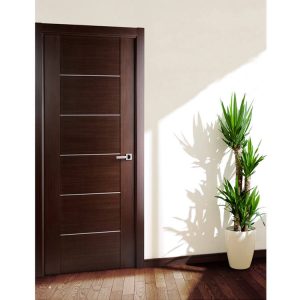
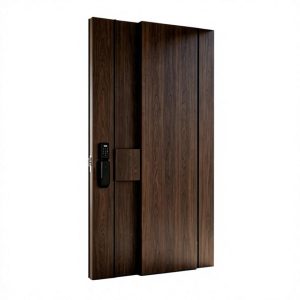
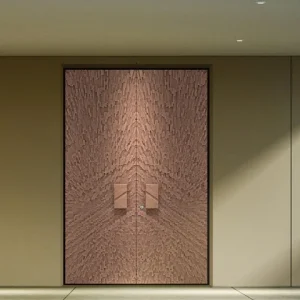
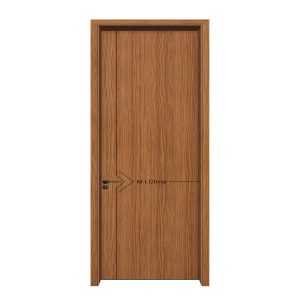
Solid slab doors have no glass and no decorative panels. The surface is one continuous plane. Common materials are solid wood (mahogany, oak, walnut), fiberglass, and steel. These doors suit modern architecture, privacy-focused entries, and commercial side entrances where sightlines matter more than ornamentation.
Single Lite Doors
Single lite doors feature one large glass opening within the door frame. Glass can be full-height, two-thirds height, or a horizontal strip. Popular configurations include 1-lite Low-E clear designs and single vertical lite layouts. These doors bring natural light into entryways while maintaining the clean silhouette of a single panel.
Multi-Lite and Horizontal Plank Variations
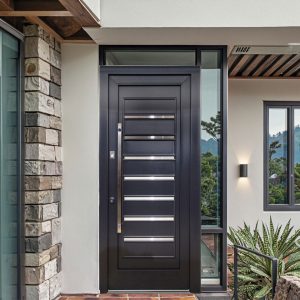
Some single panel doors incorporate multiple narrow glass lites arranged vertically or horizontally — such as 3-lite horizontal plank designs or 5-rectangle lite configurations. These maintain the overall single-panel structure but offer design differentiation. They are common in craftsman-style homes where traditional warmth meets minimalist structure.
Craftsman and Decorative Styles
Craftsman single panel doors combine the clean structure of a single slab with decorative detailing — often executed in mahogany or other hardwoods. These sit between ultra-modern and classic, making them popular in North American residential markets.
Quality and Performance Factors in Single Panel Exterior Doors
Performance depends on three variables: how the door is constructed, what materials are used, and how the glass and hardware are specified.
Stile-and-Rail vs. Solid Core Construction
Stile-and-rail construction uses a frame of vertical stiles and horizontal rails with a panel insert — wood, glass, or composite. This method is lighter and more dimensionally stable than solid construction. The panel floats within the frame, allowing natural expansion and contraction.
Solid core construction uses an engineered wood or MDF core with veneer faces. These doors are heavier, provide better sound insulation, and feel more substantial. However, they are more susceptible to moisture damage if the edges are not properly sealed.
Buying implication: For humid climates, stile-and-rail construction with proper sealing outperforms solid core. For acoustic separation and security, solid core is preferable.
Thermal Performance and Energy Codes
The U-factor measures how well a door conducts heat. Lower values mean better insulation. A standard solid wood door without glazing has a U-factor around 0.50. A thermal-break aluminum door with double-glazed Low-E glass can achieve 0.30 or better.
Thermal break technology uses a polyamide strip between the interior and exterior aluminum profiles. This interrupts the thermal bridge that would otherwise conduct heat through the frame. For projects in cold climates or jurisdictions with strict energy codes, thermal-break construction is often mandatory.
Glass Selection
Glass specification affects both performance and cost:
| Glass Type | U-Factor | Visible Transmittance | Best For |
|---|---|---|---|
| Single clear | ~1.00 | High | Mild climates, budget projects |
| Double Low-E | ~0.30–0.35 | Moderate | Most residential and commercial |
| Triple Low-E, argon-filled | ~0.20–0.25 | Lower | Cold climates, passive house |
| Low-E obscure | ~0.35 | Low | Privacy with light transmission |
Tempered glass is required by code in most door applications. Laminated glass adds security and sound reduction. Buyers should confirm which glass type their local codes require before specifying.
How to Evaluate Single Panel Exterior Door Suppliers
Supplier evaluation is a procurement discipline, not a marketing exercise. Use the framework below to compare factories systematically.
Manufacturing Capability and Capacity
Ask for monthly output capacity, production line configuration, and whether they handle both standard and custom sizes in the same line. A factory that produces 5,000 doors per month but only on one line may struggle with mixed orders. Request their production schedule visibility — can they tell you where your order sits in the queue?
Customization Flexibility
Single panel doors require customization at multiple levels: size, glass configuration, hardware, color, and finish. A supplier that offers only standard sizes will create field problems. Ask specifically: Can you adjust profile structures to meet our local building codes? Can you match custom RAL colors? Can you source specific hardware brands?
Quality Control Processes
Pre-shipment inspection is non-negotiable. Ask which tests are performed and whether documentation is provided. For exterior doors, the critical tests are:
- Air-tightness (measures air leakage through the closed door)
- Water-tightness (measures resistance to water penetration under pressure)
- Wind resistance (measures structural integrity under wind load)
These tests follow standards such as EN 12207 (air permeability), EN 12208 (water tightness), and EN 12211 (wind load resistance). A supplier should be able to provide test reports, not just verbal assurances.
Export and Logistics Experience
International procurement requires documentation: packing lists, proforma invoices, certificates of origin, and customs declarations. A supplier with foreign trade experience handles this smoothly. Ask about their FCL (full container load) and LCL (less than container load) capabilities, and whether they can manage direct delivery from factory to port.
Red Flags to Avoid
- No clear production capacity or lead time estimates
- Unwillingness to customize sizes or hardware
- No testing documentation or vague quality claims
- No export experience or unfamiliarity with international documentation
- One-size-fits-all approach to building code compliance
Key Quality Indicators for Single Panel Exterior Door Buyers
Beyond the standard tests, several quality indicators separate reliable suppliers from problematic ones.
Material Specifications
Wood doors should specify the species and moisture content. Kiln-dried wood at 8–12% moisture content resists warping. Aluminum profiles should specify alloy grade (typically 6063-T5 or T6) and wall thickness (1.4–2.0 mm for exterior applications).
Weatherstripping and Sealing
The quality of weatherstripping determines long-term air and water performance. EPDM (ethylene propylene diene monomer) rubber outperforms PVC in durability. Multi-point sealing systems — weatherstripping at the threshold, jamb, and head — provide better performance than single-point seals.
Hardware and Locking Systems
Multi-point locking systems engage at multiple points along the door edge, improving security and seal compression. Hinge quality matters — ball-bearing hinges rated for heavy doors prevent sagging over time. For commercial applications, check that locking hardware meets local security ratings.
Finish Durability
For wood doors, the finish determines maintenance frequency. Factory-applied UV-resistant finishes last 3–5 years before refinishing. For aluminum doors, powder coating (60–80 micron thickness) provides superior durability compared to anodized finishes in coastal environments.
Relevant Industry Standards and Certifications
Buyers should verify compliance with applicable standards before ordering. Common frameworks include:
- EN 14351-1 — European standard for windows and doors, covering performance characteristics including air permeability, water tightness, and wind load resistance
- ASTM E283 — Standard test method for air leakage in exterior windows and doors
- ASTM E547 — Standard test method for water penetration
- NAFS (North American Fenestration Standard) — AAMA/WDMA/CSA 101/I.S.2/A440 for windows and doors in North America
- Energy Star — Certification for energy-efficient products in the US and Canada
For fire-rated applications, additional certifications apply — such as UL 10C or NFPA 252 in North America. Fire-rated doors are not simply about thicker slabs. The frame, seal, and hardware matter just as much.
Our Door Manufacturing Capabilities
Here is how we meet the standards discussed above. Jusen Door and Windows Manufacturing Co., Ltd. operates as a direct factory supplier — not a trading house. This distinction matters for pricing and quality control.
Direct Factory Supply
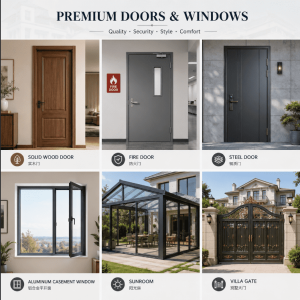
We manufacture solid wood doors, thermal-break aluminum doors and windows, system windows, casement doors, sliding doors, and custom villa doors and windows. Because we control the production process from raw material to finished product, our pricing reflects production costs — not middleman markups. For bulk buyers, this translates into 30–50% savings compared to distributor pricing.
Customization and OEM/ODM Options
Our production lines handle full customization on size, color, glass, and hardware accessories. OEM and ODM services are available, including private label options. We adjust profile structures and fittings to match local building codes of target markets — which means the Phoenix contractor scenario from the opening of this article would not happen with our frames, because we engineer them to your rough opening specifications.
Production Process: From Raw Material to Finished Door
The manufacturing process for a single panel exterior door follows a controlled sequence:
- Material selection and inspection — Wood is kiln-dried and graded. Aluminum billets are verified for alloy composition.
- Cutting and machining — Profiles are cut to spec and machined for hardware and drainage.
- Assembly — Stile-and-rail or solid core assembly with precise joinery.
- Glass installation — Glazing units are installed with proper setting blocks and sealant.
- Hardware installation — Hinges, locks, and weatherstripping are fitted.
- Surface finishing — Paint, stain, or powder coating applied under controlled conditions.
- Final inspection — Dimensional checks, hardware function, and sealing integrity verification.
Quality Control: Multi-Stage Inspection
Every order undergoes pre-shipment inspection including air-tightness, water-tightness, and wind resistance testing. We provide documentation so you know exactly what you are receiving before it leaves the factory. This is not a sampling process — it applies to each production batch.
Ordering Process: MOQ, Lead Time, and Shipping
We handle both FCL and LCL shipments with direct delivery from our China factory. Our foreign trade team prepares packing lists, proforma invoices, and full customs documents. We have experience with international clients across multiple markets and understand the documentation requirements for smooth customs clearance.
Lead times depend on order volume and customization level. Standard products ship faster; fully customized orders require additional production time. Contact us with your project specifications for an accurate timeline.
Production Process: Common Questions Answered
What is the typical MOQ for bulk orders? MOQ varies by product type and customization level. Direct factory suppliers often offer flexible MOQs. Contact us to discuss your project volume.
Can single panel exterior doors be fully customized? Yes — size, color, glass type, hardware, and finish can all be customized. Manufacturers with flexible production lines can adjust profile structures and fittings to meet local building codes.
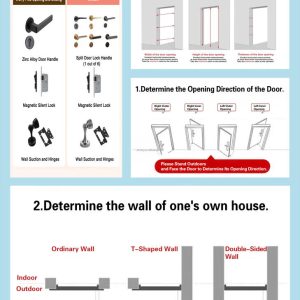
What are the disadvantages of a prehung exterior door? Prehung units are heavier and more cumbersome to transport. They cost more upfront than slab-only doors. Frames can be damaged during shipping if not properly packaged. And they require accurate rough opening dimensions — if the opening is non-standard, the prehung frame may not fit without modification.
How do I ensure doors meet local building codes? Work with a manufacturer that can adjust profiles, glass specifications, and hardware to your market’s requirements. Ask for pre-shipment test documentation covering air-tightness, water-tightness, and wind resistance.
What drives the cost difference between suppliers? Material grade, construction method, glass specification, hardware quality, and finish durability account for most price variation. A door that costs 20% more but lasts twice as long between maintenance cycles is the more economical choice over a 10-year horizon.
Decision Guide: Choosing the Right Door Configuration
Choose solid slab if: Privacy is a priority, the design calls for minimalism, or the door faces a noisy street where sound insulation matters.
Choose single lite if: The entry needs natural light, the architecture calls for a modern aesthetic, or the door faces a porch or courtyard worth seeing.
Choose multi-lite variations if: The project is residential and the design style is craftsman or transitional, where narrow glass lites add character without compromising the single-panel silhouette.
Choose thermal-break aluminum if: The project is commercial, energy codes are strict, or the door is large and requires structural rigidity with slim sightlines.
Choose solid wood if: Aesthetics are paramount, the market positions the property as premium, and maintenance is acceptable to the owner.
Choose fiberglass or steel if: Budget is constrained, security is the primary concern, or the climate is harsh and low maintenance is required.
References
- EN 14351-1:2006+A2:2010 — Windows and doors. Product standard, performance characteristics. https://www.en-standard.eu/csn-en-14351-1-windows-and-doors-product-standard-performance-characteristics/
- ASTM E283-19 — Standard Test Method for Determining Rate of Air Leakage Through Exterior Windows, Skylights, Curtain Walls, and Doors Under Specified Pressure Differences Across the Specimen. https://www.astm.org/e0283-19.html
- ASTM E547-00(2016) — Standard Test Method for Water Penetration of Exterior Windows, Skylights, Doors, and Curtain Walls by Cyclic Static Air Pressure Difference. https://www.astm.org/e0547-00r16.html
- NAFS — North American Fenestration Standard (AAMA/WDMA/CSA 101/I.S.2/A440). https://www.aamanet.org/nafs.html
- Energy Star — Windows, Doors, and Skylights. https://www.energystar.gov/products/windows_doors_and_skylights
https://doorwoodendoors.com/contact-us/” style=”display:inline-block;padding:12px 24px;background:#2563eb;color:#fff;text-decoration:none;border-radius:6px;font-weight:600″>Get a Free Quote