Content Menu
● 1. 1. Understanding Side by Side Exterior Door Configurations
● 2. 2. Material Options and Performance Criteria
● 3. 3. Procurement Framework for B2B Buyers
● 4. 4. Color, Finish, and Aesthetic Considerations
● 5. 5. The Factory-Direct Supply Advantage
● 6. 6. Partnership Models and Logistics
● 7. 7. Case Study Snapshot: How a Developer Sourced Double Doors
● 8. 8.
12 min read
A contractor in Miami once told me the hardest part of a double-door install wasn’t the framing. It was the two weeks lost waiting for a replacement leaf because the astragal didn’t match the threshold. That single misalignment cost him the client’s trust and a full weekend of rework.
Side by side exterior doors look simple from the street. Two leaves, one opening, done. But the engineering behind them—active and passive leaves, flush bolts, weatherstripping, thermal breaks—determines whether your project passes inspection or becomes a callback nightmare. For B2B buyers, the stakes are higher than for a homeowner picking a door off a showroom floor. You need consistent quality across multiple units, documented test performance, and a supplier who can deliver on a schedule.
This guide covers the terminology, material specifications, and procurement framework you need to source double doors with confidence.
1. Understanding Side by Side Exterior Door Configurations
Direct answer: Two doors side by side are most commonly called double doors, French doors, or a hinged pair. In technical terms, they consist of an active leaf (operable) and an inactive leaf (fixed), separated by an astragal that seals the gap between them.
1.1 What Do You Call Two Doors Side by Side?
The terminology matters more than you might think—especially when you submit an RFQ. Use the wrong term and suppliers may quote the wrong product.
- Double doors: The general term for any two adjacent door leaves in a single frame.
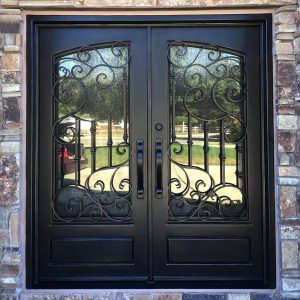
- French doors: Double doors with large glass panels, typically spanning most of the leaf height.
- Hinged pair: A technical term used in commercial specifications, referring to two operable leaves.
- Active/passive leaves: The active leaf opens regularly; the passive leaf stays fixed unless you need a wider opening. Hardware like flush bolts secures the passive leaf at top and bottom.
When you send an RFQ, specify whether you need both leaves operable or one fixed. This affects hardware, astragal type, and cost. A common mistake is assuming “double doors” means both leaves open. In many commercial projects, one leaf stays passive for security and weatherproofing.
1.2 Key Structural Components: Astragals, Flush Bolts, and Sills
Three components determine whether a double door system performs over time:
Astragal: The vertical strip that covers the meeting stile between the two leaves. It seals against air and water infiltration. Types include:
- Fixed astragal: Attached to the passive leaf, used when one leaf is inactive.
- Removable astragal: Can be detached to allow both leaves to open fully.
- Split astragal: Used when both leaves are active; each leaf carries half the seal.
Flush bolts: Vertical rods that extend into the head and sill to secure the passive leaf. They’re available in manual and automatic versions. Automatic bolts engage when the active leaf closes—a convenience feature but one more component to maintain.
Sill/threshold: The bottom transition. Options include:
- Aluminum thresholds with thermal breaks to reduce heat transfer.
- Low-profile sills that meet ADA accessibility requirements.
- Surface-mounted or flush sills depending on your weatherproofing needs.
The interaction between these three components is where most leaks and drafts occur. A quality manufacturer tests the complete assembly—not just individual parts.
1.3 Standard Size Ranges and Custom Dimensions
While sizes vary by region and manufacturer, common double door openings include:
| Opening Width | Typical Use | Notes |
|---|---|---|
| 5’0″ (1524 mm) | Residential patios | Smaller leaves, lighter hardware |
| 6’0″ (1829 mm) | Standard residential and light commercial | Most common specification |
| 8’0″ (2438 mm) | Commercial entryways | Requires heavier hinges and frames |
Standard heights are 6’8″ (2032 mm) for residential and 8’0″ (2438 mm) for commercial. However, renovation projects frequently require non-standard dimensions—an older building with an odd opening, or a design that calls for taller doors for visual impact. A capable manufacturer handles custom sizing without inflating lead times disproportionately.
2. Material Options and Performance Criteria
Direct answer: The three primary materials for side by side exterior doors are aluminum (best for large spans and high wind loads), solid wood (premium aesthetics, higher maintenance), and steel (high security, lower cost but prone to corrosion if not properly finished).
2.1 Aluminum vs. Solid Wood vs. Steel
Each material serves a different project profile. Here’s how they stack up:
| Material | U-Value Range | Wind Load Resistance | Maintenance | Relative Cost |
|---|---|---|---|---|
| Thermal-break aluminum | 1.0–2.0 W/m²K | Excellent | Low | Medium-High |
| Solid wood | 0.8–1.5 W/m²K | Good (with proper frame) | High (periodic refinishing) | High |
| Steel | 1.5–3.0 W/m²K | Good | Medium (rust risk if scratched) | Low-Medium |
Thermal-break aluminum uses polyamide strips between the interior and exterior aluminum profiles. This breaks the thermal bridge and reduces condensation. For coastal projects, aluminum’s corrosion resistance makes it the practical choice.
Solid wood delivers insulation values comparable to aluminum but requires regular staining or painting. Wood also moves with humidity changes—doors may bind in summer and gap in winter. For climate-controlled luxury villas, the aesthetic payoff justifies the maintenance.
Steel offers high security at a lower price point. But it’s heavy, which means heavier hinges and frames. And if the galvanized coating gets scratched during installation, rust follows. In salt-air environments, steel is a poor choice.
2.2 Glazing Options for Double Doors
The glass specification affects weight, thermal performance, and safety compliance:
- Insulated glass units (IGUs): Double or triple glazing with Low-E coatings to reduce heat transfer. Argon or krypton gas fills between panes for better insulation.
- Tempered glass: Required by code in most door applications. It shatters into small, blunt pieces rather than dangerous shards.
- Laminated glass: Holds together when broken. Required for hurricane-rated doors and security applications.
- Tinted glass: Reduces solar heat gain (SHGC). Useful for west-facing installations.
Glass weight matters. A 6’0″ door with 3/4″ insulated glass can weigh 150+ pounds per leaf. That requires heavy-duty hinges rated for the full weight.
2.3 Performance Testing: Air, Water, and Wind Resistance
B2B buyers should demand test reports—not generic marketing claims. The relevant standards:
- ASTM E283: Air leakage test. Measures cubic feet per minute of air passing through the assembly.
- ASTM E547: Water penetration test. Applies water at specified pressure while checking for leaks.
- ASTM E330: Wind load test. Confirms the door withstands design pressure without permanent deformation.
A door rated for a specific performance class has documented evidence. If a supplier cannot provide test reports, treat their claims as unverified. For commercial projects, your architect or local building official will likely require these documents anyway.
3. Procurement Framework for B2B Buyers
Direct answer: To evaluate a double door supplier, verify their manufacturing capability (extrusion or fabrication, not just assembly), request test reports for air-water-wind performance, confirm customization ability for non-standard sizes, and check whether they handle FCL and LCL shipments with full customs documentation.
3.1 Where Can I Find Cheap Double Exterior Doors Without Sacrificing Quality?
“Cheap” is a loaded word in procurement. Let’s define it properly: cost-effective means the lowest total cost, not the lowest unit price.
Retail distribution adds 30–50% markup. A factory-direct manufacturer eliminates that layer. But beware of prices that run 40% below market average—something is being sacrificed. Common cuts include:
- Thinner aluminum profiles (1.2 mm instead of 1.8 mm)
- Non-tempered glass that fails safety codes
- Cheaper hardware that fails after 10,000 cycles instead of 100,000
The true cost of a cheap door appears in rework, callbacks, and delays. A moderately priced door from a competent factory is almost always the better investment.
3.2 How to Evaluate a Supplier’s Manufacturing Capability
Ask these questions before placing an order:
- Do you extrude your own profiles or buy stock? In-house extrusion means better control over wall thickness and alloy composition.
- Is fabrication in-house or outsourced? Consistent quality requires controlled processes—cutting, welding, drilling, and assembly in one facility.
- What tests do you run before shipment? Air-tightness, water-tightness, and wind resistance tests should be standard, not special requests.
- Can you handle FCL and LCL shipments? If you’re ordering a container load, the factory should manage packing and loading. For smaller orders, LCL capability matters.
- Do you provide packing lists, proforma invoices, and customs documents? Missing paperwork delays shipments by weeks.
3.3 Compliance and Building Codes
Local building codes vary dramatically. A door that passes Miami-Dade hurricane requirements differs from one that meets a Minnesota energy code. The differences affect:
- Glazing: Impact-rated laminated glass for hurricane zones.
- Profile thickness: Heavier profiles for higher wind load ratings.
- Thermal performance: Lower U-values for cold climates.
A good supplier adapts its product to your market’s codes. Ask directly: “Do you test to the standards of my target market?” If the answer requires explanation, that’s a positive sign. If the answer is an immediate “yes, we comply with everything,” ask for specifics.
3.4 Key Quality Indicators for Buyers
Before committing to a supplier, inspect these details:
- Corner joints: Are they clean and sealed? Poorly sealed corners leak air and water.
- Hardware quality: Ask about the brand and cycle rating. Commercial doors need hardware rated for 100,000+ cycles.
- Weatherstripping: Check for continuous seals around the entire perimeter. Gaps at corners are a common defect.
- Finish consistency: Color should be uniform across all units, especially for large projects where doors sit side by side.
4. Color, Finish, and Aesthetic Considerations
Direct answer: For exterior double doors, choose finishes that resist UV fading and match your project’s palette. Popular choices include custom RAL powder coating, wood-grain finishes, and dark bronze anodizing—but avoid dark colors in direct sunlight, as they absorb heat and accelerate coating degradation.
4.1 What Color Door Means Your House Is Paid Off?
A red front door has long been associated with financial freedom—a tradition dating back to early American history. For B2B buyers, this matters less as folklore and more as a signal: homeowners request specific colors for emotional reasons, not just aesthetic ones.
Your supplier should offer custom powder coating in a broad range of colors (RAL or custom-matched). When a client insists on a specific shade, you shouldn’t have to compromise on finish quality to match.
4.2 What Are the Three Colors Not to Paint Your Front Door?
Designers commonly advise against:
- Flat black: Absorbs heat, causing warping and finish degradation in sun-exposed installations.
- Dark colors in direct sunlight: Same heat issue, accelerating fading and coating failure.
- Non-complementary colors: Clashes with the exterior palette, hurting resale value.
For exterior durability, specify PVDF or polyester powder coatings rather than liquid paint. These resist UV fading and chalking far better. If your project requires custom colors, ensure the supplier can match RAL codes consistently across production batches.
5. The Factory-Direct Supply Advantage
This is where the procurement theory meets manufacturing reality. As a factory-direct manufacturer of thermal-break aluminum doors and windows, our approach addresses the concerns raised above.
5.1 How We Meet the Standards You Just Read
When we say our doors pass air-tightness, water-tightness, and wind resistance tests, we mean we run those tests on every batch before shipment—not just on paper. Our pre-shipment inspection protocol includes:
- Air-tightness testing per relevant standards
- Water-tightness verification under simulated rain conditions
- Wind resistance checks for structural integrity
- Hardware function testing (hinges, locks, flush bolts)
This is our answer to the QC concerns in Section 3.2. We don’t ask you to trust our claims; we provide test reports you can review before the container leaves the factory.
5.2 Full Customization as Standard Practice
The non-standard dimensions discussed in Section 1.3? That’s our standard workflow. We customize:
- Size: Any dimension within structural limits
- Color: RAL or custom-matched powder coating
- Glass: Insulated, tempered, laminated, or Low-E options
- Hardware: Locks, hinges, handles from your specified brands or our recommended suppliers
Our OEM and ODM capabilities mean you can build your own product line without owning a factory. We produce to your specifications, under your private label if needed.
5.3 Adapting to Your Local Building Codes
Our profiles use an adjustable structure—we can modify profile thickness, glazing, and fittings to match your target market’s building codes. For a coastal project requiring higher wind load ratings, we adjust the profile gauge and specify impact-rated glazing. For a cold-climate project, we enhance the thermal break and specify higher-performance IGUs.
We also provide packing lists, proforma invoices, and full customs documentation for smooth import—eliminating the paperwork delays that plague many international orders.
6. Partnership Models and Logistics
6.1 OEM, ODM, and Bulk Supply Options
Three ways to work with us:
- OEM: You provide the specifications; we build to your exact dimensions, materials, and hardware.
- ODM: You describe the application; our engineers design the door system to meet performance targets.
- Bulk supply: For construction projects needing consistent volume across multiple units, we maintain production schedules to keep your timeline on track.
MOQs are flexible. For LCL test orders, we accommodate smaller quantities. For FCL shipments, you benefit from better per-unit pricing.
6.2 Shipping and Delivery Networks
We handle both FCL (Full Container Load) and LCL (Less than Container Load) shipments, with direct delivery from our China factory. Typical production lead time is 2–4 weeks depending on quantity and customization. Add 2–5 weeks for shipping, depending on destination and shipping method.
Documentation is included: packing list, proforma invoice, bill of lading, and any certificates required for customs clearance.
6.3 Price Competitiveness Explained
Our pricing structure is straightforward: material + fabrication + testing + logistics = your price. No middleman markup. This structural advantage means you’re not paying for a distribution network you don’t need.
When comparing quotes, use the technical framework from Section 2. Compare profile thickness, glass type, hardware quality, and test certifications—not just the bottom line. A door that fails inspection costs far more than the difference between quotes.
7. Case Study Snapshot: How a Developer Sourced Double Doors
A 20-unit villa project required 40 pairs of side by side exterior doors, each with custom dimensions and specific wind load requirements for a coastal location.
Our team provided adjustable profile specifications, produced and tested samples, then shipped FCL with full documentation. The developer received consistent quality across all 40 pairs, on schedule, with zero customs delays.
This is a repeatable process—not a one-off. Send us your specifications for a feasibility review, and we’ll confirm whether we can meet your performance targets and timeline.
8.
Frequently Asked Questions
What do you call two doors side by side?
They are commonly called double doors, French doors, or a hinged pair. In technical terms, they consist of an active leaf and an inactive leaf separated by an astragal.
Where can I find cheap double exterior doors?
“Cheap” in the B2B sense means cost-effective. Factory-direct manufacturers offer competitive pricing because there is no middleman. Always compare quotes based on material thickness, glass type, and test certifications—not just the bottom line.
What color door means your house is paid off?
Culturally, a red front door is often associated with a paid-off mortgage. For B2B purposes, this means you should choose a supplier that offers a wide range of custom powder coating colors to satisfy homeowner requests.
What are the three colors not to paint your front door?
Designers often advise against: (1) flat black (heat absorption and fading), (2) dark colors in sun-exposed areas (warping), and (3) colors that clash with the home’s exterior palette (resale value). For durability, request PVDF or polyester powder coatings.
What is the standard size for side by side exterior doors?
Common sizes are 5’0″ and 6’0″ widths with 6’8″ heights. However, custom sizes are standard practice in B2B supply—just ensure your supplier can handle non-standard dimensions.
What is the lead time for double door orders?
Typical production lead time is 2–4 weeks depending on quantity and customization. Add 2–5 weeks for shipping, depending on whether you choose LCL or FCL.
Do you provide documentation for customs clearance?
Yes. We provide packing lists, proforma invoices, and full customs documents to ensure smooth import processes for our clients.
Decision Guide
Choose a factory-direct manufacturer if:
- You need consistent quality across multiple units
- Your project requires custom sizes or finishes
- You want transparent pricing without distribution markups
- You need test documentation for code compliance
Choose a local distributor if:
- You need a single door immediately
- You prefer to inspect products in person before purchasing
- Your project is small enough that shipping costs outweigh savings
—
Sourcing side by side exterior doors comes down to three things: understanding the technical specifications, verifying supplier capability, and comparing total cost—not just unit price. The terminology, material properties, and testing standards covered here give you the framework to evaluate any supplier.
If you have a project that requires double doors, send us your specifications. We’ll confirm whether we can meet your performance targets, timeline, and budget.
References
- ASTM International. “ASTM E283 – Standard Test Method for Determining Rate of Air Leakage Through Exterior Windows, Skylights, Curtain Walls, and Doors Under Specified Pressure Differences Across the Specimen.” https://www.astm.org/e0283-19.html
- ASTM International. “ASTM E547 – Standard Test Method for Water Penetration of Exterior Windows, Skylights, Doors, and Curtain Walls by Cyclic Static Air Pressure Difference.” https://www.astm.org/e0547-00r16.html
- ASTM International. “ASTM E330 – Standard Test Method for Structural Performance of Exterior Windows, Skylights, Doors and Curtain Walls by Uniform Static Air Pressure Difference.” https://www.astm.org/e0330-14.html
- American Architectural Manufacturers Association. “AAMA/WDMA/CSA 101/I.S.2/A440 – Standard Specification for Windows, Doors, and Unit Skylights.” https://www.aamanet.org/
- U.S. Department of Energy. “Energy Efficiency of Windows, Doors, and Skylights.” https://www.energy.gov/energysaver/energy-efficiency-windows-doors-and-skylights