Last updated: November 2, 2026
Fire Doors & Life Safety · Last updated: 2 November 2026 · Jusen Doors Technical Team · Reviewed by Jusen Doors Engineering Team
Self-Closing & Latching Rules for Fire Doors (NFPA 80)
Quick answer: Fire doors protect an opening only when they return to the closed position and latch every time. NFPA 80 provides the installation, inspection and maintenance framework for fire doors and related opening protectives in North American practice, while the building code decides where assemblies are required. Select closers, coordinators, hinges and latching hardware as a listed system and inspect function—not just appearance—after installation and throughout service.
Self-closing and latching are separate functions
Self-closing means the door moves from open to closed without human help. Latching means the latch bolt positively engages so pressure and distortion do not push the leaf open during a fire. A door can swing shut yet rest against the strike without latching; that is a failed fire door in service. Testing should start from representative open positions and include the effect of seals, air pressure and any automatic door bottom.
Choose the closer from the opening, not a catalogue size
Door width, mass, stack pressure, seals and accessibility opening-force limits all affect closer power and adjustment. A closer set too weak will not latch; one set too strong can make the door difficult or unsafe to use and may accelerate hardware wear. Delayed action, backcheck and hold-open functions must be permitted for the location. Electromagnetic hold-open devices belong only where the system releases the door on alarm/power conditions required by the design.
Pairs need sequence control
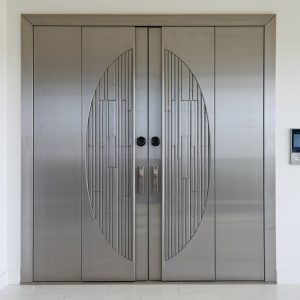
Double doors with overlapping astragals or rebated meeting stiles may need a coordinator so leaves close in the correct order. Flush bolts and automatic bolts must engage as the listed assembly requires. A pair that leaves the inactive leaf unlatched or traps the active leaf against the astragal will not perform as scheduled. Test both leaves from multiple positions and after the HVAC system is running, because pressure differential often appears only at building operation.
Field failures inspectors see repeatedly
Common defects include wedges and disconnected closers, closer arms adjusted to avoid latching, missing screws, damaged hinges, latch bolts taped back, excessive gaps, missing labels and seals painted or removed. Kick-down holders and non-approved hold-open devices are frequent operational shortcuts. Annualized inspection regimes under NFPA 80-style practice work only when defects have owners and closure evidence, not when they are copied into next year's report.
Specify hardware as an assembly
The RFQ should name leaf size/weight, closer standard and power range, latch/lock function, hinge grade, coordinator/selector, seals and threshold. Ask the supplier to confirm that all items sit within the doorset listing. For smoke locations, coordinate with NFPA 105 requirements because gasket compression can change closing force and latch reliability.
Specification checklist: what to confirm before ordering
- Destination code edition, wall type and the opening’s required fire/smoke function.
- Complete doorset configuration: leaf, frame, seals, glazing and hardware—not a leaf-only claim.
- Every scheduled size and configuration mapped to test, classification, listing or assessment scope.
- Self-closing, latching, clearances and frame fixing checked at installation.
- Labels, installation instructions and inspection records included in the handover file.
Related guides
- AS 1530.4 Fire Tests and FRL: Reading an Australian Report
- Panic Hardware Requirements: When Exit Devices Are Required
- Vision Panels in Fire Doors: Size Limits by Rating
Send the destination market, wall/opening requirements, sizes and glazing/hardware functions. We will review the configuration against the target compliance route before quotation.
Request a specification check · Browse the guide hub
FAQs
If a door closes, does it automatically latch?
No. Seals, pressure, strike alignment and closer adjustment can leave it unlatched. Inspectors should verify positive latching, not just contact with the frame.
Can a fire door be held open?
Only by an approved arrangement that releases appropriately for the fire strategy. Wedges and ordinary kick-down holders are not a solution.
Why does the closer work before handover but fail later?
Building pressure, flooring changes, seal replacement, hinge wear and user adjustments can all change closing behaviour. Periodic functional inspection catches drift.
Data note: Figures described as typical, common or planning ranges are industry budgeting ranges with the stated assumptions. Building-code duties, tested scope and final quotations depend on destination, selected construction and order schedule.