Core Conclusions: What You Need to Know About Retractable Doors
A retractable door is a door system that integrates a screen or glass panel which can be folded or pulled away when not in use. Unlike a fixed screen door, the screen portion disappears into a housing or rolls up, leaving the full doorway open when desired. This design solves the classic problem of the “always visible” screen door.
For B2B buyers—contractors, property developers, and procurement specialists—the decision is not about aesthetics alone. It is about matching the product’s mechanical characteristics to the project’s usage patterns, climate conditions, and maintenance capacity.
The three core distinctions to understand are: the retraction mechanism (rolling vs. folding), the door configuration (single vs. sliding), and whether the screen is integrated into the door frame or added as a retrofit unit. Each choice carries different implications for durability, cost, and installation complexity.
Types of Retractable Doors: Sliding, Single, and Built-In Screens
Sliding Retractable Screens
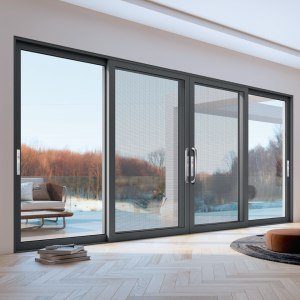
Sliding retractable screens are designed for patio doors, balcony entrances, and wide openings. The screen panel slides horizontally on a track and retracts into a side-mounted cassette when not in use.
The key advantage is the ability to cover large spans—up to several meters wide—without the weight and sagging issues common in fixed screens. The track system distributes the load evenly, and the tension mechanism keeps the screen taut.
For commercial projects, this type suits spaces where the door is used frequently and the screen must disappear completely to maintain an unobstructed view or passage. The trade-off is higher cost and more complex installation, as the track must be perfectly level to function smoothly.
Single Door Retractable Screens
A single door retractable screen is a self-contained unit that mounts to a standard single door frame, typically 24×78 inches or similar. The screen rolls down from a top-mounted cassette or pulls across from a side-mounted unit.
These units are popular for entry doors, kitchen doors, and side entrances where a full screen door would be overkill. The retractable mechanism keeps the screen out of sight when not in use, which is a significant advantage over traditional hinged screen doors that remain permanently visible.
The primary consideration here is the mechanism’s durability. Because the screen moves every time the door is used, the spring tension system and the roller bearings are the components most likely to wear out. Buyers should ask suppliers about the expected cycle life of these components and what replacement parts are available.
Built-In Screen Systems
Built-in screen systems integrate the screen directly into the door frame or the door leaf itself. This is the “door with built in screen” concept—the screen slides down from a pocket within the door, or a glass panel slides aside to reveal a screen section.
These systems are the most seamless visually but also the most expensive and complex to manufacture. They require precise machining of the door frame to accommodate the screen housing without compromising the door’s structural integrity.
Built-in systems are most appropriate for high-end residential projects or commercial spaces where design continuity is paramount. The maintenance requirement is higher because the screen mechanism is enclosed and harder to access for cleaning or repair.
Retractable Doors vs. Traditional Screen Doors: A Side-by-Side Comparison
Traditional screen doors have been the standard for decades. They are simple, inexpensive, and effective. However, they have a fundamental drawback: they are always there. A traditional screen door blocks the full view, catches wind, and requires space to swing open.
Retractable screen doors address these issues by disappearing when not needed. This difference matters in several practical ways:
Ventilation and airflow. A traditional screen door restricts the opening width. A retractable screen, when deployed, covers the full opening but when retracted, allows 100% unobstructed airflow. For spaces where cross-ventilation is critical, this is a meaningful difference.
Aesthetics and sightlines. In a commercial setting—a restaurant patio, a hotel lobby, a showroom—the visual continuity of an open doorway is valuable. A retractable screen preserves this. Traditional screen doors break the sightline.
Space requirements. Traditional screen doors need clearance to swing. In tight spaces—hallways, small entryways, balconies—this is often a problem. Retractable screens operate within the door frame itself, requiring no additional floor space.
Durability and maintenance. Traditional screen doors are exposed to the elements and physical impact at all times. Retractable screens are protected within their housing when not deployed. However, the retractable mechanism itself is a moving part that can fail. Traditional screens have fewer moving parts and are easier to repair.
Cost. Traditional screen doors are significantly cheaper to purchase and install. Retractable systems cost more upfront, but they last longer in high-traffic applications because the screen is not constantly exposed to damage.
Key Features to Evaluate: Size, Material, and Mechanism
Size and Standard Dimensions
The most common standard size for single door retractable screens is 24×78 inches. This dimension covers typical interior and exterior entry doors in both residential and light commercial construction.
However, door openings vary. Commercial projects often require wider or taller openings than residential standards. The critical question for buyers is not whether a supplier offers 24×78, but whether they can accommodate non-standard dimensions without excessive lead time or cost.
Custom sizing affects more than the screen panel itself. The housing cassette, the track length, and the tension springs must all be adjusted. A supplier that only offers standard sizes will force you to adapt your framing to their product, which adds cost to the project.
Material Selection
Aluminum is the dominant material for retractable screen housings and tracks. It is lightweight, corrosion-resistant, and can be extruded into precise profiles. For coastal environments or industrial settings, powder-coated aluminum is the standard choice.
Stainless steel hardware—springs, rollers, hinges—is essential for durability. The quality of these components determines the screen’s lifespan. Buyers should specify stainless steel for any part that comes into contact with the screen fabric or bears mechanical load.
Screen mesh comes in several grades. Standard fiberglass mesh is fine for residential use. For commercial applications, consider polyester or PVC-coated mesh, which resists tearing and maintains tension better. The mesh density affects both visibility and airflow—finer mesh blocks more insects but restricts ventilation.
Mechanism Quality
The retraction mechanism is the heart of the system. Two types dominate:
Spring-loaded roller systems use a coiled spring to retract the screen automatically. These are simple and reliable but the spring tension degrades over time. Look for systems with adjustable tension or easily replaceable spring cartridges.
Track-guided systems use a fixed track with a sliding panel. These are more robust for larger openings but require precise installation. If the track is not perfectly straight and level, the screen will bind or wear unevenly.
For motorized options, the drive system matters. A motorized retractable screen for a single door is a significant investment. The motor, the control system, and the power supply all need to be specified correctly. For commercial projects, consider whether the system will integrate with building automation systems.
Comparison Table: Retractable Door Options at a Glance
| Feature | Sliding Retractable Screen | Single Door Retractable Screen | Built-In Screen System | Traditional Screen Door |
|---|---|---|---|---|
| Best Use Case | Patio doors, wide openings | Entry doors, standard single openings | High-end residential, design-focused commercial | Budget projects, low-traffic residential |
| Opening Coverage | Up to several meters wide | Standard 24×78, custom available | Full door leaf integration | Full door leaf, fixed installation |
| Visible When Retracted | No—screen hides in side cassette | No—screen rolls into top/side housing | No—completely hidden in frame | Yes—always visible |
| Installation Complexity | Moderate—requires level track | Low—mounts to existing frame | High—requires frame integration | Low—standard hinge mounting |
| Typical Maintenance | Track cleaning, tension adjustment | Spring mechanism replacement over time | Mechanism access is difficult | Screen replacement, hinge repair |
| Relative Cost | Higher | Moderate | Highest | Lowest |
Buying Guide: How to Choose the Right Retractable Door for Your Project
Assess the Opening and Usage Pattern
Start with the physical dimensions and the frequency of use. A sliding retractable screen for a patio door that opens twenty times a day requires a heavier-duty system than a single door screen for a rarely used side entrance.
Measure the actual opening width and height. Account for the frame depth—some retractable systems require a minimum frame depth to accommodate the housing cassette. If the existing frame is too shallow, you may need to modify the framing, which adds cost.
Evaluate Climate and Environmental Factors
In coastal areas, salt air accelerates corrosion. Specify marine-grade aluminum and stainless steel hardware. In windy locations, the screen fabric must be tightly tensioned to prevent flapping and noise. Ask the supplier about wind load ratings for their screen mesh.
For energy efficiency, consider the screen’s role in the building envelope. A retractable screen does not provide insulation when retracted. When deployed, it provides some shade and airflow control but is not a thermal barrier. If energy efficiency is a priority, look for screens with reflective or UV-blocking mesh.
Understand the Cost Structure
Retractable door costs vary significantly based on size, material, and mechanism. A standard single door unit with manual operation is at the affordable end. A motorized sliding system for a wide opening is at the premium end.
For budget planning, consider the total installed cost, not just the product price. Installation labor, framing modifications, and electrical work for motorized units all add to the project cost. For large projects, request pricing for the screens in bulk—suppliers often provide volume discounts.
Installation and Maintenance Planning
Installation requirements differ by type. Single door screens are typically DIY-friendly for experienced contractors. Sliding systems require careful alignment of the track—a slight deviation will cause the screen to bind.
Maintenance is straightforward but not negligible. The tracks need periodic cleaning to remove dust and debris. The screen fabric should be cleaned with mild soap and water. The tension mechanism should be checked annually and adjusted if the screen does not retract fully.
For commercial buildings, factor in the cost of periodic maintenance contracts. A screen that fails in a tenant space creates complaints and service calls. Choosing a system with easily replaceable parts is a wise investment.
Frequently Asked Questions About Retractable Doors
Are retractable doors energy efficient?
Retractable screens provide shade and airflow control when deployed, which can reduce cooling loads in warm months. However, they are not thermal barriers like insulated glass doors. Their energy benefit is indirect—they allow natural ventilation, reducing reliance on mechanical cooling.
How long do retractable screens last?
The lifespan depends on the quality of the mechanism and the frequency of use. A well-made single door screen with stainless steel hardware can last many years with proper maintenance. The screen fabric itself may need replacement every few years in high-use applications.
Can retractable screens be installed on existing doors?
Yes. Single door retractable screens are designed as retrofit units that mount to the existing door frame. Sliding systems require more work—the track must be installed across the opening—but can also be retrofitted in most cases.
Are retractable doors secure?
A retractable screen does not provide security against forced entry. It is a screen, not a barrier. When the screen is retracted, the door operates normally. When deployed, the screen can be cut or pushed through. For security, rely on the primary door lock.
What is the difference between a retractable screen and a sliding screen door?
A sliding screen door is a fixed panel that moves on a track, always occupying part of the opening. A retractable screen rolls or folds away completely when not in use. The retractable option preserves the full opening but is more expensive and mechanically complex.
Additional Considerations: Custom Sizes, Brands, and Supplier Insights
Custom Sizes and the 24×78 Standard
The 24×78 dimension is the industry standard for single door applications. It corresponds to a typical door leaf width of 24 inches and height of 78 inches. However, this is not universal—commercial doors often use different dimensions.
When a project requires non-standard sizes, the supplier’s manufacturing flexibility becomes critical. A factory that can adjust the profile structure and fittings to match your specifications is more valuable than one that offers only fixed sizes. Custom sizing affects the housing dimensions, the screen panel width, and the tension system. Confirm the supplier’s capability and lead time for custom orders before committing.
Evaluating Suppliers and Brands
For B2B buyers, the brand name matters less than the supplier’s manufacturing capability and quality control. When evaluating suppliers, consider these criteria:
Manufacturing standards. Ask about the factory’s testing procedures. Reputable manufacturers test for air-tightness, water-tightness, and wind resistance. These tests verify that the product performs under real-world conditions.
Customization capability. Can the supplier adjust the profile structure to meet your local building codes? Building codes vary by region—wind load requirements, thermal performance standards, and safety regulations all differ. A supplier that can adapt their product to your market is a valuable partner.
Export experience. For international procurement, the supplier’s ability to handle customs documentation, provide packing lists and proforma invoices, and manage FCL or LCL shipping is essential. A factory with foreign trade experience will streamline the logistics process.
Quality control process. Inquire about the pre-shipment inspection process. A supplier that conducts rigorous inspections before shipping reduces the risk of receiving defective products.
How We Meet These Standards
As a manufacturer of doors and windows, our approach to retractable doors is built around the specific needs of B2B buyers. We operate a direct-from-factory model, which means the price you see reflects the manufacturing cost, not a middleman’s markup. This is particularly relevant for large projects where the screen quantity multiplies the price difference.
Our customization capabilities cover size, color, glass, and hardware accessories. If your project requires a non-standard opening or a specific finish to match your building’s aesthetic, we can adjust the profile structure and fittings accordingly. This flexibility extends to meeting local building codes—we adjust our product to your market’s requirements rather than forcing you to adapt to a fixed design.
Quality control is built into our process. Before shipment, each unit undergoes testing for air-tightness, water-tightness, and wind resistance. This ensures that the retractable screens you receive perform as specified, reducing the risk of field failures and callbacks.
For logistics, we handle both FCL and LCL shipments and provide full customs documentation. Our foreign trade experience means the paperwork is managed correctly, minimizing delays at the port.
If you are evaluating suppliers for a project that requires retractable doors, contact our team to discuss your specifications. We can provide detailed product information and pricing for your specific requirements.