Prehung Wood Interior Doors: The Core Specification Decision
A prehung wood interior door is a factory-assembled unit: the door slab is mounted on a jamb with hinges set, and the lock bore and latch plate are already machined. It arrives at the site ready to be leveled, shimmed, and fixed into the rough opening. That single definition is the reason prehung units dominate project procurement — the factory, not the installer, controls the critical tolerances of hinge alignment, bore position, and jamb squareness.
For a B2B buyer, the comparison decision comes down to five specification layers, each with its own cost and performance consequences:
- Wood species — determines grain character, hardness, movement under humidity change, and finishing behavior.
- Core construction — solid core, engineered, or flush; drives weight, sound transmission, and stability.
- Panel configuration — 2-panel, 6-panel, flush, glass-insert, or double-door sets; drives both aesthetics and unit cost.
- Finish — stained, natural, or unfinished; affects site labor, lead time, and color consistency across a batch.
- Customization scope — size, glazing, hardware prep, and OEM/ODM capability; determines whether a supplier can match a project’s actual opening schedule.
The rest of this guide works through each layer in the order a specification is normally built, then compares the resulting options side by side.
Wood Species and Construction: Mahogany, Natural Wood, and Engineered Options
Species comparison: mahogany vs oak vs pine vs engineered alternatives
Species choice is not primarily about appearance. It is about how the door behaves in the humidity environment of the finished building and how much abuse the surface will take.
Mahogany is a dense, fine-grained hardwood with a deep, even color that takes stain predictably. Its dimensional stability under humidity swings is one of its main attractions for interior mahogany doors in climate-controlled buildings, and its tight grain machines cleanly, which matters for the sharp edges of raised panels. Mahogany interior door specifications are common in hospitality and higher-end residential projects where consistent color across many units is required. The trade-off is cost and, for buyers focused on responsible sourcing, the need to verify the species claim rather than accept a generic “mahogany” label, which is sometimes applied loosely to unrelated species.
Oak — red or white — is harder and more dent-resistant than mahogany in most grades, with a pronounced open grain that shows clearly under a natural or light stain. It is a frequent choice for modern wood interior doors with a visible, textural surface. Oak moves more than mahogany with moisture change, so it rewards controlled site conditions and proper sealing on all six faces of the slab.
Pine is soft, light, and inexpensive. It dents and marks more readily, and its movement is significant, but it is easy to work and finishes to a clean, uniform painted or lightly stained surface. For painted doors in lower-traffic interiors, pine remains a rational specification.
Engineered alternatives — MDF with a wood veneer, or a composite core skinned with veneer — remove most of the natural movement problem because the substrate is dimensionally stable. The visible surface is real wood veneer, so the door reads as natural wood while the core behaves predictably. The limitation is that a thin veneer can be sanded through, so refinishing depth is limited compared with a solid species.
A practical rule for species selection: choose by environment first, appearance second. Interior natural wood doors in a building with wide seasonal humidity swings behave very differently from the same species in a conditioned space, and the species with better stability will hold alignment longer.
Construction types: solid core, engineered, flush, and hollow core
Core construction is the specification most often under-specified in early project stages, and the one most likely to generate complaints after handover.
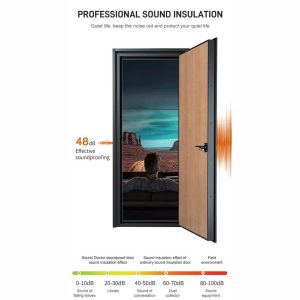
Solid core doors use a solid wood or dense particle core. They feel substantial, resist impact, and reduce sound transmission between rooms — a real consideration for bedrooms, offices, and hotel corridors. They are heavier, which affects hinge specification and handling on site.
Engineered core doors use a stable composite core, often with a solid wood stile and rail frame and a veneered face. They deliver much of the solid-core feel with better dimensional stability and lower weight, and they are the standard choice for interior flush wood doors in commercial fit-outs.
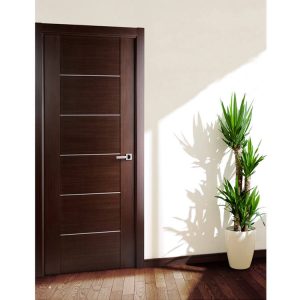
Flush doors present a flat, uninterrupted face with no panel detailing. An interior flush door suits contemporary interiors and is straightforward to specify in volume, but it offers less visual interest and hides nothing — surface flatness and veneer matching become the visible quality markers.
Hollow core doors are a lightweight honeycomb construction. They are the lowest-cost option and are acceptable for closets and low-use spaces, but they transmit sound readily, dent more easily, and are a poor match for solid-core performance expectations. Where privacy matters, hollow core is usually the wrong specification regardless of budget.
Terms buyers should know
| Term | What it means | Why it matters when buying |
|---|---|---|
| Rough opening | The framed wall opening before the door unit is installed; it must be larger than the unit | A mismatch here is the most common cause of site rework and delayed handover |
| Backset | The distance from the door edge to the center of the lock bore | Determines whether the specified lockset and latch will fit the factory prep |
| Solid core | A door with a dense, solid inner core rather than a honeycomb | Drives weight, sound reduction, impact resistance, and hinge requirements |
| Prehung | A slab already mounted on its jamb with hinges and lock prep completed | Shifts alignment and tolerance control from the site to the factory |
Panel Styles and Finishes: From 2-Panel to Flush and Glass-Insert Doors
Panel configuration
Panel style is where design intent and cost meet most visibly.
2-panel wood interior doors use two large panels, typically one above the other or side by side, giving a clean, contemporary look with relatively simple machining. They are a common choice for modern residential and hospitality interiors because the large flat areas show veneer and finish quality clearly.
6-panel wood interior doors use a traditional arrangement of small panels. The additional panel work and molding increase labor and cost, and the many edges and recesses collect finish and dust differently than a flat face. They suit traditional and transitional interiors.
Flush doors, as noted above, have no panel detail — the specification decision is about core and face veneer rather than panel geometry.
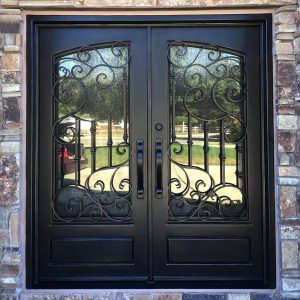
Glass-insert doors replace part of the slab with glazing. A glass wood interior door is typically specified where light transfer between rooms is wanted without opening the wall — home offices, interior partitions, and some hospitality spaces. The glazing type, safety rating, and frame detail around the insert are the items to confirm, since these affect both cost and compliance.
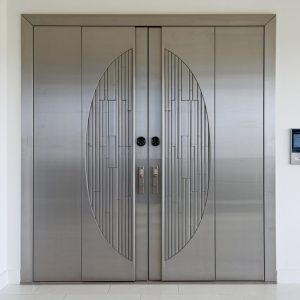
Double doors — wood interior double doors — are two coordinated leaves in one opening. The procurement risk is not the leaves themselves but the pair: they must be machined as a matched set so the meeting stiles align and the active/passive configuration works with the specified hardware.
Finish options: stained, natural, and unfinished
Finish is a project-labor decision as much as an aesthetic one.
Stained wood interior doors are factory-finished to a specified color. The advantage for volume projects is batch consistency: a factory applies the same stain and topcoat system across the whole order, which is difficult to reproduce with site finishing across multiple crews. Stain also lets a lower-cost species read closer to a premium one — within the limits of the grain.
Natural wood interior doors are finished clear or with a light, near-transparent coat that preserves the species color. This is the most demanding finish specification, because nothing hides grain mismatch or color variation between slabs. It works best when all slabs in a batch are cut from matched veneer or lumber.
Unfinished prehung wood interior doors arrive ready for site finishing. This is sometimes necessary when the finish must match existing millwork applied on site, but it introduces risk: site-applied finishes vary between crews, and unfinished doors are more vulnerable to moisture pickup and handling damage during storage. If the project can accept a factory finish, it usually removes a significant source of callbacks.
Prehung vs. Slab: Why Prehung Units Reduce Installation Risk
The prehung-versus-slab question is a tolerance question. A slab door is a flat panel; the installer must hang it, mortise the hinges, bore the lock, and align it to a jamb that may itself be out of square. Every one of those steps is a chance for misalignment, and the labor is skilled.
A prehung unit moves most of that work into a controlled factory setting. Hinges are set at consistent depths, the bore is machined to a fixed backset, and the jamb is assembled square. On site, the installer levels the unit in the opening, shims it, and fixes it — a faster operation with fewer variables.
That said, prehung is not automatically the right answer for every project. Prehung units are bulkier to ship and store, and they are less forgiving if the rough opening is significantly out of dimension, because the unit itself cannot be easily altered without affecting the factory hinge and bore geometry. Slabs can be trimmed at the edges within limits; a prehung unit’s jamb and hinge positions are fixed once assembled. Buyers should confirm the rough opening dimensions against the unit schedule before ordering, and treat any trimming of a prehung unit as a warranty-risk decision rather than a routine adjustment.
Side-by-Side Comparison: Prehung Wood Interior Door Options
The table below compares the main specification routes on the criteria that most often decide a project. It is a starting framework for specification discussions, not a substitute for confirming dimensions and compliance requirements for a specific building.
| Specification | Weight & feel | Sound reduction | Stability under humidity change | Relative cost | Typical application |
|---|---|---|---|---|---|
| Mahogany, solid core, 2-panel | Heavy, substantial | Good | High | High | Hospitality, premium residential |
| Oak, solid core, 6-panel | Heavy | Good | Moderate | Medium–high | Traditional residential, offices |
| Pine, solid core, painted | Medium | Moderate | Moderate | Medium | Painted interiors, mid-range projects |
| Engineered core, veneered flush | Medium | Moderate–good | High | Medium | Commercial fit-outs, modern interiors |
| Hollow core, any panel style | Light | Low | Moderate | Low | Closets, low-use spaces |
| Glass-insert, engineered core | Medium | Moderate | High | Medium–high | Partitions, home offices, hospitality |
| Double-door set, matched pair | Depends on core | Depends on core | Depends on core | Higher than single | Wide openings, formal interiors |
Two columns in this table deserve emphasis. Sound reduction tracks core construction far more than species — a solid-core pine door will generally outperform a hollow-core mahogany door for privacy. And stability tracks both species and core: an engineered core removes most of the movement risk that solid species carry, which is why engineered construction is common in projects with tight humidity control.
Customization and Sourcing: What B2B Buyers Should Verify
Customization scope
Custom wood interior doors are the norm in project work rather than the exception, because openings rarely match standard stock dimensions exactly. The customization dimensions a buyer should confirm before committing are:
- Size — width, height, and thickness, with the rough opening dimensions agreed in writing rather than assumed. A size guide is worth requesting from any supplier so the unit schedule and the framed openings are checked against the same reference.
- Color and finish — stain or paint match to a submitted sample, with the sample approved against the actual production batch.
- Glass — insert type, safety glazing specification, and frame detail for glass-insert models.
- Hardware prep — backset, bore diameter, hinge type and quantity, and whether the lockset is supplied or sourced locally. Hardware prep compatibility is a frequent source of site delay when the specified lockset does not match the factory bore.
- OEM/ODM — whether the supplier can produce to a buyer’s own drawings and brand, which matters for distributors and contractors supplying under their own label.
Procurement checklist
Before placing an order, a B2B buyer should be able to answer all of the following:
- Lead time — production time plus transit, quoted separately so the buyer can plan the site sequence. Custom sizes and non-standard finishes extend lead time; stock sizes do not.
- MOQ — minimum order quantity per specification. Mixed-specification orders may have a per-specification minimum rather than a single order minimum.
- Shipping — whether the order ships FCL or LCL, and how the units are packed. Prehung units are bulky and need protection at the jamb corners and slab faces; packing quality directly affects the damage rate on arrival.
- Documentation — packing list, proforma invoice, and the customs documents required by the destination market. Missing documents hold cargo at port, which is a cost that never appears in the unit price.
- Local code compliance — profile structure and fittings may need adjustment to match the building codes of the destination market. This is not a generic requirement; it is specific to the market and the building type, and it should be confirmed before production rather than after.
- Compliance items — fire-rated doors where required, formaldehyde emission limits for wood products in some markets, and accessibility clear-width requirements where applicable. These are project-specific and should be verified against the applicable local regulation, not assumed from a supplier’s general capability.
For buyers sourcing interior doors in South Carolina or other US markets, the practical implication is that documentation and code alignment matter as much as the door itself, and the supplier’s familiarity with the destination market’s requirements reduces the risk of a compliant-looking order that fails at inspection.
How one manufacturer approaches these standards
The procurement framework above is what any buyer should apply, so it is fair to describe how we meet it at Jusen Door and Windows rather than claim anything beyond the framework.
We supply prehung wood interior doors, solid wood doors, and thermal-break aluminum systems direct from our factory, which means the price reflects production rather than a chain of intermediaries. Customization is standard rather than special: size, color, glass, and hardware accessories are all specified per order, and we adjust profile structure and fittings to match the building codes of the target market. For buyers who need their own branding or drawings produced, OEM and ODM work is part of our normal output.
On quality control, every order goes through pre-shipment inspection covering air-tightness, water-tightness, and wind resistance testing, and we handle the export documentation — packing list, proforma invoice, and full customs paperwork — that keeps a shipment moving. Orders ship FCL or LCL with direct delivery from the factory. If you are building a unit schedule and want to check specifications against it, talk to our team with your opening list and finish requirements.
Frequently Asked Questions for Project Buyers
What are prehung wood interior doors and how do they differ from slab doors?
A prehung unit is a slab already mounted on its jamb, with hinges set and the lock bore machined. A slab is the door panel alone, with no jamb or hardware prep. Prehung units reduce on-site labor and alignment risk; slabs give the installer more freedom to adapt to an irregular opening but require skilled hanging and machining on site.
Which wood species is best for interior doors: mahogany, oak, or engineered wood?
There is no single best answer — it depends on the environment and the priority. Mahogany offers good stability and consistent color for premium interiors. Oak is harder and more dent-resistant but moves more with humidity. Engineered wood (a stable composite core with a veneered face) is the most dimensionally predictable and is often the strongest choice where humidity swings are a concern. Choose by environment first, appearance second.
What is the difference between solid core, engineered, and flush interior doors?
Solid core uses a dense solid inner core — heavier, better sound reduction, more impact-resistant. Engineered core uses a stable composite core, usually with a solid frame and veneered face — lighter, more stable, common in commercial fit-outs. Flush refers to the face design (flat, no panels) rather than the core, so a flush door can be built on either a solid or engineered core.
How do 2-panel and 6-panel wood interior doors compare in cost and application?
Two-panel doors have simpler machining and less panel detail, so they generally cost less and suit contemporary interiors. Six-panel doors require more panel work and molding, cost more, and suit traditional and transitional designs. The cost difference is in labor and detail rather than in the slab material itself.
Should I choose stained, natural, or unfinished prehung wood interior doors?
Choose stained when you need batch color consistency across many units — factory finishing controls this better than site work. Choose natural when the species grain and color are the design intent and you can source matched slabs. Choose unfinished only when the finish must match existing on-site millwork, and accept the added site labor and handling risk that comes with it.
Can prehung wood interior doors be customized for size, glass, and hardware?
Yes. Size, color, glass inserts, and hardware preparation are all commonly customized, and OEM/ODM production to a buyer’s own drawings is available from manufacturers set up for it. The items to lock down in writing are the rough opening dimensions, the backset and bore for the specified lockset, and the glazing specification for glass-insert models.
What should B2B buyers check before ordering prehung wood interior doors from a manufacturer?
Confirm the rough opening dimensions against the unit schedule, the core construction and species, the finish and an approved sample, hardware prep compatibility, lead time and MOQ per specification, packing method for FCL or LCL shipment, and the full set of customs documents. Also confirm whether the profile and fittings need adjustment for the destination market’s building codes, and whether any fire-rated or accessibility requirements apply to specific openings. Reviewing a supplier’s pricing structure alongside these items helps separate unit cost from total landed cost — a quote request that asks for these line items separately will give you a more useful comparison than a single lump figure.