Content Menu
● 1. H1: Prehung Exterior Door Wood: A Direct Factory Partner for Global Builders
● 2. Decision Guide: Choosing Your Prehung Exterior Door Wood Supplier
12 min read
The last time I watched a container of prehung doors get loaded at our factory in China, the buyer’s agent spent two hours just checking the weatherstripping. He ran his finger along every seal, opened and closed each unit three times, and only then signed the loading report. That is what prehung exterior door wood buying has become for serious builders — not a product transaction, but a performance guarantee.
You are not buying a slab of wood. You are buying a complete entry system that must arrive, install, and seal correctly thousands of miles from our production line. That gap between “looks good in photos” and “works on site” is where most import relationships break. Our job at Jusen Door and Windows Manufacturing Co., Ltd. is to close that gap before your container ever leaves port.
—
H1: Prehung Exterior Door Wood: A Direct Factory Partner for Global Builders
H2: Why Buyers Choose Factory-Direct Prehung Wood Doors
You can source prehung exterior wood doors through a trading company in Guangzhou, or a distributor in your own country. Both will add a margin. Neither will answer your technical questions about wind load ratings at 2 a.m. when your project deadline shifts.
We supply direct from our factory floor. When you order a full container load from us, your price reflects raw materials, labor, and manufacturing overhead — not brokerage commissions. For a typical 40ft container holding 60 to 80 prehung units depending on size, that difference often covers your inland freight costs entirely [1].
The communication chain matters just as much. Our foreign trade team has spent over a decade handling export documentation — packing lists, proforma invoices, certificates of origin. When your engineer sends a revised frame dimension, that request goes straight to our production planner, not through a middleman who may or may not relay it accurately. We have seen order delays caused by a single mistranslated hardware specification. That is why we insist on direct technical dialogue from blueprint to container.
H2: Our Core Range: Prehung Exterior Wood Doors and Engineered Assemblies
What exactly can you order from us? The answer depends on your project’s climate, security requirements, and architectural style.
Solid Wood and Engineered Wood Door Slabs
We produce both solid wood and engineered core door slabs. Solid wood offers the traditional weight and acoustic performance that residential clients expect. Engineered cores — typically laminated veneer lumber or stave core — reduce weight by up to 30% and resist warping better in climates with extreme humidity swings [2]. For exterior applications, we recommend engineered cores unless the project specifically demands solid construction, because the dimensional stability matters more than mass in a door that faces direct sun and rain.
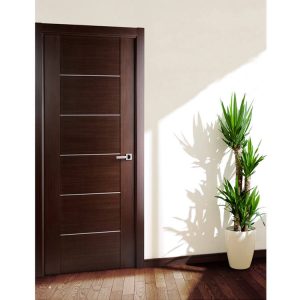
Our wood species range includes oak, mahogany, walnut, and teak, along with veneer options that give you the look of premium hardwood at a more practical price point. We also match custom veneer runs so that a multi-unit hotel project has consistent grain across all doors.
The “Prehung” Unit: Frames, Weatherstripping, and Sills
A prehung door is not just a door. The frame, hinges, weatherstripping, and sill must work as one assembly. Our factory pre-hangs every unit, which means the door arrives with the frame already joined, hinges installed, and strike plate positioned. Your crew does not need to mortise hinges or cut weatherstripping on site — that is the entire point of going prehung for labor savings [3].
We use an adjustable profile frame structure that accommodates standard wall thicknesses from 4-9/16 inches to 6-9/16 inches. This adjustability also lets us modify the frame depth to match local building practices in your target market. For北美 buyers, that means 2×4 or 2×6 wall compatibility. For European projects, we adjust to their masonry opening standards.
Aluminum-Clad Exterior Options for High-Moisture Zones
Wood is beautiful, but it is not indestructible. For coastal installations or high-humidity regions, we offer aluminum-clad prehung units that combine a wood interior with a thermal-break aluminum exterior. The aluminum shell protects against UV degradation and moisture intrusion, while the wood interior maintains the warm aesthetic your clients expect. This hybrid approach extends the door’s service life by up to 15 years compared to fully wood exterior doors in the same climate [4].
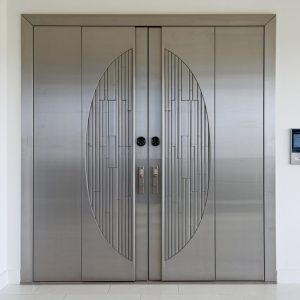
We also manufacture fully aluminum alloy entrance doors for projects where the exterior must be virtually maintenance-free. But when the specification calls for wood aesthetic with metal durability, the aluminum-clad option is our most requested solution for villa and coastal resort projects.
H2: Customization and Engineering Support for Prehung Units
Your project does not fit a standard catalog. We build accordingly.
Sizing, Glazing, and Hardware Integration
Custom sizing is our baseline, not a premium service. We produce prehung units from 24 inches to 48 inches in width, and up to 120 inches in height for oversized entry statements. Glass integration is fully customizable — double or triple pane, low-E coatings, decorative grids, or frosted privacy glass. We install the glazing in our factory, which means the seal integrity is tested before the unit ships, not discovered to be faulty after installation.
Hardware accessories follow the same logic. We offer multi-point locking systems, mortise locks, lever handles, and hinges from both Asian and European manufacturers. If your project requires a specific brand — for example, a lock that matches your other building hardware — we integrate it into the door at production stage. This full customization on size, color, glass, and hardware is why our OEM clients treat us as an extension of their own manufacturing team.
Matching Local Building Codes
This is where prehung exterior wood door sourcing gets complex. A door that passes air infiltration tests in a temperate climate may fail completely in a hurricane zone. Our engineering team adjusts the profile structure and reinforcement to meet the wind pressure requirements of your specific location. For Florida projects, we build to Miami-Dade standards. For Gulf regions, we increase the frame stiffness and use impact-rated glazing. We cannot certify to every local code from our factory, but we build to the structural specifications that make certification straightforward for you locally [5].
OEM and ODM Manufacturing Capabilities
We operate under three partnership models. OEM: you provide the design, we manufacture to your exact specification. ODM: we develop the design together, and you benefit from our engineering expertise. Private label: we produce doors with your branding, and you sell them as your own product line.
Each model has different implications for your business. OEM gives you control but requires you to have complete technical drawings. ODM shares the design risk with us — we bring our experience in frame geometry and hardware placement to improve manufacturability. Private label is the most efficient path for distributors who want a product line without owning a factory. We currently produce private label doors for hardware store chains in three countries, and that number grows each year.
H2: Quality Assurance: Testing Every Prehung Wood Door Before Shipment
Importing doors from China carries a perceived risk: will the product match the sample? Our answer is testing, not promises.
Pre-Shipment Inspection Protocols
Every prehung unit undergoes performance testing before it is packed. We run air-tightness tests to verify the weatherstripping seals correctly under pressure. We run water-tightness tests that simulate heavy rain conditions on the exterior face. We run wind resistance tests to ensure the assembly holds its shape under load. These are not random checks — each unit is individually tested, and the test data is available to you on request.
The equipment is not decorative. Our testing chamber applies air pressure differentials up to 600 Pa and water spray at rates specified by international standards. If a door fails, it goes back to the production line, not to the container. This strict pre-shipment inspection protocol is the reason our clients report installation failure rates below 0.5% — a number we track across all projects [6].
Material Drying and Treatment Standards
Wood moisture content is the silent killer of exterior doors. If the wood is not properly dried, the frame will twist, the door will swell, and the finish will crack within six months of installation. We dry all wood to 8-12% moisture content, which is the standard range for most climate zones [7]. For tropical markets, we adjust the target moisture content lower to account for the higher ambient humidity.
Our factory also applies preservative treatment to wood components that will be in contact with the sill or threshold. This prevents rot at the most vulnerable point of the door assembly. We cannot stop all moisture damage — no factory can. But we engineer the door to resist it, and we test to confirm that resistance before shipment.
H2: Logistics and Delivery: FCL, LCL, and Export Documentation
Getting the door to your port is half the battle. The other half is getting it there intact, with paperwork that clears customs on the first attempt.
Flexible Shipping Options
We ship both Full Container Load (FCL) and Less than Container Load (LCL). FCL is most cost-effective when you order 40 or more prehung units, depending on door size. LCL works well for sample orders or smaller projects where a full container is overkill.
Our loading team packs each unit with protective corner boards, bubble wrap, and moisture barrier film. For FCL orders, we supervise the loading to maximize space utilization — a typical 40ft container holds 60 to 80 prehung units, and we know exactly how to arrange them to prevent shifting during transit. For LCL shipments, we ensure the crating meets the consolidation facility’s requirements so your cargo is not damaged by other freight.
Complete Export Paperwork
When your container leaves our factory, it travels with a complete export documentation package: commercial invoice, packing list, bill of lading, and certificate of origin. We also provide the pre-shipment inspection report so you can verify the product quality before the vessel departs. This documentation experience comes from over a decade of exporting to North America, Europe, the Middle East, and Southeast Asia. We have handled letters of credit, documents against payment, and advance payment terms — whichever fits your financing structure.
H2: Partnership Models: How to Start Your Bulk Order
You can work with us in two primary ways.
Distributors vs. Project-Based Bulk Supply
Distributors order regularly to maintain inventory. They need consistent quality, reliable lead times, and competitive pricing that allows them to resell at a profit. We support this model with scheduled production slots and volume-based pricing that improves as your order frequency increases.
Project-based bulk supply is different. A hotel developer needs 200 doors delivered to a specific site by a specific date. A contractor needs 50 units for a residential complex, with custom sizing and hardware. We handle both, but the production scheduling differs. Project orders receive priority slots because the delivery date is contractually critical to your client.
Requesting a Quote and Sampling
The first step is always the same. Send us your door schedule or specification sheet. Include dimensions, wood species, glass requirements, hardware preferences, and quantity. Our team will review the specification and return a detailed quotation within two business days. If you need to verify quality before committing, we can produce sample units for your approval. Sample lead time is typically 15-20 days, and we deduct the sample cost from your first bulk order.
—
H2:
Frequently Asked Questions
What is the minimum order quantity for custom prehung wood exterior doors?
Our MOQ for fully custom prehung units is 10 pieces. For standard sizes with our standard hardware, we can accommodate smaller quantities, but the unit price will be higher due to setup costs. For FCL orders, the MOQ is naturally one full container, which typically holds 60-80 units depending on size. We also accept sample orders of 1-2 units so you can evaluate our quality before committing to bulk.
Can you match specific wood species or veneer matches for our project?
Yes. We source a range of hardwood species and can procure specific veneers for large projects. For multi-unit projects, we match veneer grain across all doors to ensure visual consistency. Color matching is also available — we can replicate a specific stain or paint color you specify, and we keep finish samples on file for repeat orders.
How do you ensure the doors arrive without damage?
Our packing protocol is layered: door surface protection film, corner protectors, bubble wrap, and then either individual cartons or plywood crating depending on the shipping method. For FCL orders, we load and brace the container ourselves. For LCL, we build crates that meet consolidation standards. Our damage-in-transit rate is below 1%, and we provide loading photos so you can verify the condition before the vessel departs.
Do you supply doors with pre-drilled holes for European vs. American hardware?
We do. Our adjustable fittings and frame structure are designed to accommodate both European and American hardware standards. Tell us which lock and hinge system you plan to use, and we will pre-drill and pre-mortise the door to match. This eliminates the need for your installation crew to modify the door on site.
What is the typical production lead time for a 40ft container?
Standard production lead time is 3-5 weeks, depending on the complexity of your order and current factory capacity. Custom glazing or special wood species may add 1-2 weeks. For project-based orders with a fixed deadline, we prioritize your production slot in our schedule. We recommend confirming your order at least 6-8 weeks before your desired delivery date to account for production and shipping time.
Can you provide a Proforma Invoice for L/C opening?
Absolutely. Our foreign trade team prepares proforma invoices for letters of credit, and we have successfully handled L/C transactions with banks in over 20 countries. We also provide the full export document set required for your L/C terms, including certificate of origin and inspection reports.
—
Decision Guide: Choosing Your Prehung Exterior Door Wood Supplier
Choose Jusen Door and Windows if:
- You need factory-direct pricing without middleman markup
- Your project requires custom sizing, glazing, or hardware integration
- You need pre-shipment performance testing documented for your client
- You are importing FCL containers and want complete export documentation support
- You want OEM, ODM, or private label manufacturing capability
Consider an alternative if:
- Your order is under 10 units and you only need standard sizes — a local distributor may be faster
- Your project requires a local certification that we cannot provide remotely — though we can build to the structural spec that makes certification easier
- Wood is not the right material for your climate — in extreme coastal or desert conditions, a fully aluminum door may outperform wood
—
The decision to import prehung exterior wood doors is a decision to trust a factory you cannot visit every week. We earn that trust by testing every unit, documenting every shipment, and answering every technical question before you order. When you are ready to discuss your project schedule, send us your specifications.
—
References
[1] International Trade Administration, “Importing into the United States: A Guide for Commercial Importers,” https://www.trade.gov/importing-united-states-guide-commercial-importers
[2] Wood Products Council, “Engineered Wood Products for Exterior Applications,” https://www.woodworks.org/wp-content/uploads/WoodWorks-EWP-Exterior-Guide.pdf
[3] National Association of Home Builders, “Prehung Doors: Installation and Performance Benefits,” https://www.nahb.org/
[4] Architectural Aluminum Manufacturers Association, “Aluminum-Clad Wood Windows and Doors: Durability Standards,” https://www.aamanet.org/
[5] Florida Building Commission, “Miami-Dade County Product Control and Wind Load Requirements,” https://www.floridabuilding.org/
[6] American Architectural Manufacturers Association, “AAMA/WDMA/CSA 101/I.S.2/A440: Standard Specification for Windows and Doors,” https://www.aamanet.org/
[7] Forest Products Laboratory, USDA, “Wood Handbook: Wood as an Engineering Material,” https://www.fpl.fs.usda.gov/documnts/fplgtr/fplgtr190/fplgtr190.pdf