Content Menu
● 1. 1. Why Visual Reference Matters in Modern Front Door Procurement
● 2. 2. Gallery: Pictures of Modern Front Doors by Material Type
● 3. 3. Pictures of Modern Front Doors by Style and Configuration
● 4. 4. Current Trends in Modern Front Doors (2025–2026)
● 5. 5. What Is the Best Front Door on the Market Right Now?
● 6. 6. How to Customize Modern Front Doors: A B2B Procurement Framework
● 7. 7. Sourcing Modern Front Doors: Factory vs. Middleman
● 8. 8. How We Meet These Standards at Jusen Door and Windows
● 9. 9.
14 min read
When an overseas buyer opens a container of front doors for the first time, the question they ask is rarely about price. It is about whether the factory can replicate the sample quality at scale. The pictures they used to communicate with the supplier—the ones with the slim black frames and the vertical glass lites—now sit beside a physical product that either matches or disappoints.
This guide exists to help you read those pictures correctly. You will learn what to look for in modern front door designs, how materials perform differently, and which technical specifications matter when you move from inspiration to purchase order.
1. Why Visual Reference Matters in Modern Front Door Procurement
Pictures of modern front doors are not just marketing material. They are the fastest communication tool between a buyer and a factory. A single image can convey profile depth, finish color, glazing style, and hardware placement—details that would otherwise require paragraphs of written specification.
1.1 The Role of Imagery in Client Approvals and Architectural Specs
Architects and builders use reference images to align client expectations with technical reality. A client may say they want a “modern door,” but that phrase means different things in Miami, Oslo, and Singapore. A picture removes ambiguity. It shows whether the door has a flush panel or a recessed one, whether the frame is 60mm or 100mm wide, and whether the glass is clear or frosted.
For B2B buyers, imagery also serves a contractual function. When a reference image is attached to an RFQ, it becomes part of the specification. The factory knows exactly what finish, profile, and configuration the buyer expects.
1.2 How to Read a Modern Front Door Picture Like a Professional
Look beyond the aesthetics. When you examine a door image, check these elements:
- Frame width: Slim frames (40–60mm visible width) indicate aluminum or steel systems. Wider frames suggest wood or composite.
- Panel configuration: Count the panels. A single full-view glass panel is the most minimalist option. Five vertical lites create a rhythm that suits transitional architecture.
- Threshold height: Low-profile thresholds (20mm or less) are a hallmark of modern design, but they require precise floor preparation.
- Hardware finish: Matte black and brushed bronze dominate current trends. The finish should match the frame color or create a deliberate contrast.
- Lighting distortion: Professional photos use soft lighting to flatter the product. A door that looks warm oak in a picture may appear greyer in daylight. Always request material swatches alongside images.
1.3 From Picture to Purchase Order: The B2B Workflow
The professional workflow follows a clear sequence:
- Reference image — collect pictures that match your architectural intent.
- Technical drawing — the factory converts the image into a dimensioned drawing.
- Material selection — choose the frame material, glass type, and finish.
- Sample approval — order a sample or review a cross-section drawing.
- Bulk order — place the production order with confirmed specifications.
Buyers who skip step 4 often face surprises. A picture cannot show you the quality of the thermal break or the thickness of the aluminum profile. Those details only appear in cross-section drawings and material specifications.
2. Gallery: Pictures of Modern Front Doors by Material Type
2.1 Aluminum Alloy Modern Front Doors (Thermal Break)
Aluminum doors dominate the modern segment for one reason: they make the slimmest sightlines possible while maintaining structural integrity. A thermal break—a polyamide strip between the interior and exterior aluminum layers—prevents cold transfer and condensation.
Visual characteristics: sharp geometry, industrial-modern aesthetic, powder-coated finishes in matte black, bronze, or anthracite grey.
Design examples:
- Full-glass aluminum entry doors with minimal frames
- Aluminum-clad wood hybrids (aluminum outside, wood inside)
- Doors with vertical glass lites and concealed hinges
Sub-trend — Leptos Single Vertical Lite Exterior Door (1-3/4″): A single narrow glass lite positioned off-center creates a vertical emphasis that draws the eye upward. The 1-3/4″ (44mm) door thickness is the industry standard for exterior doors, accommodating standard hinges and locksets. This design works well in contemporary townhouses where a full glass panel would compromise privacy.
Technical note: Thermal break aluminum profiles typically achieve U-values between 1.8 and 2.8 W/m²K, depending on profile depth and glazing. For passive house projects, look for U-values below 1.0 W/m²K, which requires triple glazing and a broader profile (80mm or more).
2.2 Solid Wood Modern Front Doors
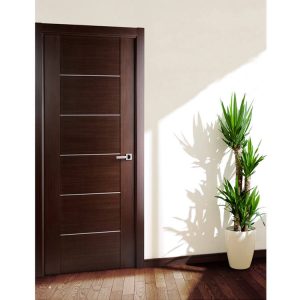
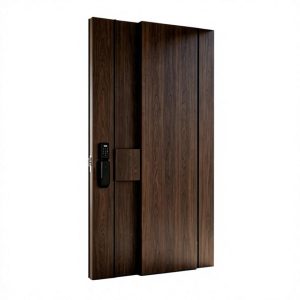
Wood remains the material of choice for buyers who want warmth and natural texture. Modern wood doors are not the ornate carved panels of previous decades. They are flush surfaces with clean lines, where the grain itself becomes the decoration.
Visual characteristics: warm texture, natural grain, hidden hinges, minimal ornamentation.
Design examples:
- Flush oak doors with concealed hinges
- Vertical multi-plank designs
- Wood doors with narrow glass side panels
Sub-trend — Multus Multi Horizontal Plank Wood Exterior Door: Horizontal plank detailing creates a contemporary rustic look that suits villa projects and coastal homes. The planks are typically 80–120mm wide, with a V-groove between them to emphasize the horizontal line. This configuration works well when paired with a dark bronze frame and clear glass sidelites.
Technical note: For exterior use, wood doors require proper moisture content (8–12% for most climates) and a durable finishing system. Look for factory-applied UV-resistant finishes or a specified on-site painting schedule. Oak and sapele are the most common species for modern exterior doors due to their dimensional stability.
2.3 Fiberglass and Composite Modern Front Doors
Fiberglass doors offer the look of wood with better dimensional stability. They do not warp, crack, or rot, and they accept paint well. The surface is typically embossed with a wood grain texture that is convincing from a distance.
Visual characteristics: wood-grain embossing, paint-ready surfaces, high dimensional stability.
Design examples:
- Fiberglass doors styled as painted wood (white, grey, black)
- Full-view 1-lite designs with wide glass panels
- French-door configurations for patio access
Sub-trend — Topa Fiberglass French Door, Exterior Grade, 1-Lite Full View: A full-view French configuration maximizes natural light while maintaining thermal performance. The 1-lite design means a single, unobstructed glass panel per door leaf. This is a strong choice for buyers in coastal regions where wood would struggle with humidity.
Technical note: Fiberglass doors are the preferred choice for high-humidity and coastal environments. The material has a similar coefficient of thermal expansion to the glass, which reduces stress on the glazing seals. This is an imperfect solution, though—fiberglass doors can feel hollow compared to solid wood, and the embossed grain pattern rarely matches real wood up close.
2.4 Steel and Mixed-Material Modern Front Doors
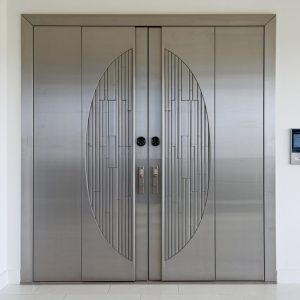
Steel doors offer the slimmest profiles and the highest security ratings. Their industrial aesthetic—sharp lines, minimal detailing, and a matte finish—suits contemporary and loft-style architecture.
Visual characteristics: industrial strength, slim profiles, mixed-material combinations.
Design examples:
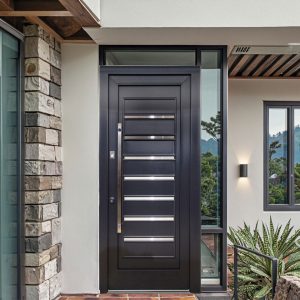
- Black steel doors with vertical glass lites
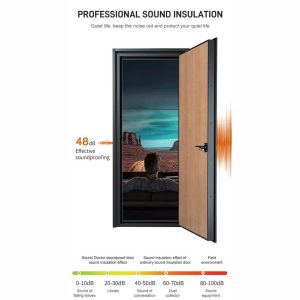
- Steel doors with wood interior faces (warmth inside, security outside)
Technical note: Steel doors conduct heat and cold readily. Unless they have a thermal break or an insulated core, they can create condensation issues in cold climates. For most residential applications, the better choice is a steel-look aluminum door—it offers the same visual effect with superior thermal performance.
3. Pictures of Modern Front Doors by Style and Configuration
3.1 Single vs. Double Modern Front Doors
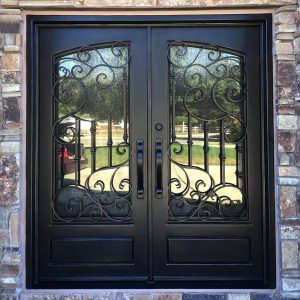
Single doors with sidelites are the most common modern configuration. They offer a wide entry statement without the cost of two active door leaves. Double doors, by contrast, make a grander statement and suit wide villa entrances or commercial ground floors.
Choose a single door with sidelites if: the opening is standard width (900–1200mm), you want to maximize wall space, or your budget is constrained.
Choose double doors if: the opening exceeds 1500mm, the architecture calls for symmetry, or you need to move large furniture or equipment through the entrance.
3.2 Full-View and Multi-Lite Glass Configurations
Glass configuration defines the visual character of a modern door more than any other element.
- 1-lite full view: a single, floor-to-ceiling glass panel. Maximum light, maximum visibility.
- 3-lite vertical: three vertical glass strips, usually with the center lite wider than the sides.
- 5-lite grid: five rectangular lites in a balanced arrangement, popular in modern farmhouse design.
Sub-trend — Quinque 5 Rectangle Lite Exterior Door (1-3/4″): Five rectangular glass lites arranged in a grid create a pattern that suits both modern farmhouse and transitional styles. The 1-3/4″ thickness maintains compatibility with standard hardware. This configuration is a strong middle ground between the minimalism of a single lite and the traditionalism of a nine-lite colonial door.
Technical note: For exterior doors, glass must be either tempered or laminated. Laminated glass offers better security (it holds together when broken) and better acoustic insulation. Low-E coatings reflect heat back to its source—useful in both hot and cold climates. Argon fill between double panes improves thermal performance by about 10% compared to air fill.
3.3 Panel and Plank Configurations
Panel configuration affects the visual weight of the door. Flush panels create a clean, minimalist look. Recessed panels add depth and shadow lines. Vertical planks draw the eye upward. Horizontal planks widen the perceived proportions.
3.4 Sidelites, Transoms, and Multi-Panel Systems
Complete entry systems—door plus sidelites plus transom—create a dramatic entrance. The transom (a glass panel above the door) can be fixed or operable. Operable transoms provide natural ventilation but require more complex hardware and sealing.
Technical note: Large glass areas require structural support. When a sidelite exceeds 800mm in width, the frame must be reinforced with steel or aluminum mullions. The glass itself should be at least 6mm thick, with 8mm or 10mm recommended for larger panels exposed to wind loads.
4. Current Trends in Modern Front Doors (2025–2026)
4.1 What Is the Current Trend in Front Doors?
The dominant trend is a move toward darker, more dramatic finishes. Matte black and dark bronze have replaced the white and beige that dominated the 2010s. These dark finishes create a strong contrast against light-colored facades and natural stone.
Slim sightlines are the second defining trend. Buyers want to see glass, not frame. This pushes manufacturers toward aluminum and steel systems with minimal visible profiles.
4.2 What Are the Trends for Front Doors in 2026?
Looking ahead, three trends will shape the market:
- Smart glass integration — electrochromic glass that changes opacity with a switch, and privacy glass that frosts on demand.
- Biophilic design — larger glass areas, natural wood tones, and doors that visually connect interior spaces to gardens and courtyards.
- Sustainability — FSC-certified wood, recycled aluminum, and low-VOC finishes. Many European markets now require environmental product declarations (EPDs) for building materials.
4.3 What Type of Front Door Is in Style?
Three styles dominate the current market:
- Modern farmhouse: black aluminum frame, wood accents, and a mix of glass and panel configurations.
- Contemporary industrial: steel-look aluminum, vertical lites, and matte finishes.
- Transitional: clean lines, minimal ornamentation, and warm neutral colors like greige and taupe.
5. What Is the Best Front Door on the Market Right Now?
There is no single best material. The right choice depends on four factors: climate, architectural style, maintenance tolerance, and budget.
| Material | Energy Efficiency (U-value) | Durability | Maintenance | Aesthetic | Cost Range |
|---|---|---|---|---|---|
| Aluminum (thermal break) | 1.8–2.8 W/m²K | Excellent | Low | Slim, industrial | $$ |
| Solid wood | 1.5–2.5 W/m²K (with core) | Good (varies by species) | High (repainting) | Warm, natural | $$$ |
| Fiberglass | 1.2–2.0 W/m²K | Excellent | Low | Wood-like | $$ |
| Steel | 2.5–4.0 W/m²K (no break) | Excellent | Medium | Slim, industrial | $–$$ |
Choose aluminum if: you want slim sightlines, low maintenance, and good thermal performance. This is the default for modern architecture.
Choose wood if: you prioritize natural aesthetics and are willing to maintain the finish every 3–5 years.
Choose fiberglass if: you are building in a high-humidity or coastal area and want the look of wood without the maintenance.
Choose steel if: security is your top priority and thermal performance is secondary.
6. How to Customize Modern Front Doors: A B2B Procurement Framework
6.1 Sizes and Configurations
Standard exterior door thickness is 1-3/4″ (44mm). Standard heights range from 2000mm to 2400mm. For non-standard openings, you must specify:
- Door leaf width and height
- Frame dimensions (depth and wall thickness)
- Threshold type (low-profile, standard, or barrier-free)
- Whether sidelites and transoms are required
6.2 Colors, Finishes, and Materials
- RAL color matching: specify the exact RAL code for the frame and door finish. Common modern choices: RAL 9005 (black), RAL 8019 (grey bronze), RAL 7016 (anthracite grey).
- Wood veneers: specify the species (oak, walnut, teak) and the cut (plain sawn, quarter sawn, or rift cut). The cut affects the grain appearance significantly.
- Anodized vs. powder-coated: anodized finishes are more durable and maintain their color better in UV exposure, but offer fewer color options. Powder coating offers unlimited RAL colors but can fade over 10+ years in direct sunlight.
6.3 Hardware and Accessories
Hardware is where budget overruns happen. Locksets, handles, hinges, and closers are specified separately from the door itself. For modern doors, the trend is toward:
- Concealed hinges (hidden when the door is closed)
- Multi-point locking systems (for security)
- Smart locks with keypad or biometric access
- Automatic closers for commercial applications
6.4 Compliance with Local Building Codes
Building codes vary by market, and a door that passes inspection in one country may fail in another. Key requirements to verify:
- Energy performance: U-value and SHGC (solar heat gain coefficient) limits by climate zone
- Wind load and impact resistance: mandatory in hurricane-prone regions like Florida, the Caribbean, and parts of Southeast Asia
- Fire rating: required for commercial and multi-unit residential buildings
- Egress requirements: the door must open outward in some jurisdictions, or meet specific width requirements
7. Sourcing Modern Front Doors: Factory vs. Middleman
7.1 The Direct-from-Factory Advantage
The price difference between buying from a factory and buying from a middleman typically ranges from 15% to 30%. The middleman’s markup covers their overhead, but it also adds a layer of communication. When a specification issue arises, the buyer talks to the middleman, who talks to the factory, who asks for clarification. Direct factory communication eliminates that delay.
7.2 What to Look for in a Manufacturing Partner
- Pre-shipment inspection protocols: ask specifically about air-tightness, water-tightness, and wind resistance testing. These are the three tests that determine whether a door will perform in real-world conditions.
- Export experience: a factory with foreign trade experience will provide proper packing lists, proforma invoices, and customs documentation. This is not a luxury—it is a requirement for smooth customs clearance.
- Logistics capability: FCL and LCL shipping options matter. A factory that can handle both can accommodate both full-container orders and smaller trial orders.
7.3 OEM vs. ODM: Which Model Fits Your Project?
OEM (Original Equipment Manufacturer): you supply the specifications and drawings; the factory manufactures to your standard. This model suits buyers who have their own brand, design team, or established specifications.
ODM (Original Design Manufacturer): the factory offers existing designs that you can brand and sell. For example, a factory may have a line of modern front doors with a unique vertical lite configuration. You choose the design, specify your color and hardware, and the factory produces it under your brand.
Choose OEM if: you have a clear specification and want a product that is uniquely yours.
Choose ODM if: you want faster turnaround and lower development costs, and the factory’s existing designs meet your market’s needs.
8. How We Meet These Standards at Jusen Door and Windows
The standards described above—slim sightlines, thermal break profiles, pre-shipment testing, and export documentation—are not theoretical. Here is how we meet them in practice.
As a manufacturing factory, we supply aluminum alloy entrance doors, thermal-break aluminum doors and windows, system windows, casement doors, sliding doors, custom villa doors and windows, sunrooms, and solid wood doors directly to B2B clients worldwide. Our production lines handle both standard configurations and fully custom specifications—size, color, glass, and hardware accessories—matching the design trends shown in the pictures above, including vertical lite, multi-plank, and full-view configurations.
Quality assurance is built into every order. Each product undergoes strict pre-shipment inspection, including air-tightness, water-tightness, and wind resistance tests, aligned with industry testing standards. These are not optional checks—they are the difference between a door that performs for twenty years and one that fails in the first storm season.
On the export side, we provide packing lists, proforma invoices, and full customs documentation. Our foreign trade experience spans multiple markets, and we understand the documentation requirements for different destinations. We ship via FCL and LCL, with direct delivery from our China factory.
For compliance, our profile structures and fittings are adjustable to match the building codes of your target market. If your project requires a specific U-value, wind load rating, or fire rating, we can adapt the profile and glazing accordingly.
9.
Frequently Asked Questions
Can I customize the size, color, and glass of a modern front door?
Yes. Customization covers dimensions (height, width, thickness), RAL colors, wood species and veneer cuts, glass types (clear, frosted, tinted, Low-E, laminated), and hardware finishes. The specification should be confirmed in writing before production begins.
How do I choose between aluminum, wood, and fiberglass for a modern front door?
Compare four factors: durability (aluminum and fiberglass win), maintenance (wood requires repainting every 3–5 years), energy efficiency (fiberglass and thermal break aluminum are best), and aesthetic fit (wood for warmth, aluminum for slim sightlines, fiberglass for wood-look without maintenance).
What is the lead time for a custom modern front door order?
Lead time varies by configuration, volume, and current production load. Standard configurations with existing tooling are faster than fully custom designs that require new molds or profiles. Discuss your timeline with the factory before placing an order.
Do you provide OEM/ODM services for front door projects?
Yes. OEM covers custom size, design, and private label manufacturing. ODM covers existing design lines that you can brand and sell. Both models support bulk supply for construction projects.
How do I verify a door supplier’s credentials?
Ask for three things: (1) pre-shipment inspection reports from a third-party agency, (2) references from buyers in your market, and (3) cross-section drawings of the profiles used. A factory that cannot provide these is a risk.
10. Conclusion
Modern front doors are defined by material innovation, minimalist geometry, and expanding glass areas. For B2B buyers, the key to success is using visual references to sharpen specifications and communicate faster with manufacturing partners.
If you are planning a project and need reliable manufacturing support, we invite you to discuss your requirements with our team. Share your reference images, your technical drawings, or your rough sketches—we will help you turn them into a specification that can be manufactured, tested, and shipped.
https://doorwoodendoors.com/contact-us/” style=”display:inline-block;padding:12px 24px;background:#2563eb;color:#fff;text-decoration:none;border-radius:6px;font-weight:600″>Get a Free Quote
—
References
- International Organization for Standardization. (2023). ISO 10077-1: Thermal performance of windows, doors and shutters. https://www.iso.org/standard/69245.html
- American Architectural Manufacturers Association. (2022). AAMA/WDMA/CSA 101/I.S.2/A440: Specifications for Windows, Doors, and Unit Skylights. https://www.aamanet.org/
- Energy Star. (2024). Windows, Doors, and Skylights: Product Criteria. https://www.energystar.gov/products/windows_doors_and_skylights
- Passive House Institute. (2023). Criteria for Passive House Certification. https://passivehouse.com/
- National Fenestration Rating Council. (2024). Certified Product Directory. https://www.nfrc.org/