Content Menu
● 1. What “Patio Door Sales Near Me” Really Means for B2B Buyers
● 2. Patio Door Product Categories You Need to Know
● 3. How Much Do Patio Doors Cost? A Procurement Framework
● 4. What Makes a Patio Door Energy-Efficient
● 5. How to Compare Patio Door Suppliers
● 6. How to Request a Quote — The RFQ Process
● 7. How We Meet These Standards
● 8. Production Process: From Raw Material to Finished Door
● 9. Quality Control: Our Multi-Stage Inspection Process
● 10. Customization and OEM/ODM Options
● 11. Ordering Process: MOQ, Lead Time, and Shipping
● 12. Certifications and Industry Standards
● 13. Questions to Ask Before Ordering
11 min read
A contractor in Ohio once told me his biggest frustration with local patio door suppliers wasn’t the price. It was the three-week wait for a simple answer about whether a non-standard opening could be accommodated. He had searched “patio door sales near me,” found a showroom twenty minutes away, and still couldn’t get a straight technical answer.
That story sums up the gap between what homeowners need and what B2B buyers actually require. When you search “patio door sales near me,” you see local showrooms and big-box retailers. But for contractors, builders, and developers, “near me” should mean “closest to the source.”
This guide walks through the entire procurement process — product categories, pricing benchmarks, quality indicators, and the exact information you need to get a fast, accurate quote. By the end, you will know how to approach suppliers, what to ask for, and how to secure pricing that matches your project’s technical and budgetary requirements.
What “Patio Door Sales Near Me” Really Means for B2B Buyers
Local listings serve homeowners well. B2B buyers need something different: volume pricing, customization capabilities, and reliable logistics. The supply chain typically looks like this: Manufacturer → Distributor → Retailer → Buyer. Each tier adds a markup that eats into project margins.
Retail supply offers limited customization and long lead times for special orders. Factory-direct supply provides competitive pricing and direct communication with engineers. For commercial projects, that difference matters.
How to Identify a Supplier That Can Handle Commercial Volume
Minimum order quantities vary significantly between factories. Some require a full container; others accommodate smaller trial orders. Ask about OEM and ODM services — a factory that offers both has in-house engineering capability, not just assembly lines.
Delivery options matter too. Can the supplier handle FCL (full container load) and LCL (less than container load)? Responsiveness to technical questions is a reliable indicator. A genuine factory answers specification questions quickly. A trading company often stalls or gives vague responses.
Why “Near Me” Should Include Global Factory Options
Direct import from a factory can save 20–40% even after shipping and duties. Local dealers often source from the same overseas factories anyway — buying direct removes the markup. Modern logistics have made factory-direct procurement straightforward for B2B buyers. Container shipping, customs brokers, and digital communication have closed the distance gap.
Patio Door Product Categories You Need to Know
Before requesting quotes, understand what you are asking for. Four main categories dominate the market.
Sliding Patio Doors
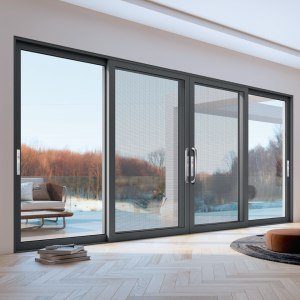
The most common configuration. Space-saving operation makes them ideal for residential patios, balconies, and commercial storefronts with wide spans. Key specs include track system quality, roller durability, glass thickness, and air-tightness ratings.
Multi-Panel and Folding Patio Doors
Also called bi-fold or accordion doors. These suit wide openings and connect indoor and outdoor spaces. Hardware load capacity and weather resistance are critical considerations. Stacking configuration affects both aesthetics and functionality.
Casement and French-Style Patio Doors
Hinged operation with a classic aesthetic. Popular in traditional architecture and villa projects. Hinge quality, multi-point locking systems, and thermal break frames determine long-term performance.
Custom and Specialty Patio Doors
Black patio doors have gained traction in modern architecture. Oversized panels, custom colors, and unique glass options (frosted, tinted, low-E) require manufacturing flexibility. If your project calls for non-standard sizes, not every supplier can deliver. Confirming customization capability early saves time.
How Much Do Patio Doors Cost? A Procurement Framework
The average cost of a new patio door depends on material, glass, hardware, and configuration. Here is a rough breakdown:
| Material | Price Range (per sq ft) | Key Characteristics |
|---|---|---|
| Vinyl/PVC | $20–$35 | Budget-friendly, good insulation, limited colors |
| Standard Aluminum | $35–$60 | Durable, slim profiles, mid-range cost |
| Thermal-Break Aluminum | $50–$90 | Excellent insulation, condensation resistance |
| Wood | $60–$100 | Premium aesthetic, higher maintenance |
| Aluminum-Clad Wood | $80–$150+ | Luxury segment, best of both materials |
Cost Drivers Beyond the Door Itself
Glass type significantly impacts price. Single glazing costs least; triple glazing with low-E coatings and argon gas fills costs most. Tempered or laminated glass adds safety but increases expense.
Hardware ranges from standard rollers to multi-point locking systems from brands like GU, Roto, or Siegenia. Finishes matter too — anodized and powder-coated options differ in durability and price. Custom RAL colors typically add a small premium.
Installation, Labor, and Regional Pricing Differences
Installation adds 20–30% to total project cost. Permits and building code compliance matter, especially in hurricane-prone or high-wind zones. Always compare “installed” quotes against “material-only” quotes. B2B buyers sourcing direct from factories often save 20–40% on product cost, which offsets installation expenses.
What Makes a Patio Door Energy-Efficient
Energy-efficient entry doors share common features. Patio doors follow the same principles at a larger scale.
Thermal Break Technology
A thermal break is a polyamide strip placed between interior and exterior aluminum profiles. It reduces heat transfer and prevents condensation. ISO 9001-certified manufacturing processes typically ensure consistent thermal break quality.
Glass and Glazing Options
Low-E (low-emissivity) coatings reflect heat while allowing light through. Argon or krypton gas fills between panes improve insulation. Two metrics matter: U-factor measures heat transfer rate; SHGC (Solar Heat Gain Coefficient) measures how much solar heat passes through. Specify both when requesting quotes.
Sealing and Air-Tightness
Multi-chamber frame designs improve structural rigidity and insulation. EPDM weatherstripping outperforms PVC gaskets in longevity. Air-tightness ratings of Class 6–8 and water-tightness ratings of Class 7–9 under EN standards indicate high performance. These specifications affect both energy bills and building code compliance.
How to Compare Patio Door Suppliers
“What is the best quality patio door brand?” is the wrong question. Brand matters less than manufacturing process, certifications, and testing standards. Many premium brands are manufactured in the same factories that supply B2B buyers directly.
Quality Certifications and Testing
Request test reports: air-tightness, water-tightness, and wind load resistance. Look for AAMA/WDMA certification (North America), CE marking (Europe), or equivalent local standards. Ask about pre-shipment inspection protocols — what the factory checks before loading your container.
Customization and Flexibility
Can the supplier match your local building codes? Do they offer adjustable profile structures for regional requirements? Color matching capabilities matter: RAL chart options, custom anodized finishes, wood-grain foil. A factory that adapts its product to your market demonstrates genuine engineering capability.
Logistics, Lead Times, and Documentation
Standard production takes 15–30 days; custom orders run 30–45 days. Shipping terms include FOB, CIF, and EXW — each shifts responsibility differently. Documentation matters: packing list, proforma invoice, full customs paperwork. A supplier with foreign trade experience simplifies customs clearance significantly.
How to Request a Quote — The RFQ Process
A professional RFQ saves everyone time. Prepare the following information before contacting suppliers:
- Project type (residential or commercial)
- Door type (sliding, folding, casement, custom)
- Quantity (number of units)
- Dimensions (width × height per opening)
- Glass specification (single/double/triple, low-E, tempered)
- Color and finish (RAL number or sample)
- Hardware preferences (brand, style, locking mechanism)
- Delivery destination (port or project site)
A professional quote includes unit price per door with FOB/CIF breakdown, MOQ requirements, production lead time, packaging details, payment terms, and sample availability.
The Value of a 24-Hour Response Commitment
Time is money on a construction site. Fast, detailed responses indicate organizational competence. If a supplier takes more than 48 hours to answer basic questions, that pattern will continue throughout your order.
How We Meet These Standards
Here is how the industry works, and how we meet those standards.
Factory-Direct Supply, No Middleman Markup
As a manufacturer, we supply directly from our factory in China. The price you receive is the factory price — no distributor or showroom markup. Our business model focuses on B2B supply: contractors, builders, and developers who need competitive pricing at volume.
Full Customization and Building Code Compliance
We offer complete customization on size, color, glass, and hardware accessories. Our engineers adjust profile structure and fittings to match local building codes in your target market. If your project requires a specific wind load rating or thermal performance, we adapt the product to meet it.
Quality Control and International Documentation
Every order passes strict pre-shipment inspection: air-tightness, water-tightness, and wind resistance tests. With years of foreign trade experience, we provide packing lists, proforma invoices, and full customs documents. We ship via FCL or LCL, direct from our factory to your port.
Ready to compare our factory-direct pricing against your current supplier? Contact our team with your project specifications and we’ll respond within 24 hours.
Production Process: From Raw Material to Finished Door
Understanding how patio doors are manufactured helps buyers evaluate supplier claims. The process begins with aluminum extrusion — billets heated to approximately 500°C and forced through dies to create profile shapes. Profile thickness typically ranges from 1.4mm to 2.0mm for structural integrity.
After extrusion, profiles undergo surface treatment. Anodizing creates a durable oxide layer; powder coating applies a baked-on finish. Both protect against corrosion and UV degradation.
Thermal break assembly follows. Polyamide strips are inserted between interior and exterior profiles, then crimped or rolled to create a mechanical bond. This step determines the door’s insulation performance.
Glass fabrication happens in parallel. Cut-to-size panes are washed, assembled into double or triple glazing units, and filled with argon or krypton gas. Low-E coatings are applied before assembly.
Final assembly brings everything together: frame fabrication, hardware installation, weatherstripping, and glazing. Each completed door undergoes functional testing — opening, closing, locking — before packaging.
Quality Control: Our Multi-Stage Inspection Process
We maintain a three-stage inspection protocol. The first stage occurs during production: dimensional checks, welding quality, and surface finish verification. The second stage happens post-assembly: air-tightness testing, water-tightness testing, and hardware functionality.
The third stage is pre-shipment inspection. Every unit is checked against the approved sample and order specifications. This includes verifying glass type, color accuracy, hardware brand, and overall workmanship. Only units that pass all checks are loaded into containers.
Customization and OEM/ODM Options
Custom patio doors require specific manufacturing capabilities. Our facility supports full customization: sizes up to 3000mm in height, RAL colors across the spectrum, glass options including tempered, laminated, low-E, and frosted finishes.
OEM and ODM services are available. OEM means we manufacture to your specifications with your branding. ODM means our engineering team designs products based on your requirements — from concept to finished product. Both models include confidential design protection.
Ordering Process: MOQ, Lead Time, and Shipping
Minimum order quantities vary by product type. Standard sliding doors typically require 20 units; custom configurations may have different requirements. Trial orders are accommodated to verify quality before committing to volume.
Production lead times run 15–30 days for standard orders and 30–45 days for custom specifications. Shipping from China to North America or Europe takes 20–35 days depending on the destination port. We provide tracking updates throughout the process.
Payment terms include T/T (telegraphic transfer) and L/C (letter of credit). A 30% deposit confirms the order; the balance is due before shipment.
Certifications and Industry Standards
Our manufacturing processes align with ISO 9001 quality management standards. Products meet CE marking requirements for the European market. For North America, we can adjust profile structures and fittings to match AAMA/WDMA specifications and local building codes.
Test reports for air-tightness, water-tightness, and wind load resistance are available upon request. These documents verify performance claims and support building permit applications.
What Is the Average Cost of a New Patio Door?
Standard aluminum sliding doors installed cost $800–$1,500. Thermal-break or custom sizes run $1,500–$3,500. B2B buyers reduce costs by 20–40% by ordering direct from the factory. The exact price depends on size, glass, hardware, and finish.
How Much Does It Cost for Home Depot to Install a Patio Door?
Home Depot installation typically ranges from $300–$800 depending on job complexity. The door itself carries retail markup. B2B buyers sourcing direct from factories save on product cost, offsetting installation expenses.
How Long Does a Custom Patio Door Order Take?
Standard production takes 15–30 days. Custom orders with special glass, colors, or hardware run 30–45 days. Shipping to North America or Europe takes 20–35 days. Plan accordingly for project timelines.
Can I Order Patio Doors in Custom Sizes and Colors?
Yes. A reliable factory offers full customization on size, color (RAL or custom), glass type, and hardware. Confirm MOQ for custom orders — some factories require minimum quantities for non-standard specifications.
Do I Need to Order a Full Container?
Both options exist. FCL is more cost-effective per unit. LCL works for smaller orders, though per-unit shipping costs run slightly higher. A good supplier provides both options with clear pricing.
Questions to Ask Before Ordering
- What are your MOQ requirements for standard and custom configurations?
- Can you provide test reports for air-tightness, water-tightness, and wind load?
- What is your production lead time for my specific order?
- Do you offer OEM and ODM services?
- What payment terms do you accept?
- Can you provide samples before bulk production?
- What documentation do you supply for customs clearance?
Avoid Suppliers Who
- Cannot answer technical specification questions directly
- Lack test reports or certifications
- Quote prices without understanding project requirements
- Have unclear MOQ or lead time policies
- Cannot provide references from similar projects
- Hesitate to offer samples or pre-production prototypes
Choose A if… Choose B if…
Choose a local showroom if you need one door immediately and installation convenience outweighs cost.
Choose a factory-direct supplier if your project requires competitive pricing at volume, custom specifications, and direct communication with engineers.
The decision comes down to project scale and technical requirements. For B2B buyers managing multiple installations, factory-direct procurement consistently delivers better margins and greater design flexibility.
Searching “patio door sales near me” does not limit you to local showrooms. For commercial projects, factory-direct procurement offers better pricing, full customization, and a direct line to the engineers who manufacture the product. Prepare your specifications, ask for detailed quotes, and expect professional responses.
References
- AAMA/WDMA/CSA 101/I.S.2/A440-17, North American Fenestration Standard/Specification for Windows, Doors, and Skylights. https://www.aamanet.org/
- EN 14351-1, European Standard for Windows and Doors — Product Standard, Performance Characteristics. https://www.cen.eu/
- ISO 9001:2015, Quality Management Systems — Requirements. https://www.iso.org/standard/62085.html
- U.S. Department of Energy, Energy-Efficient Windows. https://www.energy.gov/energysaver/energy-efficient-windows
- Efficient Windows Collaborative, U-Factor and SHGC Explained. https://www.efficientwindows.org/