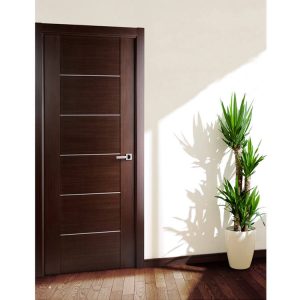
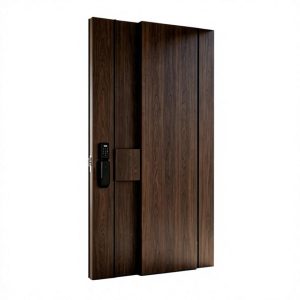
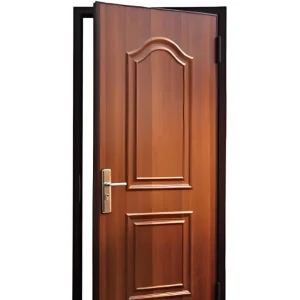
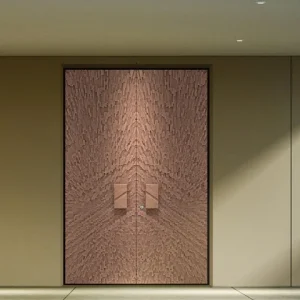
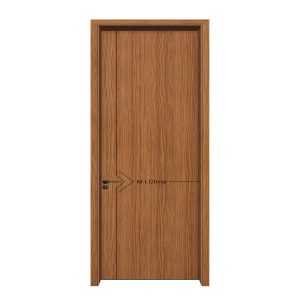
Types of Oak Internal Doors: Solid, Veneer, and Engineered
Understanding the construction differences is essential before comparing prices or aesthetics. The three main categories are often confused, and the terminology varies by supplier.
Solid Oak Doors
A solid oak door is constructed entirely from oak timber. This can mean:
- Solid stile and rail construction with oak panels (the most common method)
- Solid laminated oak where multiple oak strips are glued together to form the door slab
Solid oak doors are heavy, typically weighing more than 30 kg for a standard 1981mm x 762mm (UK door size) or 80″ x 30″ (US standard) door. They offer excellent acoustic insulation and a genuine wood feel that cannot be replicated.
The key trade-off is seasonal movement. Solid timber expands and contracts with humidity changes. A solid oak door can swell in summer and shrink in winter, which means:
- Clearances around the door must be slightly larger
- The door requires acclimatization in the room where it will be installed for at least 48–72 hours before hanging
- Warping is possible if the door is exposed to high moisture levels or central heating on one side only
Oak Veneer Doors
Oak veneer doors consist of a thin layer of real oak (typically 0.6mm to 3mm thick) bonded onto a core material. The core is usually:
- Hollow honeycomb core (lightweight, economical, common in domestic use)
- MDF or particleboard core (heavier, better screw holding, more stable)
- Engineered timber core (layered softwood or hardwood strips)
Veneer doors offer the visual appearance of oak at a fraction of the cost. Because the veneer is sliced from a single log and applied consistently, grain patterns can be matched across multiple doors—something impossible with solid oak. This makes veneer doors popular for projects requiring visual consistency across many doorways.
The main limitation is that veneer cannot be sanded or refinished. Once the veneer is damaged or worn through, it cannot be restored. Veneer thickness matters significantly here—a 0.6mm veneer is essentially a decorative skin, while a 2mm+ veneer offers some repairability.
Engineered Oak Doors
Engineered oak doors combine solid oak with an engineered core. The construction typically involves:
- A solid oak outer layer (often 3–6mm thick) on both faces
- A multi-ply or laminated timber core
- Solid oak edge lipping
This construction provides the look and feel of solid oak—including the ability to sand and refinish the surface a limited number of times—while the engineered core resists warping and twisting. Engineered oak doors are dimensionally stable and can be used in environments where solid oak would be risky, such as over underfloor heating.
The cost sits between solid and veneer doors. For many professional buyers, engineered oak represents the best balance of aesthetics, performance, and price.
Oak Door Finishes: Natural, Limed, Pale, and More
The finish on an oak door dramatically affects its appearance and how well it suits different interiors. Oak is naturally porous and light in color, but finishes can transform it completely.
Natural Oak Finish
A natural finish means the oak has been treated with a clear lacquer, oil, or wax that protects the wood without altering its color significantly. Natural oak ranges from pale honey tones to richer golden browns, depending on the oak species and whether it has been steamed (steaming darkens the timber).
Natural oak works well in:
- Scandinavian and minimalist interiors
- Traditional or cottage settings
- Spaces where you want warmth without darkening the room
The finish itself matters. Lacquered oak provides a durable, moisture-resistant surface that requires no maintenance. Oiled oak penetrates the wood, offering a more natural feel but requiring periodic re-oiling every 1–2 years in high-use areas.
Limed Oak Finish
Liming is a traditional technique where white pigment is worked into the open grain of the oak, creating a chalky, frosted appearance. The oak’s grain remains visible, but the overall tone becomes lighter and softer.
Limed oak doors suit:
- Contemporary and coastal interiors
- Shabby-chic and rustic schemes
- Rooms with limited natural light, where the pale finish helps brighten the space
Contrary to what some assume, limed oak is not a dated look. Modern liming techniques use white or light grey pigments that create a sophisticated, textured finish. Limed doors work well in contemporary spaces when paired with matte black or brushed brass hardware.
Pale Oak Finish
Pale oak refers to doors that have been treated to appear lighter than natural oak. This can be achieved through:
- White or light-grey pigmented lacquers
- Soap treatment (a Scandinavian technique)
- Selecting pale oak species or sapwood
Pale oak doors are increasingly popular in modern interiors where designers want the texture of wood without the warmth of traditional oak tones. They pair well with cool greys, blues, and white interiors.
Other Finishes to Consider
- Smoked or stained oak: Darker, richer tones achieved through smoking (ammonia treatment) or staining. Smoked oak has a distinctive dark chocolate color and suits traditional and luxury interiors.
- Brushed and oiled oak: The surface is wire-brushed to remove soft grain, creating texture, then oiled. This finish emphasizes the grain and feels tactile.
- Unfinished oak: Doors supplied without any finish, ready for site painting, staining, or oiling. This is the most economical option but requires time and skill to finish properly.
Oak Doors with Frames vs. Slab-Only: What to Buy
One of the first purchasing decisions is whether to buy doors alone (slab-only) or as a pre-hung set with frames.
Slab-Only Oak Doors
A slab-only door is just the door leaf. You must source a frame separately and have the door hung on site. This approach offers:
- Flexibility: You can match the door to an existing frame or choose a frame material independently
- Lower cost: Door slabs are cheaper than pre-hung sets
- Customization: You can cut the door to size, add panels, or modify it before hanging
The downside is that hanging a door properly requires skill. A poorly hung door—one with uneven gaps or binding hinges—will perform badly regardless of the door quality. You also need to consider the frame separately, ensuring it matches the door’s thickness and provides adequate fixing points.
Pre-Hung Oak Doors with Frames
Pre-hung sets come with the door leaf already fitted to the frame, often with hinges and latch plates installed. This option offers:
- Consistent fit: The frame and door are matched, with correct clearances already set
- Faster installation: The entire unit can be installed in one operation
- Better performance: Properly fitted frames reduce draughts and improve acoustic performance
The trade-off is cost and flexibility. Pre-hung sets are more expensive, and if your opening is non-standard, you may need custom-made frames. For renovation projects where existing frames are sound, slab-only replacement is often more practical.
Oak Pantry Doors
Pantry doors deserve specific attention because their requirements differ from standard internal doors. Pantries and utility rooms often have:
- Higher humidity levels
- Less available wall space
- The need for the door to remain open or closed reliably
For pantry applications, consider:
- Half-glazed doors: A glazed upper section allows natural light into the pantry while the solid lower section provides privacy
- Pocket or sliding doors: If wall space is limited, these save space compared to hinged doors
- Stable engineered construction: Pantries can experience temperature swings; engineered oak resists movement better than solid oak in these conditions
Comparison Table: Solid Oak vs. Oak Veneer vs. Engineered Oak
| Factor | Solid Oak | Oak Veneer | Engineered Oak |
|---|---|---|---|
| Construction | Solid timber throughout | Thin oak layer over core (hollow, MDF, or timber) | Solid oak layer over multi-ply core |
| Relative cost | Highest | Lowest | Mid-range |
| Dimensional stability | Moderate—moves with humidity | Good—core resists movement | Excellent—engineered core resists warping |
| Refinishing potential | High—can be sanded and refinished multiple times | Low—veneer thickness limits sanding | Moderate—can be refinished once or twice |
| Weight | Heavy | Light to moderate | Moderate |
| Visual consistency across multiple doors | Low—each door has unique grain | High—veneer can be matched | Moderate—solid faces vary naturally |
| Acoustic performance | Excellent | Depends on core; hollow cores are poor | Good |
| Best for | Period properties, bespoke projects, rooms needing maximum durability | Budget projects, consistent appearance, light-weight needs | Modern construction, underfloor heating, high-humidity rooms |
How to Choose the Right Oak Door for Your Project
The right oak door depends on the room, the interior style, and the performance requirements. Here is a practical framework for decision-making.
By Room and Usage
High-traffic areas (hallways, corridors, living rooms): Prioritize durability. Solid oak or engineered oak with a durable lacquered finish will withstand frequent use. Veneer doors with hollow cores can dent or sound hollow when knocked, which feels cheap in busy areas.
Bathrooms and utility rooms: Moisture resistance is critical. Engineered oak with a fully sealed finish is the safest choice. Solid oak can be used if properly finished, but the risk of movement is higher. Avoid unfinished or oiled-only doors in these spaces.
Bedrooms: Acoustic performance matters. Solid or engineered oak doors with good seals around the frame reduce noise transfer. A hollow-core veneer door will offer less sound insulation.
Pantries and storage rooms: Consider practical access. Sliding or pocket doors save space. If using a hinged door, ensure it can open fully without obstructing shelving.
By Interior Style
| Interior Style | Recommended Oak Door |
|---|---|
| Modern minimalist | Pale oak or limed oak, flush or with clean, simple lines |
| Scandinavian | Natural or pale oak, light finishes |
| Traditional/period | Solid oak with paneled designs, natural or smoked finish |
| Industrial | Dark-stained oak or smoked oak with metal detailing |
| Coastal | Limed oak or whitewashed pale oak |
| Contemporary | Engineered oak with smooth faces, clear or matte finishes |
Quality Indicators to Check
Regardless of type, inspect these quality markers before purchasing:
- Construction method: For solid doors, check whether panels are fully floating (allowing movement) or glued rigidly (which can cause cracking). For veneer doors, ask about the core material and veneer thickness.
- Veneer thickness: Ask for the actual veneer thickness in millimeters. Anything below 0.6mm is low quality and may show telegraphing (core pattern showing through) or wear quickly.
- Finish application: A factory-applied finish is generally more durable than site-applied finishes because it is cured under controlled conditions. Ask whether the finish is UV-cured, lacquered, or oiled.
- Edge treatment: Check whether edges are solid oak or veneer-wrapped. On cheaper doors, edges may be a different material that becomes visible over time.
- Moisture content: Quality manufacturers dry timber to a moisture content appropriate for internal use (typically 8–12%, but this varies by climate). Ask for documentation if possible.
- Certifications: Look for FSC or PEFC certification for sustainable timber sourcing. For fire-rated applications, check for appropriate certification (FD30 or FD60 in the UK, equivalent ratings elsewhere).
Frequently Asked Questions About Oak Doors
What is the difference between solid oak and oak veneer internal doors?
Solid oak doors are made entirely from oak timber, offering maximum durability and the ability to be refinished multiple times. Oak veneer doors have a thin layer of real oak over a core material (hollow, MDF, or timber), making them lighter and more affordable but less durable and non-refinishable. The visible surface looks similar, but the performance, weight, and longevity differ significantly.
Which oak door finish is best for a modern interior?
Pale oak and limed oak finishes are the most popular choices for modern interiors. They provide the texture and warmth of wood while keeping the palette light and airy. For a more dramatic contemporary look, smoked or dark-stained oak with matte hardware works well. The key is matching the finish to the room’s existing tones rather than following trends blindly.
Are limed oak doors suitable for contemporary spaces?
Yes. Modern liming uses white or light-grey pigments that create a textured, frosted appearance—not the heavy, chalky look of traditional liming. Limed oak doors pair well with contemporary interiors when the hardware and surrounding finishes are kept clean and minimal. They are particularly effective in coastal or Scandi-inspired schemes.
What does ‘finished oak door’ mean and why is it important?
A finished oak door has been treated at the factory with a protective coating—lacquer, oil, or paint. This is important because unfinished oak requires site finishing, which takes time and skill. Factory finishes are cured under controlled conditions, making them more durable and consistent than site-applied finishes. Buying pre-finished doors eliminates the risk of poor site finishing and allows the door to be hung immediately.
Should I buy oak doors with frames or without?
Buy pre-hung sets (with frames) for new construction or full renovations where openings are being created fresh. This ensures proper fit and performance. Buy slab-only doors when replacing existing doors in sound frames, or when you need to match a non-standard opening. Slab-only is also more economical if you have a skilled carpenter who can hang doors accurately.
How do I choose the right oak door for a pantry or utility room?
Consider the environment first. Pantries and utility rooms may have higher humidity and temperature swings. Engineered oak resists movement better than solid oak in these conditions. Choose a durable, sealed finish—lacquered is more practical than oiled for these spaces. If space is tight, consider a sliding or pocket door rather than a hinged door.
What is the best oak door option for high-traffic areas?
Solid oak or engineered oak with a durable factory-applied lacquer is the best choice for hallways, corridors, and other high-traffic areas. These constructions resist knocks and daily wear better than veneer doors. A lacquered finish provides a hard, wipeable surface that maintains its appearance with minimal maintenance. Avoid light-oiled finishes in high-traffic areas, as they show marks more readily.
Additional Considerations for Oak Internal Doors
Acclimatization Before Installation
Whatever type of oak door you choose, allow it to acclimatize to the room conditions before installation. Store doors upright in the room where they will be hung for at least 48 hours. This allows the timber to adjust to the room’s humidity and temperature, reducing the risk of movement after installation.
Measuring and Sizing
Door sizes vary by region. Standard UK internal door sizes are 1981mm x 762mm (78″ x 30″) and 1981mm x 838mm (78″ x 33″). US standard sizes are typically 80″ x 30″, 80″ x 32″, and 80″ x 36″. Always measure the actual opening, not the existing door, as frames may be out of square. Allow 2–3mm clearance on the sides and top, and 8–10mm at the bottom for floor coverings and airflow.
Seasonal Movement Expectations
Oak is a living material. Even engineered oak will move slightly with humidity changes. In winter, when central heating dries the air, doors may shrink slightly; in summer, they may swell. This is normal and not a defect. Proper clearances at installation accommodate this movement. If a door begins to bind in summer, it is often because clearances were too tight at installation.
Real-World Performance: Warping and Acoustic Insulation
The most common issue with oak doors is warping, which typically results from:
- Installing the door before it has acclimatized
- Exposing one side to moisture (e.g., a bathroom door with the shower on the other side)
- Insufficient clearance causing the door to bind and twist
Acoustic performance varies significantly by construction. Solid and engineered oak doors typically achieve better sound insulation than hollow-core veneer doors. However, the frame and seals matter as much as the door itself. A solid door with poor perimeter seals will perform worse than a lighter door with good seals.
Sustainability and Responsible Sourcing
Oak is a renewable resource, but not all oak is sustainably sourced. Look for FSC (Forest Stewardship Council) or PEFC (Programme for the Endorsement of Forest Certification) certification. These certifications verify that timber comes from responsibly managed forests. European oak is generally well-regulated; ask your supplier about the origin and certification of their timber.
Sourcing Oak Doors from a Factory: What to Look For
When sourcing oak doors for a project—whether a single renovation or a multi-unit development—the buying route matters as much as the product itself. Here is how the industry works and what to evaluate when dealing with manufacturers directly.
Factory-Direct vs. Retail
Retail suppliers add margin for warehousing, distribution, and showroom costs. Factory-direct sourcing eliminates these markups, which is why trade buyers increasingly go direct to manufacturers. The trade-off is that factory-direct requires more involvement in specification, logistics, and quality assurance on your side.
What to Evaluate in a Factory Supplier
Customization capability: Can the factory accommodate non-standard sizes, bespoke designs, or specific finishes? Many projects require doors that deviate from standard dimensions. A factory that offers full customization—size, color, glass, hardware—is more valuable than one with a fixed catalog.
Quality control procedures: Ask about pre-shipment inspection. Reputable manufacturers test for air-tightness, water-tightness, and wind resistance on doors and windows. For internal doors, check that quality control includes moisture content verification, finish inspection, and dimensional accuracy checks.
Documentation and compliance: For international sourcing, ensure the factory can provide packing lists, proforma invoices, and full customs documentation. This is essential for smooth logistics.
Shipping flexibility: Factories that handle both FCL (full container load) and LCL (less than container load) shipments offer flexibility for different order sizes. Direct delivery from the factory reduces handling and potential damage.
Adjustability to local codes: Building codes vary by market. A manufacturer that can adjust profile structures and fittings to match local building regulations saves you significant time in approvals and inspections.
How We Meet These Standards
As a factory-direct manufacturer of oak doors and architectural joinery, our approach aligns with the standards discussed above. We supply solid oak, oak veneer, and engineered oak internal doors directly from our facility, which means no middleman markup on your project.
Our customization capabilities cover size, color, glass, and hardware accessories, so you are not limited to standard catalog options. We understand that projects vary—whether you need a specific veneer match across multiple doors, a bespoke pantry door configuration, or doors pre-hung in frames to your exact dimensions.
Before every shipment, we conduct strict pre-shipment inspections covering dimensional accuracy, finish quality, and structural integrity. For international buyers, we provide complete documentation—packing lists, proforma invoices, and customs paperwork—and we handle both FCL and LCL shipments with direct delivery from our factory.
We also recognize that building codes differ across markets. Our profile structures and fittings can be adjusted to comply with local regulations, which is particularly important for commercial and multi-unit residential projects.
If you are comparing suppliers for an oak door project, contact our team to discuss your specifications.