Content Menu
● 1. Understanding Modern Wooden Doors: Types and Applications
● 2. Modern Wooden Door Trends for 2025–2026
● 3. Engineering and Performance Standards for Modern Wooden Doors
● 4. How to Evaluate Modern Wooden Doors Suppliers
● 5. Logistics, Shipping, and Documentation for Importing Wooden Doors
● 6. How a Factory-Direct Supplier Meets These Requirements
11 min read
A procurement manager for a hotel chain once told me that the hardest part of specifying wood doors is not the aesthetics. It’s proving the door will still perform after three years of coastal humidity, daily slamming, and the occasional luggage cart collision. That conversation frames what this guide covers: how modern wooden doors are built, what standards they must meet, and how a B2B buyer evaluates a factory before committing to a container order.
This is not a design inspiration piece. It is a procurement framework for architects, contractors, importers, and developers who need to specify, source, and receive modern wooden doors that meet engineering and performance requirements.
—
Understanding Modern Wooden Doors: Types and Applications
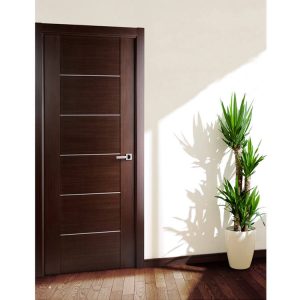
Modern wooden doors are defined by clean lines, flat panels, and minimal ornamentation—a departure from traditional raised-panel and heavily carved designs. The aesthetic draws heavily from mid-century modern principles: honest materials, simple geometry, and visual lightness [1]. Popular configurations include single vertical lite doors (one narrow glass panel), multiple rectangle lite arrangements, horizontal plank designs, and full-view glass inserts.
Direct answer: Modern wooden doors are stile-and-rail or slab-constructed doors featuring flat, minimal surfaces, often combined with glass lites and concealed hardware, designed for contemporary residential and commercial architecture.
Core Materials and Construction
The two dominant construction categories are solid hardwood and engineered wood.
| Feature | Solid Hardwood | Engineered Wood (Veneered) |
|---|---|---|
| Core | Solid timber (oak, walnut, mahogany) | MDF/HDF or particleboard core, wood veneer surface |
| Dimensional stability | Moderate; can move with humidity | High; less prone to warping |
| Cost per door (factory-direct) | $150–$400+ | $80–$200 |
| Typical applications | High-end residential, executive offices | Hospitality, multi-family, commercial |
Stile-and-rail construction—where vertical stiles and horizontal rails frame a panel—remains the standard for exterior modern wooden doors. Interior flush doors use either solid-core or hollow-core slabs. Buyers should verify wood moisture content: 6–12% for interior applications, 8–14% for exterior depending on the climate zone [2]. A door manufactured at 15% moisture content and shipped to a dry climate will crack; one manufactured at 8% and shipped to a humid region will swell and bind.
Glass and Hardware Considerations
Glass choices affect both aesthetics and thermal performance. Tempered glass is the minimum safety requirement. Laminated glass offers security and acoustic benefits. Insulated glass units (IGUs) with low-E coatings are standard for exterior modern wooden doors in cold climates, achieving U-factors between 0.25 and 0.30 when paired with proper frames [3].
Hardware defines the “modern” feel more than the wood does. Concealed hinges, minimal lever handles, and smart locks are the current standard. The weight of a solid-core door (80–120 lbs) requires three hinges, not two—a detail often missed in specification.
—
Modern Wooden Door Trends for 2025–2026
Direct answer: The leading trends for modern wooden doors in 2026 are dark matte stains (smoked oak, walnut), full-height doors (8 ft+), concealed frames, and the pairing of wood slabs with slim-profile aluminum or steel frames.
Exterior Front Door Trends
Bold, dark stains are replacing high-gloss finishes. Smoked oak, charcoal-stained walnut, and matte lacquers dominate architectural specifications. Full-height doors—8 to 10 feet tall—are now standard in luxury residential and boutique hospitality projects. The practical driver is structural: tall doors require reinforced frames and heavier hinges, which buyers must account for in hardware budgets.
Slim-profile aluminum or steel frames paired with wood slabs are increasingly common. The metal frame provides structural stability and weather resistance while the wood delivers the visual warmth. This hybrid approach addresses a known weakness of all-wood exterior doors: long-term exposure to direct sunlight and rain causes finish degradation.
Interior Door Trends
Floor-to-ceiling flush doors with hidden frames—no visible casing—are the defining interior trend. These doors sit flush with the wall and require precise drywall detailing during installation. Pivot doors are gaining traction in open-plan commercial spaces and hospitality venues because they accommodate wider openings without the hardware complexity of double doors.
Texture mixing is another direction: wood paired with black metal or brass accents in the hardware and frame. This trend works particularly well in offices and retail spaces where a purely residential look would be inappropriate.
Color and Finish Directions
Natural wood tones are displacing painted white doors in architectural specifications. The shift is driven by biophilic design principles—the desire to connect interior spaces with natural materials [4]. Smoked oak, walnut, and charcoal-stained finishes lead the palette. While no color is technically wrong, red-toned and high-gloss orange finishes are declining in preference for architectural projects. Buyers should note that dark stains require more UV protection than lighter finishes; a clear coat with UV inhibitors is recommended for exterior applications.
Performance and Sustainability Trends
FSC-certified wood and low-VOC finishes are now baseline requirements for institutional projects in North America and Europe. Acoustic-rated doors with STC ratings between 35 and 45 are specified for hotel rooms, offices, and healthcare facilities. Thermal performance for exterior doors is measured by U-factor and R-value; buyers should request NFRC-certified values rather than manufacturer claims.
—
Engineering and Performance Standards for Modern Wooden Doors
Direct answer: Modern wooden doors must meet structural, air/water/wind resistance, fire safety, and acoustic standards depending on application. Key references include WDMA I.S.2, AAMA/WDMA/CSA 101/I.S.2/A440, ASTM E152, NFPA 80, and EN 1634.
Structural Integrity
Core construction determines warp resistance. Solid-core doors (wood or particleboard) offer the highest dimensional stability. Honeycomb cores reduce weight and cost but sacrifice sound insulation and impact resistance. Foam-filled cores provide insulation and some acoustic benefit.
Industry standards reference WDMA I.S.2 for wood door performance. Buyers should request deflection data under load and verify that the door meets the specified performance class for the intended application.
Air, Water, and Wind Resistance
Exterior wooden doors must pass air-tightness, water-tightness, and wind-resistance tests. The relevant North American standard is AAMA/WDMA/CSA 101/I.S.2/A440, which classifies doors by performance grade [5]. For example, a Class 4 air permeability rating means leakage is below 0.3 L/s·m² at 300 Pa. Water tightness is rated by the pressure differential the door withstands without leakage—9A is a common target for exterior doors.
Weather-stripping and threshold design are as important as the door slab itself. A well-built door with poor seals will fail these tests. Buyers should request the actual test report, not a summary.
Fire and Safety Ratings
Fire-rated wooden door assemblies range from 20-minute to 90-minute ratings. Compliance paths vary by region: ASTM E152 and NFPA 80 in North America; EN 1634 in Europe. Fire-rated doors are not simply thicker slabs. The frame, intumescent seals, and hardware must all be certified as an assembly. A common procurement error is ordering a fire-rated door slab but non-rated hardware, which voids the assembly rating.
Acoustic Performance
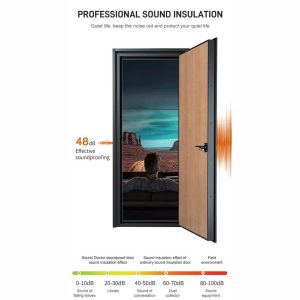
STC (Sound Transmission Class) ratings for interior doors in commercial settings typically range from 30 to 45. Heavier doors perform better, but the frame, perimeter seals, and threshold gaps matter equally. A 45 STC door installed with a 3mm undercut will perform closer to STC 30. Buyers should specify acoustic seals and automatic door bottoms for applications where speech privacy is critical.
—
How to Evaluate Modern Wooden Doors Suppliers
Direct answer: Evaluate suppliers on four axes: production capability (CNC machining, finishing lines, QC checkpoints), customization flexibility (OEM/ODM), verifiable test documentation, and pricing transparency with clear MOQs.
Factory Audit and Production Capability
Visit the factory or request a video audit. Look for CNC machining centers, veneer pressing equipment, and a dedicated finishing line with dust-controlled booths. Ask about production capacity per month and current lead times. A factory that claims 10,000 doors per month but has one finishing line is either exaggerating or compromising quality.
In-house testing capability is a positive signal. Factories that perform their own air/water/wind testing using calibrated chambers can iterate faster on prototypes. Those that rely solely on third-party labs have longer development cycles.
Customization and OEM/ODM Capabilities
OEM means the factory builds to your specification—your drawings, your hardware, your finishes. ODM means the factory designs the product and you brand it. Determine which model fits your project. For construction firms with established door specifications, OEM is typically the right choice. For importers building a product line, ODM allows faster market entry.
Request sample turnaround times and costs. A factory that cannot produce a pre-production prototype within 14–21 days will struggle with iterative development.
Quality Control and Pre-Shipment Inspection
Key inspection points: dimensional tolerance (typically ±1.5mm for width/height), finish consistency (no runs, sags, or color variation), hardware alignment, and glass seal integrity. Buyers should specify whether they want factory self-inspection or third-party inspection (SGS, TÜV, Bureau Veritas). Third-party inspection adds 2–5 days to lead time but provides independent verification.
Avoid Suppliers Who…
- Cannot provide test reports for air-tightness, water-tightness, and wind resistance
- Quote a unit price without a full specification sheet
- Have no process for dimensional inspection
- Cannot name the wood species and moisture content of their material
- Claim “no defects ever” — every factory has a defect rate; transparency matters
—
Logistics, Shipping, and Documentation for Importing Wooden Doors
Direct answer: Wooden doors ship as FCL (full container load) for bulk orders or LCL (less than container load) for samples and small projects. A 40-ft container holds 60–120 doors depending on size. Export documentation includes commercial invoice, packing list, bill of lading, and certificate of origin.
Packaging for Export
Proper packaging is plywood crates or reinforced cartons with foam corner guards and moisture-barrier wrapping. Doors are heavy and fragile—a 100 lb door dropped from a forklift will crack. Buyers should specify packaging standards in the purchase contract and photograph shipments at the factory before departure.
Shipping Modes: FCL vs. LCL
FCL is recommended for orders exceeding 20 cubic meters. Transit times from China to the US West Coast are 25–35 days; to Europe, 30–40 days. LCL is suitable for sample orders but costs more per unit and carries a higher risk of damage due to handling. For bulk orders, FCL is almost always the right choice.
Export Documentation
Key documents: Commercial Invoice, Packing List, Bill of Lading, Certificate of Origin, and Customs Declaration. Wooden doors may require phytosanitary certificates depending on the wood species and treatment (ISPM 15 for heat-treated pallets and crating). Buyers should verify that the supplier’s documentation is complete before shipment—missing paperwork at customs can delay delivery by weeks.
—
How a Factory-Direct Supplier Meets These Requirements
The sections above outline what a professional buyer should look for. Below is how one manufacturer, Jusen Door and Windows Manufacturing Co., Ltd., addresses these requirements in practice.
Direct Supply from the Factory
Jusen supplies modern wooden doors directly from its China-based manufacturing facility. There is no middleman markup because there is no middleman. This structure supports competitive pricing on bulk orders and, more importantly, direct communication between the buyer and the production team. When you have a technical question about hinge placement or finish tolerance, you talk to the people who build the doors, not a sales agent.
Full Customization and OEM/ODM Services
Customization is the core of Jusen’s production model. Size, color, glass configuration, and hardware accessories can all be specified to match project requirements. OEM and ODM services are available for brands, distributors, and construction firms that need private labeling or design-specific production.
Jusen’s adjustable profile structures and fittings can be adapted to match local building codes of target markets. For a North American project requiring fire-rated assemblies, the frame, seals, and hardware are configured to meet NFPA 80. For a European project with thermal performance requirements, the U-factor is calculated and documented.
Quality Assurance and Pre-Shipment Inspection
Every batch of modern wooden doors undergoes strict pre-shipment inspection covering air-tightness, water-tightness, and wind resistance—the same tests referenced in Section 4.2. Test documentation is available on request, and third-party inspection can be coordinated at the buyer’s expense.
Export Experience and Logistics Support
Jusen provides a packing list, proforma invoice, and full customs documentation for smooth international shipping. Both FCL and LCL shipping options are available, with direct delivery from the factory to the destination port. The foreign trade team handles the documentation so the buyer does not have to chase paperwork.
Production Process: From Raw Material to Finished Door
The production process begins with kiln-dried lumber brought to 8–12% moisture content. Boards are inspected for defects, then cut to size on CNC machining centers. Stile-and-rail joints are cut and dry-fitted before gluing. The assembled frame is pressed, sanded, and moved to the finishing line. Finishing involves multiple coats: sealer, color stain, and topcoat with UV inhibitors for exterior doors. Glass lites are installed with structural silicone, and hardware is fitted. Final inspection covers dimensions, finish consistency, and hardware function.
Customization and OEM/ODM Options
Buyers can choose from existing designs or submit their own drawings. The engineering team reviews the design for manufacturability and provides feedback within 3–5 business days. Pre-production samples are produced and shipped before bulk production begins. This process applies equally to a single prototype door and a 500-door hotel project.
Ordering Process: MOQ, Lead Time, and Shipping
Minimum order quantities for custom modern wooden doors typically range from 50 to 100 units, depending on the level of customization. Standard sizes have lower MOQs. Production lead time is 25–35 days after sample approval. Shipping adds 25–40 days depending on destination. Buyers should plan for 60–75 days total from order confirmation to arrival at port.
Certifications and Industry Standards
Jusen’s production processes align with the industry standards discussed in Section 4. Test reports for air-tightness, water-tightness, and wind resistance are available for review. Buyers requiring specific certifications—such as FSC chain-of-custody or fire ratings—should raise these requirements during the quotation phase so the engineering team can confirm feasibility and documentation.
—
Questions to Ask Before Ordering
- What is the moisture content of the wood at the time of shipment?
- Can you provide the air/water/wind test report for the specific door model?
- What is the tolerance range for width, height, and squareness?
- What is the packaging specification, and is it moisture-barrier wrapped?
- What is the defect rate for your last three production batches?
- Can you coordinate third-party inspection before shipment?
- What is the lead time for a pre-production sample?
- What documentation do you provide for customs clearance?
Choose a factory-direct supplier if you are ordering more than 50 units, need custom sizes or finishes, and want direct communication with the production team. Choose a local distributor if you need fewer than 10 doors, require immediate delivery, or have no experience with international logistics.
—
Modern wooden doors are a specification decision that affects aesthetics, performance, and the budget. The right supplier is one that can demonstrate—through test reports, production processes, and documentation—that they can deliver what they promise. A factory that opens its production floor, shares its test data, and explains its quality control process is worth more than a supplier with a polished brochure.
—
References
[1] Mid-Century Modern Design Principles — https://www.architecturaldigest.com/story/midcentury-modern-design-101
[2] Wood Moisture Content Guidelines — https://www.wood-database.com/wood-articles/moisture-content/
[3] NFRC U-Factor Ratings for Doors — https://www.nfrc.org/window-and-door-shopping-tools/
[4] Biophilic Design in Architecture — https://www.archdaily.com/tag/biophilic-design
[5] AAMA/WDMA/CSA 101/I.S.2/A440 Standard — https://www.aamanet.org/