First Section
If you are choosing a man door for a garage, warehouse, or industrial building, the decision usually comes down to two materials: steel and fiberglass. Here is the short answer: Choose steel if your priority is impact resistance, security, and the lowest upfront cost. Choose fiberglass if you need better thermal performance, corrosion resistance in harsh environments, or a door that will not dent in high-traffic pedestrian areas.
Both materials perform the core function well—providing safe pedestrian access without opening the main overhead door. But they differ meaningfully in how they handle moisture, impacts, temperature swings, and long-term maintenance. The right choice depends on your specific building conditions, not on which material is “better” in general.
This guide breaks down the differences by the criteria that actually matter in a purchase decision: durability, insulation, maintenance, cost, and code compliance. You will also find a side-by-side comparison table and practical guidance for sourcing man doors from a manufacturer.
Man Door Types Explained: Steel vs Fiberglass
A man door—sometimes called a walk door or access door—is a standard-sized pedestrian door installed either within a larger garage door panel or as a separate entry beside it. Its purpose is simple: let people enter and exit without raising the main door, which saves energy, reduces wear on the overhead door mechanism, and improves security by keeping the large opening closed.
The two dominant materials for this application are steel and fiberglass. Each has a distinct manufacturing approach and performance profile.
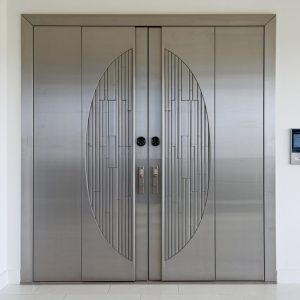
Steel man doors are typically constructed from galvanized steel sheets (usually 22 to 24 gauge) formed around a rigid frame, with a core of polyurethane foam or honeycomb material for insulation and structural stability. The exterior is usually finished with a baked-on primer and paint layer. Steel is the traditional choice for commercial and industrial applications because of its strength and low cost.
Fiberglass man doors are made from fiberglass-reinforced plastic (FRP) molded under heat and pressure into a solid door skin, often with a polyurethane foam core similar to steel doors. The fiberglass skin is inherently resistant to corrosion, never rusts, and does not dent on impact. Fiberglass doors are relatively newer to the industrial market but have gained share in coastal areas, chemical plants, and food processing facilities where moisture and washdowns are constant.
The differences between these materials affect every downstream decision you will make as a buyer, from how often you repaint to whether the door survives a forklift bump. The following sections examine each material in detail.
Steel Man Doors: Pros, Cons, and Best Use Cases
Steel man doors dominate the industrial market for good reason. They offer the highest impact resistance of any common door material, which matters in environments where carts, forklifts, or heavy equipment operate near pedestrian openings.
Durability and Security. A properly installed steel door is difficult to breach. The steel skin resists forced entry far better than fiberglass, and most steel doors can accommodate heavy-duty hardware—multi-point locks, panic bars, and reinforced hinges—without compromising the door structure. For perimeter security in warehouses or utility buildings, steel is the pragmatic default.
Moisture and Corrosion. The trade-off is corrosion. Galvanized steel resists rust, but any scratch or cut through the coating exposes the base metal. In coastal environments or facilities with frequent washdowns (food processing, car washes, marine storage), steel doors require vigilant maintenance. A small scratch left untreated can develop into rust that spreads under the paint layer.
Insulation Performance. Modern steel man doors use polyurethane foam cores that deliver respectable R-values. However, steel is a poor insulator on its own—the foam core does the work. The steel skin also conducts heat at the edges, creating a thermal bridge that reduces the door’s effective insulation value. In climate-controlled buildings, this can mean condensation on the interior surface during cold weather.
Maintenance and Repair. Steel doors are repairable. Minor dents can be filled and repainted; rust can be sanded and treated. But the repair process is labor-intensive, and if corrosion has compromised the door’s structural integrity, replacement is usually more cost-effective than repair.
Cost. Steel is typically the least expensive man door option on a first-cost basis. For large projects with many doors, the cost difference between steel and fiberglass is substantial enough to affect budget decisions.
Best use cases for steel man doors:
- Warehouses and distribution centers with moderate climate exposure
- Utility buildings, pump stations, and equipment rooms
- Perimeter security applications where forced-entry resistance is critical
- Projects with tight budgets and no corrosive environmental factors
Fiberglass Man Doors: Pros, Cons, and Best Use Cases
Fiberglass man doors address the weaknesses of steel while introducing a different set of trade-offs. The material’s defining characteristics are corrosion resistance and dimensional stability.
Corrosion Resistance. Fiberglass does not rust, rot, or corrode. This makes it the preferred choice for coastal installations, chemical storage areas, wastewater treatment plants, and any facility where the door will be exposed to salt air, harsh chemicals, or frequent pressure washing. The fiberglass skin is also impervious to insects and will not absorb moisture, eliminating the swelling and warping issues that affect wood doors.
Impact and Dent Resistance. Fiberglass is resilient rather than rigid. A steel door dented by a cart or forklift stays dented; a fiberglass door flexes on impact and returns to its original shape. This is a significant advantage in high-traffic pedestrian areas where doors are bumped regularly. However, fiberglass can crack under severe impact—a direct hit from heavy equipment can fracture the skin, and unlike steel, fiberglass repairs are difficult to make invisible.
Thermal Performance. Fiberglass naturally conducts less heat than steel, which means less thermal bridging at the door edges. Combined with a polyurethane foam core, fiberglass man doors typically achieve comparable or better R-values than steel doors of the same thickness. In climate-controlled facilities, this translates to lower energy costs and less condensation in cold weather.
Maintenance. The maintenance advantage is substantial. Fiberglass doors do not need repainting for corrosion protection. The color is molded into the material, so scratches and scuffs do not expose bare metal. A fiberglass door in a harsh environment will typically outlast a steel door by several years with significantly less maintenance labor.
Cost. Fiberglass carries a higher upfront cost than steel—typically 20% to 40% more for comparable doors, depending on size and hardware. The payback comes through reduced maintenance and longer service life, but the initial budget impact is real.
Best use cases for fiberglass man doors:
- Coastal buildings and marine environments
- Food processing, pharmaceutical, and chemical facilities
- Climate-controlled warehouses where insulation matters
- High-traffic pedestrian openings where dents would be a constant problem
Steel vs Fiberglass Man Doors: Side-by-Side Comparison Table
| Criterion | Steel Man Doors | Fiberglass Man Doors |
|---|---|---|
| Material | Galvanized steel skin (22–24 gauge) with foam core | Fiberglass-reinforced plastic skin with foam core |
| Durability | High impact resistance; dents permanently; scratches expose metal to rust | Resilient; resists dents; can crack under severe impact; never rusts |
| Insulation | Good R-value from foam core; thermal bridging at edges | Better thermal performance; lower heat conduction through skin |
| Maintenance | Requires periodic repainting and rust treatment | Minimal; no painting needed; color molded into material |
| Cost | Lower upfront cost; higher long-term maintenance | Higher upfront cost; lower lifetime maintenance |
| Moisture Resistance | Vulnerable to corrosion if coating is damaged | Fully corrosion-resistant |
| Security | Superior forced-entry resistance | Good, but less resistant to determined break-in attempts |
| Best Use | Warehouses, utility buildings, perimeter security | Coastal, food processing, chemical plants, climate-controlled facilities |
How to Choose the Right Man Door for Your Garage or Building
The decision framework below covers the factors that should drive your choice. Work through them in order, and the right material will become clear.
1. Environmental exposure. This is the most important filter. Is the door exposed to salt air, chemicals, or frequent washdowns? If yes, choose fiberglass. Is the door on a dry inland site with minimal moisture exposure? Steel will perform well and save money.
2. Impact risk. How likely is the door to be struck by equipment or heavy carts? Steel dents but holds its structural integrity; fiberglass flexes but can crack under severe impact. For areas with frequent heavy equipment traffic, steel’s dent resistance may be more valuable than fiberglass’s corrosion resistance—unless the environment demands fiberglass.
3. Insulation requirements. If the building is climate-controlled and energy costs matter, compare the R-values of specific door models rather than relying on material generalizations. A high-performance steel door with a thick foam core can outperform a thinner fiberglass door. But for equal thickness and core density, fiberglass will usually provide better thermal performance.
4. Security needs. For perimeter applications where forced entry is a concern, steel is the stronger choice. Pair it with heavy-duty hardware: multi-point locking systems, reinforced strike plates, and security hinges. If the door is interior or within a secured perimeter, fiberglass’s security limitations are less relevant.
5. Budget horizon. Calculate total cost of ownership, not just purchase price. A cheaper steel door that needs repainting every few years in a corrosive environment may cost more over a 15-year lifespan than a fiberglass door that requires no painting. For dry interior applications, steel’s lower first cost usually wins on lifetime cost.
6. Building codes and fire ratings. Man doors in commercial and industrial buildings must comply with local building codes, which may specify fire ratings, egress hardware, and accessibility requirements. Fire-rated doors must carry a label from a certified testing laboratory. Both steel and fiberglass can meet fire-rating requirements, but the specific door model must be tested and labeled for the required rating. Check with your local authority having jurisdiction (AHJ) before specifying.
7. Standard sizes and customization. Most man doors are available in standard sizes—typically 3’0″ x 6’8″ (36″ x 80″) being the most common for commercial applications. Other standard sizes include 2’8″ x 6’8″ and 3’6″ x 7’0″. If your opening is non-standard, verify that the manufacturer can produce custom dimensions without excessive lead time or cost. Both steel and fiberglass can be manufactured to custom sizes, but fiberglass may require custom molds, which can increase cost for small quantities.
Frequently Asked Questions About Man Doors
What is the difference between a man door and a personnel door?
The terms are interchangeable. “Man door” and “personnel door” both refer to a pedestrian access door installed within or beside a larger door system. Some manufacturers prefer “personnel door” for inclusivity, but there is no technical difference.
Are fiberglass man doors better for insulation?
Generally, yes—fiberglass has lower thermal conductivity than steel, reducing heat transfer at the door edges. However, the total insulation value depends on the foam core thickness and density. Compare R-values of specific models rather than relying on material alone.
What are the standard sizes for man doors?
The most common commercial size is 3’0″ x 6’8″ (36″ x 80″). Other standard sizes include 2’8″ x 6’8″ and 3’6″ x 7’0″. For industrial applications, wider doors (4’0″) are sometimes specified to accommodate equipment or wheelchairs. Always verify actual dimensions with the manufacturer, as frame sizes vary.
Can man doors be customized to fit non-standard openings?
Yes. Most manufacturers offer custom sizing, but expect longer lead times and higher costs for non-standard dimensions. For fiberglass doors, custom sizes may require new molds, which is only economical for larger quantities. Steel doors are easier to customize for single-door orders.
Which material is more durable: steel or fiberglass?
It depends on the type of durability you need. Steel is more resistant to forced entry and severe impacts. Fiberglass is more durable against corrosion, moisture, and repeated minor impacts. For a dry environment with security concerns, steel lasts longer. For a corrosive environment, fiberglass will outlast steel by a wide margin.
How do I choose between steel and fiberglass for my garage?
Start with the environment. If your garage is attached to a climate-controlled space and located away from coastal moisture, steel offers the best value. If the garage is detached, unheated, or located in a humid or coastal area, fiberglass will resist corrosion better and provide better insulation.
What should I look for in a man door manufacturer?
Evaluate the manufacturer on four criteria: quality control (test results for air-tightness, water-tightness, and wind resistance), customization capability (size, color, glass, and hardware options), experience with international shipping (documentation and packing), and the ability to adjust profiles to meet local building codes. Factory-direct manufacturers typically offer better pricing than distributors.
Additional Considerations: Customization, Sourcing, and Factory Direct Options
When you move from choosing a material to selecting a supplier, the decision criteria shift from product performance to manufacturing capability and commercial terms. For B2B buyers, the questions that matter are about quality assurance, customization, and logistics.
Quality control is the differentiator. A man door is only as good as its manufacturing process. Look for suppliers that conduct pre-shipment testing for air-tightness, water-tightness, and wind resistance. These tests verify that the door will perform as specified under real-world conditions. Without documented test results, you are relying on the manufacturer’s claims without evidence.
Customization capability matters more than you might think. Building openings are not always standard. A manufacturer that can adjust profile structures and fittings to match your local building codes—rather than forcing a one-size-fits-all product—will save you significant time in the approval process. This is particularly important for projects in regions with strict energy codes or wind-load requirements.
Factory-direct sourcing changes the cost equation. When you buy from a factory rather than a distributor, you eliminate the middleman markup. This is especially relevant for large projects where the cost difference is substantial. Factory-direct suppliers can also provide the full documentation package—packing lists, proforma invoices, and customs documents—that international buyers need.
Here is how we meet these standards. As a manufacturer of steel and fiberglass man doors, our approach is built around the requirements outlined above. We offer full customization on size, color, glass, and hardware accessories, so the door fits your opening rather than forcing you to adjust the opening to fit the door. Our pre-shipment inspection includes air-tightness, water-tightness, and wind resistance testing, and we provide the packing list, proforma invoice, and customs documentation needed for international shipments. We ship both FCL and LCL directly from our factory in China, and we adjust profile structures and fittings to match the building codes of your target market. If you are managing a construction project or need a reliable supply of man doors for multiple buildings, contact our team to discuss your specifications and get a quote.