What You Need to Know Before Buying Luxury Interior Doors
Luxury interior doors differ from standard units in three fundamental ways: material quality, construction precision, and design customization. A solid wood door with hand-finished veneer, a thermally broken aluminum frame with flush glazing, and a fire-rated composite panel all qualify as luxury—but they serve completely different project requirements.
The primary distinction buyers must understand is that “luxury” does not equal “expensive for its own sake.” It means the door is engineered to a higher performance standard—acoustic insulation, dimensional stability, fire resistance, or design integration—than a commodity interior door. Your choice should be driven by the specific demands of each room, not by a single material preference applied across the entire project.
The decision framework comes down to four variables: room function (bedroom privacy vs. public corridor durability), architectural style (modern minimalism vs. traditional detailing), performance requirements (sound transmission, fire rating, humidity exposure), and budget allocation across the total number of openings.
Exploring Luxury Interior Door Types: From Classic to Modern
Solid Wood Doors
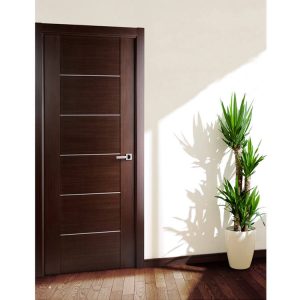
Solid wood remains the benchmark for residential luxury. The term covers two constructions: solid stile-and-rail (frame with solid panels) and solid core (veneer over engineered wood core). True solid wood doors use a single species throughout—oak, walnut, mahogany, or maple—which gives them superior acoustic mass and the ability to be refinished multiple times over their lifespan.
The trade-off is dimensional movement. Wood responds to humidity changes, which is why solid wood doors require proper acclimation before installation and consistent indoor climate control. In areas with seasonal humidity swings, veneered solid-core construction offers better stability while retaining the appearance of solid wood.
Glass and Aluminum Doors
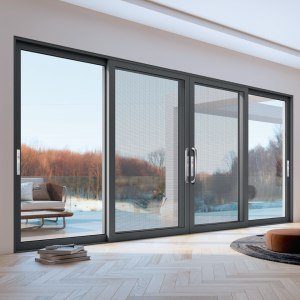
The luxury modern interior door segment has shifted toward aluminum-framed glass systems. These use thermal-break aluminum profiles—two aluminum extrusions separated by a polyamide strip—which prevents thermal transfer through the frame. This matters more than most buyers expect, even for interior applications, because it affects condensation resistance in bathrooms and temperature differentials between conditioned and unconditioned spaces.
Glass options range from clear tempered panels to frosted, textured, or switchable privacy glass. The acoustic performance depends on glass thickness and whether double-glazing is specified. A 10mm single pane provides moderate sound reduction; a 6mm + 12mm air gap + 6mm double-glazed unit performs substantially better.
Wood-Glass Combinations
For projects that need visual openness without sacrificing privacy entirely, wood-glass composite doors offer the strongest design flexibility. Full-height glazing with narrow wood stiles creates a modern look, while traditional panel doors with small glass inserts suit transitional interiors. The frame material determines the structural limit—aluminum frames support larger glass panels than wood frames of equivalent thickness.
Metal and Composite Doors
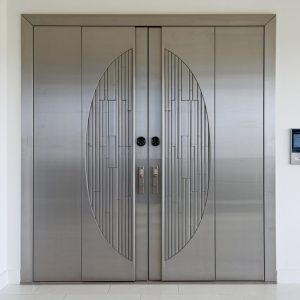
Steel and composite doors appear less frequently in residential interiors but dominate commercial and high-traffic applications. Steel doors offer the highest durability and fire ratings (up to 90 minutes when properly certified). Composite doors—typically a fiberglass or polymer skin over an insulated core—provide similar durability with better thermal performance and are available in wood-grain finishes that mimic natural timber.
Luxury Modern Interior Doors vs. Traditional Styles
The difference between modern and traditional luxury interior doors is not merely aesthetic—it reflects different engineering priorities.
Modern doors prioritize flush surfaces, hidden hardware, and minimalist profiles. A typical modern installation uses pivot hinges rather than standard butt hinges, allowing the door to swing in either direction and creating a cleaner visual line. The door itself is often floor-to-ceiling height, which requires reinforced framing and precision installation. Materials trend toward matte finishes, engineered wood with low-gloss veneers, and aluminum systems with slim sightlines.
Traditional doors emphasize raised panels, visible hinges, and decorative hardware. The construction is typically solid wood or wood veneer over a stile-and-rail frame. These doors carry more visual weight and are designed to complement moldings, wainscoting, and period architectural details. Acoustic performance is generally good due to mass, but the panel construction creates slight variations in sound insulation across the door surface.
The practical consideration for buyers is that modern luxury doors often require more careful site coordination. Floor-to-ceiling doors need exact floor leveling before fabrication. Pivot hardware requires header reinforcement. If your project timeline or site conditions cannot accommodate these tolerances, a transitional design—modern materials with traditional proportions—may be the safer specification.
Interior Decorative Doors: Balancing Aesthetics and Function
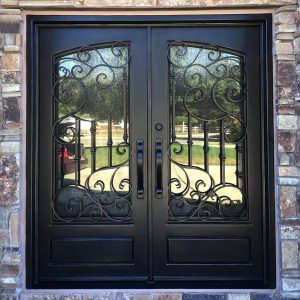
Decorative interior doors serve as architectural features rather than mere room dividers. The category includes doors with custom veneer patterns, metal inlays, backlit glass panels, and integrated lighting. These doors are typically specified for primary suites, studies, and formal entertaining spaces where the door is part of the design statement.
The engineering challenge with decorative doors is maintaining performance while accommodating design elements. A door with a large glass panel will not match the acoustic performance of a solid panel. A door with routed metal inlays needs careful moisture sealing at the junction points. When specifying decorative doors, establish the minimum acceptable performance for each opening first, then evaluate design options against that baseline.
For high-traffic decorative applications—such as a prominent corridor door in a hospitality setting—consider whether the finish can withstand repeated contact. High-gloss lacquers show fingerprints and require more maintenance than satin or matte finishes. Textured veneers hide wear better but collect dust in their grain.
Side-by-Side Comparison: Which Luxury Interior Door Fits Your Project?
| Attribute | Solid Wood | Aluminum-Glass | Wood-Glass Composite | Composite/Metal |
|---|---|---|---|---|
| Material | Natural timber (oak, walnut, mahogany) | Thermal-break aluminum + tempered glass | Wood frame + glass panels | Fiberglass skin or steel over insulated core |
| Soundproofing | Excellent (high mass) | Moderate to good (depends on glass spec) | Moderate | Good to excellent |
| Moisture Resistance | Poor without proper sealing | Excellent | Moderate | Excellent |
| Dimensional Stability | Moderate (moves with humidity) | Excellent | Good | Excellent |
| Customization | High (species, finish, panel design) | High (frame color, glass type, hardware) | Very high | Moderate (factory-set profiles) |
| Fire Rating Available | Up to 60 minutes with certification | Limited | Limited | Up to 90 minutes |
| Price Range | High | Medium-High | Medium-High | Medium |
| Best For | Bedrooms, studies, traditional interiors | Modern interiors, bathrooms, spaces needing light | Transitional designs, partial privacy | High-traffic areas, fire-rated openings |
How to Choose the Right Luxury Interior Door: A Buyer’s Guide
Room-by-Room Selection Criteria
Bedrooms and private suites: Prioritize acoustic performance and visual warmth. Solid wood or solid-core veneer doors typically achieve the best sound reduction. Specify perimeter gasketing and an automatic door bottom to close the gap between the door and floor—this gap is often the largest source of sound leakage.
Bathrooms and wet areas: Moisture resistance is the dominant factor. Aluminum-glass doors or composite doors with sealed edges perform best. If solid wood is required for design continuity, specify a factory-applied moisture-resistant finish and ensure all six sides are sealed, including the top and bottom edges.
Home offices and studies: Balance acoustic privacy with natural light. A wood-glass composite door with a lower opaque panel and upper glazing can provide both. For maximum sound isolation, a solid door with a small, sealed glass lite is preferable to a half-glazed design.
Public areas and corridors: Durability and fire safety lead. Composite or steel doors withstand daily traffic better than wood. Check local building codes for fire-rating requirements on corridor doors—many jurisdictions require 20-minute or 45-minute rated assemblies.
Performance Specifications to Verify
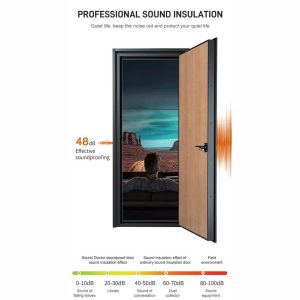
Acoustic performance: Sound transmission class (STC) ratings measure a door’s ability to reduce sound. A standard hollow-core interior door rates around 20-25 STC. Solid wood doors typically achieve 30-35 STC. For home theaters or music rooms, specify STC 40 or higher, which usually requires a specialized acoustic door assembly with perimeter seals.
Fire ratings: Fire-rated doors are tested as complete assemblies—door, frame, hinges, and hardware. A fire-rated door installed with non-rated hardware loses its certification. If fire rating is required, specify the complete assembly from a single manufacturer and verify the certification documentation.
Dimensional tolerances: Luxury doors are manufactured to tighter tolerances than standard doors. Verify the manufacturer’s specification for squareness, flatness, and edge straightness. Industry-standard tolerances range from ±1mm to ±2mm depending on the product category.
What Do Luxury Interior Doors Cost?
Luxury interior door pricing varies significantly based on material, size, finish, hardware, and customization level. Rather than relying on single price points, buyers should plan around cost tiers:
Entry-level luxury: Premium veneered doors with factory finishes and quality hardware typically range from several hundred to over a thousand dollars per door. This category includes solid-core veneer doors and basic aluminum-glass systems.
Mid-range luxury: Solid wood doors in standard sizes, custom-painted or stained, with upgraded hardware, generally cost more. Custom sizes or specialty glass options increase the price further.
High-end luxury: Fully custom doors—oversized panels, exotic veneers, integrated lighting, pivot hardware, or specialized acoustic construction—can reach several thousand dollars per opening. These prices reflect not just materials but the engineering and fabrication precision required.
The total installed cost includes framing modifications, hardware, and installation labor, which can add substantially to the door price. For budget planning, a common approach is to allocate 2-3% of total construction cost to interior doors for a typical luxury residential project.
Evaluating a Luxury Interior Door Manufacturer
When assessing suppliers, focus on verifiable capabilities rather than marketing language. The evaluation criteria that matter:
Testing and certification: Ask for documented test reports for acoustic performance, fire rating, and structural integrity. Reputable manufacturers test their products to recognized standards and can provide the reports. Be wary of suppliers who make performance claims without documentation.
Customization capability: Verify that the manufacturer can accommodate your specific sizes, finishes, and hardware requirements. Some luxury door manufacturers offer only standard configurations with limited finish options. For custom projects, confirm the range of customization before committing.
Production consistency: Inquire about quality control procedures. A manufacturer with documented inspection checkpoints—raw material verification, in-process dimensional checks, and pre-shipment finished product inspection—is more likely to deliver consistent quality across large orders.
Export and logistics experience: For international buyers, confirm that the manufacturer can handle export documentation, packing for ocean freight, and delivery coordination. A supplier experienced in foreign trade will provide proper packing lists, proforma invoices, and customs documentation.
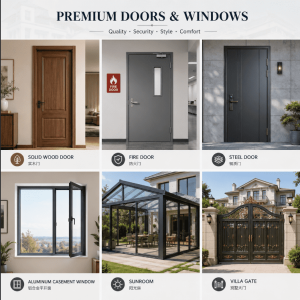
Here is how we meet these standards at Jusen Door and Windows Manufacturing Co., Ltd. As a factory-direct manufacturer, we supply solid wood doors, thermal-break aluminum doors, and custom villa doors and windows directly to buyers without middleman markup. Our production model supports full customization on size, color, glass specifications, and hardware accessories to match your project drawings.
Every order undergoes pre-shipment inspection covering air-tightness, water-tightness, and wind resistance testing, with documentation available for your review. Our foreign trade team provides complete export documentation, including packing lists and proforma invoices, and we coordinate both FCL and LCL shipments for direct delivery from our China factory. For projects in different regulatory environments, our profile structures and fittings can be adjusted to match local building codes of your target market.
If you are comparing manufacturers for a current project, we welcome the opportunity to discuss your specifications and provide a detailed quotation.
Frequently Asked Questions
What is the difference between solid core and solid wood doors?
Solid wood doors are constructed entirely from natural timber. Solid core doors have a veneer surface over an engineered core—typically particleboard, MDF, or laminated wood blocks. Solid wood offers the ability to refinish over time and a more authentic appearance, but costs more and requires stable humidity conditions. Solid core doors provide similar acoustic performance at lower cost with better dimensional stability.
Are custom luxury doors worth the investment?
Custom doors are worthwhile when standard sizes cannot accommodate your openings, when you need specific performance characteristics (acoustic, fire, or moisture ratings), or when the design requires a particular material or finish combination. For standard openings in conventional layouts, a high-quality factory door with premium hardware often delivers comparable results at lower cost.
How do I maintain and care for high-end interior doors?
Maintenance depends on the finish. Painted and lacquered doors should be cleaned with a soft, damp cloth and mild soap—avoid abrasive cleaners. Oil-finished wood doors require periodic re-oiling to maintain their appearance. Glass doors need regular cleaning with non-ammonia glass cleaner. Check and adjust hinges and latches annually to prevent sagging and ensure proper alignment.
What hardware complements luxury interior doors?
Hardware should match the door’s style and performance requirements. For modern doors, consider concealed or pivot hinges and minimal lever handles in matte black, brushed brass, or satin nickel. Traditional doors pair well with visible hinges in matching finishes and more ornate escutcheons. For acoustic performance, specify hardware with gasketing provisions and automatic door bottoms.
What are the latest trends in luxury interior doors?
Current trends include floor-to-ceiling door heights for a more dramatic visual scale, flush or nearly invisible door frames, and the use of natural materials with visible grain. Switchable privacy glass—which changes from transparent to opaque electronically—is gaining traction in high-end residential and hospitality projects. Sustainable material sourcing, including FSC-certified wood, is becoming a standard requirement for many buyers.
How do I choose the right luxury door for a renovation versus new construction?
New construction allows more flexibility—you can adjust framing to accommodate oversized doors, specify custom heights, and coordinate installation sequencing. Renovations require measuring existing openings carefully and determining whether the rough opening can be modified. In existing homes, check for level floors and plumb walls before ordering custom doors, as these conditions affect installation tolerances.