Quick Answer: Which Interior Panel Door Should You Choose?
If you need a direct answer: a 6-panel interior door is the most traditional and widely compatible option. It suits colonial, craftsman, and transitional interiors. Choose a 5-panel door if you want a slightly more modern look with a single large lower panel. Choose a 2-panel door for contemporary or minimalist spaces. The panel count affects the visual rhythm of the door, not its structural performance. Material and core type matter more for durability, soundproofing, and cost.
Panel Door Styles Explained: From 1-Panel to 8-Panel
Panel doors are defined by the number of recessed or raised sections within the door face. This is a visual design element, not a structural one. The panel count changes how light and shadow play across the surface, which influences how the door reads in a room.
1-panel doors are essentially a single large flat slab with a slight recessed border. They are the most minimal option, often used in modern or Scandinavian interiors. A flush or slab door is a variation that has no panel detail at all.
2-panel doors feature two equal or near-equal panels stacked vertically. This configuration reads as clean and contemporary. It pairs well with flat or minimal trim. The two-panel design also appears in some traditional European styles, but in the North American market, it leans modern.
4-panel doors typically arrange panels in a 2-over-2 grid or a single column of four. The single-column four-panel style is common in mid-century and craftsman homes. The 2-over-2 grid is a formal look, sometimes used in offices.
5-panel doors usually have a split upper section (two smaller panels side by side) and one large lower panel, or a variation with three small panels on top and two larger ones below. The shaker-style 5-panel door is a dominant choice in modern farmhouse and craftsman designs. The large lower panel provides a clean, unbroken surface.
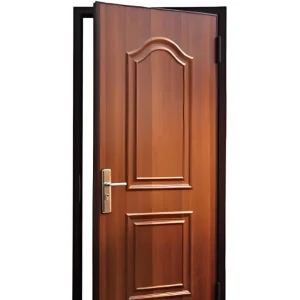
6-panel doors are the most recognized configuration in North American residential construction. They feature two columns of three equally sized panels. This symmetrical layout creates a formal, balanced appearance that works across traditional and transitional settings. The design originated in colonial architecture and remains a default specification for production homes and renovations.
8-panel doors use a 2-over-4 or 4-over-4 grid. This creates a busier, more ornate surface. Eight-panel doors suit Victorian, Edwardian, or other high-detail architectural styles. They are less common in standard stock and often require special ordering.
The practical takeaway: panel count is a style decision. It does not change the door’s fit, hardware compatibility, or basic function. It does change the perceived style of your interior.
6-Panel vs 5-Panel vs 2-Panel: A Side-by-Side Comparison
The table below compares the three most common configurations for interior use. Use it as a decision matrix, not a rating system.
| Attribute | 6-Panel | 5-Panel | 2-Panel |
|---|---|---|---|
| Visual Style | Formal, symmetrical, colonial or transitional | Craftsman, shaker, modern farmhouse | Contemporary, minimalist, modern |
| Panel Layout | Two columns of three equal panels | Typically two small top panels over one large bottom panel (shaker) | Two stacked panels, equal or near-equal height |
| Cost Range | Lowest due to high production volume | Moderate; slightly higher than 6-panel | Moderate to high; less stock availability |
| Best Room Fit | Bedrooms, hallways, home offices, formal living spaces | Kitchens, bathrooms, casual living areas, whole-home modern renovations | Modern apartments, lofts, contemporary offices, closets |
| Trim Compatibility | Works with traditional casing and baseboards | Works with flat or minimal trim for a craftsman look | Requires clean, modern trim; clashes with ornate molding |
| Availability | Widely stocked in standard sizes | Common in stock, especially in shaker style | Less common in stock; more special-order options |
Cost considerations. The 6-panel door is the most affordable of the three in most markets because it is produced in the highest volume. A 5-panel shaker door is usually priced close to a 6-panel door, sometimes slightly higher depending on the manufacturer. Two-panel doors are often special-order items unless you are buying in bulk from a manufacturer, which can raise the unit price.
Installation differences. There is no installation difference between panel configurations. A 6-panel, 5-panel, or 2-panel door of the same size and core type installs identically. The difference lies in the jamb or frame you order. You can buy any of these as a slab (door only) or prehung (door mounted in a frame). If you are replacing an existing door in a sound frame, order a slab. If you are framing a new opening or the existing frame is damaged, order prehung.
Material and Finish Options: Smooth, Wood, and Shaker
The term 6-panel smooth interior door refers to the surface texture, not the material. A smooth door has a flat, grain-free face. This is typical of doors made from MDF (medium-density fiberboard) or a smooth-faced composite. Smooth doors are designed to be painted. They do not show wood grain, which gives a clean, uniform finish.
Wood panel interior doors are made from solid wood or wood veneer over a core. Common species include pine, hemlock, oak, maple, and mahogany. Solid wood doors show natural grain and can be stained or painted. Veneer doors offer the look of wood at a lower cost and with greater dimensional stability.
MDF doors are made from wood fibers compressed with resin into dense boards. The panels and stiles are machined from MDF or molded from MDF faces. MDF takes paint exceptionally well, resists warping, and is less expensive than solid wood. Its main limitation is moisture resistance. MDF can swell if exposed to standing water or sustained high humidity. For bathrooms with direct shower exposure or laundry rooms, consider a solid wood or fiberglass option.
Hollow core vs solid core. This is a critical decision that affects sound transmission and weight.
- Hollow core doors have a honeycomb cardboard or foam interior between two thin faces. They are lightweight, inexpensive, and common in residential interiors. They offer minimal sound insulation. You can hear conversations and TV noise through them.
- Solid core doors have a solid interior made of particleboard, MDF, or wood. They are noticeably heavier, block more sound, and feel more substantial when closing. They cost more but provide better privacy for bedrooms, bathrooms, and home offices.
- Solid wood doors are entirely wood throughout. They are the heaviest and most expensive. They offer the best acoustic performance and a premium feel but require proper sealing to prevent warping in humid environments.
Shaker style refers to a specific design language: a five-piece door with a flat center panel and minimal trim. A 5-panel shaker door is the most common interpretation. The shaker aesthetic is defined by simplicity and function. It works in both modern and traditional homes because the clean lines do not compete with other design elements.
Primed vs prefinished. Most stock interior doors come primed, meaning they have a factory-applied primer coat ready for final painting. Prefinished doors come with the final paint or stain applied. Prefinished options save labor time but limit your color choices. Primed doors allow you to match your exact wall and trim color on site.
Specialty Doors: Glass Top and Other Custom Features
An interior door with top glass panel combines the classic panel layout with a glass insert in the upper section. This is a practical solution for rooms that need natural light transfer without a fully open doorway. Common applications include home offices, basements, mudrooms, and interior rooms without windows.
Glass top options vary by configuration. You can find 6-panel doors with the top two panels replaced by glass, or 2-panel doors with a single glass top. The glass can be clear, frosted, or patterned. Frosted or patterned glass provides privacy while still transmitting light. For a bathroom or office where visual privacy matters, choose frosted or obscured glass.
The framing around the glass can match the door material or use a separate mullion system. In wood doors, the glass is typically held in place by wood stops. In composite doors, the glass may be bonded into the panel during manufacturing.
When to choose a glass top door: use it for a home office where you want to see if someone is approaching, for a basement stairwell to bring light into a dark hallway, or for a pantry where you want to monitor light without opening the door. Avoid glass top doors for bedrooms and bathrooms where full privacy is required.
How to Choose the Right Interior Door for Your Project
Follow this decision sequence when specifying interior doors for a renovation or new construction project.
Step 1: Match the door to the architectural era of the building. A colonial or Georgian home looks correct with 6-panel doors. A craftsman bungalow suits 5-panel shaker doors. A mid-century modern or contemporary home calls for 2-panel or 1-panel doors. Mixing panel styles across a single floor creates visual noise. Standardize on one style per level or per visible corridor.
Step 2: Determine the core type based on room function. Use solid core doors for bedrooms, bathrooms, home theaters, and any room where sound privacy matters. Use hollow core doors for closets, utility rooms, and spaces where sound transfer is not a concern. If the budget allows, spec solid core throughout for a consistent feel and better resale value.
Step 3: Choose the material based on finish and environment. If you plan to paint all doors, MDF or composite with a smooth face is the most cost-effective choice. If you want stained wood, select a wood species that matches your trim and flooring. For high-moisture areas like bathrooms with showers, avoid raw MDF edges. Specify solid wood with proper sealing or a moisture-resistant composite.
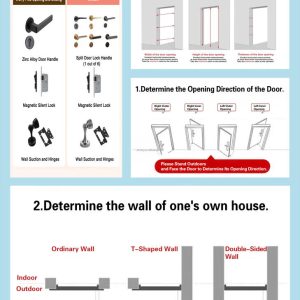
Step 4: Measure the rough opening correctly. The rough opening is the framed hole in the wall where the door installs. For a standard 30-inch door, the rough opening should be approximately 32 inches wide by 82.5 inches high for an 80-inch prehung door. This allows space for shimming and leveling. Measure the rough opening width at three points: top, middle, and bottom. Use the narrowest measurement. Measure the height from the highest point of the finished floor to the top of the framing. A common mistake is measuring from the subfloor, which adds error when tile or hardwood raises the finished floor level.
Step 5: Verify swing direction. Stand in the room the door swings into. If the hinges are on your left, it is a left-hand door. If the hinges are on your right, it is a right-hand door. For a door you pull toward you, check the hinge side from the side you pull from. For a door you push away, check the hinge side from the opposite side. When in doubt, order prehung doors with the swing specified, or take a photo of the existing door and frame for reference.
Step 6: Compare cost across configurations. The 6-panel door is the price benchmark. A 5-panel shaker door typically costs 5–15% more than a comparable 6-panel door from the same manufacturer. A 2-panel door in a modern style can cost 10–25% more due to lower production volume. Glass top inserts add cost per door, typically ranging from modest to significant depending on glass type and frame complexity. For bulk orders, these percentages shift based on negotiation and order volume.
Step 7: Consider long-term value, not just purchase price. A hollow core door that costs less upfront may need replacement sooner in high-traffic areas. A solid core door costs more but lasts longer, blocks sound better, and adds perceived value to the home. Over a 20-year horizon, the solid core door often delivers better cost-per-year value when you factor in the inconvenience and labor of replacement.
Supplier Evaluation: What to Look for in a Door Manufacturer
When you are buying interior doors in bulk for a construction project, a renovation, or a development, the supplier matters as much as the product. Retail pricing at a big-box store works for a single door replacement. For volume orders, you need a manufacturer or a direct factory supplier.
Evaluate suppliers on four criteria: customization capability, quality control, documentation, and logistics.
Customization capability. Standard sizes cover most residential openings, but commercial projects and custom homes often require non-standard dimensions. A supplier should be able to adjust door height, width, and thickness without excessive lead time. Panel configuration, glass inserts, and hardware preparation (pre-drilled holes for handles and hinges) should be available as factory options. Field modification of doors is costly and can void warranties.
Quality control. Interior doors must meet performance expectations for flatness, dimensional stability, and finish consistency. A reputable manufacturer tests for air-tightness, water-tightness, and wind resistance on exterior-rated products. For interior doors, the relevant checks are dimensional tolerance, squareness, and surface quality. Ask about pre-shipment inspection procedures. A manufacturer that inspects each batch before packing will ship fewer defective units.
Documentation. For international orders, the supplier must provide a packing list, proforma invoice, and full customs documentation. This is not optional. Delays at customs cost money and disrupt project schedules. A manufacturer experienced in foreign trade will handle these documents as a standard part of the transaction.
Logistics. Confirm whether the supplier can handle both full container load (FCL) and less-than-container load (LCL) shipments. Direct delivery from the factory reduces handling damage and shortens transit time. Ask about packaging standards for interior doors—doors should be wrapped, protected at the edges, and bundled to prevent warping during transit.
As a manufacturer of interior doors, including 6-panel, 5-panel, and custom configurations, we meet these standards through factory-direct supply. We provide full customization on size, color, glass, and hardware. Every order goes through pre-shipment inspection covering dimensional accuracy and finish quality. We supply packing lists, proforma invoices, and complete customs paperwork for international buyers. Our adjustable profile structure and fittings can be adapted to match local building codes in your target market. We ship FCL and LCL directly from our factory in China, which eliminates middleman markup and keeps unit costs competitive for volume buyers.
For project-specific pricing and specifications, contact our team with your door schedule and dimensions.
Frequently Asked Questions
What is the difference between a 6-panel and a 5-panel interior door?
The 6-panel door uses two columns of three equal panels, creating a symmetrical, formal grid. The 5-panel door typically uses two small upper panels over one large lower panel (shaker style). The 5-panel design reads as more casual and modern, while the 6-panel reads as traditional and formal.
Which panel configuration is best for a modern vs traditional interior?
For traditional interiors, use 6-panel doors. For modern interiors, use 2-panel or 1-panel doors. For transitional or craftsman interiors, 5-panel shaker doors are the safest choice. The 5-panel shaker is the most versatile because its clean lines work with both modern and traditional trim.
Are 2-panel doors more contemporary than 6-panel doors?
Yes. The 2-panel door has fewer visual breaks, which creates a cleaner, more minimal appearance. It aligns with contemporary design principles. The 6-panel door has a busier surface that reads as more classical.
What does ‘smooth’ mean in a 6-panel smooth interior door?
Smooth refers to the surface texture. A smooth door has a flat, grain-free face, typically from MDF or a smooth composite. It is designed for painting and does not show wood grain. This provides a clean, uniform finish that matches modern paint color schemes.
Can I get a 5-panel shaker door with a top glass panel?
Yes. Many manufacturers offer shaker doors with a glass insert in the upper panel area. The glass can be clear, frosted, or patterned. This configuration is popular for home offices and interior rooms that need natural light.
What materials are available for wood panel interior doors?
Solid wood options include pine, hemlock, oak, maple, and mahogany. Veneer options use a wood layer over a composite core. MDF doors offer a paintable, stable, and economical alternative. Each material has different cost, durability, and moisture resistance characteristics.
How do I choose between a 1-panel and an 8-panel door?
Choose a 1-panel door for minimalist or contemporary interiors where a flat, uninterrupted surface is desired. Choose an 8-panel door for ornate, traditional, or Victorian-style interiors that can support a busier visual design. The 1-panel is the most modern; the 8-panel is the most decorative.
What should I look for when buying interior doors in bulk?
Verify customization options for size and finish, confirm the manufacturer’s quality control process, check that full export documentation is available, and confirm shipping terms for FCL or LCL. Ask about pre-shipment inspection and how defective units are handled. For international orders, confirm the supplier can adjust profiles and fittings to meet your local building code requirements.
What are the standard sizes for interior 6-panel doors?
The most common interior door size is 30 inches wide by 80 inches high. Other standard widths include 24, 28, 32, and 36 inches. Standard heights are 78, 80, and 96 inches. These are nominal dimensions; actual measurements vary slightly by manufacturer. Always measure the rough opening before ordering.
What is the difference between prehung and slab doors?
A slab door is just the door panel. A prehung door comes mounted in a frame with hinges already attached. Use a slab when replacing a door in an existing sound frame. Use prehung when building new openings or when the existing frame is damaged. Prehung installation is more complex because the frame must be shimmed and leveled.
What is the difference between hollow core and solid core doors?
Hollow core doors have a lightweight interior structure and are inexpensive but offer minimal sound insulation. Solid core doors have a dense interior that blocks more sound, feels heavier, and costs more. Solid core is recommended for bedrooms, bathrooms, and offices where privacy matters.
Are 6-panel doors more expensive than other styles?
No. The 6-panel door is typically the least expensive option because it is produced in the highest volume. Five-panel shaker doors are close in price. Two-panel and specialty configurations often cost more due to lower production volume and special-order requirements.
Can I install a 6-panel door myself?
A slab door replacement is a manageable DIY project if the existing frame is square and sound. A prehung door installation requires shimming, leveling, and framing adjustments. For prehung installations, hire a professional unless you have experience with door framing. Incorrect installation causes binding, gaps, and premature wear.
What is the rough opening size for a 6-panel door?
For a 30-inch wide by 80-inch high prehung door, the rough opening should be about 32 inches wide by 82.5 inches high. This provides roughly 1 inch of clearance on each side and above the door for shimming. Measure the rough opening at the narrowest points before ordering.
Are 6-panel doors energy efficient?
Interior doors do not have regulated energy efficiency ratings like exterior doors. Their thermal performance depends on the core material and the conditioned space they separate. Solid core doors provide better thermal and acoustic separation between rooms than hollow core doors, but the difference is modest compared to exterior wall insulation.
What is the difference between primed and prefinished doors?
Primed doors come with a factory-applied primer coat ready for on-site painting. Prefinished doors come with the final paint or stain applied. Primed doors allow you to match your exact color scheme. Prefinished doors save installation labor but limit color options and may require touch-up if damaged during installation.
For a detailed quote on interior 6-panel doors or custom panel configurations, request pricing with your project dimensions and quantities.