The Short Version: What Matters Most When Choosing Door Glass
If you are sourcing glass inserts for exterior doors, the decision comes down to four variables: glass type, style pattern, energy performance, and security rating. Tempered or laminated glass is non-negotiable for safety. Insulated (double-pane) glass with a low-E coating is the default choice for energy efficiency in most climates. Style—whether clear, frosted, or decorative—is primarily a function of the privacy level you need and the architectural look you want. The best option is almost always a custom-sized, factory-built insulated unit with tempered inner and outer panes, rather than a single-pane retrofit that compromises both thermal performance and security.
Types of Glass Inserts: Clear, Frosted, Decorative, and Multi-Pane
Glass inserts for exterior doors are not a single product category. They range from purely functional clear panels to heavily patterned decorative units that function as the door’s primary design feature. Understanding the distinctions helps you match the product to the application.
Clear Glass Inserts
Clear glass maximizes natural light and provides an unobstructed view. It is the standard choice for sidelights, transoms, and full-light doors where visibility is desired. However, clear glass offers zero privacy—anyone outside can see directly into the entryway. For this reason, clear inserts are often paired with interior blinds or used in doors that do not face the street directly.
Frosted and Obscured Glass
Frosted glass is created by acid-etching or sandblasting one surface, producing a translucent finish that diffuses light while obscuring shapes. This is the most common solution for front doors where privacy matters but natural light is still wanted. Frosted patterns range from a uniform satin finish to gradient effects or partial frosting that leaves a clear vision strip at eye level.
Obscured glass is a broader category that includes textured patterns pressed into the glass surface during manufacturing. These textures—such as reed, hammered, or rain patterns—provide privacy while creating interesting light refraction. The trade-off is that textured surfaces are harder to clean than smooth frosted finishes.
Decorative Glass Inserts
Decorative glass inserts are where the entry door becomes a design statement. These typically feature:
- Beveled glass: Panes with angled edges that refract light like a prism, creating rainbow effects when sunlight hits them.
- Stained or art glass: Colored glass pieces assembled into a pattern, often with lead or zinc came framing.
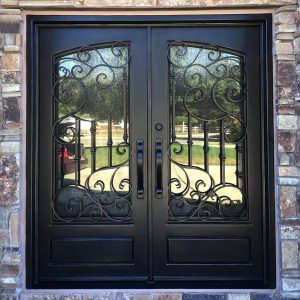
- Etched glass: Designs carved into the glass surface, ranging from simple borders to elaborate scenes.
- Textured patterned glass: Glass with embedded patterns or colored interlayers.
Decorative inserts are almost always manufactured as sealed insulated units for exterior applications. The decorative element is often sandwiched between two clear panes of glass, which protects the design and improves energy efficiency. This construction method means the decorative pattern does not affect cleaning—you wipe the smooth exterior surfaces.
Multi-Pane Styles: The 15-Pane Door
Multi-pane designs, such as the classic 15-pane glass door, divide the door’s glazing into a grid of individual panes using muntins or grilles. A 15-pane configuration typically means a grid of 3 by 5 small rectangular or square lights in the upper portion of the door.
These styles are strongly associated with traditional and craftsman architecture. The visual rhythm of multiple panes adds architectural interest without requiring colored or patterned glass. Multi-pane doors can use clear, frosted, or beveled glass within each individual light.
The practical consideration with multi-pane inserts is the grille system. True divided lites (each pane individually framed) are expensive and harder to maintain. Most modern doors use simulated divided lites (SDL) or grilles-between-glass (GBG), where the grid is bonded to the glass surface or suspended inside the insulated unit. GBG is the easiest to clean and the most energy-efficient, as there is no metal or wood framework conducting heat between the panes.
Glass Options: Tempered, Insulated, and Low-E
The glass itself matters as much as the style. Building codes and performance requirements dictate what you can install, and the choices directly affect safety, energy costs, and durability.
Tempered Glass
Tempered glass is heat-treated to be approximately four to five times stronger than annealed glass of the same thickness. When it breaks, it shatters into small, rounded pebbles rather than sharp shards, significantly reducing injury risk.
Building codes require tempered glass in “hazardous locations” —this includes door glazing, sidelites within 24 inches of the door opening, and any glass within 18 inches of the floor. This is not optional. If you are replacing an insert in an exterior door, the replacement must be tempered or laminated glass.
Laminated Glass
Laminated glass consists of two glass panes bonded together with a polyvinyl butyral (PVB) or ethylene-vinyl acetate (EVA) interlayer. When broken, the glass adheres to the interlayer, remaining in place rather than falling out of the frame. This provides:
- Enhanced security: The interlayer resists forced entry attempts.
- Sound insulation: The interlayer dampens acoustic transmission.
- UV protection: The interlayer blocks most ultraviolet radiation, protecting interior furnishings.
Laminated glass is the preferred choice for entry doors in high-crime areas or for homeowners prioritizing security. It is also used in hurricane-prone regions when specified as impact-resistant glazing.
Insulated Glass Units (IGUs)
An insulated glass unit (IGU)—commonly called double-pane glass—consists of two or more glass panes separated by a spacer and sealed to create an air gap. The gap is typically filled with argon or krypton gas, which has lower thermal conductivity than air.
For exterior doors, an IGU is the baseline recommendation. A single-pane insert creates a massive thermal bridge at the door, leading to condensation, heat loss, and higher energy bills. IGUs address these issues by providing an insulating air space between the interior and exterior panes.
Low-E Coatings
Low-emissivity (low-E) coatings are microscopically thin, virtually invisible metal oxide layers applied to glass surfaces. They work by reflecting long-wave infrared radiation (heat) while allowing visible light to pass through.
- Low-E on the interior pane reflects interior heat back into the home during winter, reducing heat loss.
- Low-E on the exterior pane reflects solar heat away during summer, reducing cooling loads.
The optimal low-E placement depends on your climate. In heating-dominated climates, a low-E coating on the interior pane’s surface facing the air gap is typical. In cooling-dominated climates, the coating is often applied to the exterior pane. Most reputable glass manufacturers offer dual-season or climate-specific low-E options.
Performance Metrics: U-Value and SHGC
When comparing glass options, two numbers matter:
- U-value measures heat transfer rate. Lower numbers mean better insulation. A typical double-pane IGU with low-E and argon has a U-value around 0.25–0.30, compared to 1.0+ for single-pane glass.
- Solar Heat Gain Coefficient (SHGC) measures how much solar radiation passes through the glass. Lower numbers mean less solar heat enters the home. For hot climates, low SHGC (0.20–0.30) is desirable; for cold climates, higher SHGC can provide passive solar heating.
These values are determined through standardized testing by the National Fenestration Rating Council (NFRC) in the US or equivalent bodies elsewhere. When specifying glass for a project, request the NFRC ratings rather than relying on marketing descriptions.
Comparison Table: Glass Insert Styles at a Glance
| Insert Style | Privacy Level | Light Transmission | Energy Efficiency | Security | Maintenance | Typical Applications |
|---|---|---|---|---|---|---|
| Clear, single-pane | None | Very High | Poor | Low | Low | Interior doors, non-code exterior applications |
| Clear, insulated (IGU) | None | High | Good–Excellent | Moderate | Low | Sidelites, doors facing private yards |
| Frosted | High | Moderate–High | Depends on glazing | Depends on glazing | Low–Moderate | Front doors, street-facing entries |
| Obscured/Textured | High | Moderate | Depends on glazing | Moderate | Moderate (texture traps dust) | Bathrooms, street-facing entries |
| Decorative (beveled/art) | Variable | Variable | Good (when IGU) | Moderate | Low (sealed unit) | Statement front doors, formal entries |
| 15-Pane (SDL/GBG) | Variable (depends on glass) | Moderate | Good–Excellent (GBG) | Moderate | Low (GBG) | Traditional, craftsman, colonial homes |
| Laminated | None–High (depends on interlayer) | Variable | Moderate–Good | High | Low | High-security applications, hurricane zones |
How to Select the Right Glass Insert for Your Door
Choosing the right insert requires evaluating your project’s specific constraints rather than picking a style based on aesthetics alone.
Step 1: Check Local Building Codes
Before any design discussion, verify the glazing requirements in your jurisdiction. Most building codes mandate tempered or laminated glass in doors and adjacent sidelites. Some municipalities have additional requirements for energy performance, particularly in new construction. Your door manufacturer or glass supplier should be able to confirm code compliance, but ultimately the responsibility rests with the project owner or contractor.
Step 2: Determine the Door Material and Configuration
Wood doors are the most accommodating for glass inserts. They can be routed or milled to accept new inserts, and the wood frame provides a secure mounting surface. Fiberglass and steel doors have factory-formed glass openings that are not easily modified. If you are replacing an existing insert, the new unit must match the original opening dimensions precisely.
If you are purchasing a new door, specify the glass insert at the time of order. Factory-installed inserts are sealed and warrantied as part of the door system. Retrofitting an insert into an existing door often voids the door manufacturer’s warranty, particularly if the door skin is cut to create a new opening.
Step 3: Match the Glass to Your Climate
Your local climate determines the optimal glass configuration:
- Cold climates (heating-dominated): Choose an IGU with low-E coating on the interior pane and argon fill. Look for a U-value of 0.28 or lower. Consider triple-pane if winter temperatures regularly drop below freezing.
- Hot climates (cooling-dominated): Prioritize low SHGC. Choose an IGU with low-E coating on the exterior pane and consider spectrally selective coatings that block solar heat while admitting visible light.
- Mixed climates: Use a dual-season low-E coating that provides reasonable performance year-round. A U-value around 0.30 and SHGC around 0.25–0.30 is a reasonable balance.
Step 4: Assess Privacy and Light Needs
Walk the property and observe how the door is approached. If the door faces a public street or a neighbor’s window, privacy should be a primary consideration. Frosted or obscured glass eliminates the need for curtains or blinds, which can obstruct the light you are trying to admit.
If privacy is not a concern, clear glass with a decorative grille pattern can add architectural interest without sacrificing views. For sidelites flanking the door, consider matching the privacy level—having a clear sidelite next to a frosted door defeats the purpose of the frosted panel.
Step 5: Evaluate Security Requirements
All tempered glass is breakable—tempering makes it safer, not impenetrable. If forced entry is a concern, laminated glass is the appropriate upgrade. The PVB interlayer holds the glass together even after impact, requiring significant effort to create an opening.
For high-security applications, consider a laminated IGU: two tempered panes with a laminated inner pane, providing both thermal performance and forced-entry resistance. This configuration is heavier than standard IGUs, so verify that the door hinges and frame can support the additional weight.
Additional Considerations: Customization, Installation, and More
Custom Sizes and Designs
Glass inserts are not limited to standard dimensions. Most manufacturers offer custom sizing to fit non-standard door openings, arched tops, or unusual cutouts. Customization also extends to the glass itself—you can specify the pattern, color, opacity, and even incorporate branding or logos for commercial applications.
When ordering custom inserts, precise measurement is critical. For existing doors, measure the opening at multiple points (top, middle, bottom) and use the smallest dimension to ensure a proper fit. The insert should have a small reveal—typically 1/8 to 1/4 inch—around all sides to allow for expansion and contraction.
Retrofit vs. New Door
Deciding between retrofitting an insert into an existing door and purchasing a new door with the insert factory-installed depends on the door’s condition and your budget.
Retrofitting is appropriate when the door itself is in good condition—solid, properly sealed, and functioning well. The cost of the insert plus installation labor is typically lower than a full door replacement. However, retrofitting voids most door warranties, and the quality of the installation depends heavily on the installer’s skill. A poorly sealed retrofit can lead to air leaks, water infiltration, and condensation between the panes.
Purchasing a new door with a factory-installed insert is the safer choice if the door is aging, if you are changing the door’s style significantly, or if you want a warranty that covers the entire unit. Factory installation ensures proper sealing and insulation, and the door is engineered to support the glass weight.
Energy Efficiency and Condensation
Condensation on door glass occurs when warm, humid interior air meets a cold glass surface. Single-pane glass condenses readily; IGUs with low-E coatings and warm-edge spacers significantly reduce condensation risk. The spacer—the component that separates the panes—matters. Aluminum spacers conduct cold to the glass edge, creating condensation rings. Warm-edge spacers made from stainless steel or polymer reduce this effect.
Cost Factors
Glass insert pricing varies widely based on size, glass type, and complexity. Several factors drive the cost:
- Glass type: Clear tempered glass is the baseline. Laminated glass adds 30–50% to the glass cost. Decorative elements—beveling, etching, art glass—add significantly more.
- Insulated vs. single-pane: An IGU roughly doubles the glass cost compared to single-pane, but the energy savings and condensation resistance justify the premium for exterior applications.
- Custom sizing: Non-standard dimensions increase manufacturing complexity and cost.
- Grille patterns: Simulated divided lites add moderate cost; true divided lites are substantially more expensive.
- Labor: Factory installation is typically included in the door price. Retrofit installation is an additional labor cost.
For budget planning, expect a basic clear tempered IGU insert to be the entry point, with decorative or laminated upgrades increasing the price substantially. Getting multiple quotes from suppliers is standard practice—glass pricing varies significantly between manufacturers.
Maintenance and Durability
Modern sealed IGUs are designed to be maintenance-free for the life of the unit. The sealed air space prevents dust and moisture from entering between the panes. The exterior surfaces require periodic cleaning with standard glass cleaner.
The most common failure mode for IGUs is seal failure, which allows moisture to enter the air space and cause fogging between the panes. This typically occurs after 10–20 years, depending on the quality of the seal and the temperature extremes the unit experiences. When an IGU fails, the entire unit must be replaced—the fog cannot be cleaned.
Warranty Considerations
Before cutting into an existing door to install a glass insert, review the door manufacturer’s warranty policy. Many door warranties are voided by any modification to the door slab, including adding or replacing glass. If the door is still under warranty, consider whether the warranty protection is worth more than the cost of the insert.
For new doors, verify that the glass insert is covered by the door’s warranty. Most reputable manufacturers warrant sealed IGUs against seal failure for a specific period—often 10–20 years—in addition to the door’s structural warranty.
Frequently Asked Questions
Are glass inserts for exterior doors secure?
Standard tempered glass is breakable, but it is significantly stronger than annealed glass and breaks into harmless pebbles rather than sharp shards. For higher security, laminated glass uses a plastic interlayer that holds the glass together when broken, making it much more difficult to penetrate. The door frame, hinges, and locking mechanism are equally important—glass is only one part of the door’s overall security.
What is the difference between decorative glass and clear glass inserts?
Clear glass is entirely transparent, providing an unobstructed view and maximum light transmission. Decorative glass includes treatments such as beveling, etching, staining, or textured patterns that obscure visibility to varying degrees while adding visual interest. Decorative glass is typically more expensive and may reduce light transmission by 10–30% depending on the pattern.
What are the best glass insert options for energy efficiency?
The most energy-efficient option is an insulated glass unit with low-E coatings and argon gas fill. Look for a U-value of 0.28 or lower for cold climates. Triple-pane IGUs provide the highest insulation but add significant weight and cost. For hot climates, prioritize a low SHGC (0.25 or lower) to reduce solar heat gain.
How do I choose between a 15-pane glass door and other styles?
The 15-pane style is primarily an aesthetic choice suited to traditional, craftsman, or colonial architecture. The practical considerations are the grille system (choose grilles-between-glass for easy cleaning and better insulation) and the glass within each pane (clear, frosted, or beveled). If your home’s architecture does not lean traditional, a simpler single-light or sidelite configuration may look more appropriate.
Can I customize the size and design of glass inserts?
Yes. Most glass insert manufacturers offer custom sizing and design options. You can specify the exact dimensions to fit non-standard openings, choose from various glass types and patterns, and select hardware finishes. For commercial projects, custom etching or branding is available. Custom orders typically require longer lead times than standard sizes.
What is the cost range for glass inserts for exterior doors?
Costs vary substantially based on size, glass type, and customization. A basic clear tempered insulated insert is at the low end of the range. Frosted or patterned glass adds a moderate premium. Decorative elements such as beveling or art glass can increase the price significantly. Laminated glass for security adds another layer of cost. For accurate budgeting, request quotes from multiple suppliers with your specific dimensions and glass requirements.
What are the different types of glass inserts for exterior doors?
The main types are clear, frosted, obscured/textured, decorative (beveled, stained, etched), and multi-pane configurations such as 15-pane designs. Each type can be manufactured as single-pane or insulated glass, and in tempered, laminated, or standard annealed glass—though building codes typically require tempered or laminated for door applications.
How We Meet These Standards
As a manufacturer of exterior doors and windows, we build glass inserts to the specifications outlined above as part of our standard production process. Our factory produces doors with factory-installed insulated glass units, which means the glazing is sealed and warrantied as part of the complete door system—not as an aftermarket retrofit.
When you source from us, you are working directly with the factory, which gives you control over customization that is difficult to achieve through a distributor or retailer. We can adjust the profile structure and fittings to match your local building codes, and we offer full customization on size, color, glass type, and hardware. Whether you need a standard 15-pane design for a residential project or a custom decorative insert for a commercial entryway, the glass configuration is specified at the time of order and manufactured to your exact dimensions.
Our pre-shipment inspection includes air-tightness, water-tightness, and wind resistance testing, ensuring the sealed glass units meet performance standards before they leave the factory. For international buyers, we provide complete export documentation, packing lists, and proforma invoices, and we ship via FCL or LCL directly from our factory.
If you are comparing suppliers for a project that requires glass inserts for exterior doors, we can provide specifications, performance data, and pricing tailored to your requirements.
Contact our team to discuss your project specifications.