
Content Menu
● 1. Why Glass and Wood Front Doors Are the New Standard for Villa Projects
● 2. Our Factory Capabilities: Customizing Wood Species and Glass Configurations
● 3. The Jusen Manufacturing Process: From Raw Lumber to Pre-Shipment Inspection
● 4. Sourcing Strategy for B2B Buyers: Direct Factory Pricing vs. Middlemen
● 5. OEM/ODM Services: Building Your Brand on Our Production Lines
● 6. Why Jusen Door and Windows is the Right Manufacturing Partner
14 min read
The last project we shipped to Melbourne taught us something about glass and wood front doors that no brochure could capture. The architect sent over a specification for a 2.8-meter pivot door with a fixed glass sidelight. The wood species was European oak. The glass was triple-glazed Low-E. The hardware had to meet Australian AS1428 accessibility standards. Our production team reviewed the drawings, adjusted the thermal-break aluminum sub-frame to handle the weight, and scheduled the CNC machining for the following week. That is what a factory partnership looks like when the door is the centerpiece of a villa entrance, not an afterthought.
Glass and wood front doors sit at the intersection of aesthetics and engineering. Wood delivers the warmth and gravitas that aluminum alone cannot replicate. Glass brings in natural light and a sense of openness. But combining these two materials into a single, durable, weather-tight entry system is not something a local carpenter can handle. It requires a factory with dedicated production lines, controlled wood conditioning, and testing protocols that verify performance before the container leaves the dock.
This guide explains how Jusen Door and Windows Manufacturing Co., Ltd. approaches glass and wood front doors—from wood species selection to pre-shipment inspection—and what B2B buyers should look for when sourcing these systems internationally.
Why Glass and Wood Front Doors Are the New Standard for Villa Projects
Walk through any high-end residential development in North America, Europe, or Australia, and you will notice a pattern. The entrance is no longer a simple solid slab. It is a statement piece—often a combination of natural wood framing, expansive glass panels, and slim sightlines that maximize views while maintaining thermal performance.
The shift toward glass and wood front doors is not a stylistic trend. It is a response to changing architectural preferences and stricter energy codes. Buyers want the warmth of wood, but they also want daylight flooding into the foyer. Developers want a product that differentiates their project from competitors. And building codes in many regions now mandate specific air-tightness and thermal efficiency ratings for entry doors.
The Aesthetic Appeal of Natural Wood vs. Aluminum Strength
Wood is beautiful. It is also dimensionally unstable. It expands and contracts with humidity changes, which is why a solid wood door that looks perfect in the factory can warp within months of installation in a climate with high moisture variation.
Our solution at Jusen is a thermal-break aluminum sub-frame that carries the structural load while the wood acts as the visible skin. The aluminum profile is designed to accommodate the weight of large glass panels without sagging over time. The wood—whether oak, mahogany, or sapele—is machined to fit precisely over this frame, creating a composite structure that delivers the best of both materials.
This approach also allows us to offer an adjustable profile structure. If your project requires a door that is 1.2 meters wide or a pivot door that reaches 3 meters in height, we can modify the internal reinforcement to match the specific dimensions and weight distribution. A traditional woodshop cannot do this. A factory with our engineering support can.
Energy Efficiency and Natural Light Integration
Double and triple glazing within a wood frame is not just about aesthetics. It directly impacts the HVAC load of the building. A poorly sealed entry door can account for up to 15% of a home’s heat loss, according to energy efficiency studies.
We test every glass and wood front door for air-tightness and water-tightness before it leaves our factory. The glass seals must perform under extreme weather conditions—heavy rain, high winds, and temperature differentials between the interior and exterior. If the seal fails, the door will fog, leak, and eventually compromise the wood frame.
Our pre-shipment tests are not a formality. We measure air infiltration rates against international standards, and we adjust the gasket compression and glass setting blocks until the numbers pass. This is the difference between a door that performs and a door that looks good on paper.
The Engineering Challenge (Why You Need a Factory, Not a Carpenter)
Here is the honest caveat: glass and wood front doors are complex systems, and not every factory can build them well. The challenge is not just in the joinery—it is in the structural engineering. A 2.5-meter-tall glass panel weighs significantly more than a solid wood slab of the same size. The hinges must be rated for that weight. The frame must resist torsion. The glass must be properly supported at the setting blocks to avoid stress fractures.
Our engineering support and technical team calculates load-bearing capacities for each custom size. We do not guess. We review the glass weight, the hardware rating, the wind load for the installation site, and the thermal expansion of the aluminum frame. Then we build accordingly.
Our Factory Capabilities: Customizing Wood Species and Glass Configurations
When a buyer contacts us about glass and wood front doors, the first question is almost always about customization. Can we match a specific wood finish? Can we use a particular glass type? Can the hardware be branded with the client’s logo?
The answer to all three is yes. We are not a distributor selling off-the-shelf products. We are a manufacturing facility with OEM/ODM services that allow full control over every component.
Wood Species Selection (Oak, Mahogany, Sapele)
The wood species determines the appearance, the durability, and the cost of the door. We work with several species, each with distinct characteristics:
- Oak: Dense, durable, with a prominent grain pattern. Ideal for contemporary and traditional designs.
- Mahogany: Rich, reddish-brown tone, naturally resistant to moisture and decay. Popular for luxury villas in humid climates.
- Sapele: A more affordable alternative to mahogany with a similar appearance and excellent stability.
We source our lumber from managed suppliers and condition it in our factory’s drying chambers. The moisture content is controlled to a specific range—typically 8% to 12%—depending on the destination market. If the door is going to Arizona, we dry the wood to a lower moisture content to prevent cracking in the dry climate. If it is going to Singapore, we adjust for higher humidity. This level of attention is part of our full customization on size, color, glass, and hardware accessories.
Glass Options (Frosted, Low-E, Double Glazed, Smart Glass)
Glass is not a single product. It is a category with significant performance variations. We offer:
- Low-E coatings: Reflect infrared radiation while allowing visible light to pass through. Reduces solar heat gain and protects interior furnishings from UV damage.
- Double and triple glazing: Multiple panes with gas fills (usually argon) to enhance thermal insulation.
- Frosted or patterned glass: For privacy without sacrificing natural light.
- Smart glass: Electronically tintable glass that adjusts transparency based on voltage. A premium option for high-end projects.
The glass configuration affects the weight of the door, which in turn affects the hardware requirements and the frame design. Our team works with you to select the right glass for your climate and performance goals, ensuring that the final product meets both aesthetic and energy efficiency targets.
Hardware Integration (Hinges, Locks, Multi-Point Systems)
The hardware on a glass and wood front door is not an afterthought. It is a critical component that must support the door’s weight and ensure security.
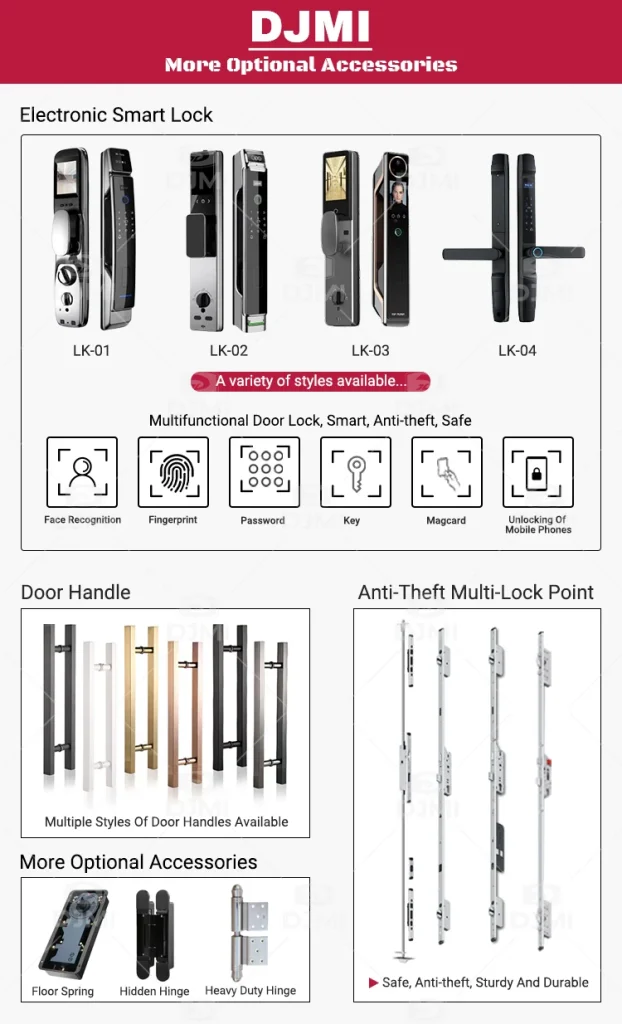
We use heavy-duty European hinges and multi-point locking systems that are rated for the specific weight of the door panel. A standard residential hinge is not sufficient for a 100-kilogram glass and wood door. We integrate hinges with ball bearings and adjustable tension to ensure smooth operation over years of use.
Hardware accessories are also customizable. If your project requires a specific security certification—such as a particular lock grade or anti-pry feature—we can source and integrate hardware that meets those requirements. Our adjustable profile structure and fittings allow us to modify the door to match local building codes of target markets, whether that is the US, EU, Australia, or elsewhere.
The Jusen Manufacturing Process: From Raw Lumber to Pre-Shipment Inspection
Understanding how a glass and wood front door is manufactured helps buyers ask better questions. Here is a look at our process, from raw material intake to the moment the door is crated for shipping.
CNC Machining and Wood Conditioning
The process begins with wood conditioning. Raw lumber arrives at our factory and is placed in drying chambers where the moisture content is gradually reduced. This is not a quick process—it takes days, not hours. If the wood is dried too quickly, it will crack or warp. We control the temperature and humidity carefully to produce stable, workable lumber.
Once conditioned, the wood is cut and shaped using CNC machining centers. These machines produce precise profiles for the door stiles, rails, and panels. The accuracy of this step is critical because the wood must fit seamlessly over the aluminum sub-frame. A tolerance of even a few millimeters can cause alignment issues with the glass and hardware.
Our production lines handle casement doors, sliding doors, and custom villa doors—not just standard entry doors. This specialization means our team has experience with the unique challenges of each product type, such as the weight distribution of a sliding door or the sealing requirements of a casement window.
Structural Assembly: Combining Wood with Thermal-Break Aluminum
The next step is the assembly of the thermal-break aluminum sub-frame. This frame is the structural backbone of the door. It is designed with a thermal break—a polyamide strip that separates the interior and exterior aluminum profiles, preventing thermal transfer and condensation.
The wood is then bonded to the aluminum frame using structural adhesives and mechanical fasteners. This combination creates a door that is strong enough to support heavy glass panels, stable enough to resist warping, and thermally efficient enough to meet modern energy codes.
Our experience in system windows gives us an advantage here. We understand how to design and assemble profiles that maintain their structural integrity under load and thermal stress. This is not a skill that can be replicated by a general millwork shop.
Strict Pre-Shipment Testing (The Jusen Standard)
Before any glass and wood front door is packaged for shipment, it undergoes a series of tests. These are not random spot checks—every unit is verified.
- Air-tightness test: Measures the air infiltration rate through the closed door. We compare the results against international standards (such as EN 12207 or ASTM E283) and adjust the seals if necessary.
- Water-tightness test: Simulates heavy rain and wind to ensure no water penetrates the door system. This is particularly important for glass-to-frame seals and threshold interfaces.
- Wind resistance test: Applies pressure to the door to simulate wind loads. This verifies that the frame, glass, and hardware can withstand the forces they will encounter in the installed location.
These tests are part of our strict pre-shipment inspection protocol. They are not optional. We have seen what happens when a door fails in the field—callbacks, rework, and damaged client relationships. Our goal is to ensure that the door performs as designed from the day of installation.
Sourcing Strategy for B2B Buyers: Direct Factory Pricing vs. Middlemen
For B2B buyers, the sourcing decision is not just about product quality. It is about total cost, supply chain reliability, and documentation. Here is how buying directly from our factory compares to working through a middleman.
The Cost Advantage of Direct Supply
When you buy from a distributor or agent, you are paying for their markup. That markup covers their overhead, their profit margin, and often their logistics management. When you buy directly from Jusen Door and Windows Manufacturing Co., Ltd. , you eliminate that layer. The price you receive is the factory price—the same price we would offer to a domestic distributor.
For contractors bidding on projects, this cost difference can be the deciding factor between winning and losing a bid. The savings can be reinvested in better hardware, higher-grade wood, or simply improving your profit margin.
Logistics and Lead Times (FCL & LCL)
We handle both FCL (Full Container Load) and LCL (Less than Container Load) shipment, with direct delivery from our China factory. This flexibility means you can order a single container of doors or consolidate with other products to fill a container.
Our production scheduling is managed to align with your construction timeline. For bulk orders, we provide a production schedule that outlines when your doors will be manufactured, tested, and ready for shipment. This allows your site team to plan the installation without unexpected delays.
Compliance with Local Building Codes
One of the most common concerns we hear from international buyers is, “Will these doors pass inspection in my country?”
The answer is yes, but it requires planning. Our adjustable profile structure and fittings are designed to be modified to match local building codes. If your region requires a specific U-value for the door, we can adjust the glass configuration and thermal break width. If your area has strict wind load requirements, we can reinforce the frame accordingly.
We have shipped glass and wood front doors to projects across North America, Europe, Australia, and the Middle East. Each market has its own codes, and we work with our clients to ensure compliance before production begins, not after the container has arrived.
OEM/ODM Services: Building Your Brand on Our Production Lines
For many of our clients, the goal is not just to buy a door. It is to sell a door under their own brand name. This is where our OEM and ODM services come into play.
Private Labeling and Custom Design
Private labeling allows you to put your brand on the door and packaging. We can customize the hardware branding—such as laser-engraving your logo on the hinges or locks—and print your branding on the crates and documentation. This creates a professional, cohesive product that reinforces your brand identity in the local market.
For custom size and design requests, our engineering team works with your architects to create signature entrances. Whether it is a pivot door with a custom bronze finish or a double door with a unique glass pattern, we have the capability to execute the design at factory quality.
Construction Project Bulk Supply
Large-scale projects require more than just product quality. They require reliability. If you are supplying doors for a 50-unit residential development, any delay in production or shipping can disrupt the entire construction schedule.
Our rich experience in foreign trade ensures that documentation, packing, and shipping schedules are handled professionally. We provide a packing list, proforma invoice, and full customs documents with every order. This paperwork is prepared accurately and in advance, so your customs broker can clear the shipment without issues.
Why Jusen Door and Windows is the Right Manufacturing Partner
By now, the picture should be clear. Glass and wood front doors are not a simple product category. They require a factory with the right equipment, engineering expertise, and quality control processes.
One-Stop Shop for Villa Entrances
We are not just a door factory. We also produce thermal-break aluminum doors and windows, system windows, casement doors, sliding doors, sunrooms, and aluminum alloy entrance doors. This means we can supply the entire building envelope—not just the front door. For developers and architects, this ensures a cohesive aesthetic across all openings and simplifies procurement by consolidating suppliers.
Engineering Support from Concept to Installation
Our team works with your engineers from the initial design phase through to installation guidance. We review the drawings, identify potential issues, and provide solutions. This collaborative approach reduces the risk of field modifications and ensures the door performs as specified.
The Jusen Commitment to Quality
The combination of factory direct pricing, rigorous testing, and export experience is why clients choose us as a long-term manufacturing partner. We do not cut corners on materials or testing. We build doors that we are proud to put our name on, and we back them with a warranty that reflects our confidence.
—
When you are ready to discuss your project, send us your CAD drawings or specifications. Our team will review them, provide feedback, and prepare a quotation that reflects the true cost of a factory-direct partnership.
—
Q: Can you manufacture glass and wood front doors in non-standard sizes?
Yes. We specialize in custom sizes, and our full customization on size and design means we can adjust the profile structure to accommodate large pivot doors or narrow European-style entrances. We calculate the structural requirements—glass weight, hardware rating, wind load—for each unique dimension to ensure the door remains stable and functional.
Q: How do you ensure the wood does not rot or warp around the glass in humid climates?
We combine solid wood with a thermal-break aluminum structure, which creates a stable sub-frame that handles expansion and contraction. Additionally, our water-tightness tests verify that moisture does not penetrate the glass-to-frame seals. For humid climates, we also adjust the wood moisture content during conditioning to minimize the risk of warping.
Q: What is the MOQ for a bulk order of custom entry doors?
We handle both FCL and LCL shipment and are flexible with order quantities. For construction projects with specific volume requirements, we recommend contacting our team to discuss your schedule. We can align production to meet your timeline without overcommitting to a rigid minimum.
Q: Do you provide documentation for customs clearance?
Absolutely. With our rich experience in foreign trade, we provide a complete set of shipping documents, including the packing list, proforma invoice, and full customs documents. This ensures smooth clearance in your target market and reduces the risk of customs delays.
Q: Can you adapt the doors to meet our local energy codes?
Yes. Our adjustable profile structure and fittings are designed to be modified to match local building codes. We can adjust the glass thickness, thermal break width, and hardware to meet specific air-tightness and wind resistance requirements in your region. Share your local code requirements during the quotation phase, and we will engineer accordingly.
Q: Can you put our company logo on the doors or packaging?
Yes, we offer OEM and Private Label services. We can customize the hardware branding and packaging to support your brand identity in the local market. This is a common requirement for distributors and developers who sell under their own brand.
—
Decision Guide:
- Choose Jusen if you need a factory that can handle custom sizes, diverse glass configurations, and strict performance testing for international projects.
- Choose a local distributor if your order volume is small, your timeline is extremely tight, and you do not require customization. But expect to pay a markup that reflects the middleman’s margin.
—
References
- International Energy Agency, “Energy Efficiency in Buildings,” https://www.iea.org/topics/energy-efficiency-buildings
- American Architectural Manufacturers Association, “AAMA/WDMA/CSA 101/I.S.2/A440-17,” https://www.aamanet.org/
- European Committee for Standardization, “EN 12207:2016 Windows and doors – Air permeability – Classification,” https://www.cen.eu/
- U.S. Department of Energy, “Energy-Efficient Door Design,” https://www.energy.gov/energysaver/energy-efficient-door-design
- Australian Building Codes Board, “Access for People with a Disability (AS1428),” https://www.abcb.gov.au/





