Content Menu
● 1. Front Door Double Specifications — What Buyers Must Define Before Sourcing
● 2. Sourcing Risks When Buying Double Front Doors from Overseas Factories
● 3. How to Verify a Double Front Door Manufacturer Before Committing
● 4. Production, Sampling, and Quality Control for Double Front Door Orders
● 5. Long-Term Supply Partnerships: What a Reliable Double Front Door Supplier Should Offer
● 6. How Jusen Door and Windows Manufacturing Co., Ltd. Meets These Double Front Door Supply Standards
● 7. Frequently Asked Questions About Sourcing Double Front Doors
13 min read
Front Door Double Specifications — What Buyers Must Define Before Sourcing
Critical Dimensions and Configurations: Active Leaf, Passive Leaf, and Frame Systems
Before contacting any supplier, a buyer should have a complete dimensional specification for their front door double unit. The total opening width for a front door double configuration typically falls between 48 inches and 72 inches, with 60 inches being the most common. Height ranges from 80 inches to 96 inches, though custom heights are increasingly requested for grand entrances.
Three configuration questions must be answered:
- Which leaf is active? The active leaf is used most frequently. It should be the leaf with the primary locking system. The passive leaf can be fixed with flush bolts at top and bottom, or it can be operable with its own handle and lock.
- Is the unit inswing or outswing? Inswing doors are more common for residential applications because they do not expose hinges to the exterior. Outswing doors are preferred in commercial settings where emergency egress is a consideration — some building codes require doors to swing in the direction of travel.
- What is the mullion situation? Some front door double units have a removable mullion — a vertical post in the center that can be removed to create a wider clear opening. This is a practical solution for buildings that occasionally need to move large equipment through the entrance.
Glass, Glazing, and Thermal Performance Requirements
The glass specification for a front door double unit is not an afterthought — it often determines the unit’s overall thermal performance and safety rating.
Double glazing is the minimum standard for most building code compliance. A typical spec would be a 6mm tempered glass + 12mm air gap + 6mm tempered glass, sometimes with argon gas filling to improve insulation. Low-E (low-emissivity) coatings on the interior pane reduce heat transfer and UV damage.
Safety glass requirements vary by jurisdiction. In the United States, the Consumer Product Safety Commission’s 16 CFR 1201 standard requires tempered or laminated glass in doors and other hazardous locations [3]. The European equivalent is EN 12150 for tempered glass and EN 14449 for laminated glass.
For buyers sourcing front door double units, the critical question is whether the factory’s glass suppliers provide certified safety glass. Tempered glass shatters into small, relatively harmless pieces; laminated glass holds together when broken. Laminated glass is the better choice for hurricane-prone regions and for doors where forced entry resistance is a concern.
Hardware, Locking Systems, and Security Compliance
Hardware selection for front door double units is where procurement mistakes happen. A buyer who specifies the door unit but leaves hardware open-ended will likely receive the factory’s standard hardware — which may not meet the project’s security requirements.
Multi-point locking systems are the industry standard for entrance doors. A multi-point lock engages bolts at multiple locations along the door edge — typically top, bottom, and center — rather than a single latch. This distributes the locking force and makes forced entry significantly more difficult.
For a front door double configuration, the active leaf should have a multi-point lock, and the passive leaf should have top and bottom flush bolts that secure it to the frame. Some commercial applications require panic bars or exit devices, which must be coordinated with the door manufacturer during production — retrofitting these later is costly and can compromise the door’s integrity.
Buyers should also specify the hinge load rating. A pair of 60-inch-wide aluminum door leaves weighs considerably more than a single 36-inch door. Heavy-duty hinges rated for the specific leaf weight should be a non-negotiable requirement for any front door double unit.
—
Sourcing Risks When Buying Double Front Doors from Overseas Factories
Material Substitution: When “Aluminum” Isn’t the Alloy You Specified
The most common sourcing failure in aluminum door procurement is material substitution. A factory quotes for 6063-T5 aluminum but delivers profiles made from lower-grade billet with thinner walls. The visual difference is minimal; the structural difference is significant.
Wall thickness is the easiest metric to verify. A 1.4mm profile has roughly 40% more material than a 1.0mm profile of the same shape. The thinner profile will flex more under wind load, and the door will feel less solid during operation. Buyers should specify the alloy grade, temper, and minimum wall thickness in the purchase contract — not just in the initial inquiry.
The impact of material substitution is not always immediate. The door may function fine for months. But under sustained wind load or heavy daily use, thinner aluminum fatigues faster. The result is sagging leaves, misaligned locking points, and air leakage around the astragal in a front door double system.
Dimensional Tolerance and Installation Compatibility Issues
Front door double units have more points of failure than single doors. The two leaves must align perfectly at the astragal. The frame must be square — a diagonal difference of more than 3mm can cause the leaves to bind or leave visible gaps.
Industry tolerance standards, such as those in AAMA 2604 or the European EN 14351-1, specify acceptable deviations. Buyers should request the factory’s tolerance documentation and understand what variances are acceptable. The key measurements are:
- Frame squareness (diagonal difference)
- Leaf height and width tolerances
- Reveal gap consistency between leaves and frame
- Jamb depth match with the wall construction
An overseas factory may produce a perfect sample unit but fail on production runs because of inconsistent welding, cutting, or assembly processes. This is why dimensional tolerance checking during production — not just at final inspection — is critical for front door double orders.
Inconsistent Batch Quality Across Multiple Orders
A factory that delivers a flawless first order may fail on the second. The reasons vary: key personnel left, raw material sourcing changed, production volume stretched capacity, or quality control standards slipped.
For B2B buyers who plan to order front door double units repeatedly, the risk of batch inconsistency is a serious concern. The mitigation strategy is not just final inspection — it is process verification. Buyers should ask about the factory’s quality management system, not just their inspection checklist.
A factory with documented standard operating procedures for each production step is more likely to deliver consistent output than one that relies on the skill of individual workers. ISO 9001 certification is a useful proxy for process discipline, though it does not guarantee product quality.
—
How to Verify a Double Front Door Manufacturer Before Committing
Factory Audit Checklist for Double Door Production Lines
A thorough factory audit for front door double production should cover four critical areas:
- Extrusion capability: Does the factory have in-house extrusion lines, or do they purchase profiles from third-party mills? In-house extrusion allows for tighter quality control and better traceability of alloy composition.
- CNC machining: Front door double frames require precise cutting, drilling, and milling. CNC-controlled machining centers ensure repeatability. Manual machining is acceptable for small runs but carries higher risk of dimensional errors.
- Surface treatment: Does the factory have in-house powder coating or anodizing lines? Outsourced surface treatment adds logistics time and creates opportunities for quality loss during handling.
- Assembly and hardware installation: Is there a dedicated assembly area with proper fixtures and alignment tools? Front door double alignment requires more care than single door assembly — the interlock between leaves must be adjusted precisely.
Key Certifications to Request for Double Front Doors
Buyers should request documentation for the following certifications, depending on their target market:
- ISO 9001 — Quality management system certification. This is a baseline requirement, not a differentiator.
- CE marking — Required for construction products sold in the European Economic Area. CE marking for doors and windows falls under harmonized standard EN 14351-1.
- SGCC certification — For safety glazing materials sold in the United States. This certifies that tempered or laminated glass meets the requirements of 16 CFR 1201.
- NFRC certification — For thermal performance ratings in North America. NFRC labels provide U-factor and Solar Heat Gain Coefficient data.
- Local building code compliance documents — For hurricane zones (e.g., Florida’s HVHZ requirements), energy codes, and accessibility standards.
Buyers should verify that certificates are current and cover the specific product line. A factory with ISO 9001 certification is not necessarily certified for the specific front door double system being purchased.
Reference Checks: What to Ask Previous B2B Buyers
When checking references, buyers should ask specific questions rather than general ones:
- How consistent was the finish color across different batches?
- How responsive was the factory when production issues were identified?
- Did the shipping documentation match the customs requirements of your country?
- How were defects handled — replaced promptly, or negotiated at a discount?
- Were lead times met as promised?
A factory that has served multiple importers in different markets is likely to be more experienced with export documentation and international standards compliance than one that primarily serves domestic customers.
—
Production, Sampling, and Quality Control for Double Front Door Orders
Why a Pre-Production Sample Is Non-Negotiable for Front Door Double Units
Front door double units have more failure points than single doors — alignment, interlock, hardware coordination, and weatherstripping. A scaled-down mockup or a digital rendering does not reveal these issues. A full-scale sample unit is the only reliable way to verify that the product meets specifications.
Buyers should request a full-size sample of the actual front door double configuration. This allows verification of:
- Leaf alignment at the astragal
- Locking mechanism operation on both leaves
- Weatherstripping compression and sealing
- Overall fit and finish
The sample should be tested, not just visually inspected. Open and close both leaves 50 times. Check for binding, noise, or gaps. Spray water on the exterior and check for leaks. This is the buyer’s opportunity to catch issues before committing to a production run.
In-Line Inspection: What to Check During Production
Waiting until final inspection is risky. By that point, defects are expensive to correct. In-line inspection during production catches issues early.
Key checkpoints during production:
- Profile cutting: Verify that cut angles and lengths match the production drawings. Front door double frames require precise 45-degree cuts at corners.
- Corner joining: Check that corners are joined squarely and that sealant is applied consistently.
- Glass unit assembly: Verify that the glass thickness, coating orientation, and spacer type match the specification.
- Hardware installation: Check that locking points align between the active and passive leaves.
- Weatherstripping: Confirm that it is continuous, not cut short at corners.
Pre-Shipment Random Sampling: Standards and Methods
The international standard for sampling inspection is ISO 2859-1, which defines Acceptable Quality Limit (AQL) levels. For entrance doors, a typical requirement is AQL 1.0 for major defects and AQL 2.5 for minor defects.
Pre-shipment testing for front door double units should include:
- Water tightness test: Spray water at the specified pressure and check for leaks at the astragal and frame corners.
- Air infiltration test: Measure the air leakage rate under positive and negative pressure.
- Operational force test: Verify that both leaves open and close with reasonable force — not too stiff, not too loose.
These tests should be performed on random samples from the production batch, not on the pre-production sample unit.
—
Long-Term Supply Partnerships: What a Reliable Double Front Door Supplier Should Offer
Stable Lead Times and Transparent Production Scheduling
For B2B buyers, lead time reliability is often more important than lead time speed. A factory that consistently delivers in 30 days is easier to plan around than one that delivers in 20 days sometimes and 45 days other times.
Aluminum door production typically requires 25 to 35 days from order confirmation to completion. This includes profile extrusion, cutting, machining, surface treatment, glass production, assembly, and testing. Factories with in-house production lines for most of these steps offer more predictable schedules than those that outsource critical stages.
Buyers should ask for a production schedule at the time of order confirmation — a document that shows when each production stage will be completed. This allows the buyer to track progress and identify delays early.
Customization Flexibility for Local Building Codes and Design Standards
Front door double units must comply with local building codes, and these codes vary significantly by region. A door designed for the European market may not meet hurricane impact requirements in Florida or thermal performance standards in Scandinavia.
A reliable supplier should be able to adjust:
- Profile wall thickness for wind load requirements
- Glass specification for impact resistance or energy efficiency
- Hardware configuration for local security standards
- Glazing options for thermal performance targets
The ability to adapt standard products to local requirements — rather than offering only fixed configurations — is a hallmark of a serious manufacturer.
OEM/ODM Capabilities for Branded Distribution
Many B2B buyers are distributors, not end users. They need private label programs that allow them to sell front door double units under their own brand.
OEM/ODM capabilities include:
- Custom color matching to the buyer’s brand palette
- Hardware branding with the buyer’s logo
- Custom packaging design for retail or project delivery
- Documentation that supports the buyer’s own certification applications
—
How Jusen Door and Windows Manufacturing Co., Ltd. Meets These Double Front Door Supply Standards
Direct Factory Supply with Full Customization for Front Door Double Units
The procurement challenges discussed above — material substitution, tolerance issues, batch inconsistency — are exactly what a direct factory relationship addresses. As a manufacturer, our approach is to eliminate the layers between the production floor and the buyer.
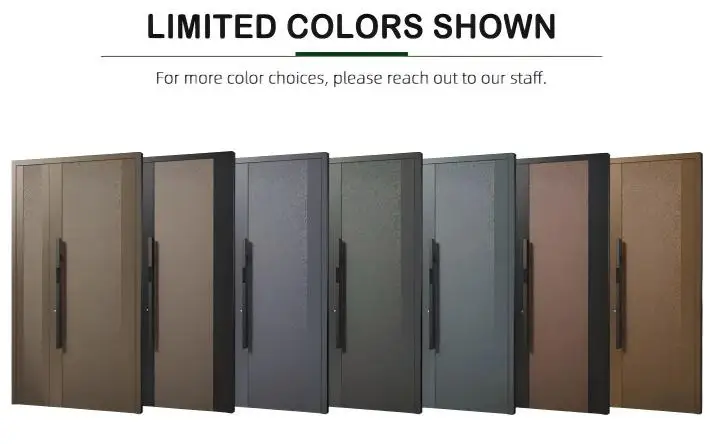
We produce front door double units in aluminum alloy, thermal-break aluminum, and solid wood configurations. Our factory handles custom sizes, colors, glass configurations, and hardware accessories in-house. This means the buyer specifies their requirements, and we adjust our production accordingly — rather than offering a limited catalog of standard sizes.
For buyers who need to adapt front door double units to local building codes, our profile structures and fittings can be adjusted to match regional requirements. A door destined for a hurricane zone can be reinforced with thicker profiles and impact-rated glass. A door for a cold climate market can be built with thermal-break profiles and low-E glazing.
Quality Assurance Aligned with International Testing Standards
Our pre-shipment inspection protocol includes air-tightness, water-tightness, and wind resistance testing — conducted on front door double units, not just single doors. This distinction matters because double door alignment and sealing are more complex than single door configurations.
The testing process follows industry standards, including the AAMA/WDMA/CSA performance requirements and EN 14351-1 test methods. Buyers can request test reports for their specific front door double configurations before shipment.
Export Documentation and Logistics for Double Front Door Shipments
Our experience in foreign trade covers the documentation requirements that international buyers need: packing lists, proforma invoices, and full customs documentation. We handle both FCL (full container load) and LCL (less than container load) shipments, with direct delivery from our factory in China.
For buyers who are new to importing, we provide clear documentation at each stage of the process. For experienced importers, we match their existing documentation workflows.
—
Frequently Asked Questions About Sourcing Double Front Doors
What is the minimum order quantity (MOQ) for front door double units?
MOQ varies by material and configuration. Aluminum front door double units typically have lower MOQs than solid wood doors, because the production process is more standardized. For a specific quote, contact our team with your project details.
Can I get a custom-sized front door double unit that matches my project’s opening?
Yes. Our factory adjusts profile structures and fittings to fit non-standard openings. Size customization is a standard service, not a special request.
How long does production and shipping take for a front door double order?
Aluminum front door double production typically takes 25 to 35 days. Shipping time depends on the destination — typically 15 to 30 days for sea freight. In-house production lines help maintain consistent schedules.
What certifications should I request for local building code compliance?
Key certifications include ISO 9001 for quality management, CE marking for the EU market, SGCC for safety glazing in the US, and NFRC for thermal performance ratings. Our factory can provide documentation to support local code compliance.
Can the supplier handle both FCL and LCL shipments for front door double units?
Yes. FCL is more cost-effective for large orders, while LCL suits smaller quantities. We handle both shipping modes with proper packaging and documentation.
What is the difference between a thermal-break aluminum front door double unit and a standard aluminum front door double unit?
A thermal-break door uses polyamide strips to separate the interior and exterior aluminum sections, breaking the thermal bridge. This improves energy efficiency, reduces condensation, and is better suited for extreme climates. Standard aluminum doors are acceptable in mild climates but perform poorly in thermal extremes.
—
Making the Sourcing Decision
Choose a factory with in-house production if you need consistent quality across multiple orders. Choose a factory with a documented quality management system if you are sourcing for projects with strict compliance requirements. Choose a factory that offers customization if your projects have non-standard dimensions or local code requirements.
The sourcing process for front door double units is not fundamentally different from other manufactured building products. Define your specifications clearly. Verify the factory’s capabilities. Test samples. Inspect during production. Confirm pre-shipment quality. The factory that performs well across these stages is the one worth a long-term relationship.
For buyers who want to discuss their specific front door double requirements — including dimensions, materials, and target market standards — send an inquiry through our contact page.
—
References
- American Institute of Architects. “Home Design Trends Survey.” https://www.aia.org/resources/6415976-home-design-trends-survey
- AAMA/WDMA/CSA 101/I.S.2/A440. “North American Fenestration Standard/Specification for Windows, Doors, and Skylights.” https://www.aamanet.org/
- Consumer Product Safety Commission. “16 CFR Part 1201 — Safety Standard for Architectural Glazing Materials.” https://www.ecfr.gov/current/title-16/chapter-II/subchapter-B/part-1201
- International Organization for Standardization. “ISO 2859-1: Sampling procedures for inspection by attributes.” https://www.iso.org/standard/1141.html
- European Committee for Standardization. “EN 14351-1 — Windows and doors — Product standard.” https://ec.europa.eu/growth/single-market/european-standards/harmonised-standards/construction-products_en