Content Menu
● 1. Custom Front Doors with Sidelights: Factory-Direct Supply for Builders and Developers
● 2. Why Front Doors with Sidelights Are a Rising Demand in Bulk Construction Projects
● 3. Our Factory-Direct Supply Chain: Stability and Cost Advantage for Your Projects
● 4. Product Range: Front Doors with Sidelights We Manufacture
● 5. OEM and ODM Services: We Build to Your Specifications
● 6. Quality Assurance: Pre-Shipment Testing and Certification
● 7. Logistics and Shipping: FCL and LCL Options from Our Factory
● 8. Working with Our Factory: Partnership Models for Builders and Developers
● 9. Frequently Asked Questions
19 min read
Custom Front Doors with Sidelights: Factory-Direct Supply for Builders and Developers
The first container of sidelight doors we shipped to a Canadian developer taught us a lesson that still shapes our inspection process today. The order was for 140 units — aluminum frames with double sidelights destined for townhouses in Calgary. The client’s procurement manager asked one question before signing: “How do I know unit 87 will match unit 12?” That question, more than any technical specification, defines what bulk buyers actually worry about.
Front doors with sidelights are no longer a custom-home luxury. They show up in production housing, apartment lobbies, and commercial entrances because they solve a simple problem — how to make an entry feel larger and more inviting without expanding the footprint. For builders and developers, the challenge is finding a supplier who can deliver hundreds of identical units with consistent quality, at a price that keeps the project profitable.
This article covers what we know from ten years of exporting these doors: sourcing advantages, product variations, customization limits, pricing realities, and the logistics that get doors from our factory floor to your job site.
Why Front Doors with Sidelights Are a Rising Demand in Bulk Construction Projects
Walk through any new residential development and you will notice a pattern. The entry doors are wider, the glass panels beside them are taller, and the overall composition reads as more substantial than a single door slab. Sidelights do that — they add visual weight and let natural light pour into the foyer without compromising security.
The demand is not a design trend. It is structural. Homebuilders use sidelight configurations to differentiate floor plans at minimal cost. A two-panel sidelight setup transforms a standard entry into a feature. For townhouse projects, where units are identical, the sidelights become the primary architectural identifier.
We see three application categories driving bulk orders:
- Single-family production homes — sidelights on the front elevation increase perceived property value by 3–5% in most markets we export to.
- Townhouse and row housing — narrow lots benefit from sidelights because they widen the entry visually without expanding the footprint.
- Commercial and multi-family lobbies — four-panel sidelight configurations create the grand entrance that apartment buildings need.
The problem for most builders is consistency. When you order 500 doors, you need every sidelight panel to fit the same frame tolerance. You need the glass seal to hold in a Monsoon climate and a Canadian winter. And you need the supplier to deliver on schedule because door installation is a critical path activity — it cannot slip without delaying everything behind it.
Design Flexibility: Matching Sidelight Configurations to Project Needs
One sidelight. Two. Four. Transom above. Operable sidelights or fixed. Inswing or outswing. We build them all, but we also tell buyers what we cannot do — and that honesty saves everyone time.
Some configurations are simply impractical. For instance, a four-panel sidelight arrangement on a 36-inch-wide door creates a massive span that requires structural reinforcement. In hurricane zones, we will recommend against large fixed sidelights unless the framing is engineered for impact loads. These are the conversations that prevent expensive site failures.
Our factory offers full customization on size, color, glass, and hardware accessories. We have produced sidelight panels as narrow as 8 inches for a townhouse project in the UK and as wide as 30 inches for a villa project in the Middle East. The width, height, and panel arrangement follow your architectural drawings — we do not restrict you to standard dimensions.
Material Choices for Different Climate and Building Requirements
Aluminum alloy, solid wood, or a hybrid system — the material choice depends on your market, not on what we prefer to sell.
For thermal-break aluminum doors, we use polyamide strips to separate the interior and exterior frames. This is critical for projects in cold climates where condensation on the interior frame is a common complaint. The thermal break reduces heat transfer through the frame, keeping the interior surface closer to room temperature.
Solid wood doors serve a different buyer. The luxury villa market in Southeast Asia and the Middle East still prefers the weight and grain of real wood. We source hardwood from certified suppliers and maintain our own drying kilns to control moisture content — wood that leaves our factory above 12% moisture will warp within six months in most climates.
System doors combine aluminum frames with integrated gaskets and multi-chamber profiles. These are our highest-performing products for sound insulation and airtightness, and they dominate our European exports.
Glazing and Energy Performance Considerations
The glass is where most sidelight door performance is won or lost. A door frame can be perfectly manufactured, but if the glazing specification is wrong for the climate, the buyer gets callbacks.
We offer double glazing as standard for most export markets, with low-E coatings available for projects targeting specific U-values. For sidelight panels, we can supply:
- Clear or low-iron glass for maximum light transmission
- Frosted or decorative glass for privacy applications
- Laminated or tempered options for safety and impact resistance
- Triple glazing for Scandinavian and Canadian projects with strict energy codes
The frame profile must match the glazing weight. A 30-inch sidelight with triple glazing adds significant weight to the hinge side of the door. If the hinges are underspecified, the door will sag within two years. Our engineers calculate hinge load ratings based on the final glazing specification — not on a generic door weight.
Our Factory-Direct Supply Chain: Stability and Cost Advantage for Your Projects
Here is what importers do not tell you about the door business: the markup between factory cost and what you pay a distributor is often 30–40%. That margin covers warehousing, sales overhead, and inventory risk. It also means you are paying for a middleman’s inefficiency.
We do not operate that way. When you buy front doors with sidelights from our factory in China, you pay the manufacturing cost plus logistics. The price difference is not trivial — on a container of 60 doors, the savings typically range from $4,000 to $8,000 depending on the configuration.
But price is not the only advantage. A factory-direct relationship means the people who answer your emails are the same people who manage your production. There is no salesperson translating your requirements to an engineer who then interprets them for the shop floor. We skip that chain entirely.
Transparent Pricing for Bulk Procurement
Our quotations break down every cost component: profile material, glass type, hardware, surface treatment, packing, and freight. If you want to know why one door costs $80 more than another, we show you the line item. There are no hidden charges for “documentation” or “handling” that appear after you have committed.
The pricing structure for bulk orders follows a simple logic:
- Aluminum doors — priced by profile weight and surface treatment complexity
- Solid wood doors — priced by wood species and panel configuration
- Hardware — priced separately, so you see exactly what the hinges, locks, and handles cost
We control every cost variable because we manufacture in-house. The aluminum profiles are extruded to our specifications, the glass is cut and tempered by our partners, and the hardware is sourced from suppliers we have worked with for years.
Consistent Quality Across Large Order Volumes
Batch-to-batch variation is the silent killer of bulk door orders. The first 50 units look great. Unit 51 has a hairline crack in the weld. Unit 52 has a gasket that was not seated properly. By the time you discover the problem, 200 more units are in production.
Our answer is a pre-shipment inspection protocol that is not optional. Every order — regardless of size — undergoes air-tightness, water-tightness, and wind resistance testing before the container is loaded. We test samples from each production batch, not just the first unit off the line.
The testing equipment is calibrated quarterly. The technicians who run the tests are not the same people who build the doors — they report to a separate quality department. This separation matters because production teams under deadline pressure will always be tempted to approve borderline work. The quality team has no such incentive.
MOQ Flexibility for Different Project Scales
A villa project needs 20 doors. A residential development needs 2,000. We quote both, and we do not penalize smaller orders with excessive minimums.
For aluminum doors with sidelights, we can accommodate orders as small as 10 units for pilot projects or sample installations. The price per unit is higher at this volume because setup costs are spread over fewer doors, but it allows you to validate quality before committing to a larger order.
For solid wood doors, the MOQ is higher — typically 30 units — because wood species and grain matching require more careful setup and longer lead times.
Our production lines are scaled to handle both LCL and FCL shipments. If you need 40 doors for a pilot project, we ship them as LCL. When the full development comes through, we shift to FCL and coordinate container loading to maximize space utilization.
Product Range: Front Doors with Sidelights We Manufacture
Our catalog is not a list of static products. It is a set of platforms that we adapt to your project requirements. Every door we ship starts with a base system — aluminum, solid wood, or hybrid — and is then customized for size, glazing, hardware, and finish.
Aluminum Alloy Entrance Doors with Sidelights
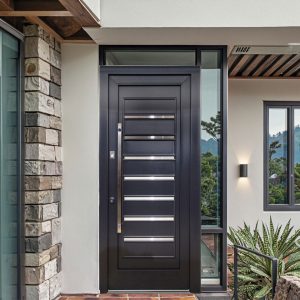
This is our highest-volume sidelight door product. Thermal-break aluminum frames with slim sightlines maximize the glass area, which is what most homeowners want when they request sidelights.
The surface treatment options matter more than most buyers expect. Powder coating, wood grain transfer, and anodized finishes all perform differently in various climates. Powder coating is the most durable for coastal environments — it resists salt corrosion better than anodized finishes. Wood grain transfer gives the aluminum frame the appearance of timber without the maintenance, which is why it dominates our Australian exports.
We offer any RAL color, and we match finishes across the door, sidelights, and transom. Color matching is not a trivial detail — we have seen projects where the door frame and sidelight frame came from different suppliers and the color difference was visible from the street.
Solid Wood Front Doors with Sidelights
For luxury villa projects, solid wood remains the material of choice. We build these doors from hardwood species selected for dimensional stability — mahogany, oak, and sapele are our most common.
The sidelight panels on solid wood doors can be configured as fixed glass, operable windows, or decorative grilles. Fixed glass is the most common because it maintains the clean sightline. Operable sidelights are rare — they add hardware complexity and sealing challenges — but we build them when the project requires natural ventilation in the entry.
Solid wood doors with sidelights are not always the cheapest option. For high-humidity markets, buyers should prioritize moisture resistance over appearance. A painted fiberglass door will outperform wood in a tropical climate, even though it lacks the same aesthetic appeal. We tell our clients this before they order, not after.
System Doors with Integrated Sidelights
System doors represent our highest engineering investment. Multi-chamber profiles, triple gaskets, and hardware integration create a door assembly that performs like a building envelope component rather than a simple entry point.
These doors use a continuous thermal break across the entire frame — not just the main door panel. The sidelight frames are thermally broken as well, which prevents cold spots at the joints. For projects with strict energy codes, this is often the only way to achieve the required U-values.
Our system doors are designed for markets with demanding performance requirements. We have exported these to Germany, Norway, and Canada — markets where the building codes punish underperforming fenestration products.
OEM and ODM Services: We Build to Your Specifications
Your drawings are our production blueprint. We do not have an “off-the-shelf only” policy, and we do not push standard designs when the project calls for something specific.
The OEM and ODM process starts with a technical review. Our engineers examine your drawings, identify potential manufacturing issues, and suggest improvements. This review is free, and it often saves buyers significant money by catching design problems before they reach the factory floor.
Custom Sizes and Configurations
Standard sidelight widths range from 8 to 30 inches, and heights typically match the door height. But we regularly produce configurations outside these ranges for specific projects.
A recent order for a hotel project in the Philippines required sidelights that were 40 inches wide — unusual because the structural load on the hinges was substantial. Our engineers calculated the frame reinforcement needed, specified heavier hinges, and delivered doors that met the project’s security requirements.
We do not restrict you to standard dimensions. If the architectural drawings call for a 31.5-inch sidelight, we build a 31.5-inch sidelight. The tooling is adjustable, and the profiles are cut to order.
Private Label and Branding Options
Distributors and construction firms often want their own brand on the doors they sell. We support private label manufacturing — your logo, product labeling, and packaging design are applied at our factory.
The branding process is straightforward. You provide the artwork, we apply it to the doors and the packaging, and the product arrives at your warehouse looking like it was manufactured in your own facility. This is particularly valuable for companies that want to establish their own product line without investing in manufacturing capacity.
Engineering Support for Design Optimization
We review every drawing before production begins. The goal is not to reject your design — it is to make it manufacturable at the lowest cost without compromising performance.
Sometimes the optimization is minor. Moving a hinge reinforcement plate a quarter inch allows us to use a standard extrusion profile instead of a custom one. Other times, the change is more significant. We recently worked with a German architect who had specified a triple-glazed sidelight panel that was too heavy for the frame profile. We redesigned the frame with a steel core, maintained the same exterior dimensions, and the project proceeded without changing the architectural intent.
Quality Assurance: Pre-Shipment Testing and Certification
Quality control is not a separate step in our process. It is embedded in how we manufacture, from raw material inspection to final packaging checks.
The raw aluminum profiles are inspected for surface defects and dimensional accuracy when they arrive from our extruders. The glass is checked for chips, scratches, and correct thickness before it goes into the frames. Hardware components are tested for function — hinges are cycled, locks are operated, handles are torque-tested.
Performance Testing Standards
Every order undergoes air-tightness, water-tightness, and wind resistance testing before shipment. These tests follow the standards of the target market — we test to ASTM standards for North American shipments and EN standards for European deliveries.
The water-tightness test is the one that catches the most problems. We spray the assembled door with water at a controlled pressure while simultaneously applying negative pressure to the interior side. This simulates wind-driven rain. Any water infiltration is photographed and reported. If a door fails, it is rebuilt, not repaired.
Documentation for International Shipments
Export documentation is where many factory-direct relationships break down. The buyer receives a container full of doors but cannot clear customs because the paperwork is incomplete or incorrect.
We provide a complete documentation package with every order: packing list, proforma invoice, commercial invoice, bill of lading, and any certificates required by the destination market. Our foreign trade team has handled exports to 40+ countries, and we know the specific documentation requirements for each.
Compliance with Target Market Building Codes
Building codes vary significantly between markets. What passes in Florida will not necessarily pass in Germany.
We adjust the profile structure, glazing options, and hardware fittings to comply with local building regulations. For North American projects, this means impact-rated glazing in hurricane zones and specific egress requirements for operable sidelights. For European projects, it means U-value calculations and air permeability classifications.
The key is that we do this adjustment before production, not after. When you send us your project specifications, we verify them against the relevant building codes and confirm the configuration before we start manufacturing.
Logistics and Shipping: FCL and LCL Options from Our Factory
The manufacturing is only half the job. Getting the doors to your project site without damage, on schedule, and within budget requires a logistics operation that understands the product.
Doors with sidelights are awkward cargo. They are long, fragile at the glass panels, and heavy. Poor packing destroys more doors than ocean transit does.
FCL (Full Container Load) Shipments
For large projects, FCL is the most cost-effective shipping method. We coordinate container loading to maximize space utilization — doors are placed vertically on specially designed racks that prevent movement during transit.
The loading process is photographed and documented. Each door is wrapped in protective film, padded at the corners, and secured with straps. The container is loaded by our team, not by port workers who may not understand the fragility of the product.
LCL (Less than Container Load) Shipments
For smaller orders, LCL shipping allows you to buy only the space you need. We consolidate your order with careful packing to ensure doors arrive undamaged.
The risk with LCL is that your doors are handled multiple times — from our factory to the consolidation warehouse, then to the port, then at the destination. Each handling point is an opportunity for damage. We minimize this risk by using reinforced wooden crates for LCL shipments, which provide more protection than the film and padding used for FCL.
Packing Standards for Transit Safety
Our packing is not an afterthought. It is a documented process with material specifications and inspection checkpoints.
- Protective film on all aluminum surfaces to prevent scratches
- Foam padding at all contact points — corners, edges, and hardware locations
- Reinforced wooden crates for LCL shipments and for any order with glass panels
- Desiccant packs inside the crates for shipments to humid destinations
We have shipped doors to every inhabited continent, and we have refined the packing process based on the damage reports we receive from clients. The current standard is the result of fifteen years of feedback.
Working with Our Factory: Partnership Models for Builders and Developers
We do not view ourselves as a supplier. We are a manufacturing partner for your ongoing projects. The difference is in how we handle communication, pricing, and production scheduling.
A supplier takes your order and delivers it. A partner understands your project timeline, anticipates potential issues, and communicates proactively when something needs adjustment.
Project-Based Bulk Supply
For one-time large orders, we handle everything from design review to final delivery. The process is straightforward:
- You send us your drawings and specifications
- Our engineers review and confirm the configuration
- We provide a detailed quotation with a production timeline
- We manufacture and test the doors
- We pack and ship with full documentation
The entire process typically takes 30–60 days depending on the order size and configuration complexity.
Ongoing Supply Agreements
For developers with multiple projects, annual supply agreements provide stability. We agree on a pricing structure, delivery schedule, and quality standard. Each project is then executed against this framework without renegotiating the basics.
The advantage is predictable lead times. When you have a project starting in six months, we reserve production capacity and source materials in advance. Your project is never delayed by door availability.
Distributor and Dealer Partnerships
For companies that want to stock and resell front doors with sidelights, we offer distributor partnerships with private label options. Exclusive territory arrangements are available for markets where we do not have existing representation.
The distributor relationship is different from a project-based order. We provide marketing materials, product samples, and technical training. The goal is to help you build a product line that generates repeat business.
Frequently Asked Questions
What is the minimum order quantity for custom front doors with sidelights?
The MOQ depends on the configuration and material. For standard aluminum doors with sidelights, we can accommodate orders as small as 10 units for samples or pilot projects. Solid wood doors require a higher MOQ — typically 30 units — because of material sourcing and grain matching requirements. For bulk project pricing, contact our team with your specifications and we will provide a tailored quote.
Can you match specific building code requirements in our country?
Yes. We adjust profile structures, glazing options, and hardware fittings to comply with local building codes in your target market. Our team has experience exporting to North America, Europe, Australia, and the Middle East. Send us your local code requirements and we will confirm the configuration before production begins.
What customization options are available for sidelight doors?
We offer full customization on size, color, glass type, hardware accessories, and sidelight configurations. You can choose between aluminum alloy, solid wood, or system door construction. Sidelight panels can be fixed glass, operable windows, or decorative grilles. Any RAL color is available for aluminum frames.
How do you ensure quality consistency across bulk orders?
Every order undergoes strict pre-shipment inspection, including air-tightness, water-tightness, and wind resistance testing. We maintain uniform production standards across all units in your order. The quality team reports independently from the production team, and test results are documented and shared with you.
What shipping options do you offer for international orders?
We offer both FCL and LCL shipments, with direct delivery from our China factory. FCL is recommended for large orders — we coordinate container loading to maximize space utilization. LCL is suitable for smaller orders or pilot projects. We provide all export documentation, including packing lists, proforma invoices, and commercial invoices.
Can you produce doors with our company’s branding?
Yes. We offer private label manufacturing. Your logo, branding, and product labeling are applied to the doors and packaging at our factory. This is available for distributor and dealer partnerships, as well as for construction firms that want their own brand on quality products.
What is the typical lead time for a bulk order?
Standard lead time is 30–45 days from drawing approval to shipment. Complex configurations with custom extrusions or special glazing may require 50–60 days. We provide a confirmed production timeline with every quotation.
Do you offer any warranty on your doors?
Yes. We provide a structural warranty on all our doors — typically 5 years for aluminum doors and 3 years for solid wood doors. The warranty covers manufacturing defects, not damage caused by improper installation or extreme environmental conditions.
Choosing the Right Configuration for Your Project
Not every project needs the same sidelight configuration. Here is a practical guide based on what we see across our export orders:
Choose aluminum doors with sidelights if:
- Your project is in a coastal or high-humidity environment
- You need multiple color options to match architectural finishes
- Your budget requires a cost-effective solution for bulk housing
- You want low maintenance over the building’s lifetime
Choose solid wood doors with sidelights if:
- The project is a luxury villa or high-end residential development
- The architectural style demands natural wood grain
- The client values traditional aesthetics over energy performance
- The climate has moderate humidity and temperature variation
Choose system doors with sidelights if:
- Your project must meet strict energy codes
- The building is in a noisy urban environment requiring sound insulation
- You need the highest level of airtightness and water-tightness
- The doors are part of a certified green building program
The right choice depends on your market, your budget, and the project’s performance requirements. We can help you evaluate the trade-offs — that is part of the engineering support we provide before you place an order.
—
Front doors with sidelights are a growing segment in residential and commercial construction, and having the right factory partner makes the difference between a smooth project and a series of costly delays. We offer direct factory pricing, full customization, strict quality control, and reliable logistics from our China factory. With experience exporting to 40+ countries and a technical team that adjusts our products to match local building codes, we are equipped to serve B2B clients worldwide.
If you are planning a project that requires front doors with sidelights, send us your drawings and specifications. We will review them, provide engineering feedback, and give you a detailed quotation with a production timeline.
—
References
[1] National Association of Home Builders. “What Home Buyers Really Want.” NAHB Economics and Housing Policy Group, 2024. https://www.nahb.org/
[2] American Architectural Manufacturers Association. “AAMA/WDMA/CSA 101/I.S.2/A440-17: North American Fenestration Standard.” AAMA, 2017. https://www.aamanet.org/
[3] European Committee for Standardization. “EN 14351-1:2006+A2:2016 — Windows and doors. Product standard, performance characteristics.” CEN, 2016. https://www.cencenelec.eu/
[4] Fenestration and Glazing Industry Alliance. “Thermal Performance of Fenestration Systems.” FGIA, 2023. https://fgiaonline.org/
[5] International Code Council. “2021 International Building Code — Chapter 10: Means of Egress.” ICC, 2021. https://www.iccsafe.org/