Key Takeaways: What B2B Buyers Need to Know First
The core difference between exterior wood double doors and exterior fiberglass double doors is how each material handles moisture, movement, and maintenance. Wood — whether solid or engineered — offers repairability, authentic grain, and full customization of size, color, and glass. Fiberglass offers a factory-applied finish that resists dents and rot with less routine upkeep, but it is harder to modify after production and typically ships in a narrower range of standard sizes.
For B2B procurement, the decision usually comes down to four variables: the climate the doors will face, the architectural specification, the maintenance regime the end user will accept, and the total landed cost per opening. Size and configuration follow from the rough opening and the structural header, not the other way around.
This guide walks through material selection, standard and custom dimensions, finish and glazing choices, cost drivers, and a procurement checklist for buyers sourcing exterior double doors in volume.
Material Deep Dive: Wood vs Fiberglass Exterior Double Doors
When buyers compare double doors exterior wood against fiberglass alternatives, they are really comparing three sub-materials: solid wood, engineered wood, and fiberglass composite.
Solid wood — typically mahogany, oak, teak, cedar, or knotty alder — is milled from a single species. It machines cleanly, accepts deep stains, and can be sanded and refinished repeatedly. Its weakness is movement: solid wood expands and contracts with humidity, so stiles and rails need proper sealing on all six faces. In coastal or freeze-thaw climates, an unsealed solid wood door will show joint separation faster than any other option.
Engineered wood uses a stable core — often a laminated or finger-jointed substrate — with a wood veneer or solid wood face. The core resists warping better than solid stock, which matters on wide leaves where a single slab would be prone to bowing. This is why engineered construction is common on double doors exterior wood in the 72-inch width class.
Fiberglass is a molded skin over a core, usually with a wood or composite frame. It does not absorb water, so rot and insect damage are effectively removed from the maintenance equation. The trade-off is that the surface cannot be sanded back to bare material — a deep scratch or impact crack is a repair job, not a refinish. Fiberglass also has a limited ability to be re-milled on site, so any size change after delivery is impractical.
For a humid or coastal project, engineered wood with a marine-grade finish system or fiberglass will both outperform untreated solid wood. For a dry, protected entry where the client wants a specific grain and stain match, solid wood remains the reference point.
Terms buyers should know
| Term | What it means | Why it matters when buying |
|---|---|---|
| Rough opening | The framed gap in the wall before the door unit is installed | Determines the maximum door size you can order; measure it before specifying |
| Thermal break | An insulating barrier between the inner and outer metal frame | Reduces heat transfer on aluminum-framed units; less relevant to all-wood doors |
| U-factor | The rate of heat loss through the whole door assembly | Varies by glazing, core, and frame — never assume one value fits all units |
| Pre-hung | The door leaves delivered already mounted in their frame | Cuts site labor and installation error; affects shipping volume and packing |
Size and Configuration Guide: 60 x 80, 72 x 80, 6-Foot, and 6/0 Double Doors
Exterior double doors are sold by the overall unit size, not by individual leaf. A 60 x 80 double door exterior is two 30-inch leaves in an 80-inch-tall frame; a 72 x 80 double door exterior is two 36-inch leaves at the same height. The “6/0” and “6-foot” shorthand refers to the nominal 6-foot width class, which in practice maps to the 72-inch opening. A 60-inch double door exterior is the narrower pairing, common where wall space or a hallway constrains the opening.
The relationship between nominal size and rough opening is where most sourcing errors happen. The rough opening must be larger than the door unit by the amount the frame and shimming require — this varies by frame type and wall construction. Buyers should confirm the rough opening dimension with the project’s framing plan before locking a door size, and should verify structural header requirements with a qualified professional, since a wide double opening carries more load than a single door.
Configuration choices that follow from size:
- Active / inactive leaf. One leaf operates; the other is fixed by flush bolts. This is standard on most patio double doors exterior units.
- French (both active). Both leaves swing, useful where frequent two-leaf access is needed.
- Sidelite or transom add-ons. These extend the unit beyond the nominal width or height and must be included in the rough opening calculation.
For non-standard openings, custom sizing is normal in the wood category. Fiberglass is more often constrained to catalog dimensions, which is a real limitation on renovation projects where the existing opening cannot be reframed.
Color, Finish, and Glass Options for Exterior Patio Double Doors
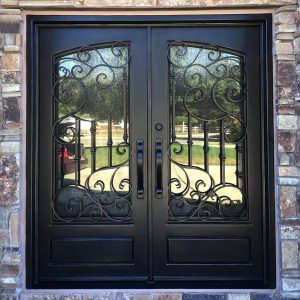
Color choice is not purely aesthetic on exterior units — darker finishes absorb more solar heat, which accelerates finish degradation and, on solid wood, increases surface movement. Black double doors exterior are a strong architectural statement and work well on modern and transitional facades, but in high-sun, high-temperature climates they will need more frequent refinishing than a lighter tone. White double doors exterior suit traditional, coastal, and farmhouse styles and reflect more heat, which is easier on the finish.
Natural wood tones remain the default for stained entries. The stain system matters more than the color: a penetrating stain plus a UV-resistant topcoat protects the substrate, while a film-forming paint can trap moisture if the edges are not sealed.
Glazing drives both appearance and performance. Common options for patio double doors exterior include:
- Clear insulated glass — maximum light, baseline thermal performance.
- Low-E coated glass — reduces solar heat gain; the coating type should be matched to the climate zone.
- Tempered or laminated safety glass — required in many jurisdictions for doors and sidelites; buyers should confirm local requirements.
- Decorative or divided lites — grilles and leaded patterns; these add cost and cleaning complexity.
A practical note on cheap double doors exterior with glass: the glass is rarely the weak point. The failure points are the seal between glass and frame, the finish on the bottom rail, and the hardware. Buyers evaluating low-cost units should inspect those three areas first.
Cost vs Value: Evaluating Cheap Double Doors Exterior with Glass
Exterior patio double doors cost is driven by five main factors: material, size, glazing, finish system, and hardware. Because regional labor, freight, and market conditions move these numbers, treat any single price as a range rather than a fixed figure.
The cost drivers, in rough order of impact:
- Material. Solid hardwood and engineered wood with a hardwood face sit at the higher end; fiberglass sits mid-to-high depending on the skin and core; lower-grade composites sit at the entry level.
- Size. Wider units use more material and require heavier hardware and framing. A 72 x 80 unit costs more than a 60 x 80 unit of the same construction.
- Glazing. Insulated Low-E and safety glass add cost over single clear panes; decorative glazing adds more.
- Finish. A multi-coat factory finish costs more up front but reduces on-site labor and callbacks.
- Hardware. Multipoint locking, quality hinges, and handlesets are a meaningful share of unit cost and a major determinant of long-term function.
The all-in cost that buyers often underestimate is finishing and installation labor. A door that arrives unfinished requires site staining, sealing, and cure time — which can exceed the price difference between a budget unit and a factory-finished one. When comparing quotes, normalize them to a delivered, finished, installed cost per opening rather than a unit price.
This is where “cheap” becomes a trap. A low unit price with an unfinished surface, thin hardware, and no test documentation usually costs more over the building’s life than a mid-priced unit with a factory finish and verified performance data.
Comparison Table: Exterior Double Door Options at a Glance
| Criterion | Solid Wood | Engineered Wood | Fiberglass |
|---|---|---|---|
| Moisture / rot resistance | Low unless sealed and maintained | Moderate to good with sealed edges | High |
| Dimensional stability | Moves with humidity | Stable core resists warping | Stable |
| Repairability | High — sand and refinish | Moderate — veneer limits sanding | Low — surface damage is a panel repair |
| Custom sizing | Full | Full | Limited to catalog or tooling |
| Finish options | Unlimited stain and paint | Wide stain range | Factory finish, limited recolor |
| Maintenance | Regular refinishing | Periodic refinishing | Occasional cleaning |
| Typical best fit | Protected entries, dry climates | Wide leaves, humid climates | Coastal, high-exposure, low-maintenance projects |
Sourcing and Procurement Recommendations for B2B Buyers
Before placing a bulk order for double doors exterior wood, work through a fixed checklist rather than a supplier’s sales sheet.
Supplier evaluation framework. Ask for the factory’s own process documentation, not just a product brochure: how air-tightness, water-tightness, and wind resistance are tested before shipment, what the QC pass criteria are, and whether the profile structure and fittings can be adjusted to match the target market’s building codes. A supplier that can answer these in writing is a different risk category from one that only quotes a price.
MOQ and lead time. Confirm the minimum order quantity per size and finish, and whether mixed-size containers are allowed. Lead time should be quoted from deposit and confirmed order, not from inquiry.
Documentation. For international trade, the supplier should routinely issue a packing list, proforma invoice, and full customs documents. Missing or inconsistent paperwork is one of the most common causes of port delays.
Shipping terms. FCL and LCL both have a place: FCL for full-project orders, LCL where a buyer is testing a new specification or supplying a smaller site. Confirm how units are crated, since double doors are heavy and damage in transit is usually a packing problem, not a manufacturing one.
This is where the factory-direct model changes the economics. As a manufacturer, our approach at Jusen Door and Windows is built around the same checklist buyers use. We supply directly from our factory, which removes middleman markup and keeps pricing competitive without cutting the specification. We offer full customization on size, color, glass, and hardware, and we adjust the profile structure and fittings to align with the building codes of the target market. Every unit goes through pre-shipment inspection covering air-tightness, water-tightness, and wind resistance, and we handle the export documentation — packing list, proforma invoice, and customs papers — as standard. For buyers who want to compare a specific specification against a quote, Talk to Our Team with your rough opening dimensions and finish requirements, or review our full product range and contact page to start a project file. Sizing conventions are covered in more detail in our size guide, and cost variables in our pricing page.
FAQ: Exterior Double Door Buying Questions Answered
What is the difference between exterior wood double doors and exterior fiberglass double doors?
Wood doors are milled from solid or engineered stock, can be sanded and refinished, and can be custom-sized. Fiberglass doors are molded skins over a core, resist moisture and rot without routine refinishing, but are harder to modify after production and usually come in a narrower size range.
What sizes are available, including 60 x 80, 72 x 80, and 6-foot options?
Standard double units include 60 x 80 (two 30-inch leaves) and 72 x 80 (two 36-inch leaves, often called 6/0 or 6-foot). Custom widths and heights are available in wood and engineered wood construction; fiberglass is more often limited to catalog sizes.
Are black or white double doors exterior suitable for all architectural styles?
Both work across styles, but they behave differently in service. Black absorbs more solar heat and may need more frequent refinishing in high-sun climates; white reflects heat and suits traditional and coastal facades. The finish system matters more than the color.
How much do exterior patio double doors cost, and what affects the price?
Pricing varies by region and market, so buyers should treat quotes as ranges. The main drivers are material, size, glazing, finish system, and hardware. Total cost of ownership also includes finishing and installation labor, which is why factory-finished units often compare better than their unit price suggests.
What should B2B buyers check before ordering double doors exterior wood in bulk?
Confirm the rough opening and header requirements, lock the size and finish per unit, verify the supplier’s pre-shipment test process, confirm MOQ and lead time, and require a packing list, proforma invoice, and full customs documents before the deposit.
Can exterior double doors be customized for size, color, glass, and hardware?
Yes. Wood and engineered wood units can be produced to custom dimensions, stained or painted to a specified color, glazed with the required glass type, and fitted with the specified hardware — including configuration adjustments to match local building codes.