Content Menu
● 1. What Are Entrance Doors with Side Panels and Where Are They Used?
● 2. Frame Materials: Solid Wood, Aluminum, and Thermal-Break Aluminum
● 3. Glass and Glazing Specifications for Side Panels
● 4. Hardware, Hinges, and Multi-Point Locking Systems
● 5. Performance Criteria and Testing Standards for Entrance Door Assemblies
● 6. How to Evaluate Entrance Doors with Side Panels Suppliers
● 7. Key Quality Indicators for Entrance Doors with Side Panels Buyers
● 8. Relevant Industry Standards and Certifications
● 9. Our Manufacturing Capabilities
● 10. Production Process: From Raw Material to Finished Entrance Doors with Side Panels
● 11. Quality Control: Our Multi-Stage Inspection Process
● 12. Customization and OEM/ODM Options
● 13. Ordering Process: MOQ, Lead Time, and Shipping
● 14. Project Applications and Case Examples
● 15. Questions to Ask Before Ordering
27 min read
The procurement manager for a Dubai villa developer had a problem. The architectural drawings specified a 1,800 mm wide entrance assembly — a 900 mm door leaf paired with a 900 mm fixed side panel. The first supplier quoted a price that seemed reasonable. The second supplier asked for the project’s wind load requirements and the local municipality’s thermal insulation code. The first supplier lost the order. This is what separates serious entrance door sourcing from guesswork.
Entrance doors with side panels are not a single product. They are a system — a door leaf, one or more fixed glazed panels, a structural frame that ties them together, and hardware rated for the combined weight and wind exposure. When buyers treat them as a single SKU, they miss the details that cause field failures: condensation between glass layers, air leakage at the mullion joint, or hinges that sag under the weight of a full-height sidelight.
This guide covers what a B2B buyer needs to know before requesting a quotation — configurations, materials, performance testing, supplier evaluation, and the cooperation models available from manufacturing partners.
What Are Entrance Doors with Side Panels and Where Are They Used?
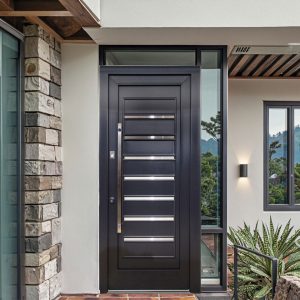
Entrance doors with side panels — also called door and sidelight assemblies — consist of a hinged door leaf flanked by one or two fixed glazed panels. The side panels are non-operable; their purpose is to expand the entrance’s visual width and allow natural light into the foyer without compromising the door’s security or insulation.
Common configurations include:
- Single door + one side panel — the most common residential configuration. The side panel is typically installed on the hinge side or the lock side, depending on traffic flow.
- Single door + two side panels — used when the entrance opening is wide enough to accommodate panels on both sides. Common in custom villas and high-end commercial spaces.
- Double doors + flanking panels — a wide assembly used in commercial storefronts, hospitality entrances, and luxury residential projects.
- Door + side panel + transom — adds a horizontal glazing unit above the door. The transom increases daylight penetration and can make a standard ceiling height feel taller.
Side panels are not decorative additions. They are structural components that must transfer wind loads from the glazing into the building structure. A poorly engineered sidelight frame will rack, distort, and eventually leak — even if the door leaf itself performs perfectly.
In 2024–2025, three demand drivers are pushing more projects toward door + sidelight configurations:
- Daylighting requirements in green building standards (LEED v4.1, BREEAM, WELL) encourage larger glazing areas in entrances.
- Energy efficiency regulations in the EU (EPBD), North America (ENERGY STAR), and parts of Asia now require thermal-break frames and insulated glass in entrance assemblies — sidelights included.
- Architectural preference for wider, more inviting entrances in residential and hospitality projects.
The market has shifted from wood-only assemblies to aluminum and thermal-break aluminum systems. Wood remains popular for interior doors and certain traditional exterior styles, but for exterior entrances with side panels, aluminum dominates because of its dimensional stability, low maintenance, and compatibility with insulated glazing units.
Frame Materials: Solid Wood, Aluminum, and Thermal-Break Aluminum
The frame material determines the assembly’s thermal performance, structural rigidity, maintenance requirements, and lifespan. There is no single “best” material — the right choice depends on the project’s climate, architectural style, and budget.
Solid Wood Doors with Side Panels
Solid wood entrance doors with side panels are specified primarily for traditional and heritage-style projects. Oak, mahogany, and meranti are the most common species for exterior use.
Advantages:
- Aesthetic warmth that cannot be replicated in metal
- Can be carved or profiled for period-accurate detailing
- Naturally insulative — wood has a U-value around 0.13 W/m²K per 100 mm of thickness
Disadvantages:
- Requires periodic refinishing (varnish or paint) every 2–4 years
- Susceptible to warping and cracking if moisture content is not controlled during manufacturing
- Heavy — a solid oak door with a full-height side panel can exceed 120 kg, requiring heavy-duty hinges
- More expensive than aluminum for equivalent performance
Wood door + sidelight assemblies are the most demanding to manufacture correctly. The frame must be engineered to allow for wood movement — wood expands and contracts with humidity changes, and a rigidly fixed side panel will eventually crack the joinery. Buyers in humid climates (Southeast Asia, coastal regions) should be cautious with wood sidelight assemblies unless the manufacturer demonstrates experience with moisture stabilization.
Standard Aluminum Entrance Doors
Standard (non-thermal-break) aluminum doors are the budget option. The frame is a single extruded aluminum profile with no thermal separation.
Advantages:
- Lower cost than thermal-break or wood
- Lightweight — easier to install and less load on the building structure
- Corrosion-resistant — suitable for coastal environments
- Low maintenance — powder-coated finish lasts 15–20 years
Disadvantages:
- Poor thermal performance — U-value typically 4.0–5.0 W/m²K for the frame
- Condensation forms on the interior surface in cold climates
- Not compliant with most modern energy codes for exterior entrances
Standard aluminum is acceptable for interior applications, unheated spaces, or projects in mild climates with no energy code requirements. For exterior entrances in climates with significant heating or cooling loads, it is not a defensible specification.
Thermal-Break Aluminum Doors with Side Panels
Thermal-break aluminum uses two separate aluminum extrusions joined by polyamide strips (typically 24–34 mm wide) to interrupt the thermal bridge. This construction is now the default specification for energy-conscious projects.
Advantages:
- U-value range: 1.1–2.0 W/m²K depending on profile depth and glazing
- Condensation resistance significantly better than standard aluminum
- Structural rigidity comparable to standard aluminum
- Available in the same range of powder-coated and anodized finishes
Disadvantages:
- Higher cost than standard aluminum (approximately 20–35% more)
- Requires precise manufacturing — the polyamide strips must be crimped correctly or the frame will lose its thermal performance
The choice between materials is not purely technical. A project in Dubai with an annual average temperature of 28°C needs different thermal performance than a project in Stockholm. The procurement framework in Section 4 will help buyers match material choices to project requirements.
Glass and Glazing Specifications for Side Panels
The side panel is essentially a fixed window in a door frame. Its glazing specification is often where the entire assembly’s performance succeeds or fails. Three factors matter: safety, thermal performance, and solar control.
Safety Glass Requirements
Building codes in most jurisdictions require tempered or laminated glass in sidelights near entryways. The reason: a person falling through a glass panel adjacent to a door can be severely injured by standard annealed glass shards.
- Tempered glass — heat-treated to be 4–5 times stronger than annealed glass. When it breaks, it crumbles into small, relatively harmless pieces. Required by code in many jurisdictions for sidelights within a certain distance of the door.
- Laminated glass — two or more glass layers bonded with a PVB (polyvinyl butyral) interlayer. When broken, the glass stays adhered to the interlayer. Provides better security than tempered glass because it resists penetration.
- Combination — tempered-laminated glass (tempered glass laminated together) provides both safety and security. Common in commercial entrances and high-end residential projects.
For side panels in commercial buildings, laminated glass with PVB interlayers is the recommended specification. It addresses both safety code requirements and security concerns — a would-be intruder cannot simply smash the glass and reach through to unlock the door.
Insulated Glass Units (IGUs)
Side panels in modern entrance assemblies use double or triple-glazed IGUs for thermal performance.
| Glazing Type | U-value (W/m²K) | Argon Fill | Best For |
|---|---|---|---|
| Single glazing | 5.8 | N/A | Unheated spaces, mild climates |
| Double glazing, clear | 2.7–2.9 | No | Budget projects, moderate climates |
| Double glazing, low-E + argon | 1.4–1.6 | Yes | Standard energy-efficient projects |
| Triple glazing, low-E + argon | 0.8–1.0 | Yes | Passive house, cold climates |
Low-E (low-emissivity) coatings are microscopic metallic layers applied to the glass surface that reflect infrared radiation while allowing visible light through. A low-E coating can reduce heat loss through the glass by 30–50% compared to uncoated glass.
The spacer system — the component that separates the two glass panes — also matters. Standard aluminum spacers conduct heat and create condensation at the glass edge. Warm-edge spacers (stainless steel or plastic) reduce this effect and improve the overall U-value by 0.1–0.3 W/m²K.
Solar Control and Aesthetics
For projects in sunny climates, solar control is as important as thermal insulation. Options include:
- Reflective glass — mirrors exterior light, reducing solar heat gain. Can make a building look cold or commercial.
- Tinted glass — absorbs solar radiation. Bronze, gray, and green are standard tint colors.
- Frosted or decorative glass — obscures visibility for privacy. Sandblasted, acid-etched, or patterned glass are options for side panels in bathrooms or street-facing entrances.
- Smart glass — electrically switchable between transparent and opaque. Expensive, but increasingly specified in hospitality projects.
The glass specification for side panels should be decided in conjunction with the door’s glazing — mismatched glass between the door leaf and side panel looks unprofessional and can cause thermal stress at the mullion joint.
Hardware, Hinges, and Multi-Point Locking Systems
Hardware is the most underestimated component of entrance door assemblies. A door with side panels is heavy — the combined weight of the door leaf, side panel frame, and glazing can easily exceed 150 kg. Standard residential hinges will not survive this load.
Hinges for Door + Sidelight Assemblies
Heavy-duty hinges rated for the specific door weight are mandatory. For doors over 80 kg, buyers should specify:
- Ball-bearing hinges — reduce friction and wear at the pivot point
- Stainless steel or brass construction — corrosion resistance in exterior applications
- Three hinges minimum — two is insufficient for a full-height door with sidelights
The hinge must be matched to the door frame material. Aluminum doors typically use welded or screw-on hinges with stainless steel pins. Wood doors require mortised hinges that are recessed into both the door and frame.
Multi-Point Locking Systems
A multi-point locking system engages the door at multiple points along the edge — typically 3 to 5 locking points — rather than a single latch. Benefits for door + sidelight assemblies:
- Better sealing — the door is pulled evenly against the frame gaskets, improving air-tightness
- Increased security — a pry bar must defeat multiple locking points instead of one
- Reduced warping — even pressure across the door height prevents the leaf from bowing
For commercial entrances, additional hardware options include panic bars (exit devices), electromagnetic locks, and access control integration. These should be specified in the project brief, not retrofitted after installation.
Adjustable Fittings and Profile Structures
One procurement consideration that international buyers often miss: building codes differ between markets. A door manufactured to European standards (EN) may not meet North American code requirements (ASTM/IBC) or vice versa. Buyers should confirm that the manufacturer can adjust:
- Profile depths — to meet local thermal performance requirements
- Gasket types and placement — to meet air and water infiltration limits
- Hardware configurations — to match local locking and access requirements
- Glazing options — to comply with local safety glass codes
This is not a standard capability. Many factories produce only for their domestic market and cannot adapt to foreign codes. Buyers should verify this capability before placing an order.
Performance Criteria and Testing Standards for Entrance Door Assemblies
The performance of an entrance door with side panels is verified through standardized testing. These tests are not bureaucratic formalities — they predict real-world behavior under wind, rain, and temperature extremes.
Air-Tightness, Water-Tightness, and Wind Load Resistance
Three core performance tests define the quality of an entrance assembly:
| Test | European Standard | ASTM Equivalent | What It Measures |
|---|---|---|---|
| Air permeability | EN 12207 | ASTM E283 | Volume of air passing through the closed assembly |
| Water tightness | EN 12208 | ASTM E547 | Resistance to water penetration under wind-driven rain |
| Wind load resistance | EN 12210 | ASTM E330 | Structural integrity under wind pressure |
Air-tightness — Measured in cubic meters per hour per square meter of facade area at a given pressure differential. Classes range from 1 (lowest) to 4 (highest). For entrance doors, Class 3 or 4 is recommended — air leakage causes energy loss, drafts, and dust infiltration.
Water-tightness — Measured by exposing the assembly to water spray while applying air pressure. Classes range from 1A to 9A (EN). Coastal areas and high-rise buildings need higher classes. A Class 6A or 7A rating is typical for good-quality entrance assemblies.
Wind load resistance — The assembly must withstand specified wind pressures without permanent deformation or glass breakage. The required class depends on building height and local wind zone. The side panel is the critical element — it has a large surface area and transfers wind load directly to the frame.
Side panels are often the weakest point in an entrance assembly because they are large, fixed glazing areas with no operable elements to distribute stress. Proper frame design — particularly the mullion joint where the door frame meets the side panel frame — is what prevents failure. A poorly designed mullion will twist under wind load, breaking the seal and allowing water ingress.
Thermal Performance and Condensation Resistance
U-value — The thermal transmittance of the entire assembly, measured in W/m²K. Lower is better. For entrance doors with side panels:
- ≤ 2.0 W/m²K — reasonable for standard projects in moderate climates
- ≤ 1.4 W/m²K — good for energy-conscious projects
- ≤ 0.8 W/m²K — required for passive house certification
The U-value of the assembly is not the same as the U-value of the frame or the glass. It is a weighted average that depends on the frame-to-glass ratio. A door with a large side panel has a higher glass area, so the glass U-value matters more. Buyers should request the whole-assembly U-value, not just the frame or glass U-value.
Condensation resistance — Measured by the temperature index (fRsi) or condensation resistance factor (CRF). A higher value means less condensation on interior surfaces in cold weather. Condensation on entrance doors is not just an aesthetic issue — it causes mold, rots wood frames, and damages floors. The frame-to-glass junction is the most vulnerable point.
Security and Burglary Resistance
European standard EN 1627 defines six resistance classes for burglar-resistant doors:
| Class | Resistance Level | Typical Use |
|---|---|---|
| RC1 | Basic | No special security requirement |
| RC2 | Low | Standard residential |
| RC3 | Moderate | High-value residential, ground floor apartments |
| RC4 | High | Commercial, sensitive areas |
| RC5–6 | Very high | Banks, government buildings |
For entrance doors with side panels, the sidelight is the security weak point. A burglar can smash the glass and reach through to unlock the door. Solutions include:
- Laminated glass in the side panel (PVB interlayer resists breakage)
- Security film applied to the interior surface
- Mullion design that prevents the glass from being removed from outside
- Anti-pry hardware on the door leaf
RC2 is the minimum recommended for exterior entrance doors in residential applications. RC3 is appropriate for ground-floor entrances and commercial buildings.
How to Evaluate Entrance Doors with Side Panels Suppliers
The evaluation framework below is designed for buyers who need to compare suppliers objectively. It is not a checklist of nice-to-haves — these are the criteria that separate reliable manufacturers from trading companies or low-capability workshops.
Step 1: Verify Manufacturing Capability
Ask for third-party test reports. In-house test claims have limited credibility. A reputable manufacturer will provide test reports from accredited laboratories (e.g., TÜV, SGS, Intertek) that verify air-tightness, water-tightness, and wind load performance.
Check the factory’s production equipment. Entrance doors with side panels require CNC machining centers for precise frame fabrication, glass cutting and tempering lines, and assembly stations with proper quality control checkpoints. A factory that outsources its frame fabrication or glass processing has less control over quality.
Confirm the factory has export experience. A manufacturer that only sells domestically may not understand the documentation requirements for international shipping. Ask for examples of export packing lists, proforma invoices, and customs documents.
Step 2: Evaluate Performance Against Your Project Requirements
Provide the supplier with your project’s specific performance targets — not just the dimensions. A competent manufacturer will respond with:
- A calculation of the assembly’s U-value based on your specified frame and glass
- A statement of the air-tightness, water-tightness, and wind load class they can achieve
- Recommendations for glass and hardware based on your climate and security requirements
If the supplier cannot answer these questions, they are not engineering their products — they are assembling components without understanding the performance implications.
Step 3: Assess Production Capacity and Lead Times
For bulk project supply, the factory’s production capacity determines whether they can meet your delivery schedule. Ask:
- What is the monthly production capacity for entrance doors with side panels?
- What is the current order backlog?
- How are production schedules managed for large orders?
A factory with a 2-month backlog may not be able to deliver in 6 weeks, regardless of what they promise in the quotation.
Step 4: Compare Total Cost, Not Just Unit Price
The unit price is only one component of the total cost of ownership. Buyers should compare:
| Cost Component | What to Check |
|---|---|
| Unit price (FOB or CIF) | What is included in the price? |
| Packing costs | Are doors packed in wooden crates suitable for sea freight? |
| Insurance | Who covers transit damage? |
| Customs and duties | What documentation is needed for your country? |
| Installation costs | Does the design allow for efficient installation? |
| Warranty claims | How much does it cost you if a product fails? |
The cheapest unit price often results in higher total cost when packing, freight, and warranty risks are factored in.
Red Flags: Avoid Suppliers Who…
- Cannot provide third-party test reports — they may not actually meet the performance classes they claim
- Quote without asking about your project requirements — a quotation for a door with side panels requires knowing dimensions, climate, and performance targets
- Offer unlimited customization without engineering input — some configurations are not structurally sound; a competent manufacturer will push back
- Cannot explain their quality control process — if they cannot describe their inspection procedures, they likely do not have meaningful ones
- Promise unrealistic lead times — a fully custom door + sidelight assembly with specialized glass typically requires 4–8 weeks; anything less than 2 weeks for a custom order should be questioned
Key Quality Indicators for Entrance Doors with Side Panels Buyers
Beyond the performance tests discussed in Section 3, several quality indicators are visible during factory evaluation or sample inspection.
Frame Construction Quality
- Corner joints — Are they welded, screwed, or mechanically joined? Welded aluminum corners are stronger and more durable than screwed joints, which can loosen over time.
- Gaskets — Are gaskets continuous or cut at the corners? Continuous gaskets (vulcanized or co-extruded) provide better sealing than cut-and-joined gaskets.
- Drainage — Does the frame have drainage channels to direct water out? A frame without proper drainage will accumulate water inside the profile, leading to corrosion and seal failure.
Surface Finish Quality
- Powder coating thickness — Standard is 60–80 microns. Thinner coatings are more prone to chipping and fading.
- Color consistency — Even between batches. A supplier that cannot maintain color consistency will produce doors that do not match across a project.
- Anodizing quality — If anodized finish is specified, check for uniformity and the absence of smut or streaks.
Glass Unit Quality
- Spacer alignment — The spacer should be evenly positioned between the glass panes. Misalignment causes thermal stress and premature seal failure.
- Seal integrity — Check the edge seal for gaps or bubbles. A compromised seal will allow moisture into the IGU, causing condensation between the panes — an irreversible defect.
- Glass thickness tolerance — Should be within ±0.2 mm of specification.
Hardware Quality
- Brand and grade — Are hinges, locks, and handles from recognized manufacturers (e.g., Hoppe, Roto, Siegenia, GU) or unbranded? Unbranded hardware is a common cost-cutting measure that fails early.
- Corrosion resistance — Hardware should be stainless steel or have appropriate corrosion protection for exterior use.
- Smooth operation — The door should open and close smoothly with no binding or scraping. A door that binds at the latch is a sign of frame misalignment.
Relevant Industry Standards and Certifications
The following standards are the most relevant for entrance doors with side panels. Buyers should reference them in their specifications and verify that suppliers can provide test documentation.
International Standards
- ISO 9001:2015 — Quality management systems. This is a baseline certification for any serious manufacturer. It does not guarantee product quality, but it demonstrates that the factory has documented quality control procedures.
- EN 14351-1 — European product standard for windows and doors. Covers performance characteristics including air permeability, water tightness, wind load resistance, and thermal transmittance. CE marking under this standard is required for doors sold in the EU.
- EN 1627 — Burglar resistance standard for doors. Classes RC1–RC6 as discussed in Section 3.
- ASTM E283, E547, E330 — American test methods for air leakage, water penetration, and wind load resistance. Required for projects in the US and many international projects that reference ASTM standards.
Thermal Performance Standards
- NFRC 100 — National Fenestration Rating Council standard for U-value measurement. Required for ENERGY STAR certification in the US.
- ISO 10077-2 — Method for calculating the thermal transmittance of door and window frames.
Energy Efficiency Programs
- ENERGY STAR — US program with specific requirements for entrance doors by climate zone.
- Passive House Institute (PHI) certification — Requires whole-assembly U-value ≤ 0.80 W/m²K for doors in certified buildings.
Buyers should note that local building codes overrule international standards. A manufacturer may be EN-certified, but if your project is in the US, you need ASTM compliance. The manufacturer should be able to adapt its products to the code of your target market.
Our Manufacturing Capabilities
At this point in the guide, the requirements for entrance doors with side panels should be clear. The standards are demanding: precise frame construction, glazing that meets safety and thermal requirements, hardware rated for heavy assemblies, and performance verified through third-party testing.
As a manufacturer, our approach to meeting these standards is direct and specific.
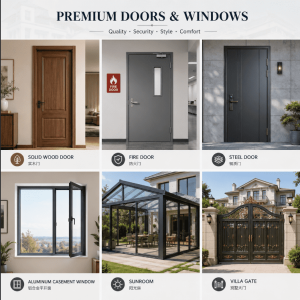
Jusen Door and Windows Manufacturing Co., Ltd. is a factory producing solid wood doors, thermal-break aluminum doors and windows, system windows, casement doors, sliding doors, custom villa doors and windows, sunrooms, and aluminum alloy entrance doors. Our production line handles both standard configurations and fully custom dimensions for entrance doors with side panels.
What this means for buyers:
Factory-direct pricing. Because we manufacture the products we sell, there is no trading company markup in our quotations. The price you receive is based on our manufacturing cost plus a reasonable margin — not a chain of intermediaries each adding their own markup.
Full customization. Size, color, glass type, and hardware accessories can all be specified to your project’s requirements. Our engineering team can adapt profile structures and fittings to align with local building codes in your target market — whether that means EN standards, ASTM standards, or a specific national code.
Pre-shipment inspection. Every order undergoes strict pre-shipment inspection covering air-tightness, water-tightness, and wind resistance testing. This is not an optional service — it is part of our standard workflow for every batch of entrance doors with side panels. We can provide test documentation for your project file.
Export experience. We have extensive experience in foreign trade and provide packing lists, proforma invoices, and full customs documentation to support international transactions. Both FCL and LCL shipment options are available, with direct delivery from our factory in China.
Production Process: From Raw Material to Finished Entrance Doors with Side Panels
Understanding how entrance doors with side panels are manufactured helps buyers evaluate supplier claims and identify potential quality issues. The production process involves several distinct stages, each with its own quality control points.
Stage 1: Raw Material Inspection
Aluminum profiles are received from extrusion mills and inspected for dimensional accuracy, surface finish, and alloy composition. Wood is checked for moisture content — typically 10–14% for exterior use. Glass is inspected for chips, scratches, and thickness tolerance.
Quality control point: Reject materials that do not meet specifications. A factory that accepts substandard raw materials cannot produce a quality finished product.
Stage 2: Frame Fabrication
Aluminum profiles are cut to length using CNC cutting centers, then machined for drainage holes, hardware mounting, and corner joints. The cutting accuracy is critical — a tolerance of ±0.5 mm is standard, and any deviation will affect the frame’s squareness and sealing performance.
Thermal-break profiles undergo a separate crimping process to secure the polyamide strips. This step must be done correctly — a poorly crimped thermal break will separate over time, destroying the frame’s thermal performance.
Wood frames are fabricated using mortise-and-tenon or dowel joints, glued and clamped under pressure. The joined frame is then sanded and prepared for finishing.
Quality control point: Each frame is checked for squareness (diagonal measurements must be within tolerance) and dimensional accuracy.
Stage 3: Surface Treatment
Aluminum frames undergo surface treatment — either powder coating or anodizing.
Powder coating — The frame is cleaned, chemically pre-treated, and then coated with dry powder that is cured in an oven at 180–200°C. The result is a durable, uniform finish. Standard coating thickness is 60–80 microns.
Anodizing — The frame is immersed in an electrolytic bath that creates a protective oxide layer on the aluminum surface. Anodized finishes are harder than powder coating but limited in color options (typically silver, bronze, and black).
Wood frames receive multiple coats of exterior-grade primer and paint or varnish. Each coat is sanded between applications.
Quality control point: Coating thickness is measured using a thickness gauge. Color is checked against the approved sample.
Stage 4: Glass Preparation
Glass is cut to size, then either tempered or laminated as required.
Tempering — Glass is heated to approximately 650°C, then rapidly cooled. This creates compressive stress on the surface, making the glass 4–5 times stronger than annealed glass.
Laminating — Two or more glass layers are bonded with a PVB interlayer under heat and pressure. The PVB interlayer holds the glass together when broken.
For insulated glass units, the glass panes are assembled with a spacer bar, primary seal, and secondary seal. The IGU is then filled with argon gas for improved thermal performance.
Quality control point: Each IGU is inspected for seal integrity, spacer alignment, and glass clarity.
Stage 5: Assembly
The frame, glass, and hardware are assembled into the finished entrance door with side panels. This includes:
- Installing gaskets around the frame and glass
- Mounting the glass into the side panel frame
- Installing hinges, locks, and handles
- Adjusting the door leaf for proper alignment and sealing
Quality control point: The assembled door is operated multiple times to check smoothness. The door leaf is checked for sagging or binding. The side panel seal is checked for gaps.
Stage 6: Pre-Shipment Inspection
Every order undergoes final inspection before packing:
- Air-tightness test (where specified)
- Water-tightness test (where specified)
- Dimensional verification against the order specification
- Visual inspection for surface defects
- Hardware function check
Products that fail any inspection point are reworked or rejected. Only products that pass all inspections are packed for shipment.
Quality Control: Our Multi-Stage Inspection Process
The inspection process described above is not just a set of procedures — it is a commitment to catching defects before they reach the customer.
Our quality control operates at four levels:
Level 1: Incoming material inspection. Every batch of aluminum profiles, glass, wood, and hardware is inspected against specifications. Materials that fail are returned to the supplier.
Level 2: In-process inspection. Each production stage has defined quality checkpoints. Operators are trained to identify defects and stop production if a problem is found.
Level 3: Final product inspection. Each finished entrance door with side panels is inspected before packing. This includes dimensional verification, surface finish check, hardware function test, and sealing performance check.
Level 4: Pre-shipment inspection. A final random inspection is conducted before containers are loaded. This is the last opportunity to catch defects before the products leave the factory.
This multi-stage approach means that defects are caught early, when they are still cheap to fix — not after installation, when rework costs are high and project schedules are disrupted.
Customization and OEM/ODM Options
Entrance doors with side panels are rarely a standard product. Each project has unique dimensions, performance requirements, and aesthetic preferences. Our manufacturing model is built to accommodate this.
OEM (Original Equipment Manufacturing)
In an OEM arrangement, the buyer provides the specifications — drawings, dimensions, performance requirements, hardware selections — and we manufacture to those exact specifications. The buyer’s brand is applied to the product and packaging.
OEM is appropriate for:
- Distributors who have their own product specifications
- Contractors who need to match existing installations
- Brands that want to outsource manufacturing while maintaining their own product identity
ODM (Original Design Manufacturing)
In an ODM arrangement, we develop the product design based on the buyer’s brief. The buyer specifies the requirements — size range, performance targets, aesthetic direction — and our engineering team develops the product. The buyer brands the finished product as their own.
ODM is appropriate for:
- Brands that want to enter the door market without investing in product development
- Distributors that need a differentiated product but do not have in-house engineering
- Projects with unique requirements that need custom engineering
Private Label
Both OEM and ODM arrangements can include private labeling — your logo, your packaging, your brand identity applied to the product. This is standard practice for distributor partnerships.
Custom Size and Design
Non-standard dimensions are standard practice for us. Entrance doors with side panels rarely come in one-size-fits-all dimensions — each project has its own opening size, and the assembly must be engineered to fit that opening while meeting performance requirements.
Our engineers work with buyers to adapt profile structures and hardware to their project’s specific needs. This includes adjusting frame depths, mullion designs, and hardware configurations to meet local building codes.
Ordering Process: MOQ, Lead Time, and Shipping
Clear expectations about ordering logistics prevent surprises later. Here is what buyers can expect when ordering entrance doors with side panels.
Minimum Order Quantity (MOQ)
MOQ varies by product type and configuration:
- Standard configurations — Lower MOQ, typically 10–20 units
- Custom designs — Higher MOQ, typically 30–50 units, because custom tooling and engineering are required
- Bulk project supply — Flexible MOQ depending on the project scale and delivery schedule
For buyers with smaller orders, we can discuss options — sometimes a slightly higher per-unit price can accommodate a lower MOQ.
Lead Times
Typical lead times for entrance doors with side panels:
| Order Type | Lead Time |
|---|---|
| Standard configuration | 2–4 weeks |
| Custom size, standard materials | 3–5 weeks |
| Fully custom (specialized glass, hardware) | 4–8 weeks |
Lead times include production but not sea freight. Shipping time depends on the destination port — typically 2–5 weeks from China to most international destinations.
Shipping Options
We support both FCL (full container load) and LCL (less than container load) shipments:
- FCL — Recommended for orders that fill a full container. More cost-effective per unit and reduces handling damage risk.
- LCL — Recommended for smaller orders. We consolidate with other shipments to fill the container.
All orders are packed in wooden crates suitable for sea freight. Glass panels are individually protected with foam and corner guards.
Documentation
We provide complete export documentation:
- Packing list
- Proforma invoice
- Commercial invoice
- Bill of lading
- Certificate of origin (where required)
- Test reports and certificates (where required)
This documentation supports smooth customs clearance in your country.
Project Applications and Case Examples
Custom Villa Entrances
A villa project in the Middle East required thermal-break aluminum entrance doors with side panels — 1,800 mm wide assemblies with double-glazed low-E glass and multi-point locking. The order was for 24 units with custom RAL-colored powder coating.
The project specified wind load resistance to local code requirements and a U-value of ≤ 1.6 W/m²K. We manufactured the assemblies with 34 mm thermal-break profiles, warm-edge spacers, and argon-filled IGUs. Lead time was 5 weeks from order confirmation to shipment.
Commercial Storefronts
A commercial developer in Southeast Asia ordered aluminum alloy entrance doors with side panels for a retail complex. The specification required tempered laminated glass for the sidelights, panic hardware on the door leaf, and a finish that would withstand coastal humidity.
The order was for 60 units with staggered delivery over 3 months to match the construction schedule. We provided FCL shipments with full customs documentation, including the certificate of origin required for the destination country.
Residential Development Projects
A housing developer ordered standardized entrance door + side panel assemblies for a multi-unit residential project. The specification was consistent across all units — 900 mm door leaf with a 450 mm side panel, standard double glazing, and a powder-coated finish.
The order volume was 200 units with staged delivery over 4 months. Standardization allowed us to optimize production and offer competitive pricing while maintaining consistent quality across all batches.
Questions to Ask Before Ordering
Before you send an inquiry to any supplier — including us — ask these questions. The answers will tell you whether the supplier understands your project’s requirements:
- What test standards do your products comply with? — The answer should reference specific standards (EN 14351-1, ASTM E283, etc.), not vague claims like “high quality.”
- Can you provide third-party test reports? — If the supplier can only provide in-house test claims, ask why they have not pursued independent verification.
- What is the U-value of the complete assembly with my specified glass? — A competent supplier will calculate this based on your glass and frame specifications.
- How do you handle drainage in the side panel frame? — The answer should describe drainage channels and weep holes, not just “we seal everything.”
- What is your warranty policy for international buyers? — Understand what is covered (profiles, glass, hardware, finish) and how claims are handled.
- Can you adjust the profile to meet my local building code? — If the supplier says “we only produce to our own standards,” that is a red flag for international projects.
- What is your rejection rate for pre-shipment inspection? — A transparent supplier will share this data. A high rejection rate is concerning; an evasive answer is worse.
- What documentation do you provide for customs clearance? — The answer should include packing lists, proforma invoices, and any certificates required by your country.
Decision Guide: Choose A If… Choose B If…
| Scenario | Recommended Choice |
|---|---|
| You need a few units for a custom villa project | A manufacturer that specializes in custom work and can engineer the side panel configuration to your drawings |
| You are a distributor building a product line | A manufacturer with OEM/ODM capability and private labeling options |
| You have a large residential development project | A manufacturer with bulk production capacity and staged delivery capability |
| Your project is in a cold climate with strict energy codes | A manufacturer with documented thermal performance (U-value ≤ 1.4 W/m²K) |
| Your project is in a coastal area with high wind and humidity | A manufacturer with high water-tightness ratings (Class 7A+) and corrosion-resistant hardware |
| You need to match an existing installation | A manufacturer that can replicate the exact profile, glass, and hardware of the existing assembly |
| You are price-sensitive and quality requirements are modest | A manufacturer producing standard aluminum doors without thermal break may be acceptable, but understand the performance trade-offs |
Choose A factory-direct manufacturer if you need competitive pricing without middleman markup, have specific performance requirements that need engineering input, and want direct communication with the people who make the product.
Choose A trading company if you need a wide range of products from multiple manufacturers consolidated into a single order. Trading companies can be useful for small orders across different product categories. However, verify their quality control process — trading companies cannot inspect products they do not make.
—
The procurement of entrance doors with side panels is a technical decision, not just a purchasing decision. The configuration must be engineered for the project’s climate, security requirements, and aesthetic direction. The materials must be matched to the performance targets. The supplier must be evaluated on their manufacturing capability, testing procedures, and export experience — not just their price quotation.
A factory-direct partner with testing capability, export experience, and customization flexibility can simplify the procurement process significantly. When the supplier understands the technical requirements, manufactures to verified standards, and provides complete documentation, the buyer’s job becomes manageable — even for complex projects.
If you are planning a project that requires entrance doors with side panels — whether a custom villa, a commercial building, or a residential development — share your specifications and we will provide a detailed quotation. Our engineering team can adapt the product to your local building codes and project requirements.
—
References
- European Committee for Standardization. “EN 14351-1:2006+A2:2016 — Windows and doors — Product standard, performance characteristics.” https://www.cencenelec.eu/
- ASTM International. “ASTM E283-19 Standard Test Method for Determining Rate of Air Leakage Through Exterior Windows, Skylights, Curtain Walls, and Doors Under Specified Pressure Differences Across the Specimen.” https://www.astm.org/e0283-19.html
- National Fenestration Rating Council. “NFRC 100-2020 — Procedure for Determining Fenestration Product U-factors.” https://www.nfrc.org/
- European Committee for Standardization. “EN 1627:2021 — Pedestrian doorsets, windows, curtain walling, grilles and blinds — Burglar resistance — Requirements and classification.” https://www.cencenelec.eu/
- Passive House Institute. “Certification Criteria for Passive Houses.” https://passivehouse.com/
- US Department of Energy. “ENERGY STAR Program Requirements for Residential Windows, Doors, and Skylights.” https://www.energystar.gov/