Enclosed Door Blinds at a Glance
Enclosed door blinds are blind systems installed between two panes of glass or within the door frame itself. They solve the two biggest problems with traditional blinds on high-traffic doors: cord hazards and constant dusting. For sliding patio doors and back entrances, they offer light control and privacy without anything hanging off the door that can snag, bend, or collect grime.
The core trade-off is upfront cost versus long-term convenience. Enclosed blinds typically cost 30–50% more than quality traditional blinds, but they eliminate replacement cycles caused by bent slats and broken cords. For commercial projects—hotels, offices, rental properties—the maintenance savings usually justify the premium. For a single-family home, the decision depends on how much you value cord-free operation and sealed-glass cleanliness.
Types of Enclosed Door Blinds Explained
There are three distinct configurations, and each suits a different situation.
Between-Glass Blinds (Integral Blinds)
These are factory-sealed units where the blind mechanism sits between two panes of glass, usually in a double-glazed or triple-glazed insulated glass unit (IGU). The blind is either permanently sealed inside or accessible through a discreet top channel for servicing.
This is the most common type for new construction and full door replacements. Because the blind is completely sealed, it never needs cleaning and cannot be damaged by handling. The main limitation is that you must specify the blind type, color, and operation method at the time of ordering the door—you cannot change it later without replacing the entire glass unit.
Integrated Frame Blinds
These mount inside the door frame itself, typically in a hollow aluminum or uPVC profile. The blind operates via a slider, crank, or magnetic mechanism on the frame edge. Unlike between-glass units, integrated frame blinds can often be removed for servicing or replacement without replacing the whole door.
This is a popular choice for aluminum sliding doors and multi-panel patio systems because the profile depth can accommodate the blind mechanism. The downside is that the frame must be designed for it from the start—retrofitting into a standard frame is rarely possible.
Add-On Enclosed Blinds (Retrofit)
These are aftermarket systems that attach to an existing door. There are two sub-types:
- Magnetic or clip-on panels: A framed blind unit that mounts to the interior face of the door or into a shallow recess. It is enclosed on both sides (or three sides) to prevent cord access and dust accumulation.
- Pocket or cassette systems: A slim housing that mounts onto the door frame and holds a blind that slides within a track. The blind is semi-enclosed—one face is open to the room.
Add-on systems are the only realistic option if you want enclosed blinds without replacing the door. They cost less than factory-integrated units but do not achieve the same sealed, dust-free result. They also add profile depth to the door, which may affect how the door swings or slides.
Enclosed Door Blinds vs. Traditional Blinds: A Side-by-Side Comparison
The decision between enclosed and traditional blinds comes down to how you weigh five factors.
| Factor | Enclosed Blinds | Traditional Blinds |
|---|---|---|
| Durability | 10–15+ years typical; sealed against dust, moisture, and impact | 3–7 years in high-traffic doors; slats bend, cords fray |
| Maintenance | None for sealed units; occasional mechanism service for frame-integrated | Monthly dusting; periodic cord and tilt mechanism repair |
| Child safety | No exposed cords (except some add-on models) | Corded models are a strangulation hazard; cordless options exist but cost more |
| Light control | Full control via slider, crank, or magnetic wand | Full control via cord or wand |
| Insulation | Adds a low-emissivity layer; improves door U-value slightly | Adds negligible insulation; can trap heat between glass and blind |
| Cost | Higher upfront; lower lifetime cost | Lower upfront; higher lifetime cost |
| Aesthetics | Clean, flush appearance; blind hidden between glass | Visible hardware; more design options |
| Repair | Requires glass unit or frame disassembly | Simple, parts widely available |
The honest trade-off: enclosed blinds win on durability, safety, and maintenance. Traditional blinds win on upfront cost, design flexibility, and repairability. If the door is in a rental property, a coastal environment with salt air, or a home with young children, enclosed blinds are the stronger choice. If you are on a tight budget and value being able to swap the blind color in a few years, traditional blinds are more practical.
How to Choose the Right Enclosed Door Blinds for Your Project
Glass Type and Configuration
The glass unit is the most important specification. For between-glass blinds, the blind mechanism sits inside the IGU, which means the unit is thicker than standard double glazing. Typical configurations use 4mm glass + blind cavity + 4mm glass, with the blind cavity ranging from 19mm to 27mm depending on the blind type.
For sliding doors, the glass unit must be tempered or laminated to meet safety glazing requirements in most jurisdictions, especially at low heights or near doorways. Verify that the glass meets your local safety standard—in the US this is typically ANSI Z97.1 or CPSC 16 CFR 1201; in the EU, EN 12150 for tempered and EN 14449 for laminated.
Operation Mechanism
Four operation methods dominate the market:
- Slider: A small knob on the frame edge that slides up and down to raise/lower the blind. Simple, low-profile, but requires access to the frame edge.
- Crank: A handle that turns to tilt or raise the blind. Easier for tall doors but adds hardware protrusion.
- Magnetic wand: A wand that attaches magnetically to a driver inside the glass unit. No holes in the frame, but the wand can be lost or demagnetized.
- Motorized: A small motor integrated into the frame, controlled by a wall switch, remote, or app. Not a focus of this guide, but worth noting that most manufacturers offer it as an option for hard-to-reach doors.
For sliding doors, the slider or magnetic wand is usually the most practical—a crank can interfere with the sliding panel’s movement.
Durability and Material Quality
The blind mechanism is the weak point, not the glass. Look for:
- Slat material: Aluminum slats with a baked-on polyester or PVDF coating resist corrosion and fading. Avoid untreated aluminum in coastal or high-humidity areas.
- Tilt mechanism: A stainless steel or brass tilt mechanism outlasts plastic gears. Ask the manufacturer what material the tilt assembly uses.
- Bottom rail: A weighted bottom rail keeps the blind taut and prevents slat sway when the door is opened or closed. Verify the rail is present and adequately weighted for the door height.
Energy Efficiency
Enclosed blinds add a low-emissivity (low-E) layer when closed. The air gap between the blind and the glass provides additional insulation. The overall U-value improvement depends on the glass specification, not just the blind.
If energy efficiency is a priority, specify a low-E coating on the inner pane and a warm-edge spacer in the IGU. The blind itself contributes roughly 0.1–0.3 W/m²K improvement to the door’s U-value—meaningful but not dramatic. Do not choose enclosed blinds solely for energy savings; choose them for convenience and durability, and treat the insulation benefit as a bonus.
Building Codes and Fire Safety
Most building codes treat enclosed blinds as part of the door assembly. The critical requirements are:
- Egress: Sliding and back doors must open freely in an emergency. Enclosed blinds do not obstruct egress because the mechanism is within the frame or glass—verify the blind does not protrude into the opening path.
- Fire resistance: Some commercial buildings require fire-rated door assemblies. A between-glass blind unit can affect the fire rating of the glass. If your project requires a fire-rated door, confirm the blind unit is compatible with the rating.
- Child safety: Corded add-on blinds can still pose a strangulation hazard. Factory-integrated and between-glass units have no accessible cords and meet CPSC safety guidelines by design.
Warranty and Quality Evaluation
A reputable manufacturer should offer at least a 5-year warranty on the blind mechanism and a 10-year warranty on the sealed glass unit. Ask for the warranty terms in writing before ordering. The warranty should cover:
- Seal failure (fogging between panes)
- Blind mechanism failure (tilt, raise/lower)
- Slat corrosion or color fade
Evaluate the manufacturer’s quality control by asking about pre-shipment testing. For door assemblies, this typically includes air-tightness, water-tightness, and wind resistance testing per standards like ASTM E283, E330, and E547 (US) or EN 12207, 12208, and 12210 (EU). A manufacturer that cannot document these tests is a higher-risk supplier.
Cost Considerations and Budget Ranges
Pricing for enclosed door blinds varies significantly by type, size, and configuration. Rather than quoting a single figure, here is how the costs break down:
Between-glass blinds add roughly 15–25% to the cost of the glass unit itself. For a standard sliding door panel (approximately 1.5m × 2.1m), this translates to a meaningful but not overwhelming premium over standard double glazing.
Integrated frame blinds are the most expensive option because they require a specially designed frame profile. Expect a 20–35% premium over a standard frame with the same glass.
Add-on retrofit systems are the most economical, typically costing 30–50% less than factory-integrated options. However, they do not achieve the same sealed, dust-free result.
The actual figures depend on your door size, blind type (venetian, pleated, or roller), and the manufacturer’s pricing structure. For accurate budgeting, request quotes from at least three suppliers with your exact door dimensions and glass specification.
Top Manufacturers and Suppliers of Enclosed Door Blinds
The market for enclosed door blinds is divided between large glass and window manufacturers and specialized door fabricators. When evaluating suppliers, focus on their ability to deliver a complete, tested door assembly—not just the blind mechanism.
For commercial and wholesale buyers, working directly with a factory offers clear advantages in cost and customization. Here is how we meet the standards discussed above.
As a manufacturer of thermal-break aluminum doors and windows, our approach to enclosed blinds is to integrate them into the door assembly at the factory, not as an aftermarket add-on. We offer between-glass blind units in double-glazed configurations, with venetian, pleated, and roller blind options. The blind mechanism is built into the IGU during production, which means it is fully sealed against dust and moisture.
Our customization capability covers the specifications that matter for enclosed blinds: glass type (tempered, laminated, or low-E), blind color and slat width, operation method (slider or magnetic wand), and frame profile depth to accommodate the blind cavity. For projects in different markets, we adjust the profile structure and fittings to match local building codes, including safety glazing and energy performance requirements.
Every door assembly undergoes pre-shipment testing for air-tightness, water-tightness, and wind resistance. This is not optional—it is part of our standard quality control. We also provide full customs documentation for international shipments, including packing lists and proforma invoices, and we support both FCL and LCL shipping.
For buyers evaluating us against other suppliers, the key question is whether the manufacturer can document their testing and customization capabilities. We can, and we are happy to walk through the specifications for your specific project.
Frequently Asked Questions About Enclosed Door Blinds
Can I install enclosed blinds on an existing door?
Yes, but only with add-on systems. Factory-integrated between-glass blinds require replacing the glass unit or the entire door. Add-on enclosed blind panels mount to the interior face of the door or frame and provide most of the same benefits—no exposed cords, reduced dust—without the sealed-glass result.
How do I measure for enclosed door blinds?
For between-glass blinds, the glass unit is manufactured to your door frame’s exact dimensions. Measure the frame opening where the glass sits, not the visible glass area. For add-on systems, measure the door leaf width and height at three points (top, middle, bottom) and use the narrowest measurement to ensure fit. Allow for a 3–5mm tolerance on all sides.
Do enclosed blinds fog up or get condensation inside?
Sealed between-glass units can develop condensation if the seal fails, which is why the warranty on seal integrity matters. Frame-integrated units have a small ventilation path that prevents condensation while keeping dust out. Add-on systems are not sealed and will behave like traditional blinds regarding condensation.
How do I clean enclosed door blinds?
You do not need to clean sealed between-glass blinds—that is the primary benefit. Frame-integrated blinds can be accessed for occasional dusting by removing the access panel. Add-on units can be wiped down like traditional blinds, though less frequently since they are partially enclosed.
Are enclosed door blinds worth the extra cost?
For sliding and back doors that see frequent use, yes. Traditional blinds on these doors suffer from repeated impact, dust accumulation, and cord wear. Enclosed blinds eliminate these failure modes. If you are outfitting a rental property, commercial space, or a home with children, the durability and cordless safety features justify the premium. For a low-traffic door where you want design flexibility, traditional blinds may be the better value.
Additional Considerations: Sliding Doors, Patio Doors, and Back Doors
Each door type has specific considerations for enclosed blinds.
Sliding Doors with Blinds Inside
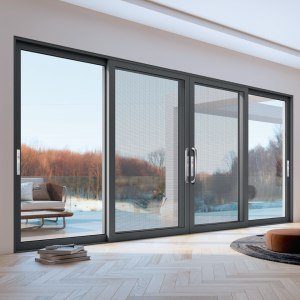
Sliding doors present a unique challenge: the blind mechanism must not interfere with the sliding action. Between-glass blinds are the best fit because the mechanism is entirely within the glass unit. The operation method matters—a slider on the frame edge is the most common, but on the stationary panel, you will need access from the interior side. Magnetic wands work well here because they do not protrude from the frame.
For heavy sliding doors, the glass unit weight increases with the blind cavity. Ensure the frame and rollers are rated for the additional weight. A typical between-glass blind unit adds roughly 5–8 kg per square meter compared to standard double glazing.
Patio Sliding Doors with Blinds
Patio doors are usually larger than interior sliding doors, which means the blind must be sized for tall, wide panels. The bottom rail weight becomes critical—an underweight rail allows the bottom slats to sway when the door is opened or closed. Specify a weighted bottom rail for any panel over 2.1 meters in height.
Patio doors also face more weather exposure. Verify the glass unit has a proper seal and that the blind slats are corrosion-resistant. Coastal installations should specify PVDF-coated or anodized aluminum slats.
Back Doors with Blinds
Back doors are often the most-used entrance in a home, which makes them the strongest candidate for enclosed blinds. The key consideration is the door type: a solid back door with a side panel or a full-glass back door. For full-glass back doors, between-glass blinds are ideal. For solid doors with a glass insert, integrated frame blinds work well because the frame profile can accommodate the mechanism without compromising the door’s thermal performance.
Back doors also tend to have lower egress clearance. Verify that the blind mechanism does not reduce the clear opening width, especially if the door is a required egress path.
Add-On Enclosed Blinds for Existing Doors
If you are not replacing the door, add-on enclosed blinds are the practical choice. Look for systems that mount flush to the door surface and have a rigid backing panel to prevent the blind from being pushed or damaged. Magnetic or clip-on systems are easier to remove for servicing, while permanent mounts look cleaner but complicate access.
The main limitation of add-on systems is the visible housing. It adds 20–40mm to the door’s profile, which can affect how the door swings or how it fits into the surrounding trim. Measure your clearances before committing to an add-on system.
Final recommendation: Choose between-glass blinds if you are replacing the door or glass unit and want the most durable, maintenance-free solution. Choose integrated frame blinds if you need serviceability and are ordering a new door with a compatible frame profile. Choose add-on enclosed blinds if you are retrofitting an existing door and accept a slight aesthetic compromise for a significant improvement in safety and maintenance.