Content Menu
● 1. Why Double Doors with Glass Are a Market Standard
● 2. Material Science: Choosing the Right Frame
● 3. Glass Technology: Safety, Insulation, and Aesthetics
● 4. Hardware and Security: The Mechanical Core
● 5. The Procurement Framework: Standards and Compliance
● 6. Supply Chain Strategy: Direct Factory vs. Middleman
● 7. How We Support B2B Projects
● 8. Frequently Asked Questions
● 9. Buyer’s Checklist: Questions to Ask Before Ordering
10 min read
A developer in Melbourne needed double front entry doors with glass for an approved architectural drawing: a rough opening of 1,850 mm by 2,400 mm, meeting local energy ratings, delivered within six weeks. The question was whether any factory could deliver a product that matched the drawings, survived shipment, and passed inspection.
This guide covers the material science, glass technology, hardware, and quality benchmarks for sourcing double front entry doors with glass, plus a framework for evaluating suppliers.
—
Why Double Doors with Glass Are a Market Standard
Architectural Trends Driving the Demand
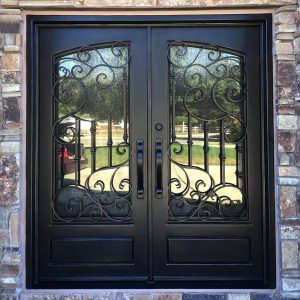
Modern projects increasingly specify wide entryways. The “bring the outside in” philosophy pushes architects toward larger glazed openings. Double front entry doors with glass create a visual and physical expansion of the entrance zone, satisfying both modern farmhouse and contemporary minimalist styles. A pair of 36-inch-wide panels creates a 72-inch opening that reads as a statement piece.
Functional Benefits Beyond Aesthetics
A 72-inch-wide opening accommodates furniture moving, wheelchair access, and equipment transport without disassembly. Natural light penetration is measurable: two 30-inch by 80-inch glass panels provide roughly 3,300 square inches of glazing, reducing daytime lighting loads. When both panels are operable, cross-ventilation improves dramatically in shoulder seasons.
The B2B Buyer’s Dilemma: Custom vs. Stock
Stock double doors come in fixed sizes—typically 60, 64, 68, or 72 inches wide. Rough openings in real construction vary; a concrete block opening might measure 1,850 mm, while a wood frame might be 1,820 mm. Custom sizing is not a luxury—it is a requirement for most projects, shaping lead times, pricing, and supplier selection.
—
Material Science: Choosing the Right Frame
Thermal-Break Aluminum: The Performance Leader
Thermal-break aluminum profiles contain a polyamide strip (typically 14.8 mm to 34 mm wide) that interrupts the thermal bridge. For double front entry doors with glass, this offers three advantages:
- Structural rigidity: Slim frame profiles (as narrow as 50 mm visible width) still support large glass panels.
- Thermal performance: U-values can reach 1.0–2.0 W/m²K, meeting ENERGY STAR criteria for most climate zones.
- Low maintenance: Powder-coated or anodized finishes withstand UV and moisture without warping or refinishing.
For extreme climates (below -20°C or above 35°C), a 34 mm polyamide strip is recommended; the wider break reduces heat transfer but increases frame depth.
Solid Wood: The Aesthetic Classic with Modern Twists
Solid wood double doors suit high-end residential and heritage projects, offering superior acoustic insulation. Engineered wood—layers of veneer over a sturdier core—is preferred over solid timber as it resists warping better. Moisture-resistant treatments are essential for exterior use.
A 45 mm thick engineered wood leaf with a 30-inch by 80-inch glass cutout can weigh 35–45 kg per panel, demanding heavy-duty hinges (at least 3 per panel, rated for 60 kg+) and a multi-point locking system.
Comparative Analysis: Weight, Insulation, and Maintenance
| Material | Strength | Thermal Performance (U-value) | Maintenance | Weight (per 30″x80″ panel) | Relative Cost |
|---|---|---|---|---|---|
| Thermal-break Aluminum | High | 1.0–2.0 W/m²K | Low (powder coat finish) | 25–35 kg | Medium-High |
| Solid/Engineered Wood | Medium-High | 1.8–2.8 W/m²K | High (re-stain/seal every 2–3 years) | 35–50 kg | High |
| Steel | High | 2.5–4.0 W/m²K (poor without break) | Medium (rust risk at edges) | 40–60 kg | Low-Medium |
Steel is rarely the right choice for residential double front entry doors with glass due to poor thermal performance and weight. For projects where energy codes apply—which is most modern construction—the thermal break is a compliance requirement, not an upgrade.
—
Glass Technology: Safety, Insulation, and Aesthetics
Double Glazing vs. Triple Glazing for Entry Doors
Double glazing (two panes with an air or argon gas gap of 9 mm to 16 mm) is the standard for residential entry doors. Argon filling improves insulation by approximately 10–15% compared to air.
Triple glazing (three panes, two gaps) is reserved for extreme cold climates or Passivhaus projects, dropping U-values to 0.5–0.8 W/m²K. The added weight (each pane adds roughly 10 kg/m²) requires reinforced frames and heavier hinges. A door leaf with a 1.0 m² triple-glazed unit can exceed 70 kg total, dictating hinge and frame specifications.
Tempered vs. Laminated Glass: Safety Regulations
Building codes require safety glass in doors and sidelites. Tempered glass is the minimum standard, shattering into small granular pieces when broken.
Laminated glass—two panes bonded with a PVB interlayer—prevents penetration when broken, making it preferred for:
- Hurricane-prone regions (meets Miami-Dade County impact standards)
- High-security applications
- Noise reduction
Laminated glass is 20–40% more expensive and heavier than tempered glass. For most residential projects, tempered double glazing is sufficient.
Design Options: Clear, Frosted, Low-E, and Decorative
Low-E coatings are standard in modern glazing, improving U-value by 15–25% without significantly affecting visible light transmission. Frosted or obscured glass provides privacy without sacrificing natural light.
Decorative options—beveled glass, leaded patterns, or colored interlayers—extend lead times by 1–2 weeks. Buyers should confirm the supplier’s glass fabrication is in-house or reliable before committing to decorative specs.
—
Hardware and Security: The Mechanical Core
Multi-Point Locking Systems
Multi-point locks engage 3 to 5 points along the door’s edge, preventing warping and resisting forced entry. For double doors, the active leaf carries the primary mechanism; the passive leaf is secured by shoot bolts. A 5-point system is recommended when glass exceeds 50% of the leaf surface, as glass reduces structural rigidity.
Mechanical multi-point locks remain the most reliable option. For B2B projects, a mechanical lock with electronic integration options is the safest approach.
Hinges and Pivots: Handling the Weight
Heavy-duty ball-bearing hinges rated for 60–100 kg per pair are the minimum for glass-heavy doors. Pivot systems are an alternative for very heavy doors, distributing weight more evenly but requiring precise floor preparation.
Use at least three hinges per leaf for doors over 50 kg; four hinges or a pivot system for doors over 70 kg.
Weather Stripping and Air-Tightness
EPDM gaskets are the industry standard, withstanding UV exposure and temperature extremes. A double-seal system (interior and exterior gaskets) provides better air-tightness than a single gasket; a triple-seal system can achieve class 4 (highest under EN 12207). Pre-formed corner gaskets are more reliable than cut-and-glued joints—buyers should confirm this with suppliers.
—
The Procurement Framework: Standards and Compliance
Key Testing Standards (Air, Water, Wind)
Common reference standards include:
- ASTM E283 (air leakage)
- ASTM E547 (water penetration)
- ASTM E330 (wind load resistance)
- EN 12207 (air permeability), EN 12208 (water tightness), EN 12210 (wind load resistance)
A door rated Class 4 for air permeability has a maximum leakage rate of 0.25 m³/h·m² at 600 Pa. A Class 9A water-tightness rating withstands 600 Pa for 15 minutes without leakage. Buyers should request test reports specifically for double door configurations, as the junction between leaves creates an additional leak path.
Understanding Building Codes and Local Regulations
Energy codes vary by region: California’s Title 24, the European EPBD, and the Australian NCC all mandate specific U-values and SHGC limits. A supplier must offer adjustable profiles—different thermal-break widths, glazing options, and hardware—to meet target-market codes.
The Importance of Pre-Shipment Inspection
A pre-shipment inspection covers:
- Glass inspection: Scratches, chips, or bubbles
- Sealant application: Consistent, gap-free sealant
- Panel alignment: Both leaves close flush with an even gap
- Hardware function: Locks and hinges operate smoothly
- Finish quality: No scratches, drips, or color mismatches
A formal inspection report with photographic evidence is the minimum deliverable. For high-value orders, third-party inspection is recommended.
—
Supply Chain Strategy: Direct Factory vs. Middleman
The Cost and Communication Benefits of Direct Sourcing
Factory Price + Logistics versus Factory Price + Middleman Margin + Logistics: the middleman margin typically ranges 10% to 30%. For a $20,000 container of doors, that is $2,000–$6,000 in savings. Direct sourcing also means technical questions go straight to the engineers, eliminating relay delays and misinterpretation.
Logistics: FCL vs. LCL and Delivery Timelines
FCL shipping suits large orders (20 to 40 doors per 20-foot container). LCL shipping incurs higher per-unit freight costs and longer transit times. Typical lead times:
- Production: 3–4 weeks standard, 4–6 weeks for custom glass or hardware
- Sea freight: 2–4 weeks from China to major ports
- Customs and inland transport: 3–7 days
Export packing is critical: wooden crates with internal bracing and foam protection for glass panes prevent damage in transit.
—
How We Support B2B Projects
Factory-Direct Manufacturing and Customization (OEM/ODM)
The industry standard: most importers buy from trading companies that source from multiple factories, adding margin and communication gaps.
Our approach: Jusen Door and Windows Manufacturing Co., Ltd. is a direct factory source. We offer full customization on size, color, glass, and hardware. When your drawings specify a non-standard rough opening or a specific RAL color, we adjust our production line to match. We control the profile structure and fittings to align with your local building codes.
Quality Assurance and Compliance
The industry standard: many suppliers provide photos and call that quality control.
Our approach: we conduct rigorous pre-shipment testing on air-tightness, water-tightness, and wind resistance, providing test data alongside your packing list. Our goal is to ensure the product performs on site, so your project passes local inspections without delays.
Export Experience and Documentation
The industry standard: some factories struggle with export paperwork, causing customs delays.
Our approach: we provide full documentation—packing lists, proforma invoices, and customs declarations—to ensure smooth FCL or LCL shipping directly from our factory in China. We are not just a factory; we are a logistics partner.
Call to Action
We invite you to discuss your upcoming project requirements. Whether you are an architect specifying materials or a developer sourcing for multiple units, we are ready to provide a detailed quotation based on your specific drawings and performance requirements.
—
Frequently Asked Questions
What is the standard size for double front entry doors with glass?
Standard sizes typically range from 60″ to 72″ wide. Most B2B projects require custom sizing to fit specific rough openings. We recommend specifying exact frame dimensions (width x height) based on your architectural plans.
What is the typical lead time for a bulk order of double doors?
Production typically takes 3–4 weeks for standard orders; custom projects with unique glass or hardware take 4–6 weeks. Shipping time depends on location and FCL or LCL choice. Factories with in-house glass fabrication and hardware assembly can compress the timeline; outsourced steps add 1–2 weeks.
Can you match specific local building codes for energy efficiency?
Yes. We use adjustable profile structures and fittings. By varying thermal-break polyamide widths and Low-E glass configurations, we adjust U-value and SHGC to meet compliance standards including ENERGY STAR and local municipal codes.
Do you offer OEM or private labeling for our brand?
Absolutely. We support OEM and ODM services, manufacturing to your exact specifications and applying your brand label and packaging. For private-label projects, provide logo artwork in vector format (AI or EPS).
How do you ensure the doors are not damaged during international shipping?
We use heavy-duty export wooden crates reinforced to protect glass and hardware, with internal foam padding, a moisture barrier, and extra corner protection for glass-heavy doors. A pre-shipment inspection ensures the door is sealed and aligned before leaving the factory.
Buyer’s Checklist: Questions to Ask Before Ordering
Before placing an order, have the supplier confirm:
- Exact U-value for the proposed glazing and frame, with test documentation
- Water-tightness rating (class under EN 12208 or equivalent)
- Wind load resistance for your project’s location
- Hinge specification and weight rating per hinge
- Multi-point lock brand and number of locking points
- Thermal-break width (polyamide strip) in millimeters
- Glass configuration (thickness, Low-E coating, gas fill, spacer type)
- Lead time broken down by production and shipping phases
- Pre-shipment inspection process and third-party availability
- Export documentation included with the shipment
Red Flags: Avoid Suppliers Who…
- Cannot provide test reports for the specific double door configuration you need
- Quote a single U-value for all doors regardless of configuration
- Do not offer custom sizing as a standard option
- Cannot explain the difference between tempered and laminated glass
- Quote lead times under 2 weeks for custom double front entry doors with glass (unrealistic for quality manufacturing)
- Do not provide a detailed packing list with the proforma invoice
Choose This If…
Choose thermal-break aluminum if your project requires high energy efficiency, low maintenance, and slim frame profiles.
Choose solid wood if the project demands a premium aesthetic and the maintenance budget supports periodic refinishing.
Choose a direct factory if your order volume justifies container shipping (20+ doors) and you want to eliminate the middleman margin.
Choose a trading company only if you need mixed products from multiple factories in a single shipment and accept the markup.
—
References
- EN 12207:2016, “Windows and doors – Air permeability – Classification,” European Committee for Standardization. https://www.en-standard.eu/
- EN 12208:2000, “Windows and doors – Water tightness – Classification,” European Committee for Standardization. https://www.en-standard.eu/
- ASTM E283-19, “Standard Test Method for Determining Rate of Air Leakage Through Exterior Windows, Skylights, and Doors,” ASTM International. https://www.astm.org/e0283-19.html
- ENERGY STAR Program Requirements for Residential Windows, Doors, and Skylights. https://www.energystar.gov/products/windows_doors_and_skylights
- California Energy Commission, Title 24 Building Energy Efficiency Standards. https://www.energy.ca.gov/programs-and-topics/programs/building-energy-efficiency-standards
- International Code Council, “2021 International Building Code,” Chapter 24 (Glass and Glazing). https://www.iccsafe.org/
- National Fenestration Rating Council, “NFRC 100: Procedure for Determining Fenestration Product U-factors.” https://www.nfrc.org/
- Miami-Dade County, “Hurricane Impact Test Protocol for Windows and Doors.” https://www.miamidade.gov/building/hurricane-window-protection.asp