Content Menu
● 1. Understanding Double French Front Doors: Types and Applications
● 2. Double French Front Doors Quality and Performance Factors
● 3. How to Evaluate Double French Front Doors Suppliers
● 4. Key Quality Indicators for Double French Front Doors Buyers
● 5. Relevant Industry Standards and Certifications
● 6. Production Process: From Raw Material to Finished Double French Front Doors
● 7. Cost Breakdown: What Determines the Price of Double French Front Doors
● 8. Sourcing Double French Front Doors: Direct Factory vs. Distributor vs. Import Agent
● 10. How Much Do New Double French Front Doors Cost?
● 11. Are Double French Front Doors a Good Idea? Pros, Cons, and Common Concerns
● 12. How to Evaluate Double French Front Doors Suppliers: A Decision Guide
● 13. Are Double French Front Doors the Right Choice for Your Project?
20 min read
A contractor from Ohio received three quotes for a custom home project specifying double french front doors. Prices ranged from $3,800 to $11,200 for what looked like the same specification. Two quotes were from distributors; one was from a manufacturer. The homeowner wanted to know why the gap was so wide — and whether the cheap option would fail in five years.
That conversation happens more often than most buyers admit. The double french front door category sits at the intersection of aesthetics and engineering, making it one of the most misunderstood products in the exterior envelope. For B2B buyers — contractors, builders, architects, distributors — the challenge isn’t finding a supplier. It’s finding one that delivers a door that performs as specified, arrives without damage, and carries the right documentation.
This guide covers what procurement professionals need before issuing a PO for double french front doors: configuration options, material science, performance testing, cost structures, and the questions that separate competent factories from trading companies with a website.
Understanding Double French Front Doors: Types and Applications
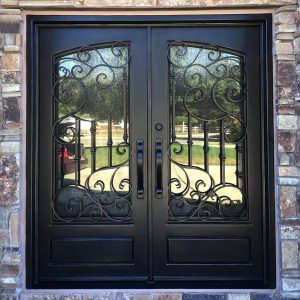
A double french front door is a pair of doors, each filled with full-length glass panels divided by muntins or mullions, installed together as the primary entrance to a building. Both panels can be operable, or one can be fixed while the other swings. The defining characteristic is the glazing — French doors are glass doors first, structural doors second.
Direct answer: Double french front doors are a pair of glass-paneled entry doors installed side by side, typically 60 to 72 inches wide in total, used in residential and light commercial projects where natural light and curb appeal are priorities.
Standard Configurations for Double French Front Doors
The configuration determines both cost and performance. Buyers should understand the three main layouts before requesting quotes.
Hinged Pairs (Both Active)
Both doors are fully operable, each with its own hinges and locking mechanism. This is the classic configuration, offering ventilation flexibility and visual symmetry. The trade-off is that both doors must be perfectly aligned to seal properly — a common failure point with cheaper manufacturing.
Fixed-and-Swing (Active + Passive)
One door is fixed with flush bolts at top and bottom, while the other operates as the primary entrance. This configuration is common in commercial applications with frequent traffic. It reduces hardware wear and simplifies the sealing system. The fixed panel can also accommodate wider glass spans without the weight constraints of an operable door.
Multi-Panel Setups
For openings wider than 72 inches, manufacturers can supply double french front doors with additional fixed sidelites flanking the operable pair. This is technically a door system, but it often comes through procurement under the same product category.
Inswing vs. Outswing
Inswing is the default for residential front entries because the door presses against frame seals when closed, providing better weather protection. Outswing saves interior floor space and performs better under positive wind pressure but requires exterior-rated hinges and more robust weatherstripping. Some building codes mandate outswing for certain egress paths.
Glazing Options for French Door Pairs
The glass specification often drives 30–40% of total unit cost. Buyers should be precise about what they need.
| Glazing Type | Thickness | Best Use Case | Relative Cost |
|---|---|---|---|
| Tempered | 4mm–6mm | Safety glazing, interior exposure | Baseline |
| Laminated | 6mm–12mm | Security, hurricane zones | +15–25% |
| Insulated (IGU) | 20mm–28mm total | Thermal performance, cold climates | +20–35% |
| Low-E Coated | Any IGU | Solar heat gain reduction | +10–20% |
The muntin pattern also affects price. Simulated divided lites (SDL) — grids applied to the glass surface — are significantly cheaper than true divided lites (TDL), where individual panes are separated by the frame structure. For double french front doors, SDL is the industry norm unless the project is a historical restoration requiring TDL.
Size Parameters and Custom Dimensions
Standard double french front doors range from 60 to 72 inches in total width, with heights from 80 to 96 inches. Custom sizing is the norm for high-end residential work. The critical constraint is weight — a 36-inch-wide panel with full glass and a solid wood frame can exceed 150 pounds. Buyers should always ask suppliers for the maximum panel weight their hardware is rated to carry.
Double French Front Doors Quality and Performance Factors
Quality in double french front doors is measurable through three performance dimensions: air-tightness, water-tightness, and structural resistance. A door that looks beautiful but fails these tests is a liability.
Direct answer: The quality of double french front doors is determined by measurable performance metrics — air-tightness (air leakage rate), water-tightness (water penetration resistance), and wind load resistance — verified through standardized testing.
Air-Tightness: The Silent Energy Leak
Air leakage is the most common homeowner complaint and the most common failure point in cheap manufacturing. The test measures air volume passing through the closed assembly under a specific pressure differential.
In Chinese standard GB/T 7106, air-tightness is graded 1 to 8, with Grade 8 highest. For front entry applications, Grade 6 or above is recommended. The European equivalent, EN 12207, uses classes 1 through 4, with Class 4 highest.
Primary culprits for poor air-tightness:
- Inadequate weatherstripping material (EPDM vs. PVC — EPDM lasts longer)
- Poor corner sealing on the frame
- Misaligned hardware preventing proper seal compression
- Frame deflection under wind load
Water-Tightness: Where Coastal Projects Fail
Water penetration testing subjects the assembly to simulated rain and wind pressure. Standards EN 12208 or GB/T 7106 classify results from Class 1 (lowest) to Class 9 (highest). For exposed locations, a minimum of Class 6 is recommended; coastal installations should specify Class 7 or higher.
The challenge is at the meeting point of the two doors — the astragal or meeting stile. This seam is a continuous potential leak path. Quality manufacturers use multi-fin weatherstripping on meeting stiles, often with concealed aluminum reinforcement to prevent flexing.
Wind Load Resistance and Structural Integrity
Wind load testing verifies the assembly can withstand specified pressure without permanent deformation or failure. Test standards include EN 12211 or GB/T 7106. Hurricane-prone regions require additional standards, such as Miami-Dade County protocol in Florida, which requires impact testing.
Wind load rating is determined by:
- Frame material and wall thickness (aluminum profiles should be at least 1.4mm–2.0mm)
- Reinforcing bars inside frame cavities
- Glass thickness and whether it is laminated
- Number and placement of hinge points
Thermal Performance: U-Value Explained
The U-value measures heat transfer rate through the entire assembly — frame, glass, and seals. Lower values indicate better insulation. The unit is W/m²K.
The whole-unit U-value matters more than the center-of-glass value. The frame often accounts for 20–30% of total door area, and aluminum frames without thermal breaks have U-values of 5.0 or higher — comparable to single-pane glass.
A properly designed thermal-break aluminum frame with low-E insulated glass can achieve a whole-door U-value of 1.5–2.0 W/m²K. Solid wood doors range from 1.8 to 2.5, depending on thickness and core construction. Energy Star requires specific U-values based on climate zone, so buyers should verify supplier test data against project location.
How to Evaluate Double French Front Doors Suppliers
The supplier selection process determines project success or failure. This framework applies to any offshore sourcing scenario, with specific attention to double french front doors requirements.
Direct answer: Evaluating double french front doors suppliers requires verification of four areas: manufacturing capability, quality control processes, export documentation competence, and communication responsiveness. Request test reports, factory audit photos, and references before committing to a PO.
Verify Manufacturing Capability, Not Just Trading Capability
The first filter is whether the supplier actually manufactures or merely trades. Trading companies cannot control quality, adjust production, or troubleshoot factory floor issues.
Signs of genuine manufacturing capability:
- Factory audit reports from third parties (SGS, BV, Intertek)
- Production line videos showing CNC machining, assembly, and finishing
- In-house testing equipment for air-tightness, water-tightness, and wind load
- Engineering staff who can answer technical questions about profile design and hardware integration
Quality Control Processes: What to Look For
The best suppliers have documented quality control (QC) spanning the entire production cycle. Key stages:
- Incoming material inspection — aluminum profiles checked for thickness and surface finish; glass verified for specifications; hardware inspected for corrosion resistance
- In-process inspection — during CNC cutting, welding, and assembly, with checkpoints at each stage
- Pre-shipment inspection — final functional testing of each unit, including air-tightness spot checks and water-tightness testing on a sample basis
Buyers should ask for the supplier’s QC checklist and request third-party pre-shipment inspection if order value justifies it.
Export Documentation Competence
For international buyers, accurate export documentation is as important as product quality. Required documents typically include:
- Commercial invoice
- Packing list with container loading details
- Bill of lading
- Certificate of origin (for tariff preference programs)
- Customs declaration forms
- Test reports and certificates of conformity
Suppliers with foreign trade experience handle these routinely. Inexperienced suppliers cause customs delays, translating to demurrage charges and project schedule impacts.
Red Flags: Avoid Suppliers Who Exhibit These Signs
- Cannot provide test reports for air-tightness, water-tightness, or wind load
- Quote prices 40%+ below market average without explanation
- Hesitate to share factory address or invite video calls from the production floor
- Offer no customization options — only standard sizes and finishes
- Require full payment before production without a letter of credit or escrow arrangement
Key Quality Indicators for Double French Front Doors Buyers
When comparing quotes, buyers need a standardized set of quality indicators. Use this checklist to evaluate each proposal.
Buyers’ Checklist: Questions to Ask Before Ordering
| Quality Indicator | What to Verify | Why It Matters |
|---|---|---|
| Profile wall thickness | ≥1.4mm for aluminum frames | Thin profiles flex and compromise sealing |
| Thermal break material | Polyamide strips (not PVC) | Polyamide maintains structural strength at temperature extremes |
| Glass specification | Tempered, laminated, or IGU with documented thickness | Safety and thermal performance depend on correct glazing |
| Hardware brand | Multi-point locking from recognized brands (e.g., Hoppe, GU) | Security and long-term reliability |
| Weatherstripping material | EPDM (not PVC) | EPDM resists UV degradation and retains flexibility longer |
| Surface treatment | Powder coating ≥60μm thickness, or anodizing | Corrosion resistance, especially in coastal environments |
| Test reports | GB/T 7106, EN 12207/12208, or ASTM equivalents | Verifiable performance data, not marketing claims |
Choose A if… Choose B if…
Choose a solid wood double french front door if: The project is high-end residential, climate-controlled, and the buyer accepts refinishing maintenance every 3–5 years.
Choose a thermal-break aluminum double french front door if: The project is in a coastal environment, requires large glass spans, demands low maintenance, or must meet strict energy codes.
Choose a hybrid aluminum-clad wood door if: The project needs the interior warmth of wood but exterior durability of aluminum — and the budget allows for the premium price.
The Imperfect Insight
Thermal-break aluminum is often presented as superior, but it has a weakness sales materials rarely mention: polyamide thermal break strips are structural components. If the supplier uses low-quality polyamide or thin strips, the frame can flex under wind load, compromising air-tightness. A well-made solid wood door can outperform a poorly engineered aluminum door on both thermal and structural metrics. Material choice matters less than engineering quality.
Relevant Industry Standards and Certifications
Double french front doors are tested against regional standards that buyers should reference in RFQ documents.
Direct answer: The key standards for double french front doors are GB/T 7106 (Chinese standard covering air-tightness, water-tightness, and wind load), EN 12207/12208/12211 (European standards for the same parameters), and ASTM E283/E330 (US standards for air leakage and structural performance).
Regional Standards Overview
| Standard | Region | Parameters Covered | Typical Passing Grade |
|---|---|---|---|
| GB/T 7106 | China | Air-tightness, water-tightness, wind load | Grade 6+ for air-tightness |
| EN 12207 | Europe | Air permeability | Class 4 (highest) |
| EN 12208 | Europe | Water-tightness | Class 6–9 |
| EN 12211 | Europe | Wind load resistance | Varies by project |
| ASTM E283 | USA | Air leakage | 0.3 cfm/ft² or lower |
| ASTM E330 | USA | Structural performance | No permanent deflection |
Certification Systems
Beyond test standards, buyers should look for quality management certifications:
- ISO 9001:2015 — Quality management systems certification, indicating documented processes
- CE marking — Required for construction products sold in the European Economic Area
- Energy Star — US program for energy-efficient products, with specific criteria for entry doors
Buyers should request copies of these certifications and verify them with the issuing body. Some suppliers display expired certificates or ones issued to a different entity.
Production Process: From Raw Material to Finished Double French Front Doors
Understanding the production process helps buyers evaluate lead times, identify QC checkpoints, and communicate effectively with suppliers.
Direct answer: The production of double french front doors involves five stages: raw material preparation, CNC cutting and machining, frame assembly and welding, surface treatment, and glazing with hardware installation. Each stage has specific quality checkpoints.
Stage 1: Raw Material Preparation
For aluminum doors, the process begins with extruded profiles. The aluminum alloy (typically 6063-T5 or 6063-T6) is extruded into the required cross-section, then cut to length. Profile wall thickness is verified here — the difference between 1.2mm and 1.6mm is not visible but dramatically affects structural performance.
For wood doors, lumber is kiln-dried to 8–12% moisture content, then finger-jointed or edge-glued into stiles and rails. Wood species determines cost — mahogany and oak are premium; engineered wood products offer dimensional stability at a lower price.
Stage 2: CNC Cutting and Machining
CNC machines cut profiles to precise dimensions and machine drainage slots, hardware mortises, and screw holes. A 5-axis CNC machining center can produce complex profiles with tight tolerances. This stage’s accuracy determines whether the door assembly will align correctly.
For thermal-break aluminum, polyamide strips are inserted and the profile is roll-formed to create a mechanical connection. Poor roll-forming can create gaps that compromise thermal performance.
Stage 3: Frame Assembly and Corner Joining
Aluminum frames are typically joined using corner crimping or injection-molded corner joints. Corner joint quality is a common failure point. Buyers should ask whether the factory uses corner crimping machines with calibrated pressure settings.
Wood frames are joined with mortise-and-tenon joints, reinforced with waterproof adhesive and mechanical fasteners. Joints should have no visible gaps when assembled.
Stage 4: Surface Treatment
Aluminum profiles are powder coated or anodized. Powder coating involves electrostatic application of dry powder, then curing at 180–200°C. Coating thickness should be 60–100μm for exterior applications. Anodizing creates a harder surface electrochemically, with typical thicknesses of 15–25μm.
Wood doors are sanded through progressively finer grits, then finished with multiple coats of exterior-grade polyurethane or marine varnish. The number of coats directly affects durability.
Stage 5: Glazing and Hardware Installation
Glass is installed with setting blocks and gaskets, then hardware — hinges, locks, handles — is mounted. Multi-point locking systems are installed at this stage, with alignment verified under load.
Final assembly is tested for operation: doors must open and close smoothly, the locking mechanism must engage fully, and weatherstripping must compress evenly.
Cost Breakdown: What Determines the Price of Double French Front Doors
Pricing for double french front doors follows a predictable cost structure that buyers can analyze to evaluate quotes.
Direct answer: The cost of double french front doors is driven by material costs (40–50%), manufacturing and customization (20–30%), and logistics including shipping and tariffs (20–30%). Raw material prices — aluminum ingot and timber — fluctuate with global markets.
Material Cost Drivers
- Aluminum ingot price — LME pricing fluctuates daily. A thermal-break profile with 1.6mm wall thickness uses approximately 8–12 kg of aluminum per square meter of door area
- Timber grade — Mahogany, oak, and walnut have significantly different costs. Engineered wood products reduce cost by 20–40%
- Glass specification — A 24mm insulating glass unit with low-E coating costs roughly 2–3 times more than single-pane tempered glass
Manufacturing and Customization Costs
| Factor | Cost Impact | Notes |
|---|---|---|
| Standard size | Baseline | No additional tooling required |
| Custom dimensions | +10–20% | Requires separate engineering and CNC programming |
| Custom color (RAL match) | +5–10% | Powder coating color changes require line cleaning |
| Hardware upgrade | +15–30% | Multi-point locking from premium brands adds cost |
| Glass upgrade | +20–40% | IGU, laminated, or low-E coatings increase unit cost |
Logistics, Tariffs, and Incoterms
The Incoterm chosen significantly affects total landed cost:
- FOB (Free On Board) — Buyer pays freight and insurance from the port of loading
- CIF (Cost, Insurance, Freight) — Supplier covers freight and insurance to the destination port
- DDP (Delivered Duty Paid) — Supplier covers everything, including import duties
Container loading efficiency matters. A 40-foot container holds approximately 40–60 double french front doors, depending on dimensions. Doors with larger glass spans require more protective packaging, reducing load count and increasing per-unit shipping cost.
Sourcing Double French Front Doors: Direct Factory vs. Distributor vs. Import Agent
The supply chain structure determines both cost and control. Each channel has trade-offs.
Direct answer: Direct factory sourcing offers the lowest unit cost and full customization control but requires MOQ commitment and logistics management. Distributors offer smaller order quantities and localized inventory but charge higher unit prices with limited customization options.
Direct Factory Sourcing
The primary advantage is cost — eliminating the middleman markup, typically 20–40%. Direct communication also allows complete customization control, from profile design to hardware selection.
Requirements include minimum order quantities (typically a container load), logistics management (freight forwarding, customs clearance), and quality inspection capability. Direct sourcing makes sense for buyers with recurring projects or a long-term partnership strategy.
Working with Distributors and Import Agents
Distributors maintain local inventory, enabling smaller orders and faster delivery. They handle logistics and often provide installation services. Trade-offs are higher unit pricing and limited customization — you choose from what the distributor stocks.
Import agents facilitate transactions between buyers and factories, charging a commission or markup while handling international trade complexities. For first-time importers, an agent reduces risk, but the added cost is permanent.
Hybrid Approaches
Many successful buyers use both channels: stock items from distributors for immediate needs, and custom items direct from the factory for project-specific requirements. This maintains supply chain flexibility while capturing cost savings on volume orders.
Direct Factory Supply: How Jusen Door and Windows Manufacturing Co., Ltd. Sources Double French Front Doors
The standards and evaluation frameworks discussed above represent what a competent buyer expects from any supplier. As a manufacturer, our approach to double french front doors is built around meeting those expectations directly.
Direct Factory Supply for Competitive Pricing
We manufacture double french front doors in our own facility, meaning the quote you receive is the factory price — no distributor markup, no import agent commission. Our pricing is transparent: itemized quotes show material costs, manufacturing costs, and logistics separately.
For buyers comparing quotes, the direct factory price for a thermal-break aluminum double french front door with insulating glass typically runs 15–30% below distributor pricing for equivalent specifications. The savings come from the supply chain, not from reduced quality.
Full Customization on Size, Color, Glass, and Hardware
Our OEM and ODM capabilities cover the full range of customization options:
- Custom dimensions — any width, height, or configuration to match rough openings
- Finish colors — RAL standard colors, custom powder coating, anodizing, or wood-grain foil finishes
- Glass specifications — tempered, laminated, insulating, low-E coated, with various muntin patterns
- Hardware accessories — multi-point locking systems, hinges, handles from recognized brands, or private label options
For distributors and importers, we offer private label manufacturing — your company name or brand on the doors and packaging.
Manufacturing Capability and Quality Assurance
Our production facility handles the entire manufacturing process in-house: CNC cutting, thermal-break assembly, frame joining, surface treatment, glazing, and hardware installation. This vertical integration provides control over every production stage.
Before shipment, each order undergoes our standard inspection protocol:
- Air-tightness testing — sample units tested to verify compliance with GB/T 7106 standards
- Water-tightness testing — simulated rain and wind pressure testing
- Wind resistance verification — structural testing for specified wind load ratings
Test reports are available for buyer review prior to shipment.
Export Documentation and Logistics
With foreign trade experience, we provide complete export documentation: packing lists, proforma invoices, commercial invoices, certificates of origin, and customs clearance documents. Our logistics team coordinates FCL and LCL shipments, with direct delivery from our factory to the port of loading.
For construction projects requiring bulk supply, we have production capacity to handle large orders with consistent quality. Our adjustable profile structure and fittings can be configured to match local building codes in your target market.
To discuss your specific double french front doors requirements — dimensions, materials, quantities, and delivery schedule — contact our team for a detailed quote.
How Much Do New Double French Front Doors Cost?
Buyers need realistic budget benchmarks to plan projects and evaluate quotes. The following ranges are based on observed market data for factory-direct pricing, excluding installation and site preparation.
Direct answer: Factory-direct pricing for double french front doors ranges from $1,500–$2,500 per pair for entry-level aluminum units, $2,500–$4,500 for thermal-break aluminum with upgraded glazing, and $4,000–$10,000+ for premium solid wood units with custom detailing.
Price Ranges by Material and Specification
| Specification | Price Range (per pair, FOB) | Notes |
|---|---|---|
| Entry-level aluminum, single-pane tempered glass | $1,500–$2,500 | Minimal thermal performance, suitable for mild climates |
| Thermal-break aluminum, IGU with low-E coating | $2,500–$4,500 | Meets most energy codes, good for coastal environments |
| Solid wood (oak/mahogany), insulated glass | $4,000–$8,000 | Premium aesthetic, requires maintenance |
| Aluminum-clad wood, custom hardware | $6,000–$10,000+ | Best of both materials, highest cost |
Cost Comparison: Double French Front Doors vs. Alternatives
| Option | Approximate Cost (installed) | Key Trade-off |
|---|---|---|
| Double french front doors | $4,000–$12,000 | Grand entrance, more glass area |
| Single door + sidelites | $3,000–$8,000 | Narrower opening, less dramatic |
| Sliding glass door | $2,500–$6,000 | No swing clearance needed, less formal |
| Bi-fold entry door | $5,000–$10,000 | Wide opening, more moving parts |
Hidden Costs to Budget For
- Structural modifications — widening a rough opening adds $500–$2,000 in framing costs
- Hardware upgrades — smart locks and premium handles add $300–$800
- Shipping surcharges — oversized items may incur liftgate or residential delivery fees
- Installation labor — professional installation runs $500–$1,500, depending on complexity
Are Double French Front Doors a Good Idea? Pros, Cons, and Common Concerns
The question every buyer hears from customers is whether double french front doors are worth the investment. The answer depends on the project context.
Advantages of Double French Front Doors
- Curb appeal — a double french front door creates a symmetrical, grand entrance that photographs well and contributes to perceived property value
- Natural light — full-height glass panels flood the entryway with daylight, reducing artificial lighting needs
- Ventilation — with both doors operable, homeowners can open both panels for cross-ventilation
- Design flexibility — available in wood, aluminum, or hybrid materials with customizable finishes
Potential Disadvantages and Mitigation Strategies
| Disadvantage | Mitigation |
|---|---|
| Higher initial cost | Consider a fixed-and-swing configuration to reduce hardware costs |
| Greater thermal loss area | Specify low-E IGU and thermal-break frames to meet energy code requirements |
| Security perception concerns | Multi-point locking systems with reinforced strike plates address this |
| Space requirements for swing clearance | Choose outswing configuration or a sliding French door system |
| Maintenance of larger glass surfaces | Specify self-cleaning glass coatings or plan for regular cleaning access |
What Do You Call a Front Door with Two Doors?
Terminology confusion causes specification errors. “Double french front doors” specifically refers to a pair of doors with full-length glass panels. “French doors” can also refer to interior doors with the same glass configuration. “Double doors” without the “French” qualifier can mean any pair of doors, including solid panel doors.
When writing RFQs, buyers should use precise language: “double french front doors” or “pair of French entry doors” to avoid ambiguity. “Twin doors” and “paired doors” are also used in some markets.
How to Evaluate Double French Front Doors Suppliers: A Decision Guide
The final step in procurement is supplier selection. This framework consolidates the evaluation criteria discussed throughout this guide.
Direct answer: The most reliable way to evaluate double french front doors suppliers is to request test reports, verify manufacturing capability through factory audits or video calls, compare itemized quotes, and speak directly with technical staff who can answer detailed questions about profile design and performance testing.
The Four-Step Evaluation Framework
Step 1: Verify Manufacturing Capability
Request factory audit reports, production line videos, and engineering team credentials. If the supplier cannot demonstrate in-house manufacturing, they are a trading company.
Step 2: Request Performance Data
Ask for test reports covering air-tightness, water-tightness, and wind load resistance. Reports should reference specific standards (GB/T 7106, EN 12207/12208, or ASTM equivalents) and show the tested configuration.
Step 3: Compare Itemized Quotes
A professional quote breaks down material costs, manufacturing costs, and logistics separately. Vague lump-sum quotes should raise questions about pricing transparency.
Step 4: Test Communication Responsiveness
Send a technical question about your project — ask about profile wall thickness, hinge load ratings, or weatherstripping material. The speed and accuracy of the response indicate the level of technical support you will receive.
Choose A Supplier If…
- They provide test reports without hesitation
- They ask questions about your project requirements rather than quoting immediately
- They offer customization options beyond standard sizes and finishes
- They provide references from buyers in your region or market segment
- Their communication is technically specific, not just sales-oriented
Avoid a Supplier If…
- They cannot explain the difference between thermal-break and non-thermal-break profiles
- They quote prices significantly below market averages without justification
- They avoid questions about quality control processes
- They do not provide export documentation as part of standard service
A Case Study: The Difference a Factory Makes
A distributor in the Netherlands ordered 120 pairs of double french front doors from our factory for a residential development project. The specification required thermal-break aluminum frames, low-E insulated glass, and multi-point locking systems. Initial delivery was scheduled for 6 weeks after order confirmation.
During production, the client requested a hardware specification change — switching from a standard handle set to smart lock integration. The engineering team revised profile machining and hardware installation within 5 days, without delaying the overall schedule. The doors shipped on time, passed pre-shipment inspection, and arrived at the Dutch port without damage.
The client has since placed three additional orders, totaling over 400 doors for subsequent development phases.
Are Double French Front Doors the Right Choice for Your Project?
The decision ultimately comes down to project requirements, budget, and performance priorities.
Choose double french front doors if: The project demands a grand entrance, the budget allows for quality materials and hardware, and the building code permits the configuration. The doors will be installed in a climate where thermal performance can be managed with proper glazing and thermal-break frames.
Choose an alternative if: The budget is constrained, the opening is too narrow for a pair of doors, or the project requires maximum thermal efficiency at the lowest cost. A single door with sidelites may be the practical choice.
The best approach is to arm yourself with the information in this guide, request detailed quotes from multiple suppliers, and evaluate each proposal against the standards and frameworks discussed.
For project-specific requirements — dimensions, materials, performance targets, and delivery timelines — get a free quote from our team. We will respond with itemized pricing and technical specifications tailored to your project.
References
- GB/T 7106-2019, “Graduation of air permeability, water penetration and wind load resistance performance of building external windows and doors,” Standardization Administration of China. https://www.chinesestandard.net/PDF/English.aspx/GBT7106-2019
- EN 12207:2016, “Windows and doors — Air permeability — Classification,” European Committee for Standardization. https://www.en-standard.eu/bs-en-12207-2016-windows-and-doors-air-permeability-classification/
- EN 12208:2000, “Windows and doors — Water tightness — Classification,” European Committee for Standardization. https://www.en-standard.eu/bs-en-12208-2000-windows-and-doors-watertightness-classification/
- ASTM E283-19, “Standard Test Method for Determining Rate of Air Leakage Through Exterior Windows, Skylights, Curtain Walls, and Doors Under Specified Pressure Differences Across the Specimen,” ASTM International. https://www.astm.org/e0283-19.html
- ASTM E330/E330M-14, “Standard Test Method for Structural Performance of Exterior Windows, Skylights, Doors and Curtain Walls by Uniform Static Air Pressure Difference,” ASTM International. https://www.astm.org/e0330_e0330m-14.html
- Energy Star Program Requirements for Residential Windows, Doors, and Skylights, US Environmental Protection Agency. https://www.energystar.gov/products/windows_doors_skylights
- ISO 9001:2015, “Quality management systems — Requirements,” International Organization for Standardization. https://www.iso.org/standard/62085.html