Content Menu
● 1. Top Risks When Sourcing Double Door from Overseas
● 2. Quality Risks: Material Substitution, Defect Rates
● 3. Supply Chain Risks: Delays, Capacity Constraints
● 4. Compliance Risks: Certifications, Standards, IP
● 5. Risk Mitigation Strategies for Buyers
● 6. How We Minimize Risks for Our Clients
● FAQ
14 min read
A procurement manager for a hotel chain in Dubai once told me the real challenge in sourcing double doors is rarely the unit price. It is consistency. The first sample looks perfect. The container that arrives three months later is a different story—different color depth, warped stiles, hardware that does not align. That gap between sample and bulk delivery is where most overseas sourcing relationships fail.
This guide covers what a B2B buyer needs to evaluate before committing to a double door supplier: material categories, technical performance criteria, inspection protocols, logistics planning, and the red flags that indicate a factory cannot deliver at scale.
—
Top Risks When Sourcing Double Door from Overseas
The primary risks in overseas double door procurement fall into four categories: material substitution, dimensional inconsistency, shipment damage, and documentation delays. Each can be mitigated through contract terms, third-party inspection, and supplier qualification—but only if the buyer knows what to ask for.
When a factory quotes a price that is 20% below market average, the savings usually come from somewhere invisible: thinner aluminum profiles, lower-grade wood fillers, or hardware with a shorter lifecycle. A double door is a system of components—the slab, frame, hinges, weatherstripping, and glazing must work together. A failure in any one of them compromises the unit.
Material Substitution: The Invisible Cost-Cutter
A common substitution practice involves wood species. A buyer specifies mahogany; the factory delivers sapele or meranti with a mahogany veneer. The visual difference is minimal in the first year. After two seasons of sun exposure, the color shift becomes obvious.
Another substitution: aluminum profile wall thickness. Standard thermal-break profiles typically use 1.4 mm to 2.0 mm wall thickness. A factory can reduce this to 1.2 mm, which lowers material cost by roughly 8-10% but reduces structural rigidity. For a large double door with full-lite glass, this can lead to sagging over time.
To protect against substitution, specify the following in your purchase contract:
- Wood species with botanical name (e.g., Swietenia macrophylla for genuine mahogany)
- Aluminum profile wall thickness and alloy grade (6063-T5 is the industry standard)
- Glass type, thickness, and coating specifications (e.g., 5 mm tempered low-E)
- Hardware brand and model number
Defect Rates: What Acceptable Quality Level Should You Set?
Most factories work to an AQL (Acceptable Quality Level) of 2.5 for major defects and 4.0 for minor defects under the ISO 2859-1 sampling standard. For architectural products like double doors, buyers should push for stricter criteria: 1.5 for major defects.
Common defects in double door manufacturing:
- Dimensional deviation: The door slab is more than 2 mm off the specified width or height
- Finish inconsistency: Color variation across the surface or between the two doors in a pair
- Hardware misalignment: Locks or hinges installed at slight angles, causing binding
- Glass seal failure: Condensation forming inside the double-glazed unit within the first year
The best protection is a pre-shipment inspection by a third-party agency (SGS, Bureau Veritas, or TÜV). The cost is typically $300-$500 per container—a fraction of the potential loss from accepting a defective shipment.
Quality Risks: Material Substitution, Defect Rates
Quality risk in double door sourcing is not about whether defects exist—every production run has some variance. It is about whether the supplier has controls in place to catch defects before shipment. This is the difference between a factory with a quality management system and one that relies on final visual inspection.
The Role of Incoming Material Inspection
A factory’s quality control starts before production. Wood must be checked for moisture content, which should be between 8-12% for most interior applications and 10-14% for exterior use in humid climates. Aluminum profiles should be checked for surface finish and dimensional accuracy. Glass should be inspected for chips, scratches, and proper tempering marks.
Ask your supplier whether they perform these incoming inspections. If they do not, the defects are already in the production line before the door is assembled.
In-Process Quality Checks
During production, the critical checkpoints are:
- Frame assembly: Squareness and diagonal measurements—the frame must be perfectly square or the door will not hang properly
- Door slab construction: For solid wood doors, check that stiles and rails are properly joined and that the core is solid (not hollow or honeycomb-filled unless specified)
- Hardware installation: Hinge mortises must be precise; misaligned hinges cause the door to sag or bind
- Glazing: The sealant bead must be continuous; gaps allow moisture ingress and fogging
- Surface finishing: For painted or stained doors, the coating thickness should be uniform
Final Inspection and Testing
The final inspection should include a simulated installation. The door is hung on a test frame to check for:
- Proper gap clearance (typically 3-5 mm on the sides and top, 8-12 mm at the bottom)
- Smooth operation of hinges and locks
- Weatherstripping compression and seal
- Visual appearance under standard lighting
Performance testing—air-tightness, water-tightness, and wind resistance—should be conducted on sample units. The relevant standards are:
- Air-tightness: EN 12207 or ASTM E283
- Water-tightness: EN 12208 or ASTM E547
- Wind load resistance: EN 12211 or ASTM E330
These tests are destructive to the sample unit, so they are typically performed on a per-order or per-year basis rather than on every unit. Ask your supplier for the most recent test reports.
Supply Chain Risks: Delays, Capacity Constraints
The most common supply chain risk in double door sourcing is not shipping delays—it is production delays caused by material shortages or capacity constraints. A factory that sells more than it can produce will push your order to the back of the line when a larger client places an order.
Production Capacity: What to Ask
Before placing a bulk order, ask the supplier:
- What is your monthly production capacity for double doors?
- How many orders are currently in your production queue?
- What is your current utilization rate? (If it is above 90%, your order will face delays)
- Do you manufacture all components in-house, or do you outsource any parts?
The answer to question 4 is critical. Many factories outsource glass cutting, aluminum extrusion, or hardware manufacturing. This is normal—but you need to know which components are outsourced and whether the supplier has backup sources for those components.
Raw Material Lead Times
Wood and aluminum have different procurement cycles:
- Solid wood: Requires 2-4 weeks for kiln drying and conditioning. If the factory does not stock raw lumber, add this to your lead time.
- Aluminum profiles: Extrusion takes 2-3 weeks after the die is confirmed. Standard profiles are stocked, but custom profiles require die creation ($1,000-$3,000 per die).
- Glass: Tempered and laminated glass typically requires 1-2 weeks. Curved or custom-shaped glass takes longer.
- Hardware: Imported hardware (e.g., European multi-point locks) can have 4-6 week lead times if not stocked locally.
A reliable supplier will have a buffer stock of raw materials for standard products. If they quote a 15-day production lead time, ask them to break it down: how many days for material procurement, how many for production, how many for finishing, and how many for packaging.
Shipping and Transit Risks
Ocean freight from China to major destinations:
- US West Coast: 18-25 days
- US East Coast: 30-40 days (via Panama Canal)
- Europe (Rotterdam): 28-35 days
- Middle East (Dubai): 15-20 days
- Australia: 15-25 days
These are transit times only. Add 3-7 days for port loading, 2-5 days for customs clearance at the destination, and 1-3 days for inland transport. A realistic total lead time from factory gate to job site is 45-60 days for most destinations.
Compliance Risks: Certifications, Standards, IP
Compliance risks in double door sourcing fall into three categories: product certifications, building code compliance, and intellectual property protection.
Product Certifications
Depending on your target market, the following certifications may be required:
| Certification | Market | Scope |
|---|---|---|
| CE | European Union | Construction Products Regulation (CPR) |
| ASTM | United States | Performance testing |
| FSC | International | Sustainable wood sourcing |
| CARB Phase 2 | California, USA | Formaldehyde emissions |
| ISO 9001:2015 | International | Quality management system |
Ask the supplier which certifications they hold and request copies of the certificates. A factory that claims CE certification but cannot provide the certificate number and the notified body that issued it is not compliant.
Building Code Compliance
Double doors for exterior applications must meet local building codes for:
- Wind load resistance: Florida (Miami-Dade County) has the strictest requirements in the US—the HVHZ (High Velocity Hurricane Zone) standard requires impact-resistant glazing and specific structural reinforcement.
- Energy efficiency: U-factor requirements vary by climate zone. The US Department of Energy has different requirements for northern and southern states.
- Fire ratings: Commercial buildings may require fire-rated doors (typically 20, 45, 60, or 90 minutes). Fire-rated double doors require specialized hardware, including astragals and coordinators.
A supplier that works internationally should be able to adjust profiles and hardware to meet these requirements. If they cannot, you will face rejection at the job site or during final inspection.
Intellectual Property Protection
If you are ordering custom-designed doors, ensure your contract includes an IP clause that prevents the factory from selling your design to other buyers. This is particularly important for:
- Custom lite patterns (e.g., a specific 6-lite configuration)
- Branded hardware designs
- Proprietary finish colors
Some factories will respect verbal agreements; others will not. Get it in writing.
Risk Mitigation Strategies for Buyers
The procurement framework below is based on how experienced buyers evaluate double door suppliers. It is not a theoretical model—it is a practical checklist refined through years of trial and error.
Step 1: Define Your Technical Requirements
Before contacting any supplier, create a specification sheet that includes:
- Door configuration (active/inactive pair, both active, or fixed/pair)
- Overall dimensions (width, height, thickness)
- Material and finish (wood species, aluminum profile, fiberglass texture)
- Glass specification (type, thickness, coating, gas fill)
- Hardware requirements (hinge type, lock type, handle finish)
- Performance targets (U-factor, air-tightness rating, wind load rating)
- Compliance requirements (local building codes, certifications)
This document serves as the basis for all supplier communication. It also protects you legally—if a supplier quotes based on an incomplete specification, they cannot be held accountable for missing requirements.
Step 2: Qualify Suppliers
Use a multi-stage qualification process:
- Desk review: Check the supplier’s website, certifications, and export history
- Documentation request: Ask for test reports, factory audit reports, and client references
- Video walkthrough: Request a live video tour of the production floor
- Sample order: Place a small order (1-5 units) to evaluate quality and communication
- Third-party audit: If the order value justifies it, commission a factory audit
Step 3: Negotiate Contract Terms
Key contract terms for double door procurement:
- Incoterms: FOB (buyer arranges shipping) vs. CIF (supplier arranges shipping). FOB gives you more control over freight costs and shipping quality.
- Payment terms: 30% deposit, 70% against BL (Bill of Lading) copy is standard. Avoid paying 100% in advance.
- Liquidated damages: Penalty clause for late delivery (e.g., 0.5% of order value per week of delay).
- Inspection rights: Your right to conduct pre-shipment inspection, either by your own team or a third-party agency.
- Warranty: 12-24 months from the date of shipment, covering manufacturing defects.
Step 4: Plan Logistics
For double doors, FCL (Full Container Load) is almost always preferable to LCL (Less than Container Load). A 40-foot container can hold approximately 20-30 double door units, depending on size. LCL shipments require additional handling at the consolidation warehouse, increasing the risk of damage.
Questions to Ask Before Ordering
Use this checklist during supplier conversations:
- Can you provide a detailed technical datasheet for your double door units?
- What are your production lead times for standard and custom orders?
- What is your monthly production capacity?
- Do you perform air-tightness, water-tightness, and wind resistance testing?
- Can you adjust your profiles and fittings to meet our local building codes?
- What export documentation can you provide?
- What is your warranty policy?
- Can you provide references from buyers in our market?
- What is your MOQ for custom and stock designs?
- Do you offer OEM or private label services?
Avoid Suppliers Who…
- Quote prices that are more than 20% below the market average
- Cannot explain their production process in detail
- Refuse to provide test reports or certification documents
- Do not have a physical factory address (only a trading office)
- Are unwilling to place a trial order
- Promise impossible lead times (e.g., 7 days for fully custom double doors)
- Do not respond to technical questions with specific answers
Choose a factory-direct supplier if your order volume is large enough to justify the MOQ (typically 10-20 units) and you need the cost savings of eliminating middleman markup.
Choose a trading company or distributor if your order is small (1-5 units), you need a wide variety of products from multiple factories, or you require local inventory and after-sales support.
—
How We Minimize Risks for Our Clients
The standards discussed above are not theoretical for us. As a manufacturing facility, we have built our processes around them because they are the same standards our international clients demand.
Direct Factory Supply and Customization
We supply double doors directly from our factory in China, which means our pricing reflects manufacturing cost plus a reasonable margin—not the markup of a trading company or distributor. This model also gives us full control over the production process, from raw material selection to final packaging.
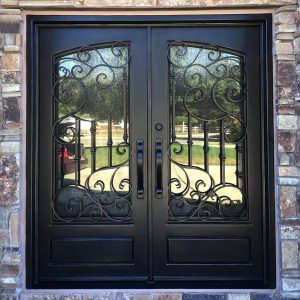
Our production line handles solid wood, thermal-break aluminum, and fiberglass double doors. We offer full customization on size, color, glass, and hardware accessories. Whether you need a 6-lite mahogany arch top prehung unit, an outswing 74″ x 97″ configuration, or a modern vertical 1-lite metal slats design, we can produce it to your specification.
One example: a client from the Middle East ordered 200 mahogany double doors for a villa project. The requirement included 8’0″ height, custom arch-top design, and multi-point locking systems. Our production team adjusted the profile structure to meet the local wind load requirements, and the entire order was delivered in 45 days from order confirmation.
Quality Control and Compliance
Our pre-shipment inspection covers air-tightness, water-tightness, and wind resistance testing—consistent with the EN and ASTM standards discussed earlier. We also adjust profile structures and fittings to match the local building codes of your target market.
For markets with strict energy efficiency requirements (such as the EU or certain US states), we offer thermal-break aluminum profiles and low-E insulated glass units. For hurricane-prone regions, we can reinforce the frame structure and use impact-resistant glazing.
Export Experience and Logistics
With years of foreign trade experience, we provide complete export documentation, including packing lists, proforma invoices, and full customs clearance documents. We support both FCL and LCL shipments with direct delivery from our factory.
Our standard production lead time is 15-30 days, depending on the complexity of the order. For stock designs, we can often ship within 10-15 days. We work with established freight forwarders to ensure your shipment arrives on time and intact.
Cooperation Models
We offer three cooperation models:
| Model | Description | Best For |
|---|---|---|
| OEM | We produce double doors to your exact specifications and brand them under your label | Distributors and retailers |
| ODM | We offer our existing designs that you can customize with your branding | Buyers who need faster turnaround |
| Private Label | We add your brand to our standard products | Resellers and e-commerce sellers |
For construction projects, we can handle bulk supply with staggered delivery schedules to match your build timeline. This ensures you receive the doors when you need them, not all at once.
Pricing and Payment Terms
As a factory-direct supplier, our pricing reflects manufacturing cost plus a reasonable margin—no distributor markup. Bulk orders benefit from tiered pricing: the more units you order, the lower the unit cost.
Our standard MOQ is 10-20 units for custom double doors. For stock designs, we can be more flexible. Payment terms are typically 30% T/T deposit, 70% balance before shipment. For large orders, we can discuss L/C (Letter of Credit) terms.
After-Sales Support
We stand behind our products with a warranty on structural integrity and hardware. We stock common hardware components for quick replacement, and our team is available for remote troubleshooting via email or video call. Installation guides are provided with each shipment.
—
FAQ
What is a double door called?
A double door is commonly referred to as a “French door” when it features full-lite glass panes running the entire length. In architectural terms, it is also called a “twin door” or “pair of doors.” The vertical strip between the two doors is called an astragal.
What does “double doors” mean in slang?
In slang, “double doors” can refer to a person with a large backside, often used humorously. In a business context, it simply refers to a pair of doors that open together as a unit.
How much do double doors cost?
Costs vary significantly based on material, size, and customization:
| Material | Price Range (Prehung Unit) |
|---|---|
| Fiberglass | $800 – $2,500 |
| Solid Wood (Mahogany) | $1,500 – $5,000+ |
| Aluminum/Thermal Break | $1,200 – $3,500 |
| Steel | $1,000 – $2,800 |
Bulk orders from a factory-direct supplier typically reduce these costs by 15-30%. For example, a mahogany double door that retails for $3,000 in the US market might cost $1,800-$2,200 FOB from a Chinese factory.
What’s the difference between a French door and a double door?
The terms are often used interchangeably, but technically, a French door has glass panes running the full length of the door. A double door can have solid panels, partial lites, or full lites. All French doors are double doors, but not all double doors are French doors.
What is the lead time for a custom double door order?
Typical production lead time is 15-30 days depending on the complexity of customization. Shipping time varies by destination: approximately 25-35 days to the US and 30-40 days to Europe. We recommend adding 1-2 weeks of buffer for customs clearance and inland transport.
Can you match local building codes for our market?
Yes. Our profile structures and fittings can be adjusted to meet the specific wind load, thermal, and safety requirements of your target market. We work with you to understand local regulations before production begins.
What is the MOQ for a custom double door order?
Our standard MOQ is 10-20 units for fully customized double doors. For stock designs or a trial order, we can be flexible—please contact us to discuss your specific needs.
Wooden double doors are not always the right choice. In high-humidity coastal areas, fiberglass or aluminum units outperform wood in terms of dimensional stability and maintenance, even though wood offers superior aesthetics. Buyers should weigh appearance against lifecycle cost based on the installation environment.
—
Sourcing double doors for a project is not a transactional purchase—it is a partnership with a manufacturer who must deliver consistency, compliance, and reliability. The right supplier is one who can demonstrate their quality control process, provide transparent documentation, and adjust their production to meet your market’s specific requirements.
If you are evaluating suppliers for your next double door order, we invite you to discuss your project requirements with our team.
—
References
- EN 12207:2016, “Windows and doors – Air permeability – Classification.” European Committee for Standardization. https://www.en-standard.eu/
- ASTM E283-19, “Standard Test Method for Determining Rate of Air Leakage Through Exterior Windows, Skylights, Curtain Walls, and Doors Under Specified Pressure Differences Across the Specimen.” ASTM International. https://www.astm.org/e0283-19.html
- EN 12208:2000, “Windows and doors – Watertightness – Classification.” European Committee for Standardization. https://www.en-standard.eu/
- ISO 2859-1:1999, “Sampling procedures for inspection by attributes.” International Organization for Standardization. https://www.iso.org/standard/1141.html
- ISO 9001:2015, “Quality management systems – Requirements.” International Organization for Standardization. https://www.iso.org/standard/62085.html
- Florida Building Code, 8th Edition (2020), “High-Velocity Hurricane Zone (HVHZ) Requirements.” Florida Department of Business and Professional Regulation. https://www.floridabuilding.org/
- US Department of Energy, “Window U-Factor Recommendations.” https://www.energy.gov/energysaver/design/windows-doors-and-skylights