Content Menu
● 1. Understanding Double Door Entry Systems: Types and Applications
● 2. Material Options: Aluminum, Wood, and Hybrid Systems
● 3. Double Door Entry Configurations and Hardware
● 4. Performance Standards and Testing for Double Door Entries
● 5. Cost Drivers and Budget Planning for Double Door Entries
● 6. How to Evaluate Double Door Entry Factory Suppliers
● 7. Working with a Direct Factory Supplier: What We Offer
● 8. Production Process: From Raw Material to Finished Double Door Entry
● 9. Quality Control: Our Multi-Stage Inspection Process
● 10. Certifications and Industry Standards
● 11. Customization and OEM/ODM Options
● 12. Ordering Process: MOQ, Lead Time, and Shipping
18 min read
When an overseas buyer places their first container order for double door entry units, the question they ask is rarely about price. It is about whether the factory can replicate the sample quality at scale. This concern is justified — doors are engineered assemblies where material selection, profile construction, hardware integration, and glazing determine whether the finished product performs for decades or fails within two seasons.
This guide is written for procurement professionals, contractors, and developers who need to specify double door entry systems with confidence. You will learn what configurations exist, which performance standards matter, how to evaluate a factory’s real capabilities, and what questions to ask before committing to an order.
Understanding Double Door Entry Systems: Types and Applications
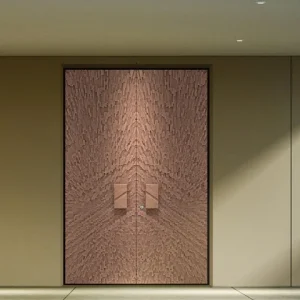
A double door entry consists of two adjacent door panels mounted within a single frame system. Unlike a single door, double doors provide a wider clear opening, serving both functional and aesthetic purposes. The two panels can be configured as active/passive — where one leaf is fixed and only the other opens — or both-active, where both leaves open independently.
The choice depends on traffic patterns. A both-active setup is standard for commercial entrances where foot traffic is high or large objects must pass through. Active/passive configurations are common in residential applications where one side remains locked for security while the other handles daily use.
Where Double Doors Are Used
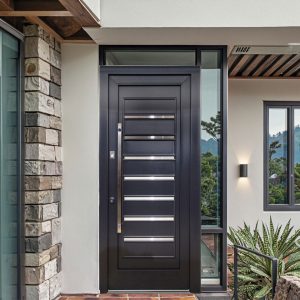
- Commercial storefronts — Retail spaces require wide entrances for customer flow and visual appeal. Aluminum systems dominate due to slim sightlines and structural performance.
- Office buildings — Main lobbies and conference room entrances use double doors for accessibility and an open feel.
- Luxury residential and villas — Double-height entryways are a design statement. Solid wood or aluminum-clad wood systems are common.
- Healthcare and hospitality — Both-active configurations with panic bars and automatic operators are used where accessibility codes require clear widths for stretchers or luggage carts.
- Industrial and institutional — Steel double doors serve high-security and high-traffic applications.
Material Options: Aluminum, Wood, and Hybrid Systems
Aluminum Double Door Entry Systems
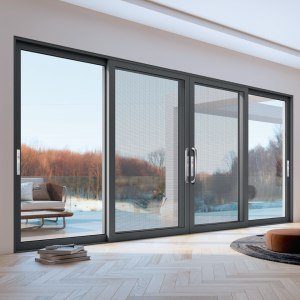
Aluminum is the workhorse of commercial applications. The key advancement is the thermal-break profile — a construction method where interior and exterior aluminum sections are separated by polyamide strips. This breaks the thermal bridge and significantly improves energy efficiency.
Typical thermal-break aluminum double doors achieve U-values between 2.0 and 3.5 W/m²K depending on profile depth and glazing specifications, per testing under European standard EN ISO 10077. For comparison, non-thermal-break systems can exceed 5.5 W/m²K. The difference matters for buildings pursuing energy certifications.
Aluminum’s structural rigidity allows for large panels with slim frames. A well-engineered system can support glazing up to 12 mm thick and handle wind loads common in high-rise applications. Surface finishes include powder coating in any RAL color, anodizing, and wood-grain foil laminates.
Solid Wood Double Door Entries
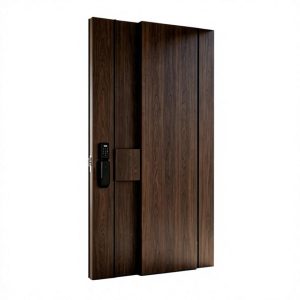
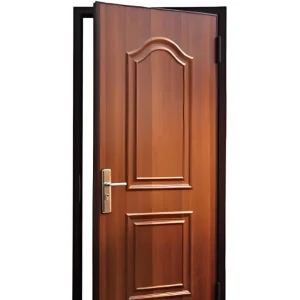
Wood remains the material of choice for luxury residential and heritage-style commercial projects. Common species include oak, mahogany, teak, and engineered wood composites. The aesthetic warmth of solid wood is difficult to replicate in metal.
However, wood requires honest consideration of its limitations. Dimensional stability is the primary concern — wood expands and contracts with humidity changes. Quality manufacturers mitigate this with proper kiln drying (to 8–12% moisture content), engineered core constructions, and seasonal sealing. Buyers in high-humidity climates should weigh these factors carefully.
Maintenance is another trade-off. Exterior wood doors need periodic refinishing every 2–3 years. Aluminum systems require virtually no maintenance beyond hardware lubrication.
Steel and Hybrid Systems
Steel double doors are specified where security is the priority — banks, government buildings, and high-security facilities. Steel offers the highest structural strength and burglary resistance but has poor thermal performance unless insulated or thermally broken.
Aluminum-clad wood systems combine the best of both materials: a timber core for insulation and aesthetics on the interior face, with an aluminum shell on the exterior for durability and minimal maintenance. These are premium products with corresponding price points.
Material comparison table:
| Attribute | Thermal-Break Aluminum | Solid Wood | Steel |
|---|---|---|---|
| Typical U-value (W/m²K) | 2.0–3.5 | 1.8–2.8 | 3.5–5.8 |
| Weight | Light–medium | Heavy | Heaviest |
| Maintenance | Low | High (refinishing) | Low (paint touch-ups) |
| Relative cost | Medium | High | Medium–high |
| Typical lifespan | 30–50 years | 25–40 years | 40–60 years |
| Best application | Commercial, modern | Luxury residential | Security-critical |
Double Door Entry Configurations and Hardware
The hardware specification is where many procurement mistakes happen. A double door entry is only as good as its weakest component, and the hardware is usually the first thing to fail.
Active/Passive vs. Both-Active Panels
In an active/passive configuration, one panel is fixed with shoot bolts at top and bottom that lock into the frame. The active panel operates daily. This configuration is simpler and less expensive — it requires one set of operating hardware.
A both-active configuration has both panels operable. Each leaf has its own locking mechanism, and they meet at a central astragal or overlapping seam. This doubles the hardware cost and adds weatherstripping complexity at the meeting stile. For high-traffic commercial entrances, this is the correct choice.
Critical Hardware Components
Multi-point locking systems — These engage locking bolts at multiple points along the door edge, typically 3–5 points. They provide better security and improved weather sealing compared to single-point locks. European standard EN 1627 defines burglary resistance classes; RC2 is adequate for most residential applications, RC3 for commercial.
Hinges — Heavy-duty butt hinges are standard for most applications. For very heavy doors (over 100 kg per leaf), pivot systems distribute weight more evenly and reduce sagging. The hinge must be matched to door weight — undersized hinges are a common cause of premature failure.
Door closers and panic bars — Commercial double doors in public buildings typically require door closers for fire safety and HVAC control. Panic bars (or exit devices) are mandatory on egress paths in most jurisdictions. These must be certified to local standards — UL listed in North America, CE marked in Europe.
Thresholds and weatherstripping — The threshold seals the gap between door bottom and floor. Adjustable thresholds with compression weatherstripping provide the best air and water tightness. Look for EPDM or silicone gaskets rather than PVC, which degrades faster.
Glazing Options
Double doors frequently incorporate glazing for natural light and visibility. The specification matters for both thermal and safety performance:
- Double glazing (two panes with an air gap) is standard. Triple glazing is used in extreme climates.
- Low-E coatings reflect infrared radiation and significantly improve U-values.
- Tempered glass — safety glass that shatters into small granules upon breakage. Required in most door applications.
- Laminated glass — two panes bonded with an interlayer that holds together upon impact. Used for security and acoustic insulation.
Buyers should verify that the supplier’s glass specifications comply with local safety standards — in the US, this means ANSI Z97.1 or CPSC 16 CFR 1201; in Europe, EN 12150 for tempered glass.
Performance Standards and Testing for Double Door Entries
Buyers evaluating suppliers should demand evidence of performance testing. The following standards are widely used internationally and provide a common language for comparing products.
Air Tightness, Water Tightness, and Wind Load
European standards EN 12207 (air permeability), EN 12208 (water tightness), and EN 12211 (wind load resistance) define test methods and classification systems used globally.
- Air tightness (EN 12207) — Classes range from 1 (least airtight) to 4 (most airtight). Class 3 or 4 is typical for commercial buildings.
- Water tightness (EN 12208) — Classes range from 1A to 9A. Higher classes indicate resistance to more severe rain and wind conditions.
- Wind load resistance (EN 12211) — Tests the door’s structural response to wind pressure. The classification determines the maximum building height and location where the door can be installed.
For a double door entry — especially a both-active configuration — the central meeting stile is the most challenging area for airtightness. A quality factory will test the complete assembled door, not just individual profiles.
Thermal Performance
The U-factor (or U-value) measures how much heat transfers through the door assembly. Lower values mean better insulation. Industry-standard testing follows EN ISO 12567 or similar hot-box methods.
Buyers should note: An energy code compliance requirement (such as LEED or BREEAM) will specify a maximum U-value. The supplier must provide documentation showing the complete door assembly meets this threshold — not just the glass or profile specifications in isolation.
Security and Safety Certifications
- Burglar resistance (EN 1627) — Rates doors from RC1 (basic) to RC6 (maximum). RC2/RC3 are common for commercial applications.
- Fire-rated double doors — Where required, doors must be tested to standards like EN 1634 (Europe) or UL 10C (North America). The frame, seals, and hardware must all be rated for the same duration.
- Accessibility compliance — In the US, the Americans with Disabilities Act (ADA) requires a minimum clear opening of 32 inches when one door leaf is open.
Standard tests to request from any supplier:
| Test | Standard | What It Validates |
|---|---|---|
| Air permeability | EN 12207 | Air leakage rate |
| Water tightness | EN 12208 | Resistance to rainwater penetration |
| Wind load resistance | EN 12211 | Structural performance under wind pressure |
| Thermal transmittance | EN ISO 12567 | Overall U-value of the door assembly |
| Burglar resistance | EN 1627 | Security performance (RC1–RC6) |
| Impact resistance | EN 13049 | Resistance to soft and heavy body impact |
Cost Drivers and Budget Planning for Double Door Entries
Understanding what drives pricing helps buyers evaluate quotes fairly and avoid either overpaying or selecting an under-specified product.
Material and Profile Costs
Aluminum prices fluctuate with global commodity markets. The extrusion cost is influenced by profile complexity — multi-chamber thermal-break profiles use more material and require more manufacturing steps than simple single-chamber profiles. A typical thermal-break profile costs 20–40% more than a non-thermal-break equivalent.
Solid wood prices vary dramatically by species. African mahogany and European oak are premium materials. Engineered wood composites (veneer over a stable core) offer a more cost-effective alternative with improved dimensional stability.
Customization and Sizing
Non-standard sizes drive costs up. A factory that produces standard sizes in volume can amortize tooling and setup costs across many units. Custom sizes require individual setup and may involve material waste. Buyers should specify sizes as early as possible to avoid change orders during production.
Custom colors — especially non-standard RAL shades — may require minimum paint quantities. Wood-grain foil finishes are generally more economical than real wood veneers.
Hardware Grade
Hardware costs can range from 5–20% of the total door price. Economy hardware from Asian manufacturers may cost half of a European premium brand, but the performance gap is significant. Multi-point locks from reputable European brands (such as GU, Hoppe, or Winkhaus) are tested to millions of cycles. For commercial applications, this reliability is worth the premium.
Cost hierarchy (low to high):
- Non-thermal-break aluminum with basic hardware
- Thermal-break aluminum with economy hardware
- Thermal-break aluminum with premium hardware and double glazing
- Solid wood systems
- Aluminum-clad wood or fully custom designs
Paying more does not automatically buy better performance. A mid-range aluminum system with properly specified hardware will outperform a premium wood door that is installed in the wrong climate. Budget should follow the application requirements, not the reverse.
How to Evaluate Double Door Entry Factory Suppliers
This is the most critical step in the procurement process. A factory’s marketing materials can claim anything. What matters is verifiable capability.
Manufacturing Capability and Quality Control
The first question to ask: does the factory produce doors in-house, or does it assemble components sourced from other manufacturers? Assembly-only operations have less control over quality and consistency. A true manufacturer will have extrusion lines (or partnerships with extruders), CNC machining centers, surface treatment lines, and assembly workshops.
Key quality checkpoints to verify:
- Incoming material inspection — Are aluminum profiles and glass inspected upon receipt?
- In-process inspection — Are there quality gates during machining, welding, and assembly?
- Pre-shipment inspection — Is every unit tested for air tightness, water tightness, and wind resistance before packing?
The most reliable way to verify these claims is to request a pre-shipment inspection report for a previous order. A reputable factory will provide these documents without hesitation.
Customization and OEM/ODM Capabilities
Buyers should confirm whether the factory can accommodate:
- Custom sizes and shapes
- Specific colors and finishes
- Custom glass specifications (thickness, coatings, safety requirements)
- Branded hardware or specific hardware brands
True OEM capability means the factory can manufacture to the buyer’s exact drawings and specifications. ODM capability means the factory has its own designs that the buyer can brand and sell. Both are valid — the right choice depends on whether the buyer has existing designs or needs a ready-made product.
A critical question for international buyers: Can the factory adjust its profile structures and fittings to match your local building codes? Building codes differ significantly between markets — what passes in China may not meet European or North American requirements. A factory with export experience will have adapted its products for multiple markets.
Logistics and Export Experience
International procurement involves more than production. The factory’s ability to handle export logistics affects your total cost and timeline.
- FCL vs. LCL — Full container load is more cost-effective for large orders. Less-than-container-load suits smaller quantities but has higher per-unit shipping costs.
- Documentation — A factory with foreign trade experience should provide packing lists, proforma invoices, and full customs documentation without being asked.
- Lead time — Standard products may ship in 15–25 days. Custom orders typically take 30–45 days. Buyers should get a written production schedule.
Supplier Evaluation Checklist
Use this 10-point checklist when evaluating double door entry suppliers:
- Does the factory own its production lines, or is it an assembly operation?
- Can it provide test reports for air, water, and wind resistance?
- Does it have ISO 9001:2015 certification or equivalent quality management?
- Can it accommodate custom sizes, colors, and hardware?
- Does it have experience exporting to your target market?
- Can it provide references from similar projects?
- What is the typical lead time for your order size?
- What are the MOQ requirements?
- Does it provide pre-shipment inspection reports?
- What is the warranty and after-sales support policy?
Avoid suppliers who:
- Cannot provide test reports or certification documentation
- Quote significantly below market rates without explanation
- Refuse to provide a pre-shipment inspection
- Have no experience with international shipping documentation
- Cannot state their production capacity in concrete numbers
Choose A if… Choose B if…
- Choose a factory with in-house production if you need consistent quality at scale. Choose a specialized assembly operation if you have a small, highly customizable order and can tolerate longer lead times.
- Choose aluminum if your project prioritizes low maintenance, slim profiles, and long-term durability. Choose wood if the architectural design demands it and the project budget can support the maintenance.
- Choose both-active doors for high-traffic commercial entrances. Choose active/passive for residential applications where daily use is light and security is the priority.
Working with a Direct Factory Supplier: What We Offer
If you are evaluating factories for your double door entry project, here is how a direct manufacturing partner can meet the criteria outlined above.
As Jusen Door and Windows Manufacturing Co., Ltd., we operate as a direct factory supplier. Our commercial model eliminates middleman markup — you are quoted factory-direct pricing, not a trading company’s resale price. You are dealing with the entity that controls production, quality, and delivery.
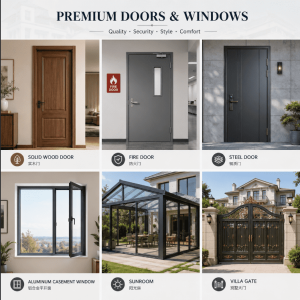
Our manufacturing capability covers solid wood doors, thermal-break aluminum doors and windows, system windows, and custom villa doors. For double door entry systems specifically, we produce both aluminum and wood configurations to your specifications.
Full customization is standard for us. We accommodate custom sizes, colors, glass specifications, and hardware accessories. Our OEM and ODM services mean you can either supply your own designs or work from our existing product range. For international buyers, our engineering team adjusts profile structures and fittings to match the building codes of your target market.
Quality control is enforced through a multi-stage inspection process. Every double door entry unit undergoes air-tightness, water-tightness, and wind-resistance testing before shipment. We provide test reports and inspection documentation as part of the standard order process.
Export logistics are handled in-house. We provide packing lists, proforma invoices, and full customs documentation. Both FCL and LCL shipping options are available, with direct delivery from our factory in China.
Production Process: From Raw Material to Finished Double Door Entry
Understanding the production process helps buyers appreciate what goes into a quality double door entry — and why cheap quotes often indicate skipped steps.
Step 1: Material Sourcing and Inspection
Aluminum profiles are sourced from qualified extruders, typically using 6063-T5 or 6063-T6 alloy. Timber is kiln-dried to the appropriate moisture content. Glass is procured from certified suppliers. Incoming materials are inspected against specifications before entering production.
Step 2: Cutting and Machining
Profiles are cut to length using CNC saws with precision tolerances of ±0.5 mm. Machining centers then drill holes, mill slots, and create the geometry for hardware installation. Misaligned holes cause hardware binding and premature wear.
Step 3: Surface Treatment
Aluminum profiles undergo surface preparation before finishing. Powder coating involves electrostatic application of dry paint followed by oven curing. Anodizing is an electrochemical process that creates a durable oxide layer. Wood components are sanded, stained, and sealed with multiple coats of finish.
Step 4: Glass and Hardware Preparation
Glass panels are cut, edged, and tempered or laminated as specified. Hardware is inspected and prepared. Multi-point locks are tested for smooth operation before installation.
Step 5: Assembly
The frame is assembled first, then glazing and hardware are installed. For double door entry systems, the meeting stile alignment is critical — the two panels must align perfectly for the weatherstripping to seal correctly. Hardware is adjusted and tested.
Step 6: Final Inspection and Testing
Every assembled unit is tested for air tightness, water tightness, and wind resistance. Visual inspection checks for surface defects, hardware operation, and overall finish quality. Units that pass are wrapped and packed for shipment.
Quality Control: Our Multi-Stage Inspection Process
Quality control at our factory is a series of inspections woven into the production flow.
Stage 1: Incoming material inspection. Profiles, glass, hardware, and finishes are checked against purchase specifications. Non-conforming materials are rejected before they enter production.
Stage 2: In-process inspection. After cutting and machining, samples are checked for dimensional accuracy. Weld quality and surface preparation are verified.
Stage 3: Pre-assembly inspection. Before final assembly, components are verified for fit. Hardware is checked for smooth operation.
Stage 4: Pre-shipment testing. Each finished unit undergoes performance testing for air tightness, water tightness, and wind resistance. Test results are documented.
Stage 5: Packing and loading inspection. Finished units are wrapped and packed. The packing list is verified against the order. Container loading is supervised to prevent transit damage.
Certifications and Industry Standards
Our factory operates under ISO 9001:2015 quality management systems. Products are tested to relevant standards including:
- EN 12207 (air permeability)
- EN 12208 (water tightness)
- EN 12211 (wind load resistance)
- EN ISO 12567 (thermal transmittance)
For buyers targeting specific markets, we provide documentation and test reports aligned with local requirements. Our engineering team works with clients to ensure profiles, glazing, and hardware comply with the building codes of the destination country.
Customization and OEM/ODM Options
Double door entry projects rarely come in standard configurations. Our customization capabilities include:
- Size and geometry — We manufacture to your architectural drawings, including non-standard widths and heights.
- Color and finish — Any RAL color for powder coating, anodizing options, and wood-grain foil finishes.
- Glass specifications — Double or triple glazing, low-E coatings, argon fill, tempered or laminated safety glass, and decorative options.
- Hardware — We install hardware from specified brands or supply our own premium options.
For OEM orders, you provide the design and we manufacture to your specifications. For ODM orders, we offer our existing double door entry designs that you can brand as your own. Private label options are available.
Ordering Process: MOQ, Lead Time, and Shipping
Minimum Order Quantity (MOQ)
Our MOQ varies by product type and customization level. Standard configurations have lower MOQs. Highly customized orders may require higher minimums to justify tooling and setup costs. Contact us with your project specifications for a specific MOQ quote.
Lead Time
Standard products typically ship in 15–25 days from order confirmation. Custom orders with unique sizes, colors, or hardware typically require 30–45 days. Large-volume construction project orders are scheduled based on the project timeline.
Shipping Options
We offer both FCL (full container load) and LCL (less than container load) shipping. FCL is recommended for orders of 20 feet or more. LCL is suitable for smaller quantities. Shipping terms (FOB, CIF, EXW) are negotiated based on your preference.
All orders include complete export documentation: packing list, proforma invoice, commercial invoice, and customs declarations. We handle the export process from our factory to the port of departure.
—
Case Studies
Case 1: Villa Project in the Middle East
A property developer in Dubai ordered 40 custom aluminum double door entry units for a luxury villa complex. The units required thermal-break profiles with double glazing to handle extreme summer temperatures. The order included custom RAL colors and European-brand multi-point locking systems. Production took 35 days, and all units passed pre-shipment testing.
Case 2: Commercial Complex in Southeast Asia
A construction company in Vietnam specified both-active aluminum double doors for a retail complex. The order required compliance with local building codes, including panic bars and specific clear widths. Our engineering team adjusted the profile structure to accommodate the required hardware. A total of 120 units were delivered in 30 days via LCL shipping. The client reported zero installation issues.
Frequently Asked Questions
What is the standard width for a double door entry?
Typical clear opening widths range from 1,200 mm to 2,400 mm for residential applications. Commercial systems can go wider. The final width depends on traffic requirements and local accessibility codes. In the US, ADA requires a minimum clear width of 32 inches when one leaf is open.
Can double door entry systems be customized to match local building codes?
Yes. Reputable factories adjust profile structures, glazing options, and hardware fittings to comply with regional standards. Buyers should verify that their supplier can provide documentation and test reports aligned with their target market’s requirements. This is a standard part of our export process.
What is the typical lead time for a factory order of double door entries?
Standard configurations typically ship in 15–25 days. Fully custom designs take 30–45 days. Order volume affects the timeline — large orders may require scheduling across multiple production runs. Buyers should request a written production schedule before placing an order.
What is the difference between OEM and ODM for double door entry orders?
OEM means the factory manufactures to the buyer’s specifications and design. ODM means the factory provides its own design that the buyer can brand and sell. Choose OEM if you have existing drawings. Choose ODM if you need a ready-made solution.
How do I choose between aluminum and wood for a double door entry?
Consider the project’s climate, architectural style, maintenance expectations, and budget. Aluminum offers durability and low maintenance with thermal-break technology for energy efficiency. Wood offers a premium aesthetic but requires more upkeep. For high-humidity climates, aluminum or aluminum-clad wood is usually the better choice.
What shipping options are available for international double door entry orders?
Factories typically offer both FCL and LCL shipping. FCL is more cost-effective for large orders. LCL suits smaller quantities. Verify that the supplier provides proper export documentation, including packing lists and customs paperwork. We provide full documentation with every order.
—
The procurement of double door entry systems comes down to specification accuracy and supplier verification. Specify materials and hardware based on the performance requirements of your project — not on assumptions about what looks good. Verify that your supplier has the manufacturing capability, testing protocols, and export experience to deliver what they promise. A factory that can document its performance testing, accommodate custom requirements, and handle international logistics is worth more than a lower quote from a supplier who cannot.
If you have a double door entry project in the pipeline, send us your specifications. Our team will review your requirements and respond with a tailored recommendation.
—
References
- European Committee for Standardization. EN 12207:2016 — Windows and doors — Air permeability — Classification. https://www.en-standard.eu
- European Committee for Standardization. EN 12208:2000 — Windows and doors — Water tightness — Classification. https://www.en-standard.eu
- European Committee for Standardization. EN 12211:2016 — Windows and doors — Resistance to wind load — Classification. https://www.en-standard.eu
- European Committee for Standardization. EN 1627:2021 — Pedestrian doorsets — Burglar resistance. https://www.en-standard.eu
- International Organization for Standardization. ISO 9001:2015 — Quality management systems. https://www.iso.org/standard/62085.html
- U.S. Department of Justice. ADA Standards for Accessible Design. https://www.ada.gov/law-and-regs/design-standards/