Content Menu
● 1. 1. Understanding Double Deck Doors: Types and Applications
● 2. 2. Are Double Front Doors a Good Idea? Performance and Practicality
● 3. 3. What Do You Call a Front Door with Two Doors? Terminology and Specification
● 4. 4. How Much Do New Double Front Doors Cost? Price Structure and Factors
● 5. 5. What Are the Disadvantages of Double Doors? Risk Mitigation for Buyers
● 6. 6. How to Evaluate Double Deck Doors Suppliers
● 7. 7. Relevant Industry Standards and Certifications
● 8. 8. Production Process: From Raw Material to Finished Doors
● 9. 9. Quality Control: Our Multi-Stage Inspection Process
● 10. 10. Customization and OEM/ODM Options
● 11. 11. Ordering Process: MOQ, Lead Time, and Shipping
● 12. 12. Working with a Factory-Direct Supplier: Our Approach
● 13. 13. Case Studies and Application Examples
● 14. Choose the Right Door for Your Project
19 min read
When an overseas buyer places their first container order for double deck doors, the question they ask is rarely about price. It is about whether the factory can replicate the sample quality at scale. The difference between a good and a bad double door shipment often comes down to specification clarity and manufacturing discipline — not luck.
This guide covers what B2B buyers, contractors, and importers need to know before sourcing double deck doors. We will go through terminology, material science, cost structures, quality benchmarks, and supplier vetting.
1. Understanding Double Deck Doors: Types and Applications
Direct answer: Double deck doors — commonly called double entry doors or double front doors — consist of two independently operable leaves within a single frame. They are used in residential villas, commercial storefronts, and institutional buildings where a wider entrance is required for aesthetics, access, or ventilation. The “deck” term is colloquial; procurement documents should use “double leaf” or “double swing” to avoid ambiguity.
1.1 Technical Definition and Common Misconceptions
The term “double deck doors” is not a formal industry classification. In manufacturing and architectural specification, these are properly called double leaf doors or double swing doors. When you issue a Request for Quotation (RFQ) with the wrong terminology, suppliers may quote the wrong product entirely.
There are three distinct configurations buyers encounter:
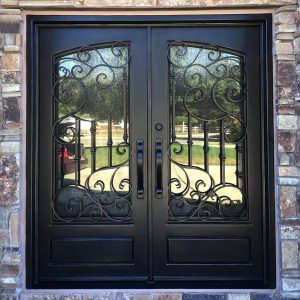
- Double front doors: Two side-hinged leaves, typically 36 inches (914 mm) each, used at main entrances. Often one leaf is fixed (“passive”) and the other operable (“active”).
- Double patio doors: Similar construction but designed for interior-exterior transitions, usually with larger glazing areas and lower thresholds.
- Double security doors: Reinforced frames, multi-point locking on both leaves, and impact-resistant glazing. Specified for high-risk commercial applications.
The active/passive leaf configuration is the most common for exterior double doors. The active leaf contains the primary locking mechanism. The passive leaf has shoot bolts at top and bottom, engaging with the frame. An astragal — a vertical profile attached to the passive leaf — covers the gap between leaves and provides a sealing surface.
1.2 Material Categories: Aluminum, Solid Wood, and uPVC
Material selection drives performance, cost, and longevity. Here is a comparative breakdown:
| Property | Thermal-Break Aluminum | Solid Wood | uPVC |
|---|---|---|---|
| Weight (per leaf, 900×2100mm) | 35–50 kg | 40–70 kg | 25–35 kg |
| U-value (W/m²K, with double glazing) | 1.1–1.8 | 1.8–2.5 | 1.3–2.0 |
| Durability | Excellent (50+ years) | Good (requires maintenance) | Moderate (15–25 years) |
| Customization potential | High (powder coating, anodizing) | High (stains, paints, carvings) | Low (limited color options) |
| Structural span capability | High (up to 2.5m per leaf) | Moderate (up to 1.2m per leaf) | Low (up to 1.0m per leaf) |
Thermal-break aluminum dominates the commercial and high-end residential market. The “thermal break” refers to a polyamide strip inserted between the interior and exterior aluminum profiles. This interrupts the thermal bridge, reducing heat transfer. For projects targeting Passive House or net-zero standards, aluminum with a 34mm or wider thermal break is the specification of choice.
Solid wood offers aesthetic warmth that aluminum cannot replicate. Species like oak, mahogany, and Sapele are common. The trade-off is maintenance — exterior wood doors require re-finishing every 2–3 years to prevent moisture damage. For importers, wood doors also raise phytosanitary certification requirements (ISPM 15) that aluminum does not trigger.
uPVC is the budget option. It is dimensionally stable and corrosion-proof. However, the material’s low structural stiffness limits leaf widths. A 1-meter uPVC leaf will flex more than an aluminum equivalent, which accelerates seal wear.
1.3 Typical Applications in Commercial and Residential Projects
Double deck doors appear in four primary project types:
- High-end villas and residences — Curb appeal and a sense of arrival. Often combined with sidelights and transoms.
- Commercial storefronts — Wide entrances for retail spaces, allowing natural light and visibility into the showroom.
- Hotel and hospitality entrances — Double doors with automatic operators for accessibility and luggage movement.
- Multi-family residential lobbies — Fire-rated double doors that meet egress requirements while maintaining aesthetic continuity.
For B2B buyers, the application dictates the specification. A hotel entrance requires different hardware (panic bars, automatic operators) than a villa entrance (decorative handles, multi-point locks).
2. Are Double Front Doors a Good Idea? Performance and Practicality
Direct answer: Double front doors are a good idea when the project requires a wider entrance for furniture movement, cross-ventilation, or architectural statement. They are not the best choice for every situation — the larger surface area increases cost, requires more locking points, and demands careful weatherproofing. Buyers should evaluate lifecycle performance, not just upfront appearance.
2.1 Aesthetic Impact and Curb Appeal
The visual weight of a double door changes the entire facade. Real estate studies consistently show that entryway upgrades return 75–100% of their cost in increased property value [1]. For architects, double doors allow a symmetrical composition that anchors the building’s facade. Mediterranean, modern farmhouse, and neo-colonial styles all favor this configuration.
From a procurement standpoint, the aesthetic benefit translates into a higher acceptable price point. Buyers can justify a 20–30% premium over a single door when the project demands a grand entrance.
2.2 Functional Benefits: Access and Ventilation
The clear opening width of a double door — typically 1,800–2,000 mm total — accommodates items that would never fit through a single door. Sofas, grand pianos, medical equipment, and industrial machinery. For commercial buildings, this eliminates the need for a separate loading entrance.
Both leaves being operable creates true cross-ventilation. In warm climates, opening both leaves generates airflow that reduces cooling loads. This is a measurable operational benefit, not just a comfort feature.
2.3 Potential Drawbacks
Let me be direct about the downsides. Double doors are not the right choice for every project.
- Cost: You are buying two leaves, two hardware sets, and a reinforced frame. Expect a 50–100% cost increase over a single door of comparable quality.
- Security: A double door has twice the locking points of a single door. Each point is a potential failure. Multi-point locks with shoot bolts are essential, not optional.
- Weatherproofing: The center seam (astragal) is a weak point. If the door is not engineered correctly, air and water infiltration occur here. This is the most common field complaint.
- Space requirements: Both leaves need swing clearance. In tight entryways, a single door is more practical.
The data supports caution. Testing standards like EN 12207 (air permeability) and EN 12208 (water tightness) classify door performance from Class 0 (no test) to Class 4 (highest). A well-engineered double door achieves Class 3 or 4; a poorly engineered one fails at Class 1. The difference is in the frame design, astragal profile, and hardware quality.
3. What Do You Call a Front Door with Two Doors? Terminology and Specification
Direct answer: The correct industry terms are “double leaf door,” “double swing door,” or simply “double door.” “French doors” refers specifically to a pair of full-height glazed doors, typically hinged and opening outward or inward as a pair. In procurement documents, use “double leaf, side-hinged” to be unambiguous.
3.1 Industry Terminology for Procurement Documents
The term you use in an RFQ determines what you receive. Here is a quick reference:
- Double leaf door: Two leaves in one frame. Standard term in architectural specifications.
- Double action door: Leaves that swing both ways (saloon style). Used in commercial kitchens and corridors.
- French doors: Two leaves, usually fully glazed, both operable. Common for patios and interior room dividers.
- Double deck doors: Colloquial; avoid in formal documents.
When writing a Bill of Quantities (BOQ), specify:
- Leaf configuration: Active/passive or both operable.
- Leaf dimensions: Width × height × thickness.
- Frame profile: Material, system name, and thermal break width.
- Glazing: Type, thickness, and U-value.
- Hardware grade: Lock brand, cylinder type, hinge specification.
- Finish: RAL color, anodizing, or wood stain.
3.2 Example Specification Snippet
Here is a specification that a factory can quote accurately:
> Thermally broken aluminum double leaf entrance door. Each leaf: 1,000 mm × 2,400 mm × 68 mm frame depth. Profile system with 34 mm polyamide thermal break. Glazing: 6 mm tempered + 12 mm argon + 6 mm low-E (U-value 1.1 W/m²K). Hardware: multi-point locking with shoot bolts on passive leaf, three concealed hinges per leaf, lever handles. Finish: RAL 7016 anthracite, powder coated to Class 2 (40 µm minimum). Compliance: EN 14351-1, air permeability Class 3, water tightness Class 3, wind load Class C3.
A spec like this removes guesswork. The factory knows exactly what to produce, and you know exactly what to inspect on arrival.
4. How Much Do New Double Front Doors Cost? Price Structure and Factors
Direct answer: Ex-works factory pricing for double deck doors ranges from $800 to $5,000+ per unit, depending on material, size, glazing, and hardware. Aluminum thermal-break doors typically cost $1,200–$2,500 per unit. Final installed cost adds 20–40% for freight, installation, and local compliance.
4.1 Cost Breakdown by Material
B2B pricing (ex-works, China factory, per complete door set):
| Material | Price Range (USD) | Notes |
|---|---|---|
| uPVC double door | $500–$1,200 | Budget option; limited span and finish options |
| Thermal-break aluminum | $1,200–$2,500 | Standard for commercial and high-end residential |
| Solid wood (engineered) | $1,500–$3,500 | Depends on veneer species and finish |
| Solid wood (premium hardwood) | $2,500–$5,000+ | Imported species, custom carvings, premium hardware |
These are production costs. They exclude freight, duties, and installation labor.
4.2 Hidden Costs to Budget For
The door itself is only part of the project cost. Buyers frequently underestimate:
- Hardware: Multi-point locks, hinges, and handles add $150–$500 per set. Grade matters. A cheap lock fails within 2 years; a quality lock lasts 15+.
- Glazing upgrades: Double glazing is standard. Triple glazing adds $50–$100 per square meter. Laminated glass (for security) adds another $30–$60 per square meter.
- Structural reinforcement: A double door span requires a reinforced header. If the opening is not already framed for it, add $200–$800 for steel lintels.
- Installation labor: Commercial installation runs $300–$800 per door, depending on site conditions.
4.3 Price vs. Value: What to Prioritize
A cheap door is expensive in the long run. Air leakage increases heating and cooling costs. Hardware failure requires callbacks. Corrosion on non-thermal-break aluminum appears within 3–5 years in coastal environments.
For B2B buyers, the calculation is simple: lifecycle cost = purchase price + maintenance + energy penalty. A $1,500 aluminum door with proper thermal breaks outperforms a $900 uPVC door within 5 years in energy savings alone, and it lasts 3 times longer.
5. What Are the Disadvantages of Double Doors? Risk Mitigation for Buyers
Direct answer: The main disadvantages are higher cost, increased security risk if hardware is under-specified, greater weatherproofing challenges at the astragal, and space requirements for leaf swing. These risks are manageable with correct specification and factory quality control.
5.1 Structural and Installation Challenges
Double doors span a wider opening than single doors. The header above the door must carry the load from above without sagging. In renovation projects, this often means adding a steel lintel. The frame must also be anchored more aggressively — typically with expansion bolts at 600 mm centers — to prevent movement.
Over time, leaves can sag if the frame is not rigid enough. This is especially true for solid wood doors, which are heavier. A 100 kg wood leaf on inadequate hinges will drop within a year. The solution is three hinges per leaf, with the top hinge bearing most of the load.
5.2 Energy Efficiency and Weather Resistance
A double door has more perimeter than a single door, which means more sealing surface. Every seal is a potential leak point. The astragal is the highest-risk area. If the astragal profile is not designed with a proper compression seal, wind-driven rain will penetrate.
Industry testing provides the benchmark. EN 12207, EN 12208, and EN 12210 classify air permeability, water tightness, and wind load resistance. A double door that achieves Class 3 or better in all three categories is considered high-performance. Buyers should demand test reports, not just marketing claims.
5.3 Maintenance and Long-Term Durability
Maintenance requirements vary by material:
- Aluminum: Annual check of seals and moving parts. Hardware lubrication every 6 months. Powder coating lasts 20+ years with minimal care.
- Wood: Re-finish every 2–3 years. Check for moisture damage at the bottom rail. More maintenance, but the aesthetic payoff is significant.
- uPVC: Low maintenance, but the material degrades with UV exposure. Color fading and surface brittleness appear after 10–15 years.
6. How to Evaluate Double Deck Doors Suppliers
Direct answer: Evaluate suppliers on four criteria: factory audit results, certification validity, testing capability, and reference projects. Do not rely on brochures or website claims. Ask for specific test reports, visit the production line if possible, and speak to existing clients in your market.
6.1 Key Criteria for Evaluating Manufacturers
1. Factory audit. Verify production capacity, equipment, and workforce. Look for CNC machining centers, thermal-break assembly lines, and proper surface treatment facilities (anodizing or powder coating lines). A factory with in-house production controls quality better than one that outsources.
2. Certifications. ISO 9001:2015 for quality management is the baseline. CE marking (EN 14351-1) is required for European markets. For the US, check AAMA/WDMA compliance. Some factories hold additional certifications like LEED contribution documentation or Passive House component certification.
3. Testing capability. Does the factory have in-house testing equipment for air, water, and wind? Or do they send samples to external labs? In-house testing means faster iteration and stricter batch control.
4. Reference projects. Ask for a list of past clients, specifically in your target market. Contact two or three. Ask about delivery times, quality consistency, and after-sales support.
6.2 Questions to Ask Before Ordering
Use this checklist during supplier evaluation:
- What is your monthly production capacity for double doors?
- Do you have test reports for air permeability, water tightness, and wind load? Can you share them?
- What is your tolerance for leaf dimensions? (Industry standard is ±2 mm.)
- How do you handle defects found during pre-shipment inspection?
- What is your standard packing for export? (Proper packing prevents transit damage.)
- Can you provide OEM/ODM services? What is the minimum order quantity?
- What is your typical lead time for a 40-foot container order?
6.3 Red Flags: Avoid Suppliers Who…
- Cannot provide test reports or certification documents.
- Quote significantly below market rates without explaining the cost difference.
- Do not have a physical factory address verifiable via Google Maps or satellite imagery.
- Refuse to offer pre-shipment inspection by a third-party agency.
- Have no export experience to your target market.
7. Relevant Industry Standards and Certifications
Direct answer: The key standards for double deck doors are EN 14351-1 (EU), AAMA/WDMA/CSA 101/I.S.2/A440 (North America), and ISO 9001:2015 for quality management. Performance classifications for air permeability, water tightness, and wind load follow EN 12207, EN 12208, and EN 12210 respectively.
7.1 European Standards (CE Marking)
EN 14351-1 is the harmonized product standard for windows and pedestrian doors in Europe. It covers:
- Mechanical strength and stability
- Air permeability (EN 12207): Classes 0–4, with 4 being the best.
- Water tightness (EN 12208): Classes 0–9, with 9 being the best.
- Wind load resistance (EN 12210): Classes A–E, with A being the best.
- Thermal transmittance (U-value): Declared value in W/m²K.
- Acoustic performance: Sound reduction index in dB.
- Fire resistance: If applicable, tested to EN 1634-1.
7.2 North American Standards
The AAMA/WDMA/CSA 101/I.S.2/A440 standard is the North American equivalent. It covers similar performance criteria but uses different test methods and classification systems. For aluminum doors, AAMA 2604 or 2605 specifies coating performance.
7.3 Quality Management
ISO 9001:2015 is the baseline quality management system. It does not guarantee door quality, but it indicates that the factory has documented processes for production, inspection, and corrective action. For buyers, this means the factory can trace defects to their root cause and prevent recurrence.
8. Production Process: From Raw Material to Finished Doors
Direct answer: A double deck door goes through six key stages: profile cutting, machining, thermal break assembly (for aluminum), surface treatment, glazing and hardware installation, and final inspection. Each stage has specific quality checkpoints.
8.1 Aluminum Door Production Steps
1. Profile cutting and machining. Aluminum profiles are cut to precise lengths using CNC double-miter saws. Tolerance is ±0.5 mm. Holes for hardware, drainage, and screw ports are machined using CNC machining centers.
2. Thermal break assembly. For thermal-break profiles, the polyamide strips are inserted between the inner and outer aluminum sections. The assembly is then crimped or rolled to create a mechanical bond. This step requires specialized equipment — a crimping machine with consistent pressure.
3. Surface treatment. Profiles are either anodized or powder coated. Powder coating involves electrostatic application of paint, followed by curing in an oven at 180–200°C. Film thickness should be 60–80 µm for exterior applications.
4. Fabrication. Profiles are assembled into frames and leaves. Corners are joined using either mechanical fasteners or welding (for steel). For aluminum, corner cleats and structural adhesive are common.
5. Glazing. Glass units are installed with setting blocks and gaskets. The glass must sit flush with no pressure points. Improper glazing causes stress cracks.
6. Hardware installation. Locks, hinges, and handles are installed and adjusted. Multi-point locks require precise alignment — a misalignment of 1 mm causes binding.
7. Final inspection. Each door is checked for dimensional accuracy, seal integrity, hardware function, and surface finish.
8.2 Wood Door Production Steps
Wood doors follow a different process: kiln drying, finger-jointing (for engineered cores), veneering, pressing, machining, sanding, and finishing. The finishing process — multiple coats of UV-cured lacquer or polyurethane — is critical for exterior durability.
9. Quality Control: Our Multi-Stage Inspection Process
Direct answer: A reliable manufacturer performs inspection at three stages: incoming material inspection, in-process inspection, and pre-shipment inspection. Pre-shipment inspection should include air-tightness, water-tightness, and wind resistance testing on sample units.
9.1 Incoming Material Inspection
Aluminum profiles are checked for alloy composition (6063-T5 is standard) and surface quality. Glass is checked for optical distortion and edge quality. Hardware is verified against the BOM (Bill of Materials).
9.2 In-Process Inspection
During fabrication, inspectors check:
- Profile dimensions (±0.5 mm tolerance).
- Thermal break integrity (no gaps or delamination).
- Weld quality (for steel frames) or corner joint strength.
- Surface finish (no scratches, runs, or color variation).
9.3 Pre-Shipment Inspection
Before loading, a final inspection is performed. This includes:
- Full dimensional check against approved drawings.
- Hardware function testing (locks, hinges, handles).
- Seal integrity check (visual and tactile).
- Sample testing for air, water, and wind, if specified.
For export orders, buyers can request third-party inspection (SGS, Bureau Veritas, or similar) at the factory. This adds cost but provides independent verification.
10. Customization and OEM/ODM Options
Direct answer: Factories offer three cooperation models: OEM (manufacture to your drawings), ODM (design and engineer to your requirements), and private label (produce under your brand). Customization extends to dimensions, profiles, colors, glass, and hardware.
10.1 OEM: Manufacture to Your Specification
The buyer provides drawings and specifications. The factory manufactures to those exact requirements. This is the most common model for established brands that have their own designs.
10.2 ODM: Design and Engineering Support
The buyer provides performance requirements and aesthetic direction. The factory’s engineering team designs the profile system, selects materials, and produces prototypes. This is ideal for buyers entering the market with a new product line.
10.3 Private Label: Your Brand, Our Production
The factory manufactures doors with the buyer’s brand name on packaging and hardware. This is common for distributors who want to build their own brand without investing in manufacturing.
10.4 Customization Parameters
- Dimensions: Any size within machine limits. Typically up to 2,500 mm × 3,000 mm per leaf.
- Colors: RAL or custom color matching. Powder coating offers the widest range.
- Glass: Clear, frosted, laminated, low-E, triple glazing, or decorative.
- Hardware: Brand and grade specified by the buyer.
11. Ordering Process: MOQ, Lead Time, and Shipping
Direct answer: For double deck doors, expect a minimum order quantity of 10–20 units for custom orders, a production lead time of 15–30 days, and shipping time of 20–40 days depending on destination. Payment terms are typically 30% deposit, 70% before shipment.
11.1 MOQ and Production Capacity
Most factories have a flexible MOQ. For standard sizes, the MOQ can be as low as 5 units. For fully custom orders (new profiles or special finishes), the MOQ is higher — 20–50 units — to justify tooling and setup costs.
11.2 Lead Time Breakdown
| Stage | Time |
|---|---|
| Engineering and sample approval | 5–10 days |
| Material procurement | 3–7 days |
| Production | 10–20 days |
| Inspection | 2–3 days |
| Total production lead time | 15–30 days |
| Sea freight (China to US West Coast) | 15–20 days |
| Sea freight (China to Europe) | 25–35 days |
11.3 Shipping Options
- FCL (Full Container Load): 20-foot or 40-foot container. Most cost-effective for bulk orders. A 40-foot container holds approximately 40–60 double doors, depending on size and packing.
- LCL (Less than Container Load): For smaller orders, cargo is consolidated with other shipments. Cost per unit is higher, but the total investment is lower.
11.4 Export Documentation
A reliable factory provides:
- Commercial invoice
- Packing list
- Bill of lading
- Certificate of origin
- Test reports and certification documents
12. Working with a Factory-Direct Supplier: Our Approach
Direct answer: As a factory-direct manufacturer, we eliminate the middleman markup, customize products to your market’s building codes, and provide full export documentation. Our pre-shipment inspection includes air-tightness, water-tightness, and wind resistance testing.
12.1 Direct Factory Supply Without Middleman Markup
When you buy from a trading company, you pay for their markup — typically 10–20% on top of factory prices. When you buy directly from the manufacturer, that margin goes to your bottom line. For a container order of 40 doors, this can mean savings of $5,000–$10,000.
12.2 Full Customization for Your Market
Every market has different building codes and performance requirements. As a manufacturer, we adjust profile structures and fittings to match local standards. For example:
- European projects: CE marking, EN 14351-1 compliance, U-value declarations.
- North American projects: AAMA/WDMA compliance, specific wind load ratings for hurricane zones.
- Middle East projects: High wind load and dust resistance, thermal performance for extreme heat.
12.3 Pre-Shipment Testing and Inspection
Every order undergoes the following before leaving our factory:
- Air-tightness testing (EN 12207 or equivalent)
- Water-tightness testing (EN 12208 or equivalent)
- Wind resistance testing (EN 12210 or equivalent)
We provide test reports with each shipment. This documentation protects you when presenting the product to your end-client or passing local building inspections.
13. Case Studies and Application Examples
Direct answer: We have supplied double deck doors for European villa projects, Middle East commercial storefronts, and North American residential developments. Each project required different compliance standards and customization levels.
13.1 European Villa Project: Custom RAL Color and Multi-Point Locking
A German importer ordered 35 sets of thermal-break aluminum double doors for a luxury villa development. Requirements included:
- Custom RAL 9005 (deep black) matte finish
- Multi-point locking with Hoppe hardware
- U-value of 1.0 W/m²K or lower
The order was produced in 22 days, inspected, and shipped FCL to Hamburg. The importer reported zero defects on arrival.
13.2 Middle East Commercial Storefront: High Wind Load Resistance
A Dubai-based contractor needed double glass doors for a retail complex. The specification required:
- Wind load resistance Class C5 (highest classification)
- Laminated safety glass
- Anodized silver finish
We adjusted the profile system to include additional reinforcement, tested the doors to C5 standards, and delivered 50 units in 30 days.
13.3 North American Residential Development: Compliance Documentation
A US developer ordered 120 double doors for a gated community. The key requirement was full documentation:
- AAMA/WDMA compliance statements
- Certificates of origin for tariff purposes
- Detailed packing lists for customs clearance
We provided all documentation, and the shipment cleared US customs without delays.
Choose the Right Door for Your Project
Choose thermal-break aluminum if you need durability (50+ years), high customization, and energy efficiency. This is the best choice for commercial projects and high-end residential.
Choose solid wood if the project demands premium aesthetics and the client accepts maintenance requirements. Best for heritage-style properties and luxury villas.
Choose uPVC only for budget projects where longevity is not a priority. The savings are real, but so are the limitations.
Choose a factory-direct supplier if you want competitive pricing, customization flexibility, and reliable export documentation. The direct relationship also means faster problem resolution if issues arise.
—
Frequently Asked Questions
1. Are double front doors worth the extra cost for a commercial project?
Yes, if the project benefits from a wider entrance for access or aesthetics. Calculate the lifecycle cost — maintenance, energy efficiency, and durability — rather than just the upfront price. Thermal-break aluminum offers the best return on investment for commercial applications.
2. What is the standard size for double deck doors?
There is no universal standard. Typical residential leaf widths are 30–36 inches (762–914 mm) per leaf. Commercial doors can be wider — up to 48 inches (1,219 mm) per leaf. Custom sizes are common for B2B orders, and factories can produce almost any dimension.
3. Can double doors be made energy-efficient?
Yes. Use thermal-break frames, low-E double or triple glazing, and ensure proper sealing at the astragal. For cold climates, look for U-values below 1.4 W/m²K. Request test reports to verify performance claims.
4. How long does it take to manufacture and ship double doors from a factory?
Production typically takes 15–30 days, depending on order size and customization. Sea freight adds 20–40 days depending on destination. FCL and LCL options are available, and a good factory will provide a detailed shipping schedule.
5. What documentation do I need for importing double doors?
You need a commercial invoice, packing list, bill of lading, and certificate of origin. Depending on your market, you may also need test reports, CE declarations, or AAMA compliance statements. A reliable factory provides all of this.
—
References
- National Association of Realtors. (2023). Remodeling Impact Report. https://www.nar.realtor/research-and-statistics/research-reports/remodeling-impact
- European Committee for Standardization. (2010). EN 14351-1:2006+A1:2010 — Windows and doors — Product standard. https://www.cen.eu
- European Committee for Standardization. (2000). EN 12207 — Air permeability classification. https://www.cen.eu
- European Committee for Standardization. (2000). EN 12208 — Water tightness classification. https://www.cen.eu
- International Organization for Standardization. (2015). ISO 9001:2015 — Quality management systems. https://www.iso.org
- AAMA. (2022). AAMA/WDMA/CSA 101/I.S.2/A440-22 — North American Fenestration Standard. https://aamanet.org
—
Ready to discuss your double deck doors project? We can provide detailed specifications, pricing, and shipping timelines for your specific requirements.
https://doorwoodendoors.com/contact-us/” style=”display:inline-block;padding:12px 24px;background:#2563eb;color:#fff;text-decoration:none;border-radius:6px;font-weight:600″>Get a Free Quote