Content Menu
● 1. Understanding Door with Decorative Glass: Types and Applications
● 2. Door with Decorative Glass: Quality and Performance Factors
● 3. How to Evaluate Door with Decorative Glass Suppliers
● 4. Key Quality Indicators for Door with Decorative Glass Buyers
● 5. Relevant Industry Standards and Certifications
● 6. Our Glass Manufacturing Capabilities
● 7. Production Process: From Raw Material to Finished Door
● 8. Quality Control: Our Multi-Stage Inspection Process
● 9. Customization and OEM/ODM Options
● 10. Ordering Process: MOQ, Lead Time, and Shipping
● 11. Certifications and Industry Standards
● 12. A Note on Color and Cultural Signals
● 13. Frequently Asked Questions
17 min read
The email arrives on a Tuesday morning. A distributor in Rotterdam is asking for a quotation on 200 entry doors with decorative glass. The spec sheet includes a low-iron glass lite, a thermal break aluminum frame, and a multi-point locking system. The client attaches a photo of a door they saw at a trade show in Milan. They want something similar, but with a matte black finish and a narrower sightline. The timeline is six weeks.
This is the reality of sourcing decorative glass doors in a B2B context. It is rarely about picking a product from a catalog. It is about translating a visual concept into a manufactured product that meets local building codes, survives transit, and installs without issues. This guide covers the technical specifications, procurement frameworks, and supplier evaluation criteria that matter when buying doors with decorative glass at scale.
Understanding Door with Decorative Glass: Types and Applications
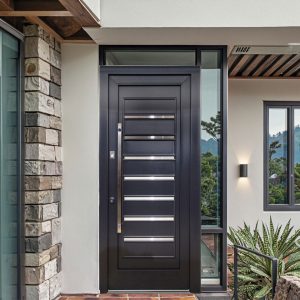
A door with decorative glass is an entrance system where the glazing serves a dual purpose: admitting light and contributing to the architectural aesthetic. Unlike a plain door with a clear window, decorative glass uses texture, pattern, color, or embedded materials to control privacy and create a visual statement. For B2B buyers, the category splits into distinct product types based on application, frame material, and design language.
Interior vs. Exterior Applications
The application dictates the engineering requirements. Interior decorative glass doors—used for office partitions, conference rooms, or pantry entrances—prioritize light transmission and aesthetics. The frames are typically lighter. A standard interior door might use 4mm to 6mm tempered glass in an aluminum or wood frame. Structural load is minimal, and thermal performance is irrelevant.
Exterior entry doors are a different product entirely. These must resist wind loads, prevent water ingress, and provide thermal insulation. The glass unit for an exterior door is typically 6mm to 10mm thick, often laminated or insulated. The frame requires a thermal break—a polyamide strip inserted between the interior and exterior aluminum profiles to prevent heat transfer. A door with decorative glass that looks identical on the outside can have completely different internal construction based on whether it faces a climate-controlled hallway or the exterior elements.
The Modern vs. Traditional Design Spectrum
Decorative glass doors span a broad design range. Understanding the distinction matters for sourcing because the manufacturing processes differ significantly.
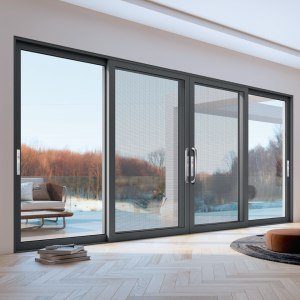
Modern doors feature minimalist frames—typically aluminum with narrow profiles (20mm to 50mm visible width). The glass is often a single large lite of clear, low-iron, or frosted glass. Hardware is usually black, bronze, or stainless steel. These doors rely on precision extrusion and clean assembly. The challenge for manufacturers is achieving tight tolerances so the slim frames align perfectly.
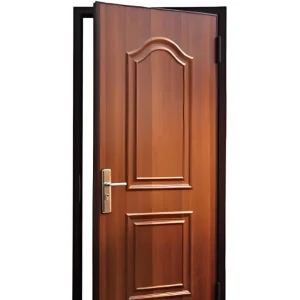
Traditional doors use solid wood or wood-clad frames with inset glass panels. Beveled, leaded, or stained glass is common. The glass is often divided into multiple lites by muntins or grilles. Manufacturing complexity shifts to joinery and wood treatment. The frame must be constructed to prevent the wood from warping around the glass—moisture content needs to be controlled at 8% to 12% before assembly, and the glass must be seated with proper expansion gaps.
Transitional designs blend both approaches. Aluminum-clad wood frames offer the warmth of wood on the interior face and the durability of aluminum on the exterior. Hybrid frames allow for larger glass lites than traditional wood doors while maintaining a less industrial appearance than full aluminum.
Wrought Iron and Crafted Inserts
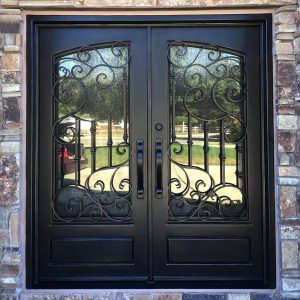
High-end villa projects have driven a revival of wrought iron doors with decorative glass panels. In this design, laser-cut steel or iron overlays are sandwiched between two lites of glass. The metal creates a pattern—geometric, floral, or abstract—that adds depth and security. The glass protects the metal from corrosion while the metal reinforces the glass against impact.
This product type demands precision fabrication. The metal overlay must fit within the glass lite with minimal tolerance—typically ±1mm. The welding of the iron frame must be clean and consistent. For B2B buyers, this means vetting the supplier’s CNC cutting and welding capacity, not just their glass sourcing capability.
Door with Decorative Glass: Quality and Performance Factors
The visual appeal of a decorative glass door is what sells it. But the performance characteristics are what determine whether a buyer gets repeat orders or a stack of warranty claims. The glass itself, the frame material, and the hardware integration each carry specific technical requirements.
Glass Types: Safety, Energy, and Aesthetics
There are four primary glass specifications that matter in decorative door applications:
Tempered glass is heat-treated to increase its strength. When broken, it shatters into small, granular pieces rather than sharp shards. Most building codes require tempered glass in doors and sidelites for safety glazing. It is the baseline specification for any decorative glass door.
Laminated glass consists of two or more glass plies bonded with an interlayer—typically PVB (polyvinyl butyral) or EVA (ethylene-vinyl acetate). When broken, the interlayer holds the shards in place. Laminated glass provides better security against forced entry and offers superior sound insulation. For exterior doors, laminated glass is the recommended choice.
Low-E (low-emissivity) coated glass has a microscopic metallic oxide coating that reflects heat while allowing visible light to pass through. A Low-E coating can reduce heat loss by up to 50% compared to uncoated glass. For exterior decorative doors in climates with extreme temperatures, Low-E is essential for energy efficiency.
Patterned or frosted glass achieves privacy through surface treatment. Acid etching or sandblasting creates a translucent finish. Patterned glass uses rollers to imprint a texture during manufacturing. Light transmission varies from 30% to 70% depending on the pattern density.
Frame Materials: Aluminum, Wood, and Steel
The frame carries the structural load and determines the door’s durability. Three material categories dominate the market:
Thermal break aluminum is the preferred choice for exterior doors. The frame consists of two aluminum profiles separated by a polyamide strip. This breaks the thermal bridge, preventing condensation and heat transfer. Premium systems use a multi-chamber design with gaskets for additional insulation.
Solid wood frames offer aesthetic warmth but require proper engineering. The wood must be kiln-dried to a stable moisture content. The frame joints must be sealed against moisture ingress. Wood expands and contracts with humidity changes, so the glass pocket must accommodate movement without stressing the glass.
Steel frames provide the highest strength-to-weight ratio. Narrow stiles (the vertical frame members) can support large glass panels. Wrought iron doors with decorative glass use steel frames with mechanical connections—typically welding or heavy-duty screws rated for the glass unit’s weight.
Hardware Integration and Smart Glass
The hardware is the most common failure point on decorative glass doors. Hinges must be rated for the weight of the specific glass unit. A door with a 10mm laminated glass lite weighs significantly more than one with a 4mm tempered lite. Undersized hinges lead to sagging and misalignment. Ball-bearing hinges are standard for heavy doors.
Multi-point locking systems are critical for security. A door with decorative glass has a large vulnerable surface. A multi-point lock engages at multiple points along the door edge, reinforcing the glass panel. For high-security applications, look for RC2 or RC3 rated locks, which are tested against forced entry attempts.
Smart glass technology is an emerging option. PDLC (Polymer Dispersed Liquid Crystal) glass contains a film that toggles between transparent and opaque when an electric current is applied. The cost is significant—typically $50 to $150 per square foot installed, depending on size and control system complexity. The PDLC film degrades over time and requires replacement every 5 to 8 years. For most B2B applications, the cost is prohibitive unless the client specifically requests the functionality.
How to Evaluate Door with Decorative Glass Suppliers
The supplier evaluation framework for decorative glass doors should follow a structured process. Price is a factor, but the cost of a failed delivery—delayed shipment, non-compliant product, damaged goods—far exceeds any initial savings.
The Supply Chain Landscape
Buyers have three sourcing options:
Local fabricators offer fast lead times (1–2 weeks) and easy communication. They can handle small orders and on-site adjustments. The trade-offs are higher unit costs and limited customization. Local fabricators typically use standard profiles from established brands.
Offshore manufacturers offer lower unit costs—often 20% to 35% less than local fabricators—and deeper customization. They can produce custom profiles, unique glass patterns, and specialized hardware configurations. The trade-offs are longer lead times (4–8 weeks production plus shipping) and higher minimum order quantities.
Trading companies act as intermediaries. They source from factories and add a markup—typically 15% to 30%. The risk is a lack of direct quality control. The buyer has no visibility into the factory’s actual production process.
The most reliable approach is direct factory sourcing. This eliminates the middleman markup and establishes a direct communication line between the buyer and the engineering team.
Questions to Ask Before Ordering
When evaluating a decorative glass door supplier, ask these specific questions:
- What is the exact glass specification? The supplier should provide the glass thickness, whether it is tempered or laminated, the interlayer type (PVB vs. EVA), and the coating specification (if any).
- What is the frame’s thermal performance? For exterior doors, request the U-value (thermal transmittance) and the frame’s condensation resistance rating.
- What is the production lead time? A realistic production time for custom decorative glass doors is 3–5 weeks. Add 2–4 weeks for shipping, depending on the destination port.
- What is the minimum order quantity? Factories typically require a minimum order of 50 to 100 units for custom production. Some offer lower MOQs for standard designs.
- How do you handle quality control? The supplier should conduct pre-shipment inspections, including air-tightness, water-tightness, and wind resistance tests for exterior doors.
- What documentation do you provide? Full export documentation—packing list, proforma invoice, bill of lading, and customs clearance documents—is essential for avoiding port delays.
Red Flags: Avoid Suppliers Who…
Several warning signs indicate a supplier may not deliver on their promises:
Cannot provide specific test data. If a supplier claims their doors meet certain performance standards but cannot provide test reports or certification numbers, treat the claim with skepticism.
Require full payment before production. Standard terms are 30% deposit and 70% balance before shipment. A supplier demanding 100% upfront is a significant risk.
Offer significantly lower prices than competitors. If a quote is 30% below market rate, the supplier is likely cutting corners on glass thickness, frame quality, or hardware specifications.
Cannot provide a pre-production sample. For decorative glass doors, patterns, colors, and finishes vary visually. A photo is not sufficient. Insist on a physical sample before committing to a bulk order.
Key Quality Indicators for Door with Decorative Glass Buyers
Beyond the basic specification, certain quality indicators separate reliable suppliers from the rest. These are the technical details that prevent callbacks and reorders.
Glass Quality Verification
The glass is the most visible component of a decorative door. Verify these parameters:
Glass thickness tolerance. Standard tolerance is ±0.2mm for tempered glass. Anything wider indicates poor manufacturing control.
Edge quality. The glass edges should be polished or seamed to remove sharp edges and reduce stress concentrations. Raw, unpolished edges are a safety hazard and a sign of cost-cutting.
Optical clarity. Low-iron glass has a visible green tint when viewed from the edge. Check the glass for bubbles, inclusions, or distortion before accepting a shipment.
Frame Construction Quality
The frame determines the door’s structural integrity:
Profile thickness. Aluminum frames should have a wall thickness of at least 1.4mm for interior doors and 1.8mm for exterior doors. Thinner profiles are prone to flexing and instability.
Thermal break width. The polyamide strip in a thermal break frame should be at least 24mm wide for optimal thermal performance.
Seal quality. Check the gaskets and weatherstripping. They should be continuous around the perimeter with no gaps or kinks.
Hardware Verification
The hardware must be matched to the door’s weight and usage:
Hinge load rating. Each hinge should be rated for the door’s total weight. A door weighing 80kg needs hinges rated for a minimum of 40kg each.
Lock cylinder grade. For exterior doors, the lock cylinder should be at least a Grade 2 or Grade 1 rated cylinder.
Relevant Industry Standards and Certifications
Compliance with industry standards is non-negotiable for B2B procurement. The following certifications are the most relevant for decorative glass doors:
| Standard | Application | Key Requirement |
|---|---|---|
| EN 14351-1 | Exterior doors (Europe) | CE marking for doors and windows; includes air permeability, water tightness, and wind load resistance |
| ASTM E283 | Exterior doors (North America) | Air leakage testing for windows and doors |
| ASTM E330 | Exterior doors (North America) | Structural performance testing for windows and doors |
| ISO 9001:2015 | Quality management | Manufacturing process quality control |
| ANSI Z97.1 | Safety glazing | Impact safety requirements for glass |
| EN 12150-1 | Tempered glass | Safety requirements for thermally toughened glass |
A supplier that cannot provide certification documents or test reports for these standards should be treated with caution. The documentation is not just paperwork—it is evidence that the product has been tested and verified.
Our Glass Manufacturing Capabilities
Once you understand the technical requirements, the next step is finding a partner who can execute them reliably. Jusen Door and Windows Manufacturing Co., Ltd. operates a direct factory supply model that addresses the procurement challenges outlined above.
Factory-Direct Supply and Customization
As a manufacturing facility, we eliminate the middleman markup. Our pricing reflects factory-direct rates, which for decorative glass doors typically translates to 15% to 30% savings compared to trading company quotes. More importantly, our production line supports full customization on size, color, glass type, and hardware accessories.
Whether you need a modern aluminum door with a low-iron glass lite and a matte black finish, or a traditional solid wood door with a wrought iron insert, our engineering team works from your spec sheet. We support OEM (white label) production and ODM (design collaboration) for distributors and construction firms developing unique product lines.
Compliance with Local Building Codes
Decorative glass doors must perform, not just look good. Our profile structures and fittings are adjustable to match the building codes of your target market. We conduct strict pre-shipment testing on air-tightness, water-tightness, and wind resistance—ensuring your order performs on site, not just on paper.
Our foreign trade team provides complete documentation: packing lists, proforma invoices, and full customs clearance documents. This reduces the risk of port delays and customs rejections.
Logistics and Volume Flexibility
We handle both FCL (Full Container Load) and LCL (Less than Container Load) shipments, delivering directly from our China factory to your port or warehouse. This flexibility is critical for buyers testing the market with a small order or stocking a large development project.
For construction projects, we offer phased delivery schedules and dedicated project management. We provide structural calculations and test reports to support building permits.
Production Process: From Raw Material to Finished Door
Understanding the manufacturing process is essential for evaluating a supplier’s capability. A door with decorative glass involves multiple production stages, each with its own quality control points.
Stage 1: Glass Processing
The glass is cut to size, then processed according to the specification. Tempering involves heating the glass to approximately 620°C and then rapidly cooling it. This creates compressive stress on the surface and tensile stress in the core, increasing the glass’s strength. Laminated glass is assembled by placing an interlayer between two glass plies and applying heat and pressure in an autoclave.
For decorative patterns, the glass may be acid-etched, sandblasted, or screen-printed. Wrought iron inserts are laser-cut from steel sheets, then sandwiched between glass lites during the lamination process.
Stage 2: Frame Fabrication
Aluminum frames are cut to length, then machined for drainage holes and hardware installation. The profiles are assembled using corner keys and structural sealant. Thermal break profiles have the polyamide strip inserted and crimped into place before assembly.
Wood frames require joinery—typically mortise and tenon or dowel joints. The wood is sanded, sealed, and finished before the glass is installed.
Stage 3: Assembly and Hardware Installation
The frame is assembled, and the glass unit is seated with setting blocks and gaskets. Hardware—hinges, locks, handles—is installed and adjusted. The door is then tested for function: opening, closing, locking, and sealing.
Stage 4: Finishing and Packaging
The door is cleaned, inspected, and wrapped in protective film. Edges are protected with cardboard corners. The door is then crated for export. Proper packaging is essential to prevent damage during transit.
Quality Control: Our Multi-Stage Inspection Process
Our quality control process mirrors the industry standards above. Each door with decorative glass undergoes inspection at multiple points:
- Incoming material inspection: Glass, aluminum, wood, and hardware are verified against specifications upon arrival.
- In-process inspection: Dimensional checks occur at each production stage. Frame alignment, glass seating, and hardware installation are verified.
- Pre-shipment inspection: Before packing, each door undergoes a final check. Air-tightness, water-tightness, and wind resistance are tested on a sample basis, with test reports provided to the buyer.
- Documentation review: All certifications, test reports, and export documents are reviewed before shipment.
This process is aligned with ISO 9001:2015 quality management standards, ensuring consistency across production runs.
Customization and OEM/ODM Options
B2B buyers have three primary partnership models available:
OEM (White Label): You provide the specification; we manufacture to your exact dimensions and performance requirements. This is ideal for hardware stores and distributors who need a consistent, unbranded product.
ODM (Design Collaboration): We co-develop new designs based on market trends. You bring the concept; we engineer the profile and glass package. This works well for architects and boutique builders seeking unique statement doors.
Bulk Project Supply: For construction projects, we offer phased delivery schedules and dedicated project management. We work with your specifications to ensure compliance with local building codes.
Ordering Process: MOQ, Lead Time, and Shipping
The ordering process for decorative glass doors follows a standard sequence:
- Inquiry and specification: Submit your drawings or dimensions, including glass type, frame material, and hardware preferences.
- Quotation: Our engineering team responds within 24 hours with a detailed quotation and lead time.
- Sample approval: For custom designs, we produce a pre-production sample for your approval.
- Production: Standard production time is 3–5 weeks for custom orders.
- Inspection: We conduct pre-shipment testing and provide inspection reports.
- Shipping: We arrange FCL or LCL shipment, providing full export documentation.
MOQ: Minimum order quantities are flexible depending on the design. Standard designs may be available with MOQs as low as 20 units. Fully custom designs typically require a minimum of 50 units.
Lead Times: Production time is 3–5 weeks, plus 2–4 weeks for shipping depending on the destination port.
Certifications and Industry Standards
Jusen Door and Windows Manufacturing Co., Ltd. maintains compliance with relevant industry standards for decorative glass doors. Our production processes align with ISO 9001:2015 quality management requirements. Our exterior door systems are tested for air-tightness, water-tightness, and wind resistance according to applicable standards.
We provide documentation to support your building permit applications and customs clearance. Our foreign trade team ensures that all paperwork—packing lists, proforma invoices, and certificates of origin—is complete and accurate.
A Note on Color and Cultural Signals
The question occasionally arises about what a door color signifies. In some traditions, a red door means a paid-off mortgage; in others, a black door carries the same meaning. From a design perspective, color choice is about curb appeal and property value perception. Black is modern and sophisticated. Red is welcoming and bold. Blue conveys calm and stability. Navy is a strong choice for coastal properties. The best color choice is one that contrasts with the facade and creates visual interest.
Color also affects the manufacturing process. Darker frame colors absorb more heat, which can affect the thermal performance of an exterior door. Lighter colors reflect heat and are more energy-efficient in warmer climates. Powder-coated finishes are durable and available in a wide range of colors, including custom RAL matches.
—
Frequently Asked Questions
What is the looking glass in a door called?
The decorative glass panel itself is often called a “door lite” or “glazing panel.” A small vertical window beside the door is a “sidelite.” A horizontal window above the door is a “transom.” These terms are used interchangeably across the industry.
What are doors with glass called?
They are generally referred to as “glazed doors” or “doors with lites.” In the industry, they are categorized by frame material—aluminum glazed doors, wood glazed doors—or by glass type—frosted glass doors, leaded glass doors.
What is the difference between tempered and laminated glass for doors?
Tempered glass is heat-treated for strength and shatters into small pieces on impact. Laminated glass has a plastic interlayer that holds the shards together, offering better security and sound insulation. For exterior doors, laminated is often preferred; for interior doors, tempered is usually sufficient.
Can I get a decorative glass door with a thermal break?
Yes. Aluminum frames with polyamide thermal break strips are standard for energy-efficient exterior doors. This prevents condensation and heat loss, which is critical in climates with extreme temperatures.
How much is a smart glass door?
Smart glass (PDLC switchable film) costs significantly more than standard tempered glass—typically $50 to $150 per square foot installed, depending on size, control system, and frame complexity. The film degrades over time, so consider maintenance costs in your lifecycle budget.
—
Decision Guide: Choosing the Right Sourcing Approach
Choose a local fabricator if: You have a small order (under 20 units), require immediate delivery, or need on-site installation support.
Choose a direct factory if: You have a larger order (50+ units), need custom profiles or glass patterns, or want to establish a long-term supply relationship with consistent pricing.
Choose a trading company if: You want a single point of contact for multiple product categories and are willing to pay a 15–30% markup for convenience. Be aware that the lack of direct quality control is a risk.
Choose OEM if: You are a distributor or retailer with an established brand and need consistent, unbranded products.
Choose ODM if: You are an architect or developer with a specific design concept that requires engineering expertise to bring to production.
—
References
- EN 14351-1:2006+A2:2016, “Windows and doors – Product standard, performance characteristics” — European Committee for Standardization. https://www.cen.eu
- ASTM E283-19, “Standard Test Method for Determining Rate of Air Leakage Through Exterior Windows, Skylights, and Doors Under Specified Pressure Differences Across the Specimen” — ASTM International. https://www.astm.org
- ASTM E330/E330M-14, “Standard Test Method for Structural Performance of Exterior Windows, Skylights, and Doors by Uniform Static Air Pressure Difference” — ASTM International. https://www.astm.org
- ISO 9001:2015, “Quality management systems — Requirements” — International Organization for Standardization. https://www.iso.org
- ANSI Z97.1-2015, “American National Standard for Safety Glazing Materials Used in Buildings” — American National Standards Institute. https://www.ansi.org
- EN 12150-1:2015, “Glass in building – Thermally toughened soda lime silicate safety glass” — European Committee for Standardization. https://www.cen.eu
—
Ready to discuss your project requirements? Send us your drawings or dimensions, and our engineering team will respond within 24 hours with a detailed quotation and lead time.
https://doorwoodendoors.com/contact-us/” style=”display:inline-block;padding:12px 24px;background:#2563eb;color:#fff;text-decoration:none;border-radius:6px;font-weight:600″>Get a Free Quote