The Bottom Line: Doble Door vs. Bifolding Door – Which Wins?
If you are choosing between a doble door and a premium external bifolding door, the decision comes down to one question: do you prioritize a wide, flexible opening or a simple, secure, and cost-effective entrance?
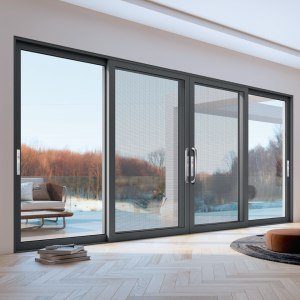
A doble door—two hinged panels that swing open from the center—is the practical choice for most commercial and residential projects. It offers reliable weather performance, straightforward hardware, and lower cost per square meter. A premium external bifolding door, by contrast, delivers a dramatically wider opening by stacking multiple panels to one side. That flexibility comes with a higher price tag, more complex hardware, and stricter installation requirements.
For a standard entrance, a service door, or a project with a limited budget, the doble door wins. For a patio, terrace, or space where you want to fully open the wall to the outside, the bifolding system is worth the premium.
Doble Doors Explained: Design, Benefits, and Limitations
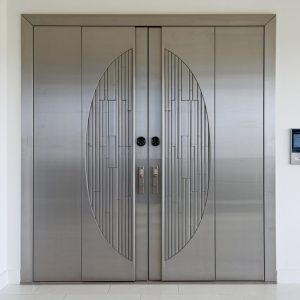
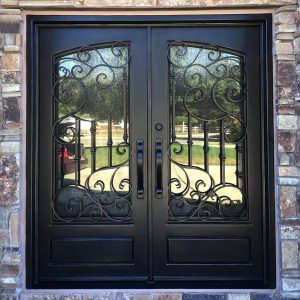
A doble door is a pair of side-hinged panels that meet in the middle. Each panel typically has its own hinges on the outer frame, and the two panels close against each other with a central seam. This configuration is sometimes called a French door when the panels are fully glazed, but the term “doble door” generally refers to any double-panel hinged entrance.
The key difference from a standard single door is the opening width. A single door typically spans 90 to 100 cm. A doble door can span 150 to 200 cm or more, because each leaf carries only half the load. This makes it suitable for entrances that need to accommodate furniture, equipment, or wheelchair access without resorting to a sliding system.
Advantages of doble doors:
- Simplicity: Only two panels mean fewer moving parts. Hinges, locks, and handles are standard items available from any hardware supplier.
- Security: A doble door locks at the center point, usually with a multi-point locking system. With two panels, you have two sets of hinges and a central locking point, which distributes force evenly across the frame.
- Weather performance: Because the panels close against a central astragal (the vertical strip that covers the seam), it is easier to achieve consistent compression around the full perimeter. This translates into predictable air and water tightness.
- Cost: Fewer panels, simpler tracks, and standard hardware make doble doors significantly cheaper than bifolding systems.
Limitations of doble doors:
- Opening width is limited by panel size. A 200 cm wide opening means each leaf is 100 cm, which is manageable. Beyond 240 cm, the leaves become heavy, requiring stronger hinges and more effort to operate.
- The central seam is a potential weak point. If the astragal is poorly designed or the frame twists over time, you may get air or water infiltration at the meeting point.
- They swing inward or outward, requiring clearance. Unlike a bifold that stacks to the side, a doble door needs floor space in the direction of the swing.
Premium External Bifolding Doors: What They Offer and When to Use Them
A premium external bifolding door consists of multiple panels—typically four to eight—connected by hinges. The panels run on a top track and, in most systems, a bottom track or guide. When opened, the panels fold like an accordion and stack neatly to one or both sides of the opening.
The defining advantage is the opening width. A bifolding door can span 3 to 6 meters or more, which is impossible with hinged panels. When fully open, the effective gap is roughly 90% of the total width, because the stacked panels occupy only a small fraction of the opening.
Advantages of premium external bifolding doors:
- Maximum opening width: Ideal for connecting indoor spaces to patios, gardens, or terraces.
- Flexible ventilation: You can open just one panel for daily ventilation or fold everything back for a fully open wall.
- Modern aesthetic: The slim sightlines and continuous glass surface appeal to contemporary architectural styles.
Limitations of premium external bifolding doors:
- Cost: Each additional panel adds hardware, track, and installation labor. A bifolding system typically costs two to three times more than a doble door of similar width.
- Complexity: The folding mechanism, track alignment, and panel adjustment require precision. Poor installation leads to binding, uneven gaps, and premature wear.
- Weather performance is harder to achieve: With multiple panels and multiple folding joints, there are more potential leak points. Premium systems use gaskets at every joint, but the risk of air or water infiltration increases with the number of panels.
- Floor track requirements: Most external bifolding systems use a low-threshold bottom track. This creates a small step or a channel in the floor, which can be a trip hazard or a drainage concern.
Use a bifolding door when the opening width exceeds 3 meters and the design calls for a strong indoor-outdoor connection. Use a doble door when the opening is 2.4 meters or less, or when security and weather performance are the top priorities.
Doble Door vs. Bifolding Door: Side-by-Side Comparison Table
| Criterion | Doble Door | Premium External Bifolding Door |
|---|---|---|
| Opening style | Two hinged panels swing open from the center | Multiple panels fold and stack to one or both sides |
| Maximum opening width | Up to ~2.4 m (limited by leaf weight) | 3–6 m or more, with ~90% clear opening when folded |
| Space requirement | Needs swing clearance in front of or behind the door | Needs side space for stacked panels, plus track clearance |
| Cost per square meter | Lower; standard hardware and simple frame | Higher; each panel adds hardware, track, and labor |
| Insulation (thermal) | Good; continuous gaskets around each leaf, central astragal seals the seam | Moderate to good; multiple joints require high-quality gaskets, more potential thermal bridges |
| Security | Strong; central multi-point lock, fewer moving parts | Moderate; more panels mean more locking points to coordinate, hardware is more complex |
| Weather performance | Predictable; easier to achieve consistent compression | More challenging; more joints, requires precise installation and premium gaskets |
| Maintenance | Simple; standard hinges and locks, easy to adjust | Complex; track alignment, panel adjustment, and roller replacement require specialized service |
| Installation complexity | Moderate; similar to a large single door | High; requires level floor, precise track alignment, and structural support for the header |
How to Choose the Right Door System for Your Project
The selection process should start with the opening width and the intended use, not with aesthetics.
Step 1: Define the opening width. Measure the rough opening in the wall. If it is under 2.4 meters, a doble door is almost always the more practical and cost-effective choice. If it exceeds 3 meters, a bifolding system is the only way to achieve a fully open wall.
Step 2: Assess the location and exposure. An external door on a north-facing, wind-driven rain side of a building will test the weather seals more than a sheltered south-facing opening. For exposed locations, the simpler sealing geometry of a doble door is an advantage. If you still want a bifold, specify a system with proven test results for air permeability, water tightness, and wind load resistance.
Step 3: Consider the traffic pattern. Who uses this door daily? A bifold with a low threshold is easier for wheelchair users than a doble door with a raised step. But if the door leads to a service area or a storage room, the simplicity of a doble door is more practical.
Step 4: Check the structural header. Bifolding doors are heavy. The header above the opening must support the weight of the panels when they are stacked to one side. This often requires a steel lintel or a reinforced concrete beam. A doble door transfers weight directly to the jambs, so the header load is lower.
Step 5: Compare total installed cost. Get quotes for the door system, the hardware, and the installation labor. For a 3-meter opening, a bifolding system may cost 2.5 to 3 times more than a doble door of the same width. Factor in the cost of any structural reinforcement needed for the bifold.
Frequently Asked Questions About Doble and Bifolding Doors
What is a doble door and how does it differ from a standard single door?
A doble door has two hinged panels that meet in the center, creating an opening roughly twice the width of a single door. It uses the same frame structure but distributes the width across two leaves, so each panel is lighter and easier to operate than one oversized single door.
Which door type is more cost-effective for a commercial project?
For openings up to 2.4 meters, the doble door is significantly more cost-effective. The hardware is standard, the frame is simpler, and installation labor is lower. Bifolding systems only become cost-justifiable when the opening exceeds 3 meters and a wide open access is a functional requirement.
How do doble doors and bifolding doors compare in terms of insulation and security?
A doble door with a thermal-break frame and double or triple glazing performs well in insulation tests because the sealing perimeter is continuous and predictable. Security is also stronger, with a central multi-point lock and fewer moving parts. A bifolding door can achieve similar thermal performance with premium gaskets, but the multiple folding joints create more potential weak points for both heat loss and forced entry.
What should buyers look for when sourcing doble doors or bifolding doors from a manufacturer?
Ask for the test reports for air permeability, water tightness, and wind load resistance. These should be performed according to a recognized standard, such as EN 12207, EN 12208, and EN 12210 for European markets, or the equivalent local standards. Also verify the hardware brand and the warranty terms. For bifolding doors, ask specifically about the track system and whether the rollers and hinges are replaceable.
Can a doble door be installed in an opening that was designed for a bifold?
Yes, but the frame must be adapted. The rough opening width is the same, but the jamb depth and the header structure may differ. A doble door requires a solid mounting surface for the hinges, while a bifold needs a track header. In most cases, a steel or timber sub-frame can be fitted inside the existing opening to accommodate either system.
What is the maximum width for a doble door before it becomes impractical?
Around 2.4 meters is the practical limit. Beyond that, each leaf exceeds 120 cm in width and becomes heavy to operate. The hinges must be reinforced, and the risk of sagging over time increases. For wider openings, consider a bifolding system or a sliding door instead.
Additional Considerations: Sizing, Materials, and Customization
Sizing standards. Doble doors are typically available in widths from 120 cm to 240 cm, with each leaf sized proportionally. Bifolding doors are modular, with each panel typically 60 to 90 cm wide. The number of panels determines the total width. When specifying, always provide the exact rough opening dimensions rather than assuming a standard size.
Materials. For external applications, thermal-break aluminum is the most common choice for both doble doors and bifolding systems. The aluminum profile is reinforced with a polyamide thermal break to reduce heat transfer. For doble doors, you also have the option of solid wood or wood-aluminum composite, which offers a different aesthetic but requires more maintenance. For bifolding doors, aluminum is the standard because of the structural rigidity needed for the folding mechanism.
Glazing. The glass specification affects both thermal performance and cost. Double glazing with low-emissivity coating is the minimum for most climate zones. Triple glazing adds insulation but increases weight, which is a consideration for the hinges on a doble door and the track load on a bifold. For large bifolding panels, consider laminated glass for safety and security, as it holds together if broken.
Hardware quality. The hinges, locks, and handles determine the long-term reliability of any door system. For doble doors, look for stainless steel hinges with sealed bearings and a multi-point locking system with a central hook or roller cam. For bifolding doors, the track and roller quality is critical. Ask the manufacturer for the hardware brand and the expected cycle life.
Weather performance and testing. External doors in most developed markets must meet minimum standards for air permeability, water tightness, and wind load resistance. These are tested in a laboratory according to national or international standards. When comparing quotes, ask for the actual test results, not just the certification mark. A door that passes the minimum grade may not perform well in an exposed location.
Customization and compliance. For projects outside the manufacturer’s home market, check that the profile structure and fittings can be adjusted to match local building codes. This includes everything from the direction of opening (inward vs. outward) to the locking mechanism required by local security regulations. A manufacturer with export experience will typically adjust the profile and hardware to meet the target market’s requirements.
Supplier evaluation for B2B buyers. When sourcing either door type, evaluate the manufacturer on four criteria: test data, production capacity, export documentation, and after-sales support. Request the packing list, proforma invoice, and customs documents before committing to a large order. For container shipments, confirm whether the supplier handles both FCL and LCL and what their lead time is for the specific configuration you need.
As a manufacturer, our approach to these requirements is straightforward. We build thermal-break aluminum doble doors and bifolding systems to the same testing standards, and we provide the air tightness, water tightness, and wind resistance test reports with every batch. Our factory in China supplies directly to contractors and distributors, which removes the middleman markup and allows us to offer competitive pricing on both doble doors and premium external bifolding doors.
For project buyers, we offer full customization on size, color, glazing, and hardware. If your project requires a specific locking system or a particular profile depth to match local building codes, we adjust the profile structure and fittings accordingly. We also handle the full export documentation, including packing lists and proforma invoices, and we ship both FCL and LCL directly from our factory.
If you are comparing quotes for a project and need a manufacturer that can meet your technical specifications without the markup, send us your drawings and we will respond with a detailed quotation.