Content Menu
● 1. What Are STC and OITC Ratings, and Why Do They Matter for Bedroom Doors?
● 2. How Does Door Core Construction Affect Soundproofing Performance?
● 3. What Role Do Frames, Seals, and Thresholds Play in Soundproofing?
● 4. Materials Comparison: Wood vs. Thermal Break Aluminum vs. Steel
● 5. Fire-Rated Doors and Acoustic Performance: What Are the Compatibility Rules?
● 6. How Should Buyers Evaluate Soundproof Door Suppliers for Large Projects?
● 7. Questions to Ask Before Ordering Soundproof Doors
7 min read
A hotel developer in Singapore once ordered 400 bedroom doors with an STC rating of 45. The doors arrived on schedule, passed visual inspection, and were installed across four floors. During the soft opening, guests in adjacent rooms could hold conversations through the wall. The problem was not the door slab. It was the 6-millimeter gap under each door, left unsealed because the contractor had never installed automatic drop seals.
Noise complaints are the most common source of dissatisfaction in hotels and multifamily housing. Standard hollow-core interior doors typically achieve an STC rating of 20 to 25, meaning they block very little speech or television sound. For bedrooms, industry best practice now targets STC 45 or higher. Reaching that number requires understanding how sound moves through a door assembly — not just the slab, but the frame, the seals, and the threshold.
This guide explains the technical specifications that matter, the procurement pitfalls that cause acoustic failure, and how to evaluate suppliers for large-scale projects.
What Are STC and OITC Ratings, and Why Do They Matter for Bedroom Doors?
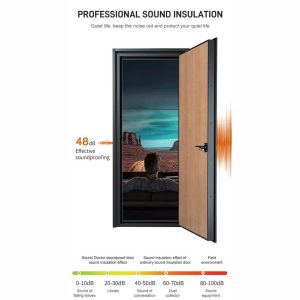
Sound Transmission Class (STC) measures how much sound energy is reduced when passing through a partition. The scale is logarithmic: an STC 30 door blocks roughly half the perceived noise of an STC 20 door. For bedroom applications, STC 45 represents the practical threshold for “quiet” — normal speech becomes inaudible and television sound is reduced to a faint murmur.
Outdoor-Indoor Transmission Class (OITC) measures low-frequency sounds such as traffic, aircraft, and bass from audio systems. A door facing a busy street requires a balanced STC and OITC profile. A door between two bedrooms primarily needs high STC.
The ratings are only valid for the complete assembly: the slab, frame, gaskets, and threshold tested together as a unit. A door leaf rated STC 50 installed in a standard frame with no perimeter sealing will perform at roughly STC 30 in the field. This distinction is the most common source of acoustic failure in real projects.
How Does Door Core Construction Affect Soundproofing Performance?
The core material determines the door’s mass and damping characteristics. Mass alone does not guarantee acoustic performance, but it is the starting point for any high-STC assembly.
Solid Wood and Engineered Wood Cores
Solid wood doors offer natural damping due to their density. A 45-millimeter solid core door typically weighs 40 to 50 kilograms and achieves STC 30 to 35 without additional sealing. With perimeter gaskets and a drop seal, the same door can reach STC 40 to 45.
Engineered wood cores — typically multi-layer particleboard or MDF with a solid wood veneer — provide more consistent density than natural timber. Acoustic-grade particleboard is compressed to a uniform mass, reducing the resonant “dead spots” found in natural wood. Most high-STC wood doors in hospitality projects use this construction.
Honeycomb Cores: The Budget Compromise
Honeycomb cores are lightweight and inexpensive, making them the default for standard interior doors. They provide almost no acoustic isolation. A honeycomb door with perimeter seals rarely exceeds STC 28. For bedroom applications, honeycomb cores are inadequate unless the specification allows for a significantly lower performance target.
Mineral and Insulated Cores
Mineral wool or acoustic foam-filled cores combine mass with sound absorption. These doors typically achieve STC 45 to 55 in laboratory tests. The trade-off is weight: a mineral-core door can exceed 60 kilograms, requiring heavy-duty hinges and reinforced frames.
What Role Do Frames, Seals, and Thresholds Play in Soundproofing?
The door is only one component of the acoustic assembly. Sound travels through the path of least resistance — typically the gaps around the door.
The “Weakest Link” Principle
A heavy acoustic door slab installed in a lightweight frame with no gasketing performs worse than a modest door with proper perimeter sealing. Sound does not pass through the door leaf; it passes around it. The frame must be rigid enough to support the door’s weight without flexing, and it must be mechanically anchored to the wall structure to prevent vibration transfer.
Acoustic Gaskets and Drop Seals
Perimeter gaskets — typically EPDM or silicone — compress against the door leaf to create an airtight seal when the door is closed. These gaskets must be routed into the frame, not surface-mounted, to ensure consistent compression across the full perimeter.
Automatic drop seals close the critical gap at the bottom of the door. When the door closes, a plunger mechanism activates a seal that drops against the threshold. Without a drop seal, the gap under a standard door — typically 6 to 12 millimeters — negates the performance of even the best door slab.
Materials Comparison: Wood vs. Thermal Break Aluminum vs. Steel
Different project types demand different door materials. The table below summarizes the key trade-offs.
| Material | Typical STC Range | Best Use Case | Key Limitations |
|---|---|---|---|
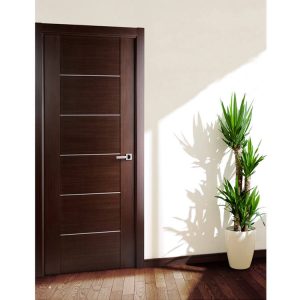
| Solid/Engineered Wood | 35–50 | Hotels, luxury apartments, residential | Moisture sensitivity in humid climates |
| Thermal Break Aluminum | 35–45 | Modern villas, coastal projects, high wind load areas | Requires careful thermal break design |
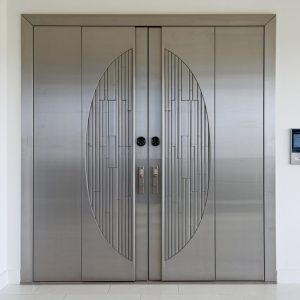
| Steel | 40–55 | Commercial buildings, fire-rated assemblies | Industrial appearance; finishing required |
Wood remains the standard for hospitality and high-end residential because of its aesthetic flexibility. Thermal break aluminum offers superior structural stability and corrosion resistance, making it the preferred choice for coastal and high-rise applications. Steel provides the highest STC and fire-rated compatibility but requires extensive finishing to suit residential aesthetics.
Fire-Rated Doors and Acoustic Performance: What Are the Compatibility Rules?
Fire-rated doors require intumescent seals that expand when exposed to heat. Acoustic seals are soft and compressible. These two requirements can conflict.
The solution is a dual-function seal — an intumescent strip combined with an acoustic gasket — that passes both fire and acoustic testing as part of the complete assembly. Specifiers must verify that the acoustic rating was achieved with the fire-rated components in place, not with a separate non-fire-rated seal configuration.
A fire-rated door is not automatically acoustic. The two performance criteria are tested separately, and a door that passes fire testing may perform poorly acoustically if the seals are not designed for both functions.
How Should Buyers Evaluate Soundproof Door Suppliers for Large Projects?
Acoustic door procurement fails most often because buyers focus on the door leaf specification while ignoring the assembly requirements. Use the following framework to evaluate suppliers.
Verification of Test Documentation
Request the acoustic test report for the exact assembly being quoted — same slab, same frame, same seals, same threshold. A supplier who offers a generic “STC 45 door” without supporting assembly-level test data cannot guarantee performance.
Component Compatibility Rules
Acoustic ratings are void when components are mixed across suppliers. A door slab from one manufacturer and a frame from another will not perform to the rated STC unless the combination has been field-tested. Confirm that the supplier provides the complete assembly and takes responsibility for its acoustic performance.
Specifier and Installer Responsibilities
The specifier must define the STC target for each partition type and verify that the door assembly matches the wall system’s rating. The installer must follow the manufacturer’s installation instructions precisely — gasket alignment, hinge adjustment, and threshold installation all affect acoustic performance.
Red Flags to Watch For
- Suppliers who quote STC ratings without providing the test standard and report number
- Suppliers who cannot explain the difference between lab-tested and field-tested performance
- Suppliers who offer acoustic doors without perimeter gaskets or drop seals as standard components
- Suppliers who do not provide installation instructions for the acoustic assembly
Questions to Ask Before Ordering Soundproof Doors
Before placing an order, request the following information from the supplier:
- What is the STC rating of the complete assembly (slab + frame + seals), and which laboratory issued the test report?
- Is the acoustic rating valid with the fire-rated seals installed, or only with non-fire-rated components?
- What is the maximum allowable gap between the door and frame for the rated performance to hold?
- Are the gaskets field-replaceable, and what is the expected service life?
- What installation training or documentation does the supplier provide for contractors?
How We Meet These Standards
The industry knowledge above represents the standard that any competent acoustic door supplier should meet. The challenge for B2B buyers is finding a factory that can execute these complex assemblies reliably at scale — and document the performance honestly.
As a factory-direct manufacturer, our approach starts with the assembly, not the individual components. We engineer the door slab, frame, and sealing system as one unit, with acoustic performance verified through pre-shipment inspection. Every order undergoes air-tightness and structural integrity testing before leaving our facility — not just a visual check that the door looks correct.
We offer full customization on size, color, glass, and hardware to match the acoustic and fire requirements of your local building codes. Our engineering team can adjust the profile structure and fittings to suit regional standards, whether you are building to European, North American, or Asia-Pacific specifications.
For international projects, we handle the documentation that matters: full customs paperwork, proforma invoices, and FCL or LCL shipment directly from our China factory to your job site. You deal with the manufacturer, not a trading intermediary who cannot answer technical questions about the assembly.
Send us your project specifications for a technical review. We will confirm whether your target STC rating is achievable with the wall construction you have specified, and provide the test documentation to back it up.
Contact: Leon Wu — cyxs001@gmail.com
References
- ASTM International. “ASTM E90-09(2016) Standard Test Method for Laboratory Measurement of Airborne Sound Transmission Loss of Building Partitions and Elements.” https://www.astm.org/e0090-09r16.html
- International Code Council. “International Building Code (IBC) — Chapter 12: Interior Environment.” https://www.iccsafe.org/
- National Research Council Canada. “Sound Transmission Class (STC) Ratings for Building Assemblies.” https://nrc.canada.ca/
- Door and Hardware Institute. “Acoustical Door Assemblies: Selection and Specification Guide.” https://www.dhi.org/
- Intertek. “Acoustic Testing Services for Doors and Building Partitions.” https://www.intertek.com/