Key Takeaways: What to Know Before Buying House Doors
If you are sourcing doors for a residential project, the “best” option is rarely a single material or style. It is the one that balances your project’s climate, security requirements, architectural style, and budget over the building’s lifetime. Here is the short version before we dig into details:
- For energy efficiency and low maintenance, aluminum with thermal breaks and composite doors lead the market.
- For classic aesthetics and design flexibility, solid wood remains the premium choice, though it demands more upkeep.
- For security, steel and reinforced aluminum offer the highest structural resistance.
- For cost-sensitive, large-scale projects, steel and standard aluminum are the most economical.
- For patio access, folding and sliding doors maximize the opening, but sliding systems are generally more reliable and cost-effective.
House Door Types: Single, Double, Folding, and More
The door’s configuration affects its function, cost, and installation complexity. Most residential entry points use one of these four types.
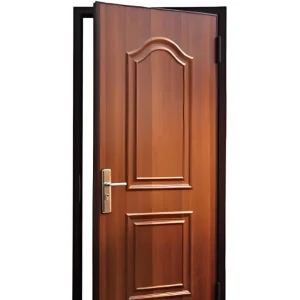
Single doors are the standard for most side and rear entrances. They are the most cost-effective, require less wall space, and simplify hardware selection. For a primary entrance, a single door should be at least 36 inches wide to meet accessibility standards and allow furniture movement.
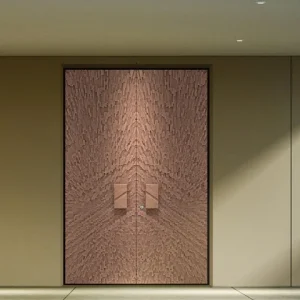
Double front house doors create a grander visual statement and a wider opening. They are a strong choice for large villas and high-end projects. The benefit is primarily aesthetic and practical: moving large furniture in and out is easier. However, double doors cost more because you need two door leaves, a more complex locking system (often with shoot bolts at top and bottom on the inactive leaf), and more hardware. They also reduce the usable wall space on either side of the entrance.
Folding doors (sometimes called bi-fold or accordion) are increasingly popular for patio and terrace connections. Their advantage is the ability to open an entire wall to the outdoors. The trade-offs are significant: folding hardware is complex and expensive, the doors require precise floor and header alignment to operate smoothly, and the many hinges and tracks are potential failure points. For a patio, foldable doors for patio use are best suited to mild climates where they will be used frequently. In extreme cold or heat, the long gasket lines reduce overall insulation compared to a solid wall. They also cost more per square foot than sliding doors.
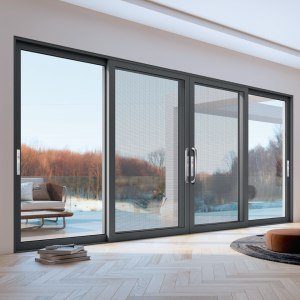
Sliding doors are the more practical alternative for patios. They offer large openings but with one fixed and one or two moving panels. Their simpler mechanism is more durable, provides better weather sealing, and is easier to maintain. For most projects where the goal is light and access rather than a fully open wall, sliding doors are the better engineering choice.
Material Comparison: Wood, Aluminum, Steel, and Composite
The material determines the door’s structural performance, lifespan, and maintenance schedule.
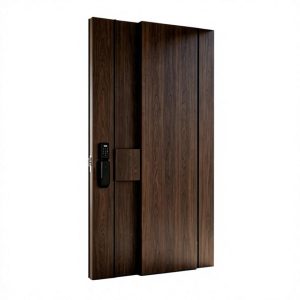
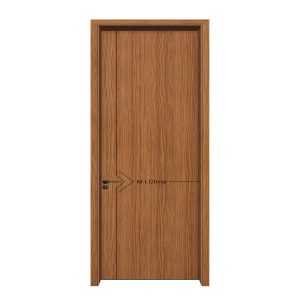
Solid wood remains the benchmark for high-end residential design. It offers natural insulation and a timeless aesthetic that can be painted or stained. The drawbacks are real: wood expands and contracts with humidity, requiring regular refinishing every few years. It is also vulnerable to rot and insect damage if not properly sealed. For exterior use, you must specify a stable species like teak, oak, or mahogany, or an engineered wood construction. In harsh, wet climates, wood requires the most ongoing maintenance of any material.
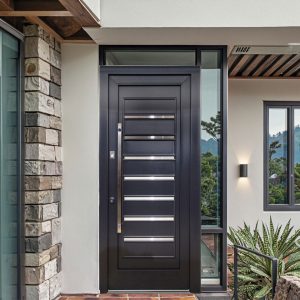
Aluminum has evolved significantly. Standard aluminum frames are strong and lightweight but conduct heat easily. The current industry standard is thermal-break aluminum, where a polyamide strip separates the interior and exterior frames. This design dramatically improves insulation, making it competitive with wood and composite. Aluminum is highly durable, does not rust, and requires minimal maintenance. It is also the best material for large, heavy door panels and floor-to-ceiling glazing because of its strength-to-weight ratio. The cost is higher than steel but generally lower than premium wood.
Steel doors are the most secure option in terms of forced entry resistance. The steel skin wraps a foam core, providing good insulation and structural rigidity. They are also the most cost-effective option for large projects. The downsides: steel dents and scratches, and any breach in the paint will lead to rust. In coastal or high-humidity environments, steel requires diligent maintenance. It also offers less design flexibility for custom shapes and colors than aluminum or wood.
Composite doors (typically a glass-reinforced plastic skin over a foam core) are engineered to address wood’s maintenance issues. They resist rot, warping, and fading and can mimic wood grain convincingly. Their insulation is excellent. The main limitation is customization: they are available in a set range of styles and colors, and on-site modifications are difficult. For large projects needing a consistent, low-maintenance product, composite is a strong candidate, though high-end composite doors can be pricey.
Design and Customization: Making Your Door Stand Out
A design house door needs to complement the architecture without compromising performance. When specifying doors, consider these elements:
- Color and Finish: Aluminum and steel can be powder-coated in a wide range of colors. Wood can be stained or painted. With aluminum, you can also achieve a wood-grain finish through a transfer process, giving you the look with the material’s low maintenance.
- Glass: The choice of glazing affects both aesthetics and energy performance. Double or triple glazing with low-emissivity (Low-E) coatings is standard for energy-efficient projects. For security, laminated glass is significantly harder to break than standard tempered glass. Obscured or frosted glass offers privacy for side and rear entrances.
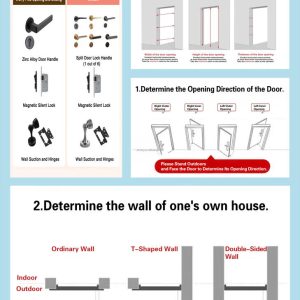
- Hardware: The handle, lock, and hinges are high-use components. Specify hardware that is tested to a high cycle count. For security, look for multi-point locking systems that engage the door at multiple points along the frame, rather than a single bolt. Consider smart lock compatibility — many modern locks are designed to retrofit standard deadbolts, but you should confirm the door’s thickness and backset will accommodate them.
- Proportions: A door that is too narrow for a large facade will look lost; one that is too wide will look squat. As a rule, the door height should be roughly one-third to one-half of the wall height. For a dramatic effect, consider a full-height door that extends to the ceiling line.
Side-by-Side Comparison Table
| Material | Insulation | Security | Relative Cost | Maintenance | Customization |
|---|---|---|---|---|---|
| Solid Wood | Good (natural) | Good (depends on core) | High | High (refinishing needed) | Excellent (any size/shape) |
| Thermal-Break Aluminum | Excellent (with thermal break) | Excellent (high structural strength) | Medium-High | Low | Excellent (custom colors, large sizes) |
| Steel | Good (foam core) | Excellent (hardest to penetrate) | Low-Medium | Medium (rust risk if scratched) | Limited (mostly standard sizes) |
| Composite | Excellent (foam core) | Good | Medium-High | Very Low | Limited (pre-set styles) |
How to Choose the Right House Door for Your Project
Your decision should follow a logical sequence, not a preference for a single material.
- Assess the Environment: Start with the local climate. In hurricane-prone regions, you need doors rated for high wind pressure and impact resistance. In extreme cold, prioritize low U-values (a measure of heat transfer — the lower the number, the better the insulation). In hot, humid climates, focus on thermal performance and corrosion resistance. In high-crime areas, security is the primary driver.
- Define the Performance Targets: Set specific criteria. For energy efficiency, ask for the door’s U-value or R-value (thermal resistance). For security, ask if the door and its hardware meet recognized standards like the ANSI/BHMA grades for locks. For wind resistance, confirm the door is engineered for the specific wind load requirements of your project’s location. Do not accept vague claims; ask for the test data.
- Calculate the Lifetime Cost: The purchase price is only a fraction of the total cost. A cheap steel door that rusts in five years is more expensive than a quality aluminum door that lasts twenty. Factor in energy savings from better insulation, maintenance costs (repainting wood, replacing corroded hardware), and lifespan. A higher upfront cost is often justified by lower annual costs.
- Verify Compliance: Building codes vary significantly by region and municipality. Fire-rated doors, for instance, have specific ratings (e.g., 20, 45, 60, or 90 minutes) and cannot be modified on site. Egress requirements dictate door width and operation. It is your responsibility to verify that the door you specify meets local codes. A reputable supplier should be able to provide documentation on their product’s performance, but they cannot guarantee compliance with a code you have not shared.
Additional Considerations: Patio Folding Doors and Double Front Doors
The two most common special requests we see are for folding patio doors and grand double entrances.
Foldable doors for patio use are a premium feature. They are an excellent choice for projects in temperate climates where indoor-outdoor living is a priority. The key specification is the number of panels and the stacking configuration. A standard system might have 3 to 6 panels. The hardware must be heavy-duty, and the installation requires a perfectly level threshold. The cost is often 1.5 to 2 times that of a comparable sliding door. If the goal is maximum openness, they are the right choice. If the goal is reliable access and light, a sliding door is the more robust and economical solution.
Double front house doors are a statement piece. They are ideal for wide facades and add resale value. The critical specification is the locking mechanism. One leaf is typically the “active” door and has the main handle and lock. The other is “inactive” and is secured at the top and bottom with shoot bolts. For daily use, you only need to unlock the active leaf. This design gives you the grand appearance without the need to operate both heavy doors every time. Ensure the inactive leaf’s shoot bolts are easy to reach and operate, as this is a common point of frustration.
How We Meet These Standards as a Manufacturer
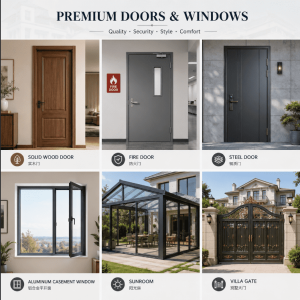
When you are sourcing for a project, you are not just buying a product; you are buying a partner who can deliver on specifications and timelines. As a factory-direct manufacturer of solid wood, thermal-break aluminum, and system doors and windows, we hold ourselves to the performance metrics discussed above.
Our approach to meeting these standards is straightforward. We do not rely on generic profiles. Our thermal-break aluminum systems are designed with adjustable profile structures and fittings, which allows us to adapt the door’s configuration to the specific building codes and wind-load requirements of your project’s location. This is crucial for projects in regions with stringent energy or safety regulations.
For quality assurance, we perform pre-shipment inspections on every order, including tests for air-tightness, water-tightness, and wind resistance. This is not an optional check; it is a standard step to ensure the doors we ship will perform as specified on your site. We provide full documentation, including packing lists and customs documents, to streamline your logistics.
Because we are a manufacturer, you work directly with the production team. This means we can offer full customization on size, color, glass, and hardware without the markup of a middleman. For construction projects, this direct line of communication is critical for managing custom specifications and delivery schedules. We handle both FCL and LCL shipments, delivering directly from our factory to your port.
If you are evaluating suppliers for a current project and need detailed specifications or test data to compare against your requirements, contact our team. We can discuss your project’s specific performance needs and how our manufacturing process can meet them.
Frequently Asked Questions
What is the most secure type of house door?
Steel doors with a solid core and a multi-point locking system offer the highest resistance to forced entry. Aluminum doors with reinforced frames and security glazing are also excellent options, especially when paired with impact-resistant glass. The lock hardware grade (e.g., ANSI/BHMA Grade 1) is as important as the door material itself.
Which door material is best for energy efficiency?
Thermal-break aluminum and composite doors with insulated cores and double or triple glazing perform best. Look for a low U-value. The quality of the weatherstripping and the door’s seal against the frame are equally critical — a poorly sealed door will negate the benefits of a high-performance panel.
How much do quality house doors cost?
Costs vary widely based on material, size, glazing, and hardware. Steel doors are generally the most budget-friendly for large orders. Standard aluminum and composite doors sit in the mid-range. High-end thermal-break aluminum, solid wood, and large custom folding systems are the most expensive. For a bulk project, the final unit price is heavily influenced by volume, customization level, and the supplier’s logistics.
What are the pros and cons of steel vs. fiberglass (composite) doors?
Steel is stronger and cheaper but dents and rusts if the surface is damaged. Fiberglass/composite resists dents, rust, and rot and is a better insulator, but it is more expensive and offers less flexibility for on-site modification. Steel is a good choice for security-focused budgets; composite is better for low-maintenance and energy efficiency.
How long do different door materials last?
With proper maintenance, a quality steel or aluminum door can last 30-50 years. Composite doors are also long-lived, with many manufacturers offering extended warranties. Solid wood doors can last indefinitely if they are regularly refinished and protected from moisture, but they require the most upkeep to achieve that lifespan.
Can I get a custom-sized door for a non-standard opening?
Yes, custom sizing is standard practice for manufacturers. Both wood and aluminum systems can be fabricated to your exact opening dimensions. This is a key advantage of working directly with a factory, as it avoids the need for extensive framing modifications on site. Always provide accurate rough opening measurements.