Last updated: September 17, 2026
What B2B Buyers Should Know Before Comparing White Storm Doors
A white storm door is an exterior secondary door mounted outside a primary entry door to provide weather protection, ventilation, and insect screening. For B2B buyers — distributors, contractors, multifamily developers, and hospitality specifiers — the purchasing decision rarely comes down to appearance alone. It comes down to four variables that determine total project cost: material, glass and screen configuration, size and mounting method, and sourcing channel.
The practical rule is straightforward. Match the material to the climate and traffic level, match the glass configuration to how the door will actually be used, confirm the size against the rough opening rather than the door slab, and choose a sourcing channel that can deliver consistent repeat batches — not just a low first order.
Three points separate a workable specification from an expensive mistake:
- Material drives maintenance cost more than purchase price. A cheaper door that needs repainting or hardware replacement every few years costs more over a project’s life than a higher-priced door that does not.
- Glass configuration is a usage decision, not a style decision. Full-view, 6-lite, and screen-away doors solve different problems — ventilation, light, privacy, and security.
- Sourcing channel determines whether the specification survives repeat orders. Clearance stock and custom production behave very differently when a buyer needs 200 matching units across three shipments.
This guide works through each of these in turn, then covers how to compare suppliers, including the documentation and inspection expectations that matter in international trade.
Material Deep Dive: Wood, Aluminum, and Vinyl or Steel Storm Doors
Material selection is the single largest driver of both durability and maintenance liability across a storm door’s service life. The three families below behave differently enough that they should not be treated as interchangeable.
Wood Storm Doors with Glass
Wood storm doors — typically built from pine, fir, or a hardwood like mahogany or oak — remain the reference point for high-end residential and heritage-sensitive projects. They accept paint and stain well, which makes a white finish achievable in either a painted or a pickled/stained look, and they can be milled to match existing trim profiles.
The trade-offs are real. Solid wood moves with humidity, so a wood storm door with glass in a wet coastal climate or a freeze-thaw region needs a properly sealed finish and periodic recoating. A wood storm door with screen and glass inserts gives the buyer both ventilation and weather protection in one unit, which is why this configuration is common in villa and custom residential work. For buyers specifying a 6-lite wood storm door, the muntin grid adds visual weight that suits traditional facades but also creates more joints to seal and finish.
Wood is the right choice when the project’s architectural language demands it and the owner accepts a maintenance schedule. It is the wrong choice when the buyer needs a zero-maintenance exterior across a large multifamily portfolio.
Aluminum Storm Doors
Thermal-break aluminum is the workhorse material for commercial and multifamily storm doors. It does not rot, does not require repainting, and holds a powder-coated white finish with good color stability. Aluminum profiles can be extruded to tighter tolerances than wood, which matters when a project needs hundreds of doors to fit the same opening dimension consistently.
The limitation is thermal performance and feel. Aluminum conducts heat unless a thermal break separates the interior and exterior faces, and even with a thermal break it will not match a well-built wood door for perceived solidity. For most B2B buyers, though, that trade-off is acceptable in exchange for predictable maintenance costs and repeatable supply.
Vinyl and Steel Storm Doors
Vinyl and steel occupy the value tier. Vinyl resists corrosion and is inexpensive, but it can become brittle in sustained cold and its color options are limited by the extrusion process. Steel offers good structural rigidity and accepts a durable paint finish, but any breach in the coating — a scratch, a stone chip, a poorly sealed edge — becomes a rust starting point. In humid or coastal environments, steel requires more attention than aluminum.
For a white storm door specification, the practical ranking for B2B work is usually: aluminum for volume and low maintenance, wood for architectural and premium residential, vinyl or steel for cost-driven replacement programs where service life expectations are shorter.
Glass and Screen Configurations: Full-View, 6-Lite, Screen-Away, and Ventilation
Configuration determines how the door functions day to day, and it is where buyers most often specify the wrong product for the intended use.
Full-View Glass
A full-view door carries a single large glass panel, usually tempered, with the screen stored behind or in a separate insert. It maximizes daylight and gives an unobstructed view, which suits entry doors where visibility is a security feature — a resident can see who is at the door before opening. The trade-off is that a full-view door offers no ventilation unless the glass panel is interchangeable with a screen insert.
6-Lite and Divided-Lite Glass
A 6-lite wood storm door divides the glazed area into six smaller panes with muntins. The grid reduces the size of any single glass panel, which can be an advantage in high-wind or impact-sensitive regions, and it delivers a traditional appearance. Compared with a full-view glass storm door, a 6-lite door admits less light and provides slightly less visibility, but it reads as more architecturally deliberate on colonial, craftsman, and heritage facades.
Screen-Away and Self-Storing Configurations
Screen-away storm doors carry a screen that retracts into the door frame or into a housing when not in use, so the same door provides a screened opening in mild weather and a glazed opening in cold weather. This is the configuration most buyers want for a white storm door with screen and glass capability, because it eliminates the seasonal chore of swapping inserts and the storage problem of keeping the unused panel.
Ventilation and Insert Interchangeability
A storm door with ventilation works either through a screen-away mechanism, a removable screen insert, or a divided-lite design where individual panes open. The key procurement question is not whether the door ventilates, but how the insert is retained. Inserts held by a simple friction channel are faster to change but can rattle or loosen; inserts held by a positive latch or cam system hold position better and are less likely to be damaged during seasonal changeover. For multifamily projects, specify the retention method explicitly, because it directly affects maintenance call volume.
Terms Buyers Should Know
| Term | What it means | Why it matters when buying |
|---|---|---|
| Prehung | The door slab is already mounted in its frame with hinges and hardware, ready to set into the opening | Reduces on-site labor and alignment errors; requires accurate rough-opening dimensions at order time |
| Slab | The door panel only, supplied without a frame | Used when the existing frame is sound and being reused; demands precise field measurement |
| Screen-away | A screen that retracts into the door or frame housing when not in use | Eliminates seasonal insert swapping, which lowers long-term maintenance load in rental and multifamily properties |
| Rough opening | The framed gap in the wall that receives the door unit | The dimension that actually governs fit; ordering by door size alone is the most common sourcing error |
Size, Handing, and Prehung Versus Slab Decisions
Sizing errors cause more storm door returns and reorders than any other single factor, so this section is worth reading carefully before a purchase order is issued.
Standard Sizes: 36×84 and 8-Foot Options
The most common North American entry door size is 36 inches wide by 80 inches high, and storm doors for that opening are typically specified as a 36×84 storm door — the 84-inch figure accounts for the door plus the frame and threshold clearance in a prehung unit. Buyers should treat 36×84 as a nominal unit size, not a rough-opening size.
An 8 foot storm door is a different product category. Eight-foot openings are used in commercial entries, tall residential entries, and some hospitality applications. An 8 foot screen door or 8 foot storm door must be specified with the actual rough opening height, and buyers should confirm that the supplier’s frame can accommodate the additional height without excessive deflection. Tall doors also place more load on hinges and closers, so hardware specification becomes more critical at this size.
Prehung Storm Doors and Prehung Screen Doors
A prehung storm door arrives assembled in its frame with hinges, closer, and often the handle set installed. The advantages are consistent alignment, faster installation, and fewer field errors — all of which matter when a contractor is installing dozens of units. The requirement is accurate rough-opening measurement at the time of order, including any out-of-square or out-of-plumb conditions in the existing wall.
A prehung screen door follows the same logic but is supplied with the screen configuration as the primary function. Buyers choosing between prehung and slab should decide based on whether the existing frame is being retained. If the frame is sound and square, a slab replacement is economical. If the frame is damaged, out of square, or being replaced as part of a renovation, a prehung unit is almost always the better choice.
Handing and Swing Direction
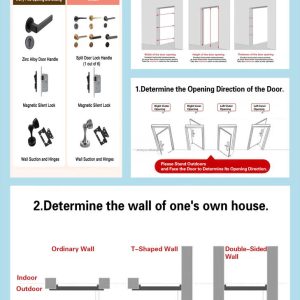
Handing is determined by which side the hinges sit on when viewed from outside, and it must be confirmed before production. A door ordered with the wrong handing cannot be corrected on site without reworking the frame. For bulk orders, buyers should confirm handing per unit or per building elevation rather than assuming a single configuration applies throughout a project.
White Storm Door Comparison Table
The table below summarizes the main white storm door types by material, glazing configuration, typical size range, and best-fit use case. Use it as a starting point for specification, then confirm dimensions against actual rough openings.
| Type | Material | Glass / Screen Configuration | Typical Sizes | Best-Fit Use Case |
|---|---|---|---|---|
| Full-view aluminum storm door | Thermal-break aluminum | Single tempered glass panel, screen insert | 32–36 in. wide, 80–84 in. high | Multifamily entries, rentals, security visibility |
| 6-lite wood storm door | Pine, fir, or hardwood | Six divided glass panes, optional screen insert | 32–36 in. wide, 80–84 in. high | Heritage, craftsman, and custom residential facades |
| Screen-away storm door | Aluminum or vinyl | Retractable screen with glazed panel | 32–36 in. wide, 80–84 in. high | Mixed-climate entries needing year-round ventilation |
| Wood storm door with screen and glass | Solid wood | Interchangeable screen and glass inserts | 32–36 in. wide, 80–96 in. high | Villa and premium residential with seasonal ventilation |
| 8 foot storm door | Aluminum or wood | Full-view or divided-lite | 36 in. wide, 96 in. high | Commercial entries, tall residential, hospitality |
| Prehung storm door unit | Aluminum, vinyl, or wood | Varies by insert | Standard and custom rough openings | Volume installation where frame replacement is included |
Two notes on reading this table. First, size ranges are nominal — the rough opening governs. Second, material and configuration are independent choices: a buyer can specify an aluminum frame with a 6-lite grid, or a wood frame with a full-view panel, if the project calls for it. The table shows common pairings, not fixed combinations.
Sourcing and Procurement: Clearance, Custom, MOQ, and Logistics
Sourcing decisions determine whether a specification can be repeated reliably across a project timeline.
Clearance Versus Custom Production
Storm doors on clearance can be attractive for small replacement programs, but they carry structural risks for B2B buyers. Clearance inventory is typically limited to specific sizes, handings, and colors, which means a project cannot be scaled or repeated. If a buyer needs 150 matching white storm doors across three buildings, clearance stock will almost certainly not cover the requirement, and mixing batches can produce visible color and hardware differences.
Custom production solves the consistency problem but requires planning. Buyers should expect to confirm profile, finish color, glass specification, hardware, handing, and packaging before production begins, and to allow lead time for manufacturing plus transit.
MOQ and Lead Time
Minimum order quantity depends on how much of the door is customized. Standard-profile doors in common sizes generally carry lower MOQs than fully custom sizes, colors, or hardware sets. Lead time is driven by the same factors: stock-profile production is faster than custom extrusion, custom color matching, or custom glazing. For project work, buyers should build lead time into the construction schedule rather than treating it as a post-award detail.
Documentation and Inspection
International sourcing requires a complete document set: packing list, proforma invoice, commercial invoice, and the customs documentation required by the destination country. Buyers should also confirm what pre-shipment inspection is performed. Air-tightness, water-tightness, and wind resistance testing before shipment is the practical way to catch unit-level defects before they cross a border, where resolution becomes far more expensive.
How One Manufacturer Approaches These Requirements
As a manufacturer, our approach at Jusen Door and Windows is built around the same variables buyers are comparing here. We supply directly from our factory, which removes middleman markup from the price structure, and we offer full customization on size, color, glass, and hardware so a specification can be matched to local building codes rather than adapted to whatever stock exists. Because profile structure and fittings can be adjusted, buyers working in different markets can align the door to local code requirements without changing suppliers.
On the procurement side, we handle FCL and LCL shipment with direct delivery from our China factory, and we provide packing lists, proforma invoices, and full customs documentation as standard. Before shipment, units go through air-tightness, water-tightness, and wind resistance testing, which is the point in the process where defects are cheapest to correct. For buyers who want to compare a custom specification against their current sourcing, Get a Quote and we will work through the configuration with you.
FAQ: White Storm Door Buying Questions
What is the difference between a white storm door with screen and a screen door with glass?
A white storm door with screen is a full storm door unit that includes a screen insert, usually alongside a glass panel. A screen door with glass is a door whose primary function is screening but which also carries a glazed insert, often interchangeable. In practice the difference is which function is primary: the storm door prioritizes weather protection with ventilation as a secondary function, while the screen door prioritizes ventilation with glass as a secondary option. For four-season climates, the storm door configuration is the more useful specification.
Which is better for B2B projects: wood storm doors with glass or aluminum storm doors?
It depends on the maintenance model the owner will accept. Wood storm doors with glass are better where architectural character is a requirement and the owner will maintain the finish. Aluminum storm doors are better for multifamily, rental, and commercial projects where low maintenance and repeatable supply matter more than appearance. For most volume B2B procurement, aluminum is the lower-risk specification.
What sizes are available for white storm doors, including 36×84 and 8-foot options?
Standard residential units are commonly specified around 32 to 36 inches wide and 80 to 84 inches high, with 36×84 being the most frequently ordered nominal size. Eight-foot doors are available for taller openings and are specified by actual rough-opening height. Custom sizes are also produced, which is often necessary in renovation work where existing openings are not standard.
How do screen-away storm doors and storm doors with ventilation work?
Screen-away storm doors carry a screen that retracts into the frame or a housing when not in use, so the door can switch between screened and glazed operation without removing and storing a panel. Other ventilation designs use removable inserts or divided-lite panes that open. The retention method matters: latch or cam systems hold inserts more securely than friction channels and reduce maintenance issues over time.
Are storm doors on clearance a viable option for bulk procurement?
For a small, one-time replacement program, clearance stock can work. For projects that require matching units across multiple buildings or future phases, clearance is usually not viable because sizes, handings, and colors are limited and cannot be repeated. Buyers should treat clearance as a one-off purchase, not a supply strategy.
What should buyers check when ordering prehung storm doors or prehung screen doors?
Confirm the rough opening dimensions, including out-of-square and out-of-plumb conditions; confirm handing and swing direction; confirm the hardware set and closer specification; and confirm that the frame depth matches the wall construction. Prehung units reduce installation labor but only if the rough opening was measured accurately before the order was placed.
How does a 6-lite wood storm door compare to a full-view glass storm door?
A 6-lite wood storm door divides the glazing into six panes, which suits traditional facades and reduces the size of any single glass panel. A full-view glass storm door uses one large panel, admitting more light and providing an unobstructed view. Choose 6-lite for architectural fit and divided-light appearance; choose full-view for maximum daylight and visibility.
What is a 3000 series storm door and when is it specified?
A 3000 series storm door is a manufacturer-specific product designation rather than an industry standard. Series numbers typically indicate a tier of construction, hardware, or glazing within a single brand’s lineup, so a 3000 series door from one supplier is not directly comparable to a similarly numbered door from another. Buyers should ask for the underlying specifications — frame material, glass type, hardware, and warranty terms — rather than comparing series numbers across brands.
Additional Considerations: Brown, Rustic, Bifold, and Series-Specific Options
Not every project calls for a standard white unit, and a few adjacent categories come up often enough in procurement conversations to warrant a brief note.
A brown storm door with screen is the same product family as a white storm door, differing only in finish. The procurement implication is that color changes the production process — custom color matching adds lead time and may raise MOQ — so buyers should confirm color consistency across batches, not just the color chip.
A rustic storm door typically refers to a design with heavier framing, visible joinery or board-and-batten detailing, and a stained or distressed finish. These are usually produced in wood and specified for custom residential and hospitality projects where the door is part of the design intent rather than a purely functional layer.
Bifold storm doors and bifold screen doors are used where a wide opening needs to be covered but full swing clearance is not available. They are less common than single-leaf units and are usually specified for specific structural conditions rather than general use. Buyers should confirm the track and pivot hardware specification, since bifold systems place different loads on hardware than hinged doors.
Finally, buyers comparing a white storm door with screen against a wood storm door with screen and glass should recognize that these are often the same door described at different levels of specificity. The useful comparison is not the product name but the underlying specification: frame material, glazing type, insert retention method, handing, and hardware. When those five items are confirmed in writing, the risk of a mismatched order drops sharply — and repeat procurement becomes a matter of reordering a known specification rather than starting the comparison again.