Last updated: September 17, 2026
Key Takeaways: Double Door Screen Door Essentials
A double door screen door is a two-panel screen or storm door system built to cover a double-width opening — most commonly a French door pair or a double front entry. Unlike a single screen door, it has to solve a problem that single doors never face: a wide span with a center seam, two independently moving leaves, and hardware that must keep both panels aligned over years of use.
The practical decision comes down to three families of product:
- Hinged pairs — two framed screen or storm panels, each hung on its own side, meeting at the center. Most durable, most traditional, best for high-traffic entries.
- Retractable units — a mesh or screen cassette mounted at the head or side that pulls across the full opening and retracts into a housing when not in use. Best when the screen is seasonal or should disappear.
- Modular kits — component packages (frames, mesh, spline, hardware, tracks) assembled on site, often used for odd widths or retrofit work.
For most double front doors, a hinged pair or a dual-cassette retractable system gives the best balance of durability, airflow, and clean sightlines. Kit systems win when the opening is non-standard or the buyer wants to control cost and assembly directly.
Three things drive satisfaction more than brand: correct measurement of the rough opening, a center-seam strategy that prevents sag, and mesh selection matched to pets, sun exposure, and airflow needs. The rest of this guide works through each of those.

Types of Double Door Screen and Storm Doors
Hinged pairs
A hinged double screen door uses two framed panels, each hung on opposite jambs. Each leaf typically spans 30 to 36 inches, so a pair covers openings roughly 60 to 72 inches wide — the standard range for residential French doors and double front entries. Each panel carries its own closer or hold-open, and the pair meets at a center astragal or overlap.
This is the configuration most buyers picture when they search for a screen door for a double front door. It offers the most rigid structure, the widest hardware selection, and the easiest repair path, because a damaged panel can be replaced individually.
Retractable double screen doors
Retractable double screen doors use one or two mesh cassettes that pull across the opening on a track and roll back into a housing. Two common layouts exist:
- Dual side-pull — two cassettes mounted on the left and right jambs, each pulling toward the center and meeting in the middle.
- Single full-span pull — one cassette spanning the full width, usually mounted at the head, with the screen drawn down or across.
Retractable screen door for double door applications is popular where the screen should be invisible when open, where the door is used mostly in shoulder seasons, or where the entry is visible from inside the home and a framed panel would look heavy.
Sliding and track-based panels
Sliding screen panels run on top and bottom tracks and bypass each other at the center. They suit openings where a swinging panel would conflict with steps, planters, or a narrow landing. The trade-off is that sliding panels depend on clean, aligned tracks; grit and ice are their main enemies.
Storm door configurations
A storm door for double doors adds a full glazed or glazed-and-screen leaf that protects the primary door from weather and adds a thermal buffer. On a double opening, storm doors are almost always supplied as a matched pair, because a single full-width storm leaf would be too heavy and too wide for standard closers.
Many current products are combined units: a storm door with screen, where the glass panel and the screen panel interchange seasonally in the same frame. That combination is the most common specification for double storm doors exterior use, because it delivers winter weather protection and summer ventilation from one purchase.

Retractable vs. Hinged vs. Kit Systems
How retractable mechanisms actually work
A retractable unit relies on a spring-loaded roller inside a cassette, a tensioned mesh, and a track or guide that keeps the screen edge aligned as it travels. The mechanism is simple, but the failure points are predictable: a stretched or creased mesh, a weak return spring, and a track that collects debris.
Are retractable double screen doors worth it? They are worth it when the screen is used intermittently, when sightlines matter, and when the opening is protected from direct wind loading. They are a weaker choice on an exposed, wind-driven entry where the screen stays deployed for months at a time — a hinged pair handles constant load better.
Where hinged pairs outperform
Hinged panels carry their own structural frame, so they resist wind, pet impact, and repeated use without depending on a tensioned membrane. On a wide double opening, hinged pairs also solve the center-seam problem more directly: an astragal, a center overlap, or a fixed center post gives the two leaves a defined meeting point rather than a free-floating seam.
Where kits make sense
A double storm door kit typically bundles two door frames or panels, glazing or mesh inserts, hinges, closers, handles, a center astragal or meeting stile, weatherstrip, and fasteners. Kits are assembled on site and are the usual route for non-standard widths, for matching an existing trim profile, or for buyers who want to control the mesh and hardware specification themselves.
The kit route demands more from the installer. Frame squareness, hinge placement, and center alignment all have to be set correctly on site, and a kit assembled out of square will sag at the center regardless of hardware quality.
Preventing center sag on wide openings
Center sag is the most common long-term complaint on double screen and storm doors, and it is almost always a hardware and geometry problem rather than a mesh problem. Practical countermeasures:
- Add a center meeting stile or astragal so each leaf has a positive stop.
- Use a third hinge or a heavier-gauge hinge on each leaf above roughly 36 inches of panel width.
- Fit a hold-open or a closer rated for the panel weight, not the cheapest unit in the catalog.
- Keep both leaves on the same plane at installation; a leaf that starts out of plane will drift.
Comparison Table: Double Door Screen & Storm Door Options
| Configuration | Typical opening width | Best for | Durability | Center-seam risk | Relative cost band | Maintenance load |
|---|---|---|---|---|---|---|
| Hinged pair (screen) | 60–72 in | High-traffic entries, pets, year-round use | High | Low with astragal | Mid | Low |
| Hinged pair (storm, glass/screen combo) | 60–72 in | Cold or wet climates, weather protection | High | Low with astragal | Mid–high | Low–mid |
| Dual side-pull retractable | 60–96 in | Seasonal use, clean sightlines, wide openings | Mid | Mid (center overlap) | Mid–high | Mid |
| Single full-span retractable | 60–96 in | Wide openings, minimal frame presence | Mid | Low (no center seam) | High | Mid |
| Sliding bypass panels | 60–96 in | Tight landings, no swing clearance | Mid | N/A (bypass) | Mid | Mid–high (track cleaning) |
| Modular kit (screen or storm) | Custom | Non-standard widths, matching trim, spec control | Varies with assembly | Depends on install | Low–mid | Varies |
Cost bands are relative, not quoted figures. Actual pricing depends on panel width, frame material and finish, glazing type, mesh grade, hardware, and order volume. A double storm door with screen in a standard aluminum frame sits at a different price point than a custom wood-clad pair with laminated glass.
How to Choose the Right Double Door Solution
Start with the door type
French doors, hinged double entries, and sliding patio pairs each impose different constraints. French doors usually swing inward with a low threshold, so an out-swinging screen or storm pair needs a frame that clears the threshold and any exterior trim. Sliding doors need a bypass or retractable solution because a swinging panel has nowhere to go.
Measure the opening correctly
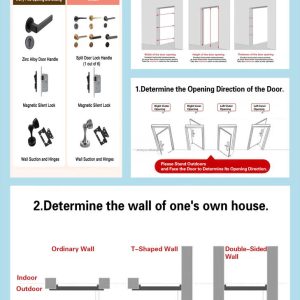
Measurement is where most double door screen door projects fail. The reliable sequence for a screen door for double doors:
- Measure the width at three points — top, middle, and bottom of the opening — and use the smallest figure.
- Measure the height at the left, center, and right, and again use the smallest.
- Measure the depth of the jamb or frame, because mounting hardware and cassettes need a defined reveal.
- Check for square by comparing the two diagonals. A difference of more than about 1/8 inch over the height signals a racked opening that will fight any prefabricated panel.
- Note any obstructions: door hardware, thresholds, steps, planters, or an outward-swinging primary door.
Use the manufacturer’s own measuring instructions as the governing document once a specific product is chosen, and confirm the required clearance for hinges, closers, and cassette housings before ordering.
Match the mesh and glazing to the household
- Standard fiberglass mesh — good visibility, moderate durability, low cost.
- Aluminum mesh — stronger and more rigid, slightly reduced visibility, common on storm door with screen units.
- Pet-resistant mesh — heavier weave or coated polyester; worth the upgrade where large dogs push through the screen.
- Solar or privacy mesh — reduces heat gain and glare, but lowers light transmission; useful on west-facing entries.
For storm doors, the glazing choice matters as much as the mesh: tempered or laminated glass where impact or safety codes apply, and interchangeable glass and screen panels where seasonal ventilation is wanted.
Climate, code, and property rules
Cold climates favor a storm door pair for the added thermal buffer; hot, humid climates favor screen-first configurations with high airflow. Before ordering, check whether the entry is on an egress path, whether the property is subject to HOA restrictions on exterior modifications, and whether rental agreements permit adding hardware to the frame. These constraints can eliminate an option before price ever becomes the deciding factor.
Choose A if… choose B if…
Choose a hinged pair if the entry is used daily, pets or children pass through often, or the opening is exposed to wind. Choose a retractable system if the screen should disappear for most of the year and sightlines matter more than maximum durability. Choose a kit if the opening is non-standard, the trim must be matched, or the buyer wants direct control over mesh and hardware specification.

Sourcing and Customization for B2B Buyers
For distributors, contractors, and project buyers, the sourcing decision rests on four things: whether the supplier can hold tolerances across a production run, whether the profile and hardware can be adapted to local building codes, whether lead time and MOQ fit the project schedule, and whether the documentation supports customs clearance.
This is the stage where the industry standard and the factory’s own method need to line up. Here is how we meet those standards at Jusen Door and Windows: we manufacture thermal-break aluminum and solid wood door and window systems, including double door screen and storm configurations built as matched pairs. Because we supply directly from our factory, sizing, color, glass, and hardware are specified per order rather than pulled from a fixed catalog, and the profile structure and fittings can be adjusted to suit the building codes of the destination market.
For buyers who need verification before shipment, our pre-shipment inspection covers air-tightness, water-tightness, and wind resistance testing, and we handle the export documentation set — packing list, proforma invoice, and customs documents — alongside FCL and LCL shipment options. OEM, ODM, custom sizing, private label, and bulk project supply are all available. If you are comparing double door screen and storm door suppliers for a specific opening, you can talk to our team with your dimensions and destination market, and we will confirm what the profile and hardware package needs to be.
Two internal references are worth reviewing before you finalize a specification: our size guide for measuring and tolerance conventions, and our price page for how configuration choices affect cost.
Additional Considerations
Magnetic screen doors on double openings. Magnetic closure panels are a low-cost option for occasional use, but on a double front door they rely on a center seam that has no structural support. They work reasonably on light-traffic openings and poorly where pets or wind are involved.
Pet and child wear. The two failure points are the lower screen corners and the center seam. Reinforced corner patches, heavier spline, and pet-resistant mesh address the first; a positive center stop addresses the second.
Maintenance schedule. Clean tracks and cassettes quarterly, lubricate hinges and closers twice a year, and inspect spline and mesh tension each season. Replacement mesh, spline, rollers, and closer arms are the parts most likely to need sourcing over the life of the door, so confirm they are available before committing to a system.
Total cost of ownership. Purchase price is only part of the picture. Add replacement mesh and spline, closer or roller replacement, and the labor to re-hang a sagging leaf. A slightly higher initial specification on hinges, astragal, and mesh frequently costs less over ten years than a cheaper system that needs re-alignment.
Warranty and specification verification. Warranty terms, mesh grades, and glazing specifications change between product generations. Confirm the current specification sheet and warranty document at the time of order rather than relying on older marketing material.
Frequently asked questions buyers raise before ordering.
What is a double door screen door and how does it differ from a single screen door? It is a two-panel system sized for a double-width opening, with a center meeting point and hardware rated for two leaves rather than one. The center seam and the wider span are the differences that matter.
What are the best options for a double front door screen door? A hinged pair for daily use and durability, or a dual side-pull retractable system where the screen should retract out of sight. Both are proven; the choice depends on traffic, exposure, and how often the screen stays deployed.
Can you use a storm door on double doors or French doors? Yes. Storm doors for double front doors are supplied as matched pairs, and combined glass-and-screen units cover both winter protection and summer ventilation. Check egress and local code requirements first.
How do retractable double screen doors work and are they worth it? A spring-loaded cassette tensions the mesh and a track guides it across the opening. They are worth it for seasonal use and clean sightlines, and less suited to constant wind exposure.
What is included in a double storm door kit? Typically two frames or panels, glazing or mesh inserts, hinges, closers, handles, a center astragal or meeting stile, weatherstrip, and fasteners. Confirm whether the kit is pre-hung or assembled on site.
How do I measure for a screen door for double doors? Measure width and height at three points each and take the smallest figures, check the jamb depth, and verify square by comparing diagonals. Follow the chosen manufacturer’s measuring instructions before ordering.
What materials are best for double storm doors exterior applications? Aluminum with a thermal break resists corrosion and holds finish well; wood suits traditional architecture but needs more maintenance; fiberglass resists dents and moisture but offers fewer finish options.
What should B2B buyers consider when sourcing double door screen doors? Tolerance consistency across the run, code adaptation for the destination market, lead time and MOQ against the project schedule, and whether the supplier provides complete export documentation.