What Is a Craftsman Style Screen Door?
A craftsman style screen door is a door designed with the architectural vocabulary of the American Craftsman movement—clean, straight lines, flat recessed panels, and minimal ornament—that allows ventilation while preserving the home’s exterior character. Unlike a generic aluminum screen door, a true craftsman unit uses square or slightly tapered rails and stiles, exposed joinery details, and a full- or half-lite glass insert above the screen panel. The visual weight sits in the lower third of the door, which is typically a solid panel or divided into two stacked flat panels.
The key distinction is proportion. Craftsman doors are not simply “wooden screen doors”; they follow a specific geometry: wider bottom rails, narrower top rails, and panel widths that relate to the overall door width in a 1:2 or 1:3 ratio. Buyers looking for an authentic look should check that the door’s trim and panel layout echo these proportions rather than just being a flat door with screen mesh stretched over a frame.
Craftsman Screen Door Sizes: Standard and Custom
Screen door sizing follows the finished door opening, not the rough opening. The standard residential door slab is 36 inches wide by 80 inches tall, and most screen doors are manufactured to fit that exact finished opening dimension. For older homes, the opening may deviate by a quarter to half an inch, which is why measuring the actual finished opening matters more than assuming a nominal size.
| Door Type | Standard Width (inches) | Standard Height (inches) | Typical Application |
|---|---|---|---|
| Single door, pre-hung | 30, 32, 34, 36 | 80, 82, 84 | Standard residential entry |
| Single door, custom | 28–42 | 78–96 | Non-standard openings, older homes |
| Double door (pair) | 60, 64, 68, 72 (total) | 80, 82, 84 | Wide entryways, patio access |
| Outswing exterior door | Matches existing door slab | Matches existing door slab | Coastal or space-constrained entries |
Custom sizing is common for craftsman screen doors because the style is frequently found in early-20th-century homes, where door openings are rarely perfectly square or standard. A manufacturer can accommodate widths in one-inch increments and heights in two-inch increments, but the frame must be built to the exact finished opening after accounting for the hinge and latch side clearances.
When ordering, specify the finished opening width and height (the interior dimensions of the door frame where the screen door will sit), not the rough opening. The rough opening includes the framing studs and is typically 1 to 1.5 inches larger than the finished opening. Supplying the wrong dimension is the most common ordering error.
Craftsman Style Storm Doors: A Versatile Alternative
A craftsman style storm door differs from a screen door in one critical way: it is a multi-season unit with interchangeable or integrated glass and screen panels. A screen door is typically a single-season product—screen mesh in a frame—while a storm door provides insulation and weather protection during colder months and converts to a screen configuration for ventilation in warmer weather.
The visual distinction matters. Many storm doors labeled “craftsman style” are essentially aluminum or vinyl units with decorative trim applied to mimic the look. A true craftsman storm door uses a full-lite glass panel over a lower solid panel, with the screen stored behind the glass or swapped seasonally. The frame profile is thicker than a screen door to accommodate the insulated glass and weatherstripping.
For buyers deciding between the two, the question is usage frequency. If the door will function primarily as a screen from spring through fall and be removed or replaced in winter, a dedicated screen door is simpler and less expensive. If the door must remain in place year-round, providing weather protection and energy efficiency, a storm door with a screen option is the functional choice. Note that storm doors add significant weight—a full-unit aluminum storm door with insulated glass can weigh 40 to 60 pounds—so the existing door frame and hinges must be in good condition.
Retractable Screen Doors for Outswing Doors
Outswing exterior doors present a problem for traditional screen doors. A conventional screen door mounts on the interior side of the jamb and swings inward, which conflicts with an outswing door’s hardware and clearances. Retractable screen doors solve this by mounting to the exterior door frame and pulling a screen across the opening when ventilation is needed, then retracting into a cassette when not in use.
For outswing doors, the retractable system must be installed on the interior side of the jamb, with the screen extending across the opening and attaching to a magnetic or hook latch on the opposite side. This configuration works because the retractable screen does not swing; it slides horizontally. The cassette housing mounts to the door frame or the adjacent wall, and the screen pulls across the opening without interfering with the outswing door’s swing arc.
The critical caveat is clearance. The outswing door’s handle, deadbolt, and any protruding hardware must not catch on the screen track or the guide rail. Measure the distance from the door face to the interior wall surface; if the door handle extends more than 2.5 inches from the door face, a standard retractable screen may not clear it without a spacer kit or a custom offset mount.
Retractable Screen Door Sizes: What to Know
Retractable screen doors are manufactured to fit a defined range of opening widths and heights, with custom sizes available but at a cost premium. Unlike a traditional screen door, which is sized to the full opening, a retractable screen is sized to the clear opening width between the jamb stops.
| Opening Width (inches) | Opening Height (inches) | Configuration |
|---|---|---|
| 24–36 | 80–84 | Single door, standard cassette on one side |
| 36–48 | 80–84 | Wider single door or narrow double |
| 48–72 | 80–96 | Double door, cassette mounted on one side with latch on the other |
| 72–96 | 80–96 | Extra-wide openings, requires reinforced track and heavier mesh |
The cassette height must match the opening height within a tolerance of about 0.25 inches. Most manufacturers offer cassettes in standard heights of 80, 82, and 84 inches, with custom heights available in one-inch increments. The screen mesh itself is typically fiberglass or polyester, and for wide openings above 60 inches, the mesh must be tensioned properly to prevent sagging.
A practical consideration: retractable screens reduce the clear opening width by roughly 3 to 4 inches due to the cassette housing and the latch mechanism. For a 36-inch opening, the usable pass-through width is about 32 inches. If the door is a primary egress point or used to move furniture or appliances, verify that the reduced clear width is acceptable.
How to Measure for Your Craftsman Screen Door
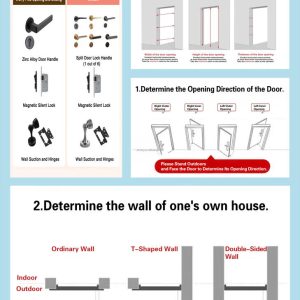
Measuring for a screen door requires three dimensions: width, height, and depth of the door frame. Errors in any of these dimensions will result in a door that does not fit or does not seal properly.
Measure the width at three points: the top of the opening, the middle, and the bottom. Use the narrowest measurement as your width, because a screen door must fit within the tightest point. Do the same for the height, measuring on the left side, center, and right side, and again use the shortest dimension. Screen doors are manufactured with a small clearance—typically 0.125 to 0.25 inches—to allow for expansion and smooth operation, so the door should be ordered at the narrowest measurement minus the recommended clearance.
For the depth, measure from the interior face of the door stop to the exterior edge of the frame. This determines whether a standard-depth screen door frame will fit or whether a custom-depth frame is needed. Most residential door frames have a depth of 4.5 to 5.5 inches, but older craftsman homes may have deeper or shallower frames, especially if the exterior has been re-sided.
Check for squareness. If the opening is out of square by more than 0.25 inches across the diagonal, the screen door will bind or leave gaps. A competent installer can shim the frame during installation, but significant out-of-square conditions may require a custom-built door that matches the opening’s actual geometry rather than a nominal rectangular dimension.
Terms Buyers Should Know
| Term | What it means | Why it matters when buying |
|---|---|---|
| Finished opening | The interior dimensions of the door frame where the screen door mounts, measured from jamb to jamb and header to threshold | Ordering to the finished opening (not the rough opening) is the difference between a door that fits and one that must be returned |
| Full-lite | A screen door design where the upper portion is a single glass panel, often with a solid lower panel | Full-lite designs maximize natural light while maintaining the craftsman aesthetic; half-lite designs offer more privacy |
| Outswing door | An exterior door that swings outward rather than into the home | Outswing doors require retractable or special mounting screen solutions because a traditional inward-swinging screen door cannot be installed |
| Cassette | The housing unit of a retractable screen door that contains the rolled screen mesh | Cassette dimensions determine the minimum frame depth required for installation and affect the clear opening width |
Material and Finish Options
Wood remains the default for authentic craftsman screen doors because it accepts paint and stain in a way that matches original trim and siding. Clear vertical-grain Douglas fir and Western red cedar are the traditional choices; both hold paint well and resist rot when properly finished. Mahogany and sapele are alternatives for homeowners who want a darker, richer appearance under a clear finish.
Aluminum and fiberglass units are available in craftsman profiles, but the visual fidelity varies. A quality aluminum door can replicate the flat panels and square rails closely, and it eliminates the maintenance burden of repainting every two to three years. The trade-off is thermal performance and weight. Aluminum conducts heat, which matters on a south-facing door, and the hollow frame sections can feel less substantial than a solid wood door.
The finish system matters more than the material for longevity. On a wood screen door, the exterior face should be finished with a high-quality exterior-grade paint or a marine varnish, with all six sides of the door sealed before installation. Failure to seal the bottom edge and the top rail ends is the most common cause of premature rot. Plan on refinishing a wood screen door every two to three years in most climates, more frequently in coastal or high-UV environments.
How to Choose Between Traditional, Storm, and Retractable Screen Doors
The decision comes down to three variables: the door’s orientation, the local climate, and the home’s architectural context.
For an inswing door in a temperate climate where the screen will be used seven or more months per year, a traditional hinged craftsman screen door is the straightforward choice. It is less expensive than a storm door, easier to repair, and provides the most authentic appearance because the entire door is visible when closed.
For an inswing door in a climate with distinct heating and cooling seasons, a craftsman style storm door with a screen option is the better investment. The storm door provides an insulating air gap in winter, protects the primary door from wind-driven rain, and converts to a screen configuration when outdoor temperatures permit. Expect to pay more, but the energy savings and extended service life of the primary door typically justify the difference.
For an outswing door, a retractable screen system is the only practical option that does not require permanent removal of the screen during winter. The cassette mounts inside the jamb, the screen slides across when needed, and the system is invisible when retracted. This configuration preserves the clean exterior appearance of the door, which matters on a craftsman home where the front door is a prominent architectural feature.
Sourcing Considerations for Buyers
When sourcing craftsman screen doors for a project or renovation, the manufacturer’s ability to match existing site conditions matters more than the catalog price. Custom sizing, the option to specify a particular wood species, and the flexibility to adjust panel proportions to match the home’s existing millwork are the capabilities that separate a supplier who understands the style from one who only offers stock sizes.
As a manufacturer of custom doors and windows, our approach is to treat each craftsman screen door as a built-to-order product rather than a stock item. We produce doors to the exact finished opening dimensions provided by the buyer, offer a range of wood species and finish options, and can adjust the rail and stile proportions to match the architectural character of the home. For trade buyers, we provide pre-shipment inspection reports covering air-tightness, water-tightness, and wind resistance on request, and we handle FCL and LCL shipments with full customs documentation. If you are working with non-standard openings or need a specific profile configuration to match local building codes, send us your measurements and we will confirm what is possible.
Frequently Asked Questions
Can a retractable screen door be used on an outswing door?
Yes. The retractable screen mounts to the interior side of the door frame and slides horizontally across the opening, so it does not interfere with the outward swing of the door. The main constraint is clearance for the door handle and any protruding hardware, which must not catch on the screen track.
What is the difference between a craftsman screen door and a storm door?
A screen door is a single-season product with mesh that provides ventilation. A storm door is a multi-season unit with a glass panel for insulation and weather protection, plus a screen option for warmer months. Storm doors are heavier, more expensive, and remain in place year-round.
What are the standard sizes for craftsman style screen doors?
Standard widths are 30, 32, 34, and 36 inches, with standard heights of 80, 82, and 84 inches. Custom sizes are available in one-inch width increments and two-inch height increments for non-standard openings.
How do I measure my door for a craftsman screen door?
Measure the finished opening width at the top, middle, and bottom, and use the narrowest dimension. Measure the height on the left, center, and right, and use the shortest dimension. Subtract 0.125 to 0.25 inches for clearance. Also measure the frame depth and check the opening for squareness.