Aluminum Double Pane Windows: What You Need to Know First
For commercial projects, aluminum double pane windows are the default choice when you need slim sightlines, high structural strength, and long service life. The core configuration—two glass panes separated by a sealed air or gas space—cuts heat transfer roughly in half compared to single glazing, while the aluminum frame provides rigidity that vinyl or wood cannot match in large spans.
The decision to specify aluminum double pane windows comes down to four factors: thermal performance, structural capacity, finish durability, and cost. Understanding how these interact will determine whether you end up with a curtain wall that performs for 40 years or a facade that needs replacement in 15.
Types of Aluminum Double Pane Windows: A Detailed Breakdown
Thermal Break vs. Non-Thermal Break Frames
The single most important distinction in aluminum windows is whether the frame incorporates a thermal break. A thermal break is a polyamide or polyurethane strip inserted between the interior and exterior aluminum profiles, interrupting the metal-to-metal heat path.
Non-thermal break frames conduct heat readily. In cold climates, they will form condensation on interior surfaces, increase heating loads, and feel cold to the touch. In hot climates, they transfer solar heat into the building. These frames are cheaper and still common in mild climates or interior applications.
Thermally broken frames use a pour-and-debridge or crimped polyamide strip method. The result is a frame that performs closer to vinyl or wood in thermal terms while retaining aluminum’s structural advantages. For any commercial project in a climate with significant heating or cooling loads, thermal break frames are not optional.
Casement, Sliding, Fixed, and Awning Configurations
Casement windows hinge on the side and crank outward. They offer the best ventilation control and the tightest seal when closed because the compression seal engages mechanically. For commercial facades, casement units are common in low-rise applications and where individual room ventilation is required.
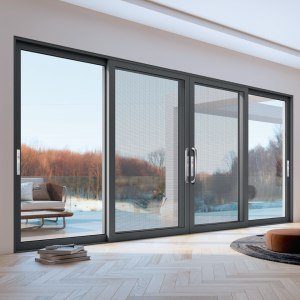
Sliding windows move horizontally on tracks. They are cheaper per square meter, simpler to operate, and ideal for wide openings where you want unobstructed views. The trade-off is a less effective seal—sliders typically have higher air leakage rates than casements.
Fixed windows have no operating hardware. They are the most economical per square meter, offer the best thermal and acoustic performance because there are no moving parts or seals to fail, and dominate high-rise commercial construction where ventilation is handled by a mechanical system.
Awning windows hinge at the top and open outward from the bottom. They shed rain while open, making them practical for mid-rise facades. Their geometry also directs incoming air upward, which can improve indoor air circulation.
Aluminum Double Pane Windows vs. Other Frame Materials
Aluminum vs. Vinyl (uPVC)
Vinyl frames achieve excellent thermal performance at a lower cost. However, vinyl has a coefficient of thermal expansion roughly four times that of aluminum, meaning it moves significantly with temperature changes. In dark colors or direct sun exposure, vinyl frames can warp, bow, or become brittle over time.
Aluminum’s structural strength allows for thinner frames and larger glass areas. A vinyl frame in a 2-meter span needs reinforcement; an aluminum frame does not. For commercial projects with tall, wide, or geometrically complex openings, aluminum is often the only viable frame material.
Aluminum vs. Wood
Wood offers premium aesthetics and natural insulation, but it demands ongoing maintenance—repainting, sealing, and protection from moisture and insect damage. In commercial settings, the lifecycle cost of wood is typically higher than aluminum because of labor costs for maintenance.
Aluminum frames with wood interior cladding are available if you want the warmth of wood inside with aluminum’s durability outside. This hybrid approach is common in boutique hotels and executive office spaces.
Aluminum vs. Steel
Steel frames are stronger than aluminum but heavier, more expensive, and prone to corrosion unless galvanized or stainless. Aluminum’s corrosion resistance is naturally superior—it forms a protective oxide layer—making it the better choice for coastal environments. Steel is reserved for heritage reproductions or structural glazing systems where very slim profiles are required.
Black Double Pane Windows: A Style Option Worth Considering
Black double pane windows have moved from residential trend to commercial standard. The finish is achieved through powder coating or anodizing, and it reads as a deliberate architectural statement rather than a default white or silver.
Powder coating is the more common method. The frame is cleaned, pretreated, and sprayed with electrostatically charged dry paint, then cured in an oven. The result is a tough, uniform finish available in any RAL color, including matte or gloss black. Powder coating thickness typically ranges from 60 to 120 microns, and quality systems carry a warranty against fading or chalking.
Anodizing is an electrochemical process that thickens the natural oxide layer on aluminum. It is more durable than powder coating—the finish is part of the metal, not a coating on top—but it is limited to metallic tones: silver, bronze, and black. Anodized black has a subtle metallic sheen that differs from the flat appearance of powder-coated black.
For commercial projects, black frames work best when you want strong visual contrast against light facades or when matching black architectural details like railings and sunshades. The practical consideration is heat absorption—black frames get hotter in direct sun, which can affect thermal performance in hot climates. With a thermal break, this is manageable.
Comparison Table: Key Features at a Glance
| Feature | Casement | Sliding | Fixed | Awning |
|---|---|---|---|---|
| Frame type | Thermally broken or non-break | Thermally broken or non-break | Thermally broken or non-break | Thermally broken or non-break |
| Glass options | Low-E, tempered, laminated, gas fill | Low-E, tempered, laminated, gas fill | Low-E, tempered, laminated, gas fill | Low-E, tempered, laminated, gas fill |
| Finish | Powder coat, anodize | Powder coat, anodize | Powder coat, anodize | Powder coat, anodize |
| Price per m² | Highest | Moderate | Lowest | Moderate |
| Air leakage | Lowest | Higher | Lowest | Low |
| Ventilation | Full control | Limited | None | Rain-safe |
| Best for | Low-rise, individual rooms | Wide openings, views | High-rise, mechanical ventilation | Mid-rise, rain exposure |
Performance Metrics: What the Numbers Actually Mean
U-Factor and R-Value
U-factor measures how well a window conducts heat—lower is better. For aluminum double pane windows, the complete unit U-factor depends on the frame, the glass, and the spacer.
A non-thermal break aluminum frame with clear double glazing will achieve a U-factor around 2.8 to 3.0 W/m²K. Adding a thermal break drops this to approximately 2.0 to 2.4 W/m²K. With low-E glass and argon fill, a thermally broken aluminum window can reach 1.4 to 1.8 W/m²K. For comparison, a high-performance vinyl window with triple glazing can reach 0.8 to 1.0 W/m²K, but at the cost of much thicker frames.
R-value is the inverse of U-factor (in imperial units) and is rarely used in commercial spec writing outside North America. If you see R-value quoted, convert to U-factor for comparison.
SHGC and Solar Heat Gain
Solar Heat Gain Coefficient measures the fraction of solar radiation that passes through the window. A SHGC of 0.30 means 30% of solar heat enters the building.
For hot climates, you want a low SHGC to reduce cooling loads. Low-E coatings with a low solar transmittance, combined with a tinted outer pane, can achieve SHGC values around 0.25 to 0.35. For cold climates, a higher SHGC (0.40 to 0.50) allows passive solar heating.
Air Leakage, Water Resistance, and Wind Load
These three metrics are tested together in most certification schemes. Air leakage is measured in cubic meters per hour per square meter of opening area at a given pressure differential. Water resistance is the pressure at which no water penetrates the assembly. Wind load resistance is the pressure the window withstands without permanent deformation.
For commercial projects, look for products tested to the relevant local standard—AAMA/WDMA in North America, or EN standards in Europe. A well-designed casement window will achieve air leakage ratings of 1.5 m³/h/m² or better at 100 Pa, water resistance of 300 Pa or higher, and wind load ratings suitable for the building height and location.
Glass Options for Double Pane Units
Low-E Coatings
Low-emissivity coatings are microscopically thin metal oxide layers that reflect long-wave infrared radiation. In winter, they reflect interior heat back into the building. In summer, they reflect solar heat away. The coating position within the double pane unit matters: a “hard coat” low-E on the interior pane surface optimizes winter performance, while a “soft coat” low-E on the outer pane surface optimizes solar control.
Tempered and Laminated Glass
Tempered glass is heat-treated to increase strength and, when broken, shatters into small granules rather than sharp shards. It is required for glazing in doors, sidelites, and areas within reach of occupants. Laminated glass consists of two panes bonded with a polyvinyl butyral (PVB) interlayer. When broken, the fragments adhere to the interlayer, maintaining the opening’s integrity. Laminated glass is specified for overhead glazing, hurricane-prone regions, and where security is a concern.
Gas Fills: Argon and Krypton
Argon and krypton are denser than air, reducing convection and conduction within the cavity. Argon is the standard fill—it is inexpensive and improves the center-of-glass U-factor by about 10% compared to air. Krypton performs better but costs significantly more, making it practical only in narrow cavities (6 to 8 mm) where argon’s benefit diminishes.
Spacer Systems
The spacer separates the two glass panes at the edge. Aluminum spacers conduct heat, creating a cold edge that can cause condensation. Warm-edge spacers—made of stainless steel, plastic, or foam—reduce this effect. For commercial projects, specify warm-edge spacers to avoid condensation issues and improve overall U-factor.
How to Choose the Right Aluminum Double Pane Windows for Your Project
Climate-Based Selection
In hot climates, prioritize low SHGC and a thermally broken frame. Specify a soft-coat low-E coating on the outer pane with a tinted outer glass to reduce solar gain. Argon fill is worthwhile if the frame is thermally broken; otherwise, the frame dominates heat transfer and glass upgrades have marginal benefit.
In cold climates, prioritize low U-factor. Specify a hard-coat low-E on the interior pane, argon fill, and warm-edge spacers. A thermally broken frame is essential—without it, the frame will be the weak point regardless of glass performance.
In mixed climates, balance U-factor and SHGC. A moderate low-E coating with a mid-range SHGC (around 0.35 to 0.40) works well.
Building Codes and Energy Compliance
Check your local energy code before specifying. Many jurisdictions now require windows to meet maximum U-factor and SHGC values that vary by climate zone. Your window supplier should provide NFRC or equivalent ratings for the exact configuration you intend to purchase—not just the glass center-of-glass values, but the complete unit ratings.
Structural Considerations for Commercial Facades
For openings wider than 1.5 meters or taller than 2 meters, verify the frame’s wind load rating. Aluminum’s strength allows for larger spans, but mullion sizes and wall thickness must be engineered for the specific project. A supplier that offers adjustable profile structures to match local building codes is a practical advantage here.
Cost Factors and Price Ranges
Aluminum double pane window pricing varies significantly based on configuration, finish, and volume. As a general guide, expect to pay more per square meter than vinyl but less than premium wood or steel systems.
Key cost drivers include:
- Frame type: Thermal break adds 20–30% over non-break frames
- Glass: Low-E and argon adds 10–15%; laminated adds 20–30%; both together can add 40%
- Finish: Anodizing costs more than powder coating; custom colors add a small premium
- Hardware: Multi-point locking systems and concealed hinges add cost but improve performance and security
- Size and shape: Non-standard sizes and arched or angled frames incur additional fabrication costs
For a commercial project, budget for the complete installed cost, including flashing, sealants, and labor. Installation typically adds 20–40% to the material cost.
Installation and Maintenance Considerations
Proper installation is critical for aluminum double pane windows. The frame must be anchored correctly, flashed against water intrusion, and sealed at all penetrations. Poor installation—not the window itself—is the most common cause of water leaks and air infiltration in commercial buildings.
Maintenance requirements are modest. Aluminum frames do not need painting or sealing. Clean the frames periodically with mild soap and water; avoid abrasive cleaners that can damage the finish. Check the weatherstripping and seals annually and replace them when they show signs of wear. The insulated glass unit has a service life of 15 to 25 years, depending on the spacer quality and temperature extremes; when seal failure causes fogging between the panes, the unit must be replaced.
Partnering with a Manufacturer: What to Look For
When evaluating suppliers for a commercial project, the questions that matter are about process and verification, not marketing claims.
Quality control: Ask how the manufacturer tests air-tightness, water-tightness, and wind resistance before shipment. A supplier that performs these tests on every batch—not just on a sample—is demonstrating a real commitment to quality.
Customization capability: Your project will likely require specific sizes, colors, and hardware configurations. Confirm that the manufacturer can handle full customization without compromising lead times.
Documentation: For international procurement, you need a manufacturer that can provide packing lists, proforma invoices, and complete customs documentation. This is where experience in foreign trade becomes a practical advantage.
Logistics: Understand whether the manufacturer ships FCL or LCL and how they handle packaging for export. Proper crating prevents transit damage, which is a common source of disputes.
As a manufacturer ourselves, this is how we meet these standards at Jusen Door and Windows. We operate a direct factory supply model, which means you are buying from the production source rather than through a middleman—this affects both pricing and accountability. Every order undergoes pre-shipment inspection covering air-tightness, water-tightness, and wind resistance, and we adjust our profile structures and fittings to match the building codes of your target market. Our customization options cover size, color, glass specification, and hardware accessories, and we handle both FCL and LCL shipments with full export documentation.
For commercial projects, the right manufacturer is one that treats your building code compliance as their responsibility, not yours. If you are comparing suppliers and want to discuss your project specifications, Contact Our Team to get a detailed proposal.