Last updated: October 1, 2026
The Short Answer: The Best Exterior Door Brands at a Glance
For B2B buyers, the “best” exterior door brand depends on your project’s performance requirements — not on brand prestige alone. After scoring brands on material performance, manufacturing consistency and cost-per-year value, 2026’s landscape falls into three tiers:
| Project Type | Best Brand Direction | Why |
|---|---|---|
| Cold climate / energy efficiency | Therma-Tru, Pella (fiberglass) | Low thermal conductivity, U-factor 0.20–0.30, no condensation or warping |
| Commercial / budget security | Masonite, JELD-WEN (steel) | Highest strength-to-cost ratio for high-traffic or rental use |
| Premium residential / architecture | Simpson, TruStile, Marvin, JUSEN (wood & custom) | Design flexibility, structural precision, unmatched curb appeal |
The key shift in 2026 is no longer material alone — it’s manufacturing precision. The best exterior door brands now compete on air-tightness ratings, thermal-break technology, and compliance with stricter North American and European building codes.
How We Evaluated the Brands (and Why You Can Trust This)
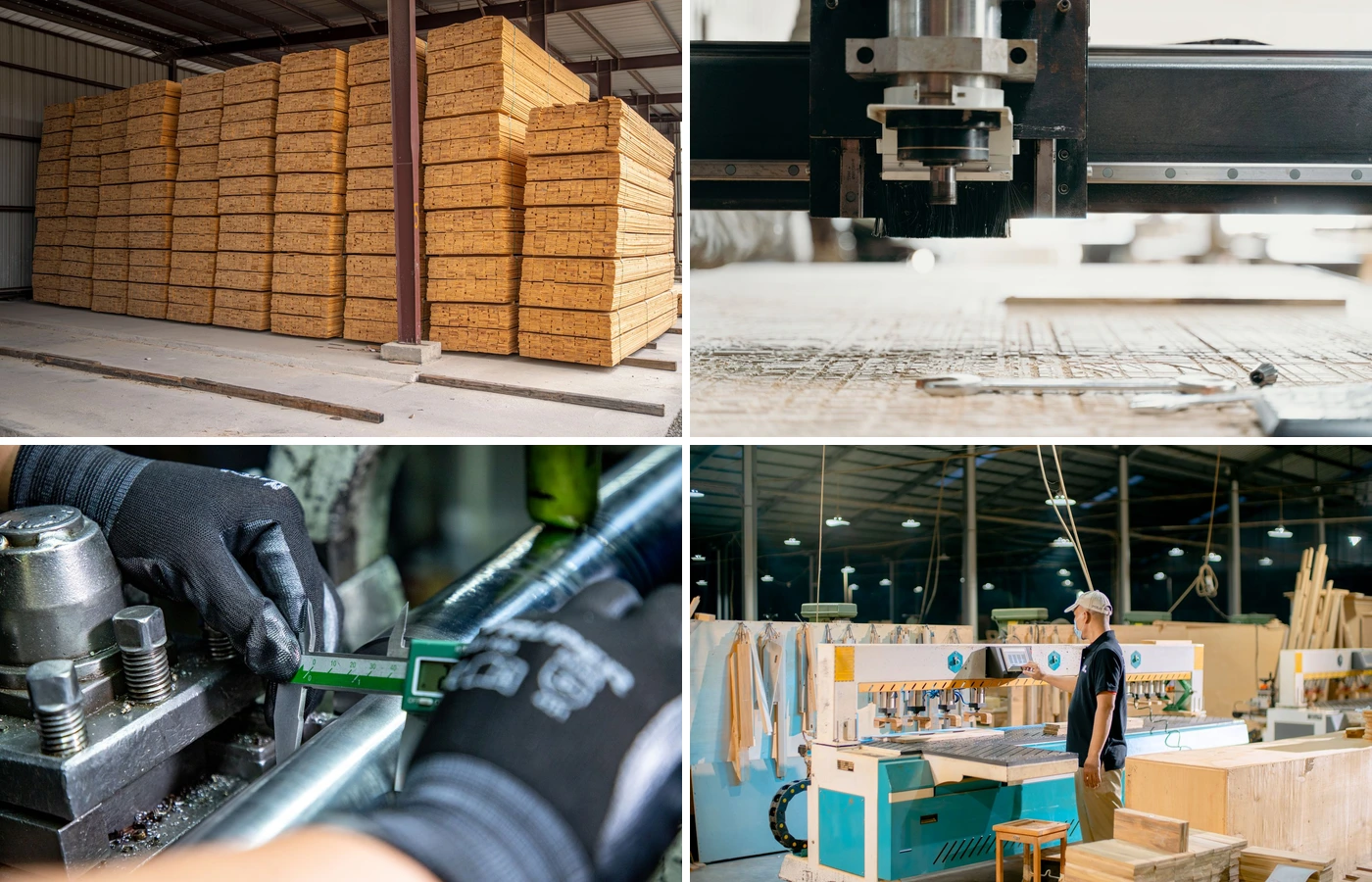
Most “best exterior door brand” lists are affiliate roundups written by generalists. This one is written from a factory floor. JUSEN manufactures solid wood, engineered wood, thermal-break aluminum and system doors in Guangdong, China, exporting to distributors, builders, developers and designers since 2005.
We scored each brand across 7 weighted criteria, based on published manufacturer specifications plus our own export warranty-claim data:
| Criterion | Weight | What We Measured |
|---|---|---|
| Thermal performance | 20% | NFRC U-factor, SHGC |
| Weather & water resistance | 20% | Air infiltration (cfm/ft²), water penetration pressure |
| Structural / security | 15% | DP rating, lock-block construction, forced-entry resistance |
| Durability & dimensional stability | 15% | Warp/twist tolerance, swelling under 85% RH |
| Aesthetics & customization | 10% | Species, finishes, glass options, size freedom |
| Maintenance burden | 10% | Refinish interval, repairability |
| Total cost of ownership (20 yrs) | 10% | Unit cost + install + refinishing + replacement risk |
Transparency note: JUSEN manufactures wooden and wood-composite doors; we do not manufacture steel or fiberglass, which is precisely why we can honestly tell you when those materials are the better choice. Where we recommend our own products, we label it clearly.
The 5 Numbers Every Exterior Door Brand Should Give You
Before comparing brand names, learn the five numbers printed on the NFRC/WDMA label. If a brand cannot provide all five, that is your answer about the brand.
- U-Factor (how much heat escapes; lower is better) — 0.50+ is poor; 0.25–0.30 good; 0.17–0.21 excellent (ENERGY STAR 7.0 often requires 0.17 or less for opaque doors). Demand the NFRC-certified number, not a “calculated” one.
- SHGC (solar heat gain through glass) — 0.25 or lower for hot climates; 0.30–0.40 can be a free winter heater in cold zones.
- Air Infiltration (cfm/ft²) — industry baseline 0.30; premium doors achieve 0.10. This single number is the difference between a door that whistles in January and one that doesn’t.
- DP / Performance Grade — DP30 standard residential; DP40–DP50 for high-wind; impact-rated + DP50 for hurricane zones (Miami-Dade NOA / Florida Product Approval).
- Warranty Terms (read the exclusions) — a “limited lifetime warranty” that voids unless the door is protected by an overhang of half the door height is common. An unprotected south/west door needs a deep overhang, a storm door, or a factory-applied high-solids UV coating.
Material Breakdown: Which Type of Exterior Door Wins?
The material choice determines nearly every performance attribute: insulation, security, durability, maintenance and cost. Here is how the four main types compare in practice.
Wood: The Aesthetic Standard, Higher Maintenance
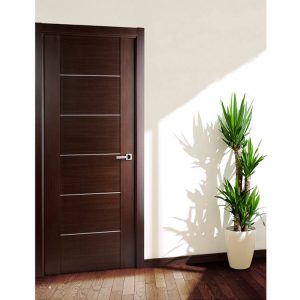
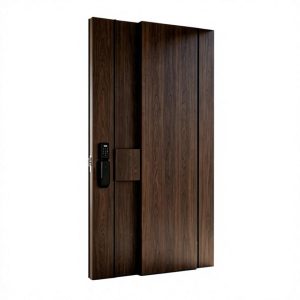
Wood remains the choice for high-end residential and historic restoration. It offers the best acoustic insulation and an unmatched natural aesthetic that can be refinished indefinitely. It is also the most maintenance-intensive — it expands and contracts with humidity, requiring periodic refinishing. For B2B buyers, wood wins when the project demands architectural authenticity and the client accepts a maintenance schedule. The best wooden exterior doors use engineered cores (LVL or stave-core) and kiln-drying to 8–12% MC to minimize instability while keeping a real wood surface. Expect 50–100 year lifespan with proper care.
Steel: The Security and Value Option
Steel is the standard for commercial applications and budget residential. A 24-gauge insulated steel skin delivers excellent impact resistance at the lowest cost per square foot. Trade-offs: rapid heat conduction (needs a thermal break) and permanent dents. Within about 2 miles of saltwater, rust is a matter of when, not if. For rentals, high-traffic entrances, or security-first projects, steel remains the pragmatic choice. Lifespan 20–30 years.
Fiberglass: The Climate Champion
Fiberglass is the fastest-growing material category because it solves the core problems of wood and steel — it won’t warp, rot or dent, and SMC skins reproduce wood grain convincingly. With a full polyurethane foam core it reaches U-factors below 0.20, meaning less heat loss and no interior condensation. Drawbacks: it sits between steel and premium wood on price, and a deep impact can crack the skin (replacement rather than repair). Lifespan 30–50 years.
Aluminum: The Engineering Choice for Modern Architecture
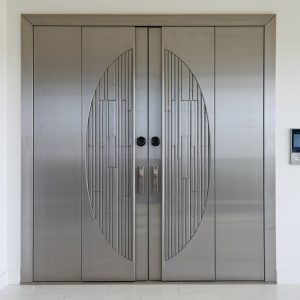
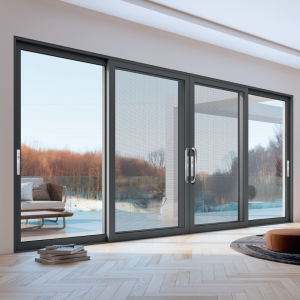
Thermally broken aluminum — a polyamide strip separating inner and outer profiles — delivers thermal performance comparable to fiberglass with superior rigidity, the thinnest sightlines and the largest panel sizes. It is the best choice for oversized, pivot, coastal or high-rise projects where wind-load resistance matters. Fully recyclable, minimal maintenance, but typically pricier than steel. Lifespan 40+ years.
Best Exterior Door Brands Compared (2026)
Searchers comparing doors usually also compare makers. Here is an honest, high-level landscape — including where JUSEN fits. Rated on thermal performance, security, durability and value.
| Brand | Country | Material Focus | Core Strength / Best For | Watch Out For |
|---|---|---|---|---|
| Therma-Tru | USA | Fiberglass, Steel | Fiberglass category leader; best-in-class insulation ratings; excellent dealer network | Premium pricing on fiberglass lines |
| Pella | USA | Wood, Fiberglass | Strong NFRC ratings, integrated blinds options, broad range | Expensive for the performance delivered |
| Andersen / Renewal | USA | Wood, Fiberglass (Fibrex) | Strong warranty, established reputation, nationwide service | Higher cost, longer lead times |
| Masonite / Owens Corning | USA | Steel, Fiberglass | Massive scale, strong security features, competitive pricing | Steel lines can dent in high-traffic use |
| JELD-WEN | USA | Wood, Steel, Fiberglass | Full-line, broad range, strong big-box presence, consistent quality | Limited customization on standard lines |
| Simpson Door | USA | Solid wood | Heritage solid-wood craftsmanship, premium residential | Long lead times; premium pricing |
| TruStile / Rogue Valley | USA | Architectural custom wood | High-end custom doors, design flexibility | Very high cost; project-only channel |
| Marvin | USA | Aluminum-clad wood | Architectural clad wood, superb engineering | Luxury pricing |
| JUSEN | China | Solid & engineered wood, thermal-break aluminum | Factory-direct custom solid/engineered wood & aluminum; OEM/ODM; export-optimized packaging; 40–60% below domestic at equal spec | Less established in the North American residential market; ships containers, not single slabs |
The notable 2026 shift: factory-direct manufacturers like JUSEN are increasingly competitive on aluminum and custom wood because they eliminate the distribution markup that established brands carry. Where JUSEN genuinely wins: custom sizes, custom species, custom carving/CNC patterns, OEM branding and landed cost on volume. Where we don’t: if you need one door delivered to a Chicago driveway on Thursday, buy from a local dealer.
Best Exterior Door Brands by Use Case
| Scenario | Recommended Brand Direction / Spec |
|---|---|
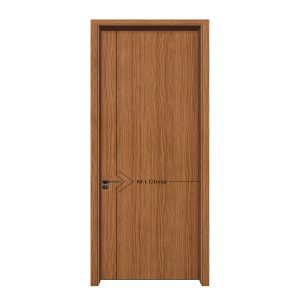
| Best overall (look + resale + repairability) | Solid mahogany / white oak slab, 1¾″ min (2¼″ over 42″ openings), engineered laminated stiles, 8–12% MC, all six edges sealed. JUSEN equivalent: JS-E100 Series, FOB from $285/set. |
| Best value / low maintenance | Fiberglass, SMC skin + full polyurethane core (R-5 to R-6), composite edge stiles, adjustable composite sill. Therma-Tru / Pella fiberglass, or JUSEN engineered wood for volume. |
| Best security | Security is 90% frame, not slab. 3-point multipoint lock, 3″ screws into the king stud, reinforced strike plate, solid lock block, 1¾″ slab. Steel (Masonite/JELD-WEN) or wood/fiberglass with multipoint lock. |
| Coastal / hurricane zones | Impact-rated glass, DP50+, Miami-Dade NOA / Florida Product Approval, 316 stainless hardware, aluminum-clad or fiberglass, sill pan flashing. No untreated steel within 2 miles of surf. |
| Cold climates (zones 5–8) | U-factor 0.20 or lower, triple-point weatherstripping, thermally broken sill, argon-filled Low-E glass. Fiberglass (Therma-Tru) or thermally broken aluminum. |
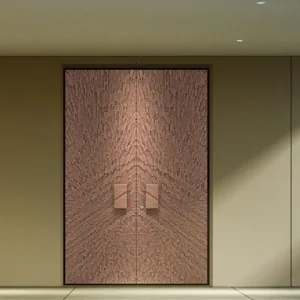
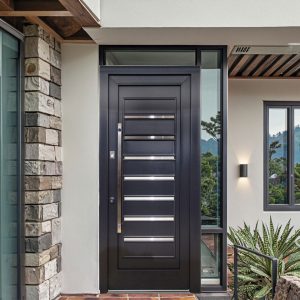
| Luxury / oversized pivot | 48″–60″ × 96″–120″ pivot; heavy-duty pivot hardware rated 2–3× slab weight; torsion-resistant internal frame. JUSEN equivalent: JS-PV Series, up to 60″ × 120″. |
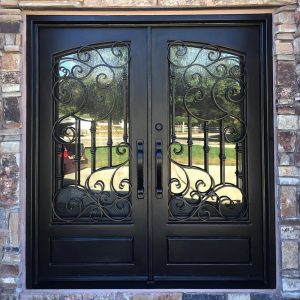
| Double entry pairs | Astragal with flush bolt top and bottom; reinforced head jamb for pairs over 72″ total. |
| Budget under $500 | Insulated steel 6-panel, pre-hung, 36″ × 80″. Honest, functional, fine for rear/garage entries. |
| Developers & importers (volume) | Factory-direct engineered-core wood with hardwood veneer, pre-finished/pre-hung in factory, complete set — eliminates $120–$250/door on-site finishing labor. |
Brand vs Trading Company: The Factory Audit Scorecard
For B2B buyers, the single most important question is not “which brand is famous” but “am I dealing with a manufacturer or a trading company — and can the factory back its claims?” Use this scorecard to audit any supplier:
| Audit Item | Green Flag | Red Flag |
|---|---|---|
| Business license & ISO 9001 | Valid, verifiable certificates | Expired or unavailable |
| Production capacity | Clear monthly capacity and line count | Vague answers |
| Material traceability | Batch records, wood species, coating data | No traceability |
| QC process | Incoming, in-process and pre-shipment QC | Only final random check |
| Test reports | Third-party or recognized lab reports (ASTM E283/E331/E330) | No test evidence |
| Export packing | PE film, foam, corner protection, plywood crate/pallet, loading plan | Thin carton only |
| Engineering support | Shop drawings, hardware schedules | No technical drawing |
| References | Project cases in your market | No verifiable cases |
| Warranty | Written structural / finish / hardware warranty | Verbal promise only |
Exterior Door Cost Guide 2026 (Real Numbers)
U.S. retail, installed
| Door Type | Slab Only | Pre-Hung Unit | Installed (incl. labor) |
|---|---|---|---|
| Steel, basic | $250–$600 | $400–$900 | $700–$1,700 |
| Fiberglass, mid | $600–$1,400 | $900–$2,200 | $1,500–$3,500 |
| Fiberglass, premium w/ glass | $1,400–$3,000 | $2,000–$4,500 | $3,000–$6,500 |
| Solid wood, standard | $1,200–$3,000 | $1,800–$4,500 | $2,800–$7,000 |
| Solid wood, custom/oversized | $3,000–$8,000 | $4,000–$12,000 | $6,000–$18,000 |
| Pivot, oversized | $4,000–$15,000 | — | $8,000–$25,000 |
| Double door w/ sidelites & transom | — | $4,000–$15,000 | $7,000–$25,000 |
Installation labor alone: typically $400–$1,200 for a straight swap; $1,500–$4,000+ if the rough opening or header must be modified.
Factory-direct FOB reference (importers, 1×40HQ basis)
| Product | FOB China (USD/set) | Qty per 40HQ |
|---|---|---|
| Engineered-core wood entry door, veneered, pre-finished | $150–$280 | 180–240 sets |
| Solid hardwood entry door 1¾″ | $260–$520 | 150–200 sets |
| Solid wood double door w/ sidelites | $600–$1,400 | 60–90 sets |
| Oversized pivot door set | $900–$2,200 | 40–70 sets |
Landed-cost reality check: add roughly 8–20% duty (HTS 4418.21/4418.29/4418.20 — confirm with your customs broker), ocean freight and inland delivery. Even at today’s freight rates, a factory-direct custom wood door typically lands 40–60% below the U.S. retail equivalent at the same specification. Duty rates, Section 301 status and AD/CVD scope change — verify before you commit.
How to Choose an Exterior Door Brand: 9-Step Buyer’s Checklist
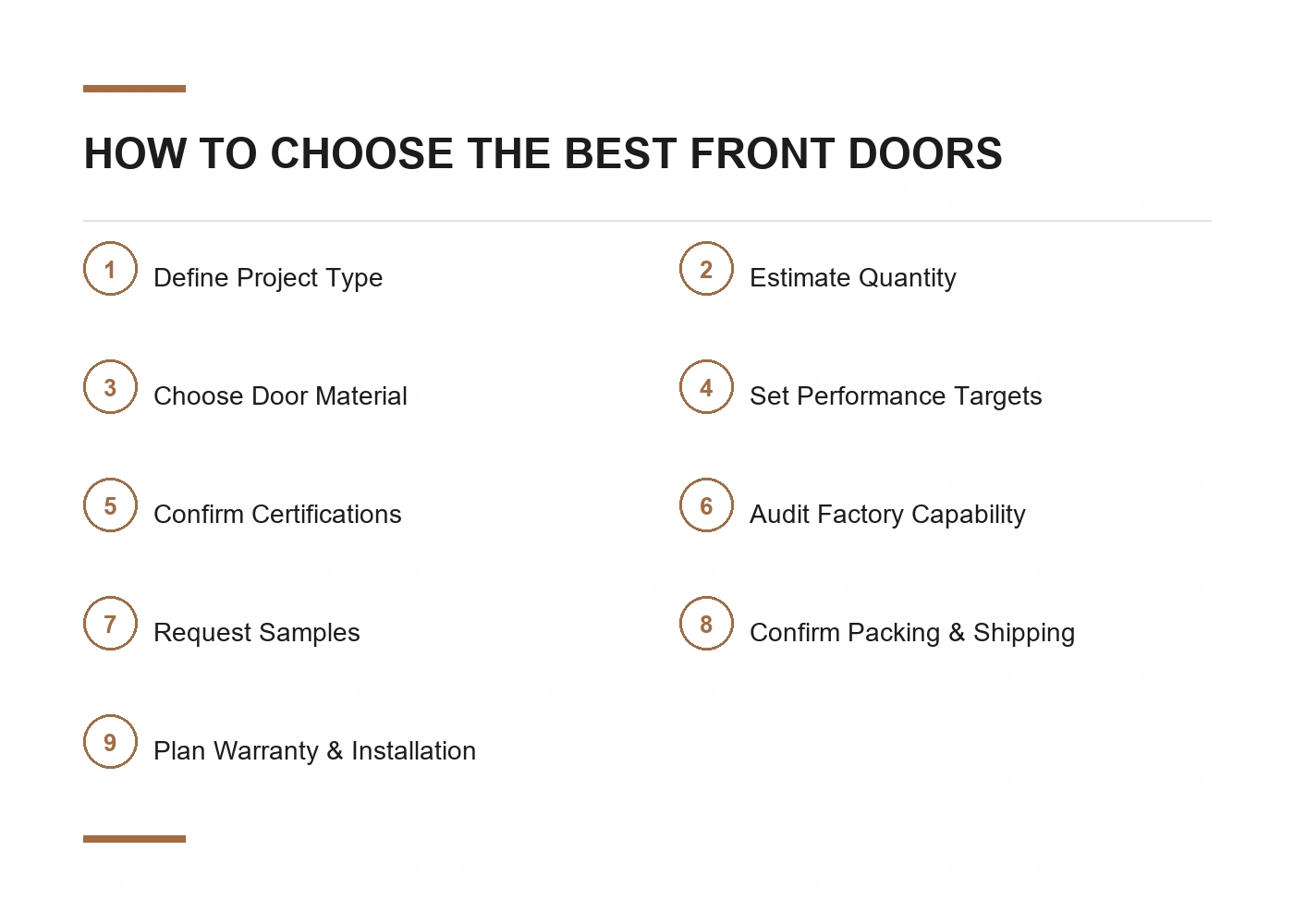
- Define the project type. Single-family, multi-family, hotel, villa, commercial or replacement.
- Estimate volume and frequency. One-time or recurring program? This affects MOQ and lead time.
- Choose the material — wood, engineered wood, fiberglass, steel or aluminum by climate and budget.
- Set performance targets. U-factor, SHGC, air/water/wind ratings, security grade, acoustic needs.
- Confirm certification. NFRC, CE/EN 14351-1, AS, fire rating or other local compliance before quoting.
- Audit factory capability. Production area, capacity, QC, in-house testing, R&D, export experience (see scorecard above).
- Request samples and test reports. Compare finish, color, glass, hardware action, packing quality.
- Confirm Incoterms, packing and shipping. FOB/CIF/DDP; crate, pallet, corner protection, container loading plan.
- Plan installation, warranty and spare parts. Shop drawings, installation guide, hardware schedule, written warranty.
What Actually Makes an Exterior Door Fail (Inspect These Before You Buy)
After 20 years of warranty claims, exterior doors almost never fail in the middle of the panel — they fail at six points. A brand’s willingness to speak to these is a quality signal:
- The bottom rail. The #1 failure point — water wicks up end grain. Demand a factory-sealed bottom edge (aluminum or composite cap).
- The stiles. One-piece solid stiles will move. Finger-jointed, laminated (3–5 ply) stiles are the single most important construction upgrade.
- The lock block. Must be solid hardwood, min 8″ × 20″, dead-center of latch height.
- The glass seal. Door IGU units see more vibration than windows — look for warm-edge spacers and a dual seal (PIB + silicone).
- The sill & threshold. Adjustable composite sill with a sill pan is the difference between a dry floor and a $9,000 subfloor repair.
- The finish. Exterior wood needs 6–8 coats of UV-resistant, high-solids system — ask for the dry film thickness (DFT); premium runs 120–180 microns. Most suppliers have never been asked.
Frequently Asked Questions
What are the best exterior door brands in 2026? For cold climates and energy efficiency, Therma-Tru and Pella fiberglass lead. For commercial/budget security, Masonite and JELD-WEN steel. For premium residential and architectural work, Simpson, TruStile, Marvin — and factory-direct custom wood/aluminum from JUSEN, typically 40–60% below domestic at equal spec.
Which exterior door material is the most secure? Security depends more on the complete system than the skin. A wood or fiberglass door with a 3-point multipoint lock, hardwood lock block, reinforced strike plate and 3″ screws into framing is more secure than a steel door with a basic deadbolt.
What U-factor should an exterior door have? 0.25 or lower for mixed climates, 0.20 or lower for cold climates. ENERGY STAR for opaque doors generally requires 0.17 or less. Always request the NFRC-certified figure.
How much do exterior doors cost in 2026? Installed: $700–$1,700 basic steel, $1,500–$3,500 mid fiberglass, $2,800–$7,000 solid wood, $8,000–$25,000 oversized pivot or double-door systems. FOB China reference: engineered-core wood $150–$280, solid hardwood $260–$520 per set.
Should I buy from a manufacturer or a trading company? For container/volume orders, deal directly with a manufacturer — verify production capacity, QC process, third-party test reports, export packing and written warranty. Use the factory audit scorecard above.
Can I import exterior doors directly? Yes — standard practice for distributors and developers. Expect a 50-set MOQ, 25–35 days production plus ocean transit. Verify HTS 4418 duty, CARB/TSCA Title VI for composites, ISPM-15 packaging, and insist on pre-shipment inspection.
Do exterior doors add resale value? Yes — entry-door replacement consistently ranks among the highest cost-recouped remodeling projects in U.S. Cost vs. Value research, frequently returning close to or above 100% of project cost.
Final Verdict & How to Get a Quote
The best exterior door brands in 2026 combine material expertise with manufacturing precision. For most projects, fiberglass from Therma-Tru or Masonite offers the safest balance of performance and value. For cold climates, prioritize U-factor and air-tightness data over brand reputation. For custom architectural work and volume procurement, factory-direct manufacturers like JUSEN win on pricing, customization and landed cost.
JUSEN produces every door to order with full customization on size, color, glass and hardware; pre-shipment inspection includes air-tightness, water-tightness and wind-resistance testing per batch; adjustable profile structures comply with local building codes across markets. Factory-direct pricing, full customs documentation, flexible FCL/LCL shipping.
Talk to a door engineer, not a salesperson. Send your drawing, spec or photo — we return a technical feasibility review and quotation within 24 hours.
Request a Quote on WhatsApp · Contact Form · Download Catalog · Browse Exterior Door Collection
Related: Solid Wood vs Engineered Wood · How to Measure a Rough Opening · Importing Wooden Doors from China · Best Front Doors 2026
Disclosure: JUSEN manufactures wooden and wood-composite doors. Brand comparisons reflect publicly available positioning and are not sponsored. Prices are indicative 2026 estimates and vary by region, specification and order volume. Always verify duty rates, building codes and certifications for your jurisdiction.