Content Menu
● 1. What Is a Wooden Door with Design?
● 2. How Door Construction Affects Design Options
● 3. What Quality Indicators Matter for Wooden Doors?
● 4. How to Evaluate Wooden Door Suppliers
● 5. Industry Standards and Certifications for Wooden Doors
● 6. Glass in Wooden Doors: Design Trends and Trade-offs
● 7. Production Process: From Raw Material to Finished Door
● 8. Customization and OEM/ODM Options for Wooden Door Buyers
● 9. Ordering Process: MOQ, Lead Time, and Shipping
● 10. How Jusen Door and Windows Manufacturing Co., Ltd. Meets These Standards
9 min read
The first container shipment is where most wooden door projects hit their first real test. The samples looked perfect in the showroom. The question is whether the factory can replicate that finish across 200 units, maintain consistent dimensions, and deliver on the date promised. Buyers who understand how wooden doors are actually manufactured—not just how they look—make better sourcing decisions.
This article covers what defines a well-executed wooden door with design, the technical specifications that separate premium manufacturing from commodity production, and how to evaluate suppliers before committing to a bulk order.
What Is a Wooden Door with Design?
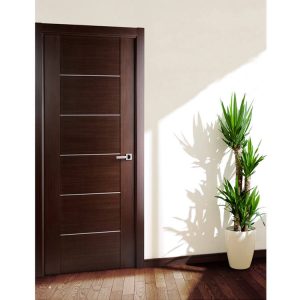
A wooden door with design refers to a door that combines structural function with intentional aesthetic features—panel configurations, glass integration, surface finishes, or hardware details that go beyond a plain flush slab. The “design” element can range from a recessed panel layout to full-height glass sidelites with decorative muntins.
For B2B buyers, the term covers a broad spectrum: stile-and-rail entry doors, interior doors with glass lites, custom-sized villa doors, and commercial doors that need to meet both aesthetic and performance requirements. The manufacturing approach—solid wood, engineered core, or hollow construction—determines how much design flexibility is possible without compromising durability.
How Door Construction Affects Design Options
The core construction of a wooden door determines what design features are structurally possible. There are three primary construction methods:
| Construction Type | Design Flexibility | Dimensional Stability | Typical Use |
|---|---|---|---|
| Solid wood | High—can be carved, routed, shaped | Moderate—prone to seasonal movement | Premium residential, heritage projects |
| Engineered core (LVL, HDF, blockboard) | High—stable substrate for veneers | High—minimal warping | Most export projects, commercial |
| Hollow core with stile-and-rail | Medium—limited to framed designs | Medium—lighter weight | Interior doors, budget projects |
Engineered cores have become the industry standard for export-oriented production. A veneered engineered door offers the appearance of solid wood at lower cost, with better resistance to warping—especially important when doors travel across climate zones in a shipping container.
Wood species selection also affects design execution. Oak and walnut provide distinct grain patterns that work well with clear finishes. Rubberwood and pine offer cost-effective substrates for painted or laminated surfaces. Sapele and mahogany provide the deep tones architects often specify for entry statements.
What Quality Indicators Matter for Wooden Doors?
Moisture content is the most critical quality parameter. Wood that leaves the factory with moisture above 12% will continue to move after installation, causing warping, cracking, or finish failure. Reputable manufacturers kiln-dry lumber to 8–12% for interior doors and lower for exterior applications.
Finish quality separates professional manufacturing from workshop production. A proper lacquer or PU finish involves multiple coats—typically a sealer, color coat, and protective topcoat—with sanding between stages. UV-resistant finishes are essential for exterior doors exposed to direct sunlight.
For glass-integrated doors, the glazing method matters. Screw-fixed beads allow glass replacement without replacing the entire door. Glued-in glass offers a cleaner look but makes future replacement labor-intensive. Buyers managing multi-unit properties should specify removable beads to reduce long-term maintenance costs.
How to Evaluate Wooden Door Suppliers
Supplier evaluation requires looking beyond samples and price quotes. A structured assessment covers four areas:
Manufacturing capability. What equipment does the factory operate? CNC routing centers produce precise panel profiles and consistent joinery. Automated sanding lines ensure uniform surface preparation. A factory with in-house glass processing has better control over lead times than one that outsources.
Export experience. Has the supplier shipped to your market before? Documentation matters—packing lists, proforma invoices, certificates of origin, and customs declarations must be accurate. A supplier familiar with your destination port can anticipate documentation requirements.
Quality control processes. Ask about inspection protocols. A pre-shipment inspection following AQL (Acceptable Quality Limit) sampling—typically 2.5 for major defects, 4.0 for minor—provides a statistical basis for accepting or rejecting a batch.
Production capacity. Monthly output in units tells you whether the factory can handle your order volume. A factory producing 5,000 doors per month has different capacity constraints than one producing 20,000.
Questions to Ask Before Ordering
- What is the moisture content of the timber at the time of production?
- Can you provide a pre-production sample for approval before bulk manufacturing?
- What is your AQL inspection standard for final random inspection?
- Are glass panels tempered or laminated? What thickness?
- What is your production lead time for a 40-foot container?
- Can you provide the packing list and customs documents required for my destination port?
- What is your MOQ for custom sizes and finishes?
Red Flags to Avoid
- Unwillingness to provide test reports or material certifications
- Vague answers about production lead times
- No clear policy on sample costs or sample lead time
- Inability to explain their quality control process in specific terms
- Prices significantly below market rates—usually indicates material substitution or skipped QC steps
Industry Standards and Certifications for Wooden Doors
Wooden doors for international projects typically reference one or more of these standards:
- ASTM E737 — Standard specification for pre-hung doors (North America)
- EN 14351-1 — European standard for windows and pedestrian doors
- GB/T 29498 — Chinese national standard for wood doors
- ANSI/WDMA I.S. 6A — American architectural door standard
Fire-rated doors add another layer. A 30-minute or 60-minute fire door requires not just a thicker slab but specific frame construction, intumescent seals, and certified hardware. The design must accommodate these components without compromising aesthetics.
Buildings in hurricane-prone regions also require impact-rated doors, tested for windborne debris resistance. These doors typically use laminated glass and reinforced frames—design features that must be engineered from the start, not retrofitted.
Glass in Wooden Doors: Design Trends and Trade-offs
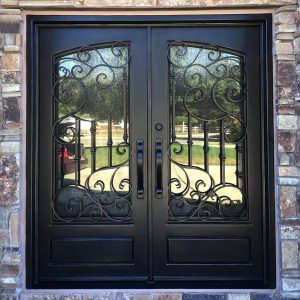
Glass integration is the most requested design feature in contemporary wooden doors. Natural light transmission, visual openness, and the architectural trend toward indoor-outdoor connectivity drive this demand. But glass compromises insulation and privacy.
The performance trade-off can be managed. Double-glazed units with low-E coatings reduce heat transfer. Laminated glass provides security and meets impact ratings. Frosted or patterned glass offers privacy without sacrificing light. The design solution depends on the door’s location and function.
Cost increases with glass area and glass type. A wooden door with standard tempered glass typically costs 20–50% more than a solid door of the same size and species. Insulated or decorative glass adds more. For budget-conscious projects, value engineering means using glass only where it matters—a narrow sidelite or top lite rather than a full-glass panel.
Production Process: From Raw Material to Finished Door
Understanding the production sequence helps buyers appreciate why lead times and quality standards vary between factories.
- Timber selection and conditioning — Lumber is inspected for defects, then kiln-dried to target moisture content.
- Core preparation — Engineered cores are cut to size and checked for flatness.
- Veneer application — Veneer sheets are matched for grain consistency and applied with adhesive under pressure.
- CNC machining — Panel profiles, grooves, and cutouts for glass or hardware are routed with precision.
- Sandling and surface preparation — Multiple sanding passes create a smooth substrate for finishing.
- Finishing — Sealer, color coats, and topcoats are applied in controlled environments.
- Glass and hardware installation — Glazing beads, hinges, and locksets are fitted.
- Final inspection — Each door is checked against the approved sample and quality standards.
- Packaging — Doors are wrapped, crated, or boxed for sea freight.
The drying and conditioning stages are non-negotiable. A factory that skips proper conditioning to meet a tight deadline is shipping problems to your job site.
Customization and OEM/ODM Options for Wooden Door Buyers
Customization in the B2B context means more than choosing a color. It includes:
- Dimension customization — Oversized doors for double-height entrances, non-standard widths for renovations
- Configuration — Double doors, French doors, pocket doors, bi-fold systems
- Finish matching — RAL color matching, custom stain colors, texture replication
- Glass options — Tempered, laminated, insulated, decorative patterns
- Hardware specifications — Hinges, handles, locksets, smart locking integration
OEM (Original Equipment Manufacturing) means producing doors to the buyer’s specifications without the buyer’s brand. ODM (Original Design Manufacturing) means the factory provides the design and the buyer brands it. Both models are standard practice in the industry.
Ordering Process: MOQ, Lead Time, and Shipping
Most factories require a minimum order quantity of 20–50 units for custom designs. Smaller orders are sometimes accepted for samples or prototypes, but the unit cost will be higher.
Production lead time for a 40-foot container typically ranges from 25 to 40 days, depending on order complexity. Sea freight adds 20–40 days depending on the destination port. Buyers should request a written production schedule before confirming an order.
Shipping options include FCL (Full Container Load) and LCL (Less than Container Load). FCL is more cost-effective for large orders—typically 60–100 doors per container depending on size and packaging. LCL works for smaller orders but carries higher per-unit freight costs and longer transit times due to consolidation.
How Jusen Door and Windows Manufacturing Co., Ltd. Meets These Standards
As a manufacturing facility, our approach to wooden doors with design is defined by the same standards discussed above. We produce custom wooden doors per architectural drawings or client specifications—covering size, color, glass type, and hardware accessories. OEM and ODM projects are our standard workflow, not an exception.
Quality control follows industry protocols. Every order undergoes pre-shipment inspection, including air-tightness, water-tightness, and wind resistance tests where applicable. We follow international AQL sampling methods and provide test reports with the shipment.
Our export experience means buyers receive complete documentation—packing lists, proforma invoices, and full customs paperwork. We ship both FCL and LCL directly from our China factory. Profile structures and fittings can be adjusted to match local building codes in your target market.
Because we are a manufacturing facility with no middleman markup, our pricing reflects factory-direct economics. When you source custom-designed doors in bulk, that difference matters.
Contact Our Team to discuss your project requirements and request a quotation.
—
What color door means your house is paid off?
In design circles, a bold-colored front door—often red, blue, or black—is informally associated with a fully paid-off home. It is a stylistic signal of pride in ownership, not a technical standard. For B2B buyers, color choice is more relevant for brand identity or architectural cohesion than property status.
Can we replace glass only on a wooden door?
Yes, if the door uses a removable glazing bead or screw-fixed stops. The glass panel can be replaced without replacing the entire door—common for damage repair or upgrading to energy-efficient glazing. When specifying doors, ask whether the design allows glass-only replacement. It reduces long-term maintenance costs for property managers.
Why are some wooden doors filled with glass?
Glass provides natural light, visual openness, and architectural aesthetics. Large panels are common in entryways, patios, and interior partitions. The trade-off is reduced insulation and privacy, mitigated with double glazing, low-E coatings, or frosted glass.
How expensive is a glass door?
A wooden door with glass typically costs 20–50% more than a solid door of the same size and species. A $200 solid door may cost $240–$300 with standard tempered glass, more with premium glazing. Bulk B2B pricing depends on volume, glass type, and design complexity.
What is the typical MOQ for custom-designed wooden doors?
Most factories require 20–50 units for custom designs. Some accept smaller sample orders. MOQ varies with design complexity, material availability, and production setup costs. Confirm MOQ and sample policy before engaging a supplier.
How long does production and shipping take for bulk wooden door orders?
Typical production is 25–40 days for a 40-foot container. Sea freight adds 20–40 days depending on destination. A reliable supplier provides a written production schedule and shipping timeline before order confirmation.
Can a factory match local building codes for wooden doors?
Reputable export-oriented factories adjust profile structures, glazing, fire ratings, and hardware to comply with target market codes—ASTM in North America, EN in Europe. Request compliance documentation and test reports before production.
References
- ASTM International. “ASTM E737 — Standard Specification for Pre-Hung Doors.” https://www.astm.org/e0737-22.html
- European Committee for Standardization. “EN 14351-1 — Windows and Doors.” https://standards.cencenelec.eu/
- ANSI/WDMA. “I.S. 6A — Architectural Door Standard.” https://www.wdma.com/
- National Wood Flooring Association. “Moisture Content Guidelines for Wood Products.” https://www.nwfa.org/