Content Menu
● 1. Understanding Modern Style Exterior Doors: Types and Applications
● 2. Modern Style Exterior Doors Quality and Performance Factors
● 3. How to Evaluate Modern Style Exterior Doors Suppliers
● 4. Key Quality Indicators for Modern Style Exterior Doors Buyers
● 5. Relevant Industry Standards and Certifications
● 6. Production Process: From Raw Material to Finished Door
● 7. Quality Control: A Multi-Stage Inspection Approach
● 8. Customization and OEM/ODM Options
● 9. Ordering Process: MOQ, Lead Time, and Shipping
10 min read
A contractor in Chicago once ordered forty modern exterior doors for a townhouse project. The samples looked perfect. The shipment arrived with frames that didn’t match the local wind-load requirements. The entire install was delayed by six weeks. That is the gap between looking at a door and specifying one correctly.
This guide covers what B2B buyers need to know about modern style exterior doors—from material science and performance testing to supplier verification and logistics. The goal is to give you a framework that prevents the Chicago scenario from happening to you.
Understanding Modern Style Exterior Doors: Types and Applications
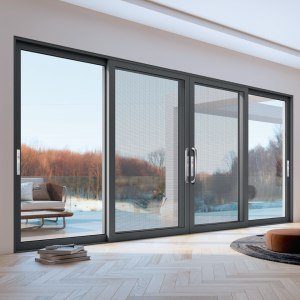
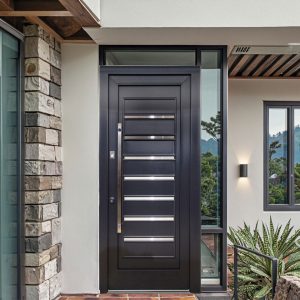
Modern style exterior doors are defined by clean lines, flush surfaces, concealed hardware, and an emphasis on glass area over ornamentation. They serve a different architectural purpose than traditional paneled doors. They are designed to make a visual statement through proportion and material honesty.
The current market splits into three dominant material categories, each with distinct performance profiles.
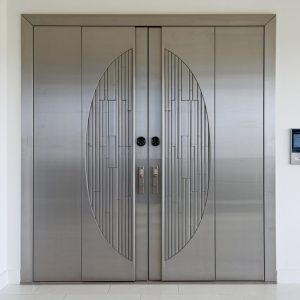
Aluminum Alloy Doors: These use thermal-break profiles—two aluminum extrusions separated by a polyamide strip. This design interrupts the thermal bridge, improving insulation significantly. Aluminum allows for the slimmest sightlines, which architects prefer for maximizing glass area. They are the standard choice for system windows and casement doors in commercial and high-end residential projects.
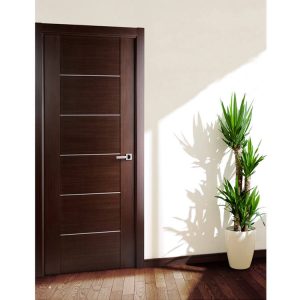
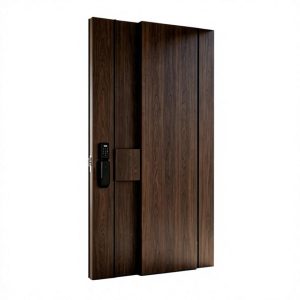
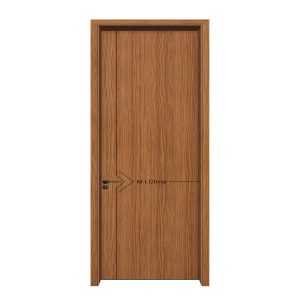
Solid Wood Doors: Wood offers natural insulation and a premium aesthetic that aluminum cannot replicate. Modern configurations include multi-horizontal plank designs and flush slabs with hidden grain patterns. The trade-off is maintenance. Wood expands and contracts with humidity, requiring proper sealing and periodic refinishing.
Fiberglass Doors: These mimic wood grain but offer superior dimensional stability. They do not warp, rot, or dent as readily as wood. Fiberglass doors with polyurethane foam cores achieve excellent R-values, making them a strong choice for extreme climates.
The application determines the material. A coastal villa with salt air exposure needs aluminum or fiberglass. A luxury residence where the entry door is the focal point of the facade justifies solid wood.
Modern Style Exterior Doors Quality and Performance Factors
A door’s visual design matters only after its structural performance is verified. For modern doors with large glass panels, the engineering demands increase significantly.
Air, Water, and Wind Resistance
The three critical performance metrics are air-tightness, water-tightness, and wind-load resistance. These are tested under controlled conditions, typically referencing standards like ASTM E283 (air leakage), ASTM E547 (water penetration), and ASTM E330 (wind load).
A door with a large single pane of glass is essentially a structural element. The frame must transfer wind loads to the surrounding wall. The seals must prevent water from being driven through the joints during storms. Buyers should request test reports for every product line, not just the standard configurations.
Thermal Performance and Energy Codes
Energy codes are tightening globally. The U-value (thermal transmittance) of a door assembly matters for building compliance. Thermal-break aluminum profiles achieve U-values between 2.0 and 3.5 W/m²K depending on glass specifications. Solid wood doors with proper weatherstripping perform comparably.
Glass selection is the largest variable. Double-glazed units with Low-E coatings are now standard. Triple glazing is common in northern climates. The spacer material between glass panes also affects the U-value—warm-edge spacers reduce heat loss at the glass edge.
Hardware and Structural Integrity
Modern exterior doors are heavy. A 1-3/4-inch thick solid wood door with a full-view glass lite can weigh over 150 pounds. Standard residential hinges are inadequate. Buyers should specify heavy-duty hinges rated for the door’s actual weight.
Concealed hinges are a defining feature of modern doors. They require precise alignment and must be rated for continuous use. Smart locks are increasingly integrated, which means the door must accommodate wiring or battery compartments without compromising the clean aesthetic.
How to Evaluate Modern Style Exterior Doors Suppliers
Supplier evaluation requires more than checking reviews. A visit to the factory is ideal, but for most international buyers, a structured remote audit works. The following framework applies.
Checklist for Supplier Verification
- Manufacturing capability: Does the supplier cast, extrude, or machine its own profiles? Or do they assemble components from other factories? Integrated manufacturers control quality better.
- Customization flexibility: Can they adjust profile structures to match your local building codes? This is critical for wind-load requirements that vary by region.
- Testing equipment: Does the factory have on-site testing for air-tightness and water-tightness? Or do they send samples to an external lab? On-site testing suggests faster iteration.
- Export documentation: Can they provide packing lists, proforma invoices, and full customs documentation? Missing paperwork causes port delays.
- Production capacity: What is their monthly output? Can they scale for a construction project that requires 500 doors in one shipment?
Red Flags to Avoid
- No test reports: Any supplier that cannot provide third-party performance data is a risk.
- Fixed sizes only: A supplier that refuses custom dimensions cannot handle most modern architectural specifications.
- Vague lead times: If they cannot commit to a production schedule in writing, expect delays.
- Middlemen: Trading companies add cost and dilute quality control. Factory-direct sourcing eliminates the markup and the communication gap.
Decision Guide: Choose A if… Choose B if…
Choose a factory-direct manufacturer if: You need customizable products, competitive pricing for bulk orders, and direct communication with the production team.
Choose a local distributor if: You need doors immediately, cannot manage international logistics, or require a local warranty service provider.
Key Quality Indicators for Modern Style Exterior Doors Buyers
Beyond the test reports, several indicators signal manufacturing quality.
Profile wall thickness: For aluminum doors, the main frame profile should be at least 1.4mm thick, and 2.0mm or more for commercial applications. Thinner profiles flex under load.
Surface treatment: Powder coating should be at least 60 microns thick. Anodizing is an alternative for coastal environments. Check for uniform coverage, especially at corners and cut edges.
Weatherstripping: Quality doors use EPDM or silicone seals, not PVC. The seals should be continuous or properly cornered, not butt-jointed.
Glass specifications: Verify the glass brand and type. Tempered or laminated glass is mandatory for safety. Check the spacer type and whether the unit is filled with argon gas.
Hardware brand: Ask which hardware brands the supplier uses. Reputable suppliers use established brands like Hoppe, Siegenia, or equivalent. Some offer hardware customization to match your project requirements.
Relevant Industry Standards and Certifications
Understanding the standards landscape helps you specify the right product and verify supplier claims.
| Standard | Focus | Region |
|---|---|---|
| ASTM E283 | Air leakage | North America |
| ASTM E547 | Water penetration | North America |
| ASTM E330 | Wind load | North America |
| EN 1026 | Air permeability | Europe |
| EN 1027 | Water tightness | Europe |
| EN 12211 | Wind resistance | Europe |
| NFRC U-Factor | Thermal performance | North America |
Buyers should ask which standards the supplier tests against and request copies of the reports. The standards may be adjusted based on your target market—what passes in California may not meet Florida’s high-velocity hurricane zone requirements.
Production Process: From Raw Material to Finished Door
Understanding the manufacturing process helps you evaluate lead times and quality risks.
For aluminum doors: The process begins with profile extrusion—billets of aluminum alloy are heated and forced through a die. The extruded profiles are cut to length, then processed through CNC machining for drainage holes, hardware slots, and corner cuts. Thermal-break strips are inserted, and the profiles are assembled into frames. Glass is cut, edged, and tempered. The unit is assembled, weatherstripping is applied, and the door undergoes final adjustment.
For solid wood doors: The process starts with lumber selection and kiln drying to reduce moisture content to 8-12%. The wood is milled into stiles and rails, joined, and laminated. The door is sanded, stained, and sealed. Glass openings are routed, and the lite is installed with glazing beads.
For fiberglass doors: The process uses a compression molding technique where fiberglass mat is pressed with resin into a door skin. The skins are bonded to a composite frame and filled with foam insulation.
Quality control happens at each stage, but the final inspection is the most critical. The door must be checked for squareness, hardware alignment, and weatherstrip continuity.
Quality Control: A Multi-Stage Inspection Approach
For a factory-direct manufacturer, quality control is the backbone of the operation. The approach should cover every stage from raw material to finished product.
Raw material inspection: Incoming aluminum profiles, wood, and glass are checked against specifications. This prevents defects from entering the production line.
In-process inspection: During assembly, technicians check dimensions, profile alignment, and hardware installation. This is where issues like misaligned hinges or uneven gaps are caught.
Pre-shipment inspection: This is the final gate. Every door undergoes a functional test—opening and closing, lock operation, and seal integrity. For larger orders, samples are pulled for air-tightness, water-tightness, and wind resistance testing.
Buyers should request the pre-shipment inspection report. A supplier that performs this test on every order, not just on request, demonstrates a consistent quality culture.
Customization and OEM/ODM Options
Modern architectural projects rarely use off-the-shelf dimensions. Customization is not a luxury—it is a requirement.
Full customization means the supplier can adjust size, color, glass type, and hardware accessories to your specifications. The best manufacturers also offer OEM (Original Equipment Manufacturing) services where they produce doors under your brand name. This works well for distributors who want to build a product line without investing in their own factory.
ODM (Original Design Manufacturing) takes it further. The supplier designs the product based on your requirements and handles the manufacturing. This is ideal for architects with specific design concepts that need engineering expertise to execute.
The key question is whether the supplier’s production line can handle your specific requirements without disrupting their standard workflow. Ask for examples of custom projects they have completed.
Ordering Process: MOQ, Lead Time, and Shipping
Understanding the ordering process prevents surprises later. Here is what to expect from a professional factory-direct supplier.
MOQ (Minimum Order Quantity): Factory-direct manufacturers typically have lower MOQs than trading companies because they control the production process. Standard MOQs may be 50-100 units per size. For OEM projects with custom branding, the MOQ may be higher.
Lead time: Production typically takes 2-4 weeks after order confirmation and sample approval. Custom sizes or complex glass configurations may take longer. Shipping adds another 2-5 weeks depending on your destination port.
Shipping: FCL (Full Container Load) is the most efficient for bulk orders. LCL (Less than Container Load) works for smaller quantities but costs more per unit. A reliable supplier will help you calculate the most cost-effective shipping method based on your order volume.
Documentation: Full customs documentation is non-negotiable. This includes the packing list, proforma invoice, bill of lading, and any certificates of origin required by your country. A supplier with foreign trade experience handles this without errors.
Payment terms: Typical terms are 30% deposit and 70% before shipment, or an irrevocable Letter of Credit for larger orders. Be wary of suppliers demanding 100% payment upfront.
How We Meet These Standards as a Manufacturer
The industry standards discussed above are not theoretical—they are the benchmarks we build to every day. As a factory-direct manufacturer, our approach is straightforward: we design our production process around the requirements of international buyers.
Adjustable Manufacturing for Local Building Codes
Here is how the industry works: many suppliers offer fixed dimensions and standard profiles. If the local building code requires a higher wind-load rating or a different thermal performance, the buyer is left to find another supplier or compromise on quality.
Here is how we meet these standards: our profile structures and fittings are adjustable to match the building codes of your target market. If your project requires a specific U-value or wind-resistance rating, we can modify the profile design, glass specification, and hardware to meet that requirement. This saves you the cost of custom engineering or the risk of failing local inspections.
Customization and Private Label Capabilities
We support full customization on size, color, glass, and hardware accessories. For distributors looking to build a private label, we adapt our production lines to your drawings and brand specifications. For contractors needing specific lite patterns—whether a single vertical lite or a multi-horizontal plank design—we can execute those configurations without quality compromise.
Our OEM and ODM services are built for B2B buyers who need consistent quality at scale, not one-off prototypes.
Logistics and Documentation Support
We handle both FCL and LCL shipments directly from our factory in China. Our foreign trade team provides all necessary paperwork—packing lists, proforma invoices, and full customs documents—to ensure smooth clearance at your port. We have the experience to navigate export procedures that might otherwise delay your project.
Pre-Shipment Quality Assurance
Before any container leaves our facility, every door undergoes inspection. Our pre-shipment checks include air-tightness, water-tightness, and wind resistance testing. This is not a marketing claim—it is a procedure we follow on every order to protect our clients from receiving substandard products.
If you are sourcing for a construction project, a distributor line, or a custom villa, the right supplier is the one that matches your technical requirements, not just your budget.
References
- ASTM International. “Standard Test Method for Determining Rate of Air Leakage Through Exterior Windows, Skylights, Curtain Walls, and Doors.” https://www.astm.org/e0283-19.html“>https://www.astm.org/e0283-19.html
- ASTM International. “Standard Test Method for Water Penetration of Exterior Windows, Skylights, Doors, and Curtain Walls by Uniform Static Air Pressure Difference.” https://www.astm.org/e0547-21.html“>https://www.astm.org/e0547-21.html
- NFRC. “Understanding U-Factors and R-Values.” https://www.nfrc.org/window-types/“>https://www.nfrc.org/window-types/
- European Committee for Standardization. “EN 1026: Windows and doors—Air permeability—Test method.” https://www.en-standard.eu/“>https://www.en-standard.eu/
- American Architectural Manufacturers Association. “AAMA/WDMA/CSA 101/I.S.2/A440: Standard Specification for Windows, Doors, and Unit Skylights.” https://www.aamanet.org/“>https://www.aamanet.org/
https://doorwoodendoors.com/contact-us/” style=”display:inline-block;padding:12px 24px;background:#2563eb;color:#fff;text-decoration:none;border-radius:6px;font-weight:600″>Get a Free Quote