Content Menu
● 1. 1. Understanding House Glass Doors: Types and Applications
● 2. 2. Glass Selection for House Glass Doors: Technical Considerations
● 3. 3. Frame Materials: Aluminum, Steel, and Wood
● 4. 4. Performance Standards and Testing for Residential Doors
● 5. 5. Customization Options for House Glass Doors
● 6. 6. How to Evaluate House Glass Doors Suppliers
● 7. 7. Production Process: From Raw Material to Finished House Glass Doors
● 8. 8. Quality Control: Our Multi-Stage Inspection Process
● 9. 9. Customization and OEM/ODM Options
● 10. 10. Ordering Process: MOQ, Lead Time, and Shipping
● 11. 11. How We Meet These Standards: Factory-Direct Supply and Custom Manufacturing
14 min read
A contractor once rejected a shipment of sliding doors because the U-value didn’t match the spec sheet. The doors looked perfect, but the numbers were off by 0.3 W/m²K, and the building inspector wouldn’t sign off. That discrepancy cost the distributor two weeks and a penalty clause.
That story explains why this guide exists. House glass doors are engineered assemblies that must meet thermal, structural, and safety requirements across different climate zones. For B2B buyers — contractors, architects, distributors, and developers — selection involves understanding glass specifications, frame construction, performance testing, and supplier verification.
1. Understanding House Glass Doors: Types and Applications
House glass doors are door systems using glass as the primary panel material, framed in aluminum, wood, or steel. They serve as functional access points and architectural features that bring natural light into living spaces.
1.1 Sliding Glass Doors
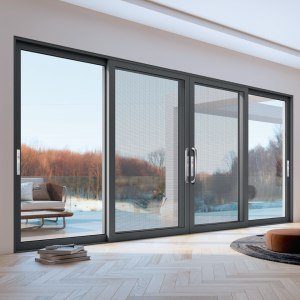
Sliding glass doors operate on track systems with two to six panels moving horizontally. This is the most space-efficient option for residential projects because no swing radius is required.
Key specifications to evaluate:
- Track system: Aluminum tracks with nylon or stainless steel rollers. Roller quality determines smoothness and lifespan.
- Panel weight capacity: Standard systems handle 80–150 kg per panel. Heavy-duty systems go up to 200 kg.
- Weather sealing: Dual or triple weatherstripping with brush seals and EPDM gaskets.
- Threshold design: Low-threshold options (20–30 mm) improve accessibility but require careful drainage engineering.
Sliding doors suit high-traffic openings where floor space matters — patios, terraces, and balconies.
1.2 French and Hinged Glass Doors
French doors feature two hinged leaves that swing inward or outward. Full-height glass panels with narrow stiles maximize the view while maintaining a classic aesthetic.
Technical considerations:
- Hinge load capacity: Each hinge must support the full leaf weight. For glass-heavy doors, use three hinges per leaf with reinforced mounting plates.
- Frame depth: Deeper frames (70–90 mm for aluminum) provide better thermal performance but reduce the glass area.
- Glass-to-frame ratio: High ratios (80%+ glass) create a premium look but increase structural demands on the frame.
French doors fit formal living rooms, studies, and transitions between indoor and outdoor spaces.
1.3 Folding and Multi-Slide Glass Doors
Folding doors (bi-fold) and multi-slide systems stack panels to one side, opening an entire wall. Multi-slide systems use parallel tracks that allow panels to tuck behind each other without folding.
Critical specifications:
- Panel count: Systems range from 3 to 12 panels. More panels require more complex hardware.
- Folding hardware: Stainless steel hinges and rollers rated for 80–120 kg per panel.
- Corner support: Corner posts or mullions must handle structural loads from two directions.
- Stack space: Folding doors need wall space to park stacked panels; multi-slide systems need track length.
These systems dominate luxury villa projects where indoor-outdoor flow is the central architectural concept.
1.4 Full-Glass Pivot and Entry Doors
Pivot doors rotate on a vertical axis rather than hinged on the side. This allows much wider panels — up to 1,500 mm or more — with minimal framing.
Key technical points:
- Pivot hinge mechanism: Floor-mounted pivot sets with adjustable bearings. Must be rated for the door’s weight and frequency of use.
- Glass thickness: Typically 10–12 mm tempered glass for safety and rigidity.
- Wind load resistance: Large pivot doors act as sails in wind. Structural calculations must account for local wind zones.
Pivot doors make statement entrances for high-end residential projects, though they are not the most practical for high-traffic family homes.
2. Glass Selection for House Glass Doors: Technical Considerations
The glass is the most technically complex component of the entire door system. Specifying the wrong glass can lead to thermal failures, safety violations, or premature seal failure.
2.1 Tempered vs. Laminated Glass
Tempered glass undergoes heat treatment that makes it 4–5 times stronger than annealed glass. When broken, it shatters into small, blunt fragments that are less likely to cause injury. Most building codes require tempered glass in door applications.
Laminated glass consists of two or more glass layers bonded with a PVB (polyvinyl butyral) or SGP (SentryGlas Plus) interlayer. When broken, the interlayer holds the glass together, preventing penetration.
| Property | Tempered Glass | Laminated Glass |
|---|---|---|
| Strength | 4–5× annealed | 2–3× annealed (depends on layer count) |
| Break pattern | Small blunt fragments | Held together by interlayer |
| Security | Moderate | High |
| Sound insulation | Standard | Improved (interlayer dampens sound) |
| UV protection | None | PVB blocks ~99% of UV |
| Cost | Lower | Higher |
Tempered glass is the minimum standard. Laminated glass adds security and sound insulation, making it suitable for entry doors and ground-floor openings.
2.2 Insulated Glass Units (IGUs) for Energy Efficiency
Single-pane glass is no longer acceptable for exterior doors in most markets. Insulated glass units combine two or three panes separated by a spacer and sealed to create an insulating air gap.
Key components:
- Low-E coatings: Microscopic metallic layers that reflect heat while transmitting visible light. Low-E coatings can reduce heat loss by 30–50% compared to uncoated glass.
- Gas fills: Argon or krypton gas injected into the air gap reduces heat transfer. Argon is common; krypton offers better performance but costs more.
- Spacer systems: Warm-edge spacers (stainless steel or polymer) reduce heat loss at the glass edge better than conventional aluminum spacers.
Typical U-values for double-glazed IGUs: 1.0–1.6 W/m²K. Triple glazing can reach 0.5–0.8 W/m²K but adds significant weight and cost.
2.3 Tinted, Reflective, and Decorative Glass Options
- Tinted glass (bronze, gray, green): Reduces solar heat gain by absorbing sunlight. Best for warm climates with high cooling loads.
- Reflective glass: A metallic coating reflects solar radiation, reducing glare and heat gain. Provides daytime privacy but can look mirrored from outside.
- Frosted or patterned glass: Sandblasted or acid-etched surfaces provide privacy while transmitting light. Common for bathroom and home office doors.
Farmhouse-style doors often use divided-lite glass — grids or muntins that divide the glass into smaller panes. Modern manufacturing achieves this with decorative grilles between IGU panes, which are easier to clean than true divided lites and offer better thermal performance.
3. Frame Materials: Aluminum, Steel, and Wood
The frame determines the door’s structural integrity, thermal performance, and aesthetic character. Each material has distinct trade-offs.
3.1 Thermal-Break Aluminum Frames
Thermal-break aluminum profiles use a polyamide strip to separate the interior and exterior aluminum sections. This breaks the thermal bridge that would otherwise conduct heat through the frame.
| Property | Thermal-Break Aluminum |
|---|---|
| Strength | High; supports large spans |
| Thermal performance | Good (U-value 1.5–2.5 W/m²K depending on system) |
| Maintenance | Low; powder-coated finish resists corrosion |
| Slim sightlines | Excellent; narrow profiles maximize glass area |
| Cost | Moderate to high |
Thermal-break aluminum is the dominant material for modern residential doors. It handles large sliding and folding configurations that wood or steel cannot match at the same weight.
3.2 Solid Wood Frames
Wood frames offer natural aesthetics and premium feel. But wood has real limitations. Exterior wood doors require regular maintenance — repainting or resealing every few years. High-humidity environments cause warping and swelling unless the wood is properly treated and sealed. For exterior applications, hardwood species (mahogany, oak, meranti) are preferred over softwoods.
Wood frames suit luxury villas, traditional homes, and farmhouse-style projects where authenticity matters more than maintenance convenience.
3.3 Steel and Aluminum-Clad Frames
Steel frames provide the slimmest sightlines of any material system — often just 20–30 mm wide. This creates an industrial-modern aesthetic with maximum glass exposure.
The trade-off is cost and thermal performance. Steel conducts heat readily, so thermal-break steel systems are complex and expensive. Aluminum-clad frames combine a wood interior with an aluminum exterior, offering warmth inside and durability outside.
Choose steel for architectural statement doors where aesthetics justify the premium. Choose aluminum-clad for projects that need wood’s interior look without exterior maintenance.
4. Performance Standards and Testing for Residential Doors
Every house glass door sold into a regulated market must meet documented performance standards. Buyers should know which tests matter and what the numbers mean.
4.1 Air-Tightness, Water-Tightness, and Wind Load Resistance
These three tests form the core of door performance evaluation:
- Air-tightness (EN 12207 / ASTM E283): Measures the volume of air leaking through the closed door under pressure. Classes range from 1 (lowest) to 4 (highest). Class 4 is recommended for residential exterior doors.
- Water-tightness (EN 12208 / ASTM E547): Tests resistance to water penetration under simulated rain and wind. Classes range from 1A to 9A. Higher classes matter for exposed locations.
- Wind load resistance (EN 12210 / ASTM E330): Tests structural performance under wind pressure. Test pressures are based on building height, location, and local wind zone.
Ask suppliers for test reports that match your project’s requirements.
4.2 Thermal Performance (U-Value and SHGC)
U-value measures heat transfer through the entire door system — glass, frame, and spacers. Lower values indicate better insulation. The relevant standard is EN 10077 or ISO 10077 for windows and doors.
- Cold climates: Target U-values below 1.5 W/m²K. Triple glazing with warm-edge spacers may be necessary.
- Temperate climates: U-values of 1.6–2.0 W/m²K are typical for double-glazed thermal-break systems.
- Warm climates: Focus on SHGC (Solar Heat Gain Coefficient) instead. Lower SHGC (0.25–0.35) reduces cooling loads.
4.3 Hardware Durability and Corrosion Resistance
Hardware is the most failure-prone component of high-use doors. Rollers, hinges, locks, and handles undergo thousands of cycles per year.
Relevant specifications:
- Cycle testing: EN 1191 specifies 10,000 open/close cycles for window and door hardware. Some suppliers test to 20,000 cycles for high-use applications.
- Corrosion resistance: EN 1670 classifies hardware corrosion resistance from 0 (lowest) to 5 (highest). Class 4 or 5 is appropriate for coastal environments.
- Material quality: Stainless steel (grade 304 or 316) for coastal areas; high-grade zinc alloy for interior hardware.
5. Customization Options for House Glass Doors
B2B buyers rarely order standard sizes. Customization is the norm in residential construction, where each project has unique dimensions and design requirements.
5.1 Size and Configuration Customization
- Width and height: Custom dimensions to match architectural drawings. Most manufacturers handle openings from 600 mm to 3,000 mm wide and up to 3,000 mm high.
- Panel configurations: Two-panel sliders, three-panel folding doors, or four-panel multi-slide systems.
- Special configurations: Corner units, pocket doors (panels slide into wall cavities), and curved or angled installations.
5.2 Color and Finish Options
- Aluminum: Powder coating in any RAL color. Anodized finishes offer a metallic look. Wood-grain foil laminates replicate wood appearance on aluminum profiles.
- Wood: Custom stains, paints, and clear finishes. UV-resistant finishes extend exterior durability.
5.3 Glass and Hardware Customization
- Glass: Thickness, tint, coating, and decorative patterns can all be specified.
- Hardware: Handle styles, lock types (multi-point locking systems), and concealed hinges.
- Smart home integration: Motorized operation, sensors, remote control, and integration with home automation systems.
One caution: deeper customization extends lead times and increases cost. Standardize where possible, customize where the project demands it.
6. How to Evaluate House Glass Doors Suppliers
The supplier selection process determines whether your project succeeds or fails. Use a systematic evaluation framework, not first impressions.
6.1 Key Supplier Evaluation Criteria
| Criterion | What to Check | Why It Matters |
|---|---|---|
| Factory-direct capability | Does the supplier own production or resell? | Direct factories eliminate middleman markup and control quality |
| Quality control | In-house testing? Third-party certification? | Documented QC means consistent output |
| Production capacity | Monthly output, number of production lines | Verifies ability to handle bulk orders |
| Export experience | Documentation, shipping, customs handling | Reduces friction in international transactions |
| Communication | Response time, technical knowledge | Indicates reliability during problem resolution |
6.2 Questions to Ask Before Ordering
- What is your monthly production capacity for this product type?
- Can you provide test reports for air-tightness, water-tightness, and wind load?
- What is your standard lead time for custom orders?
- What is your minimum order quantity (MOQ)?
- How do you handle defects discovered after shipment?
- Can you provide references from buyers in my market?
- What is your packaging standard for export shipments?
6.3 Avoid Suppliers Who…
- Cannot provide test reports: Performance claims without documentation are marketing, not facts.
- Quote prices without specifications: A vague quote means hidden costs later.
- Have no export experience: International shipping has specific documentation and packing requirements.
- Refuse pre-shipment inspection: Transparent suppliers welcome third-party or buyer inspections.
- Offer prices far below market rates: Quality has a cost. Unusually low quotes usually mean inferior materials or workmanship.
6.4 Choose A if… Choose B if…
Choose a factory-direct manufacturer if: you need competitive pricing, direct communication, and the ability to customize products to your specifications.
Choose a local distributor if: you need small quantities, immediate availability, or local installation support. The markup is the price of convenience.
7. Production Process: From Raw Material to Finished House Glass Doors
Understanding how house glass doors are manufactured helps buyers evaluate supplier claims and identify quality indicators.
7.1 Aluminum Frame Production
- Profile extrusion: Aluminum billets are heated to approximately 500°C and forced through steel dies to create the desired profile cross-section.
- Cutting: Profiles are cut to precise lengths using CNC saws. Tolerances of ±0.5 mm are standard.
- Machining: Drainage holes, lock grooves, and hardware mounting points are milled or drilled.
- Thermal break insertion: For thermal-break profiles, polyamide strips are inserted and crimped or poured and cured.
- Surface treatment: Powder coating (electrostatic application, cured at 180–200°C), anodizing, or wood-grain foil application.
- Assembly: Frame components are joined with corner connectors, screws, or welding (for steel).
7.2 Glass Processing
- Cutting: Glass sheets are cut to size with diamond-tipped cutters.
- Edge grinding: Edges are ground and polished to remove sharp edges and micro-cracks.
- Tempering: Glass is heated to 600–700°C then rapidly cooled. This creates surface compression that gives tempered glass its strength.
- Lamination (if applicable): PVB or SGP interlayer is placed between glass layers and bonded under heat and pressure.
- IGU assembly: Glass panes are assembled with spacers, desiccant, and sealant. Low-E coatings and gas fills are applied during this step.
7.3 Final Assembly
- Glass panels are fitted into frames with setting blocks and gaskets.
- Hardware (rollers, hinges, locks) is installed and adjusted.
- Weatherstripping is fitted.
- The complete unit undergoes functional testing — opening, closing, locking.
8. Quality Control: Our Multi-Stage Inspection Process
Quality control for house glass doors is not a single checkpoint. It is a continuous process across the production chain.
8.1 Incoming Material Inspection
Raw materials — aluminum profiles, glass, hardware, seals — are inspected upon arrival. Profile dimensions are checked against specifications. Glass is verified for thickness, coating integrity, and edge quality.
8.2 In-Process Inspection
During production, inspectors check:
- Profile cutting accuracy
- Machining precision
- Surface treatment consistency (coating thickness, color matching)
- Assembly alignment and squareness
8.3 Pre-Shipment Inspection
Before every shipment, finished doors undergo:
- Air-tightness testing: Performed on sample units or on request for specific orders.
- Water-tightness testing: Simulated rain and wind conditions.
- Wind load resistance testing: Structural performance under pressure.
- Functional testing: Opening/closing cycles, lock operation, roller smoothness.
- Visual inspection: Glass clarity, frame finish, hardware alignment.
Test documentation is provided with each shipment, giving buyers verifiable evidence of compliance.
9. Customization and OEM/ODM Options
B2B buyers need flexibility. No two projects are identical, and suppliers must accommodate variations in size, design, and performance requirements.
9.1 OEM Partnerships
OEM (Original Equipment Manufacturing) means the supplier produces doors to the buyer’s specifications — dimensions, colors, hardware, and branding. The buyer owns the design and specifications.
OEM suits established brands that have design teams and specific product requirements. The supplier’s role is manufacturing execution.
9.2 ODM Partnerships
ODM (Original Design Manufacturing) means the supplier provides the design and engineering, and the buyer brands the product. The buyer selects from the supplier’s existing product range or requests modifications.
ODM suits buyers entering the market or expanding product lines without investing in design and engineering resources. The supplier handles technical development, testing, and production.
9.3 Private Label
Private label combines OEM or ODM production with the buyer’s branding — logos, packaging, and documentation. This allows distributors to sell products under their own brand without owning production facilities.
10. Ordering Process: MOQ, Lead Time, and Shipping
Clear expectations about ordering prevent misunderstandings.
10.1 Minimum Order Quantity (MOQ)
MOQ varies by product type and customization level. Standard configurations typically have lower MOQs — often 20–50 units. Fully custom orders may require higher MOQs because of tooling and setup costs.
10.2 Lead Times
- Standard configurations: 15–30 days from order confirmation.
- Custom orders: 30–45 days, depending on complexity.
- Large bulk orders: 45–60 days with production scheduling.
Always request a production schedule in writing before confirming an order.
10.3 Shipping Options
| Shipping Method | Best For | Cost | Lead Time |
|---|---|---|---|
| FCL (Full Container Load) | Large orders (20ft or 40ft containers) | Lower per-unit cost | 25–35 days sea freight |
| LCL (Less than Container Load) | Small orders | Higher per-unit cost | 30–40 days sea freight |
| Air freight | Urgent orders | Much higher | 5–10 days |
10.4 Packaging Standards
Export packaging protects doors during long sea voyages. Standard practices include:
- Protective plastic film on frames and glass
- Corner guards and edge protectors
- Wooden crates or reinforced cartons
- Desiccant packets to prevent moisture damage
- Palletization for forklift handling
11. How We Meet These Standards: Factory-Direct Supply and Custom Manufacturing
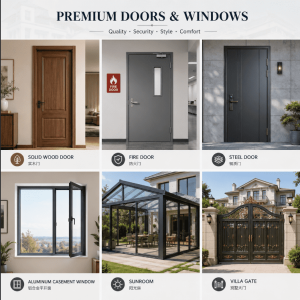
As a factory-direct manufacturer, we produce house glass doors and windows — thermal-break aluminum systems, solid wood doors, and aluminum alloy entrance doors. Our production facility handles the entire manufacturing process, from profile processing to final assembly.
11.1 Customization Capabilities
We offer full customization on size, color, glass type, and hardware accessories. You can specify exactly what your project requires — down to the RAL color of the powder coating and the glass configuration.
Our adjustable profile structures and fittings can be adapted to match local building codes in your target markets. This is particularly important for buyers exporting to regions with specific thermal or safety requirements.
11.2 Quality Assurance
Every order undergoes strict pre-shipment inspection covering air-tightness, water-tightness, and wind resistance testing. These tests align with the international standards discussed in this guide — EN and ASTM equivalents.
We provide test documentation and inspection reports so you can verify compliance before shipment. This documentation also supports your own quality assurance processes with clients.
11.3 Export Experience and Logistics
With substantial experience in foreign trade, we provide complete export documentation: packing lists, proforma invoices, and customs paperwork. Our team manages the logistics of FCL and LCL shipments, with direct delivery from our China factory.
For B2B buyers, this means a single point of contact from order confirmation to delivery. We coordinate packaging, shipping schedules, and documentation to match your construction timeline.
12. Why B2B Buyers Choose a Factory-Direct Partner
The value proposition of factory-direct sourcing goes beyond lower prices.
12.1 Cost Competitiveness Without Middlemen
Sourcing directly from the factory eliminates intermediary markups. This directly impacts your project’s bottom line. Our pricing structure itemizes material, hardware, labor, and shipping costs, so you understand what you are paying for.
12.2 Long-Term Supply Stability
Consistent production capacity supports ongoing and repeat orders. Direct communication with the production team means faster issue resolution and better quality control. You are not dependent on a distributor’s inventory or priorities.
12.3 Partnership Approach
Whether you need OEM, ODM, custom sizing, private label, or bulk supply for construction projects, our team works as an extension of your supply chain. We support both small-batch custom orders and large-scale construction project bulk supply.
Decision Guide
Choose a factory-direct manufacturer like us if: you need competitive pricing, full customization, direct communication, and documented quality control for bulk orders.
Choose a local distributor if: you need small quantities immediately, local installation support, or you lack experience managing international shipments.
Choose OEM if: you have established designs and need a manufacturing partner.
Choose ODM if: you need design and engineering support to develop your product line.
Choose LCL if: you are testing a new market or need smaller quantities.
Choose FCL if: you have confirmed demand and want the lowest per-unit shipping cost.
—
References
[1] EN 12207:2016 — Windows and doors. Air permeability. Classification. https://www.en-standard.eu/
[2] EN 12208:2000 — Windows and doors. Watertightness. Classification. https://www.en-standard.eu/
[3] EN 12210:2016 — Windows and doors. Wind load resistance. Classification. https://www.en-standard.eu/
[4] ISO 10077-1:2017 — Thermal performance of windows, doors and shutters. https://www.iso.org/
[5] EN 1191:2012 — Windows and doors. Resistance to repeated opening and closing. https://www.en-standard.eu/
[6] EN 1670:2007 — Building hardware. Corrosion resistance. https://www.en-standard.eu/
https://doorwoodendoors.com/contact-us/” style=”display:inline-block;padding:12px 24px;background:#2563eb;color:#fff;text-decoration:none;border-radius:6px;font-weight:600″>Get a Free Quote