Content Menu
● 1. What Are Glass French Doors? Types and Applications
● 2. What Quality and Performance Factors Matter for Glass French Doors?
● 3. What Sizes Do Glass French Doors Come In?
● 4. How Much Do Glass French Doors Cost?
● 5. How to Evaluate Glass French Doors Suppliers
● 6. What Standards and Certifications Apply to Glass French Doors?
● 7. Production Process: From Raw Material to Finished Doors
● 8. Customization and OEM/ODM Options
● 9. Ordering Process: MOQ, Lead Time, and Shipping
● 10. How Jusen Door and Windows Manufacturing Co., Ltd. Meets These Standards
11 min read
The first container of glass French doors a buyer imports usually arrives with a mix of relief and anxiety. The units look right. The glass has the Low-E coating specified. But when the installer tries to fit the frames into the rough openings, something is off by half an inch. That half-inch costs two days of site labor and a change order.
Most procurement problems with glass French doors do not come from poor workmanship. They come from mismatched specifications, unclear communication of dimensions, and a lack of verification before production starts. This guide covers what B2B buyers need to know before placing a bulk order.
What Are Glass French Doors? Types and Applications
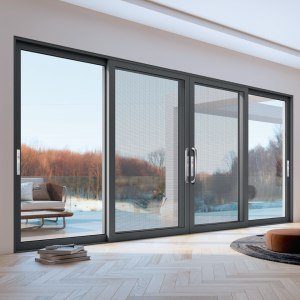
Glass French doors are hinged door units — typically two panels that swing inward or outward — with glass lites occupying most of the panel surface. They are specified in residential and light-commercial projects where natural light and visual continuity between spaces matter.
The core components of a French door unit are the stiles (vertical frame members), rails (horizontal frame members), glazing beads (which hold the glass in place), and weather-stripping. Buyers choose between prehung units (door slab pre-attached to a frame with hinges already installed) and slab-only doors. For B2B projects, prehung units are almost always the better choice. They reduce on-site labor and eliminate the risk of improper installation — a common cause of warranty callbacks.
Glass Configurations: Full Lite vs. Divided Lights
The glass configuration defines both the aesthetic and the cost of the unit.
- Full lite: A single pane of glass occupying the entire panel. Maximum visibility, modern appearance.
- Divided lites: Multiple glass panes separated by grilles or muntins. Common patterns include 6-lite, 10-lite, and 15-lite configurations.
A critical distinction exists between true divided lites (TDL) and simulated divided lites (SDL) . TDL uses individual glass panes separated by structural muntins — historically accurate but thermally inefficient and expensive. SDL applies grilles onto a single insulated glass unit, achieving the divided look without the thermal penalty. For exterior applications, SDL is the standard recommendation.
Material Substrates: Aluminum, Wood, and Fiberglass
| Material | Strength | Thermal Performance | Best For | Cost Level |
|---|---|---|---|---|
| Thermal Break Aluminum | High | Excellent (with thermal break) | Exterior, large spans | Mid-High |
| Wood (Pine, Oak) | Moderate | Good | Interior, covered exterior | Low-Mid |
| Fiberglass | High | Excellent | Exterior, high-humidity | High |
Thermal break aluminum uses a polyamide strip between the interior and exterior aluminum profiles to interrupt heat transfer. This construction delivers slim sightlines and high structural strength, making it suitable for large door spans. The frames are powder-coated for color customization and corrosion resistance.
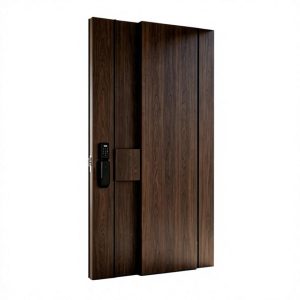
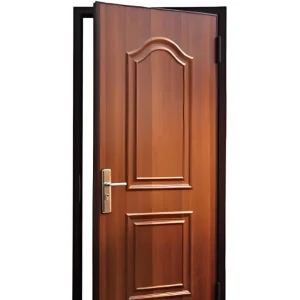
Wood doors — typically primed pine for interior applications — remain the most cost-effective option for dividing interior spaces. They are not recommended for unprotected exterior exposure due to moisture absorption and warping.
Fiberglass offers the dimensional stability of aluminum with the appearance of wood. It resists rot and does not expand or contract significantly with temperature changes. The trade-off is cost — fiberglass units typically command a premium.
What Quality and Performance Factors Matter for Glass French Doors?
For exterior applications, the performance of a glass French door hinges on three factors: glazing, thermal metrics, and weather resistance.
Glazing: Low-E, Tempered, and Laminated
Low-E (low emissivity) glass has a microscopic metallic coating that reflects heat while transmitting light. It is the industry standard for exterior units and is required by most building energy codes. A double-glazed unit with Low-E coating and argon gas fill achieves a U-factor around 0.25–0.30, depending on the spacer system.
Tempered glass is heat-treated to increase strength. Building codes require safety glazing — tempered or laminated — in doors and adjacent sidelites because of the risk of human impact. Tempered glass breaks into small granules rather than sharp shards.
Laminated glass consists of two glass layers bonded with a PVB interlayer. It holds together when shattered, providing security and acoustic insulation. For street-facing facades or high-end villas, laminated glass is often specified even when code does not require it.
Thermal Performance: U-Factor and SHGC
Two metrics define the energy performance of a door:
- U-Factor: The rate of heat transfer through the unit. Lower is better for cold climates.
- SHGC (Solar Heat Gain Coefficient): The fraction of solar radiation transmitted through the glass. Lower SHGC reduces cooling loads in hot climates.
Climate zone determines the optimal balance. Northern regions prioritize low U-factor; southern regions prioritize low SHGC. A supplier that cannot explain how their units perform on both metrics — with test data — should raise a red flag.
Air and Water Tightness Testing
Exterior doors face wind-driven rain and pressure differentials. Industry standards such as EN 12207 (air permeability) and EN 12208 (water tightness) classify performance levels. A door rated Class 4 for air permeability and Class 9A for water tightness is considered high-performance for residential applications.
Buyers should request test reports for the specific profile system being quoted. Not all manufacturers test every profile configuration, and performance varies with glass thickness and hardware.
What Sizes Do Glass French Doors Come In?
Standard widths for exterior double French doors range from 5’0″ to 6’0″, with heights of 6’8″ being the most common. Interior units are available in 4’0″ and 5’0″ widths at the same height.
The growing trend in custom residential work is 8’0″ tall units. These require structural reinforcement — heavier hinges, thicker stiles, and tempered or laminated glass to handle the increased weight and wind load. Not all factories can produce tall units reliably. The profile must be engineered for deflection, not simply scaled up from a standard design.
Rough Opening vs. Unit Dimensions
The single most common specification error is confusing rough opening (RO) with unit dimensions. The rough opening is the framed opening in the wall; the unit dimension is the actual size of the door frame. The difference is the installation clearance — typically 1/2″ to 3/4″ on each side and top.
When ordering, provide the RO size to the supplier, not the door size. A factory experienced in export will confirm the RO and provide a shop drawing for approval before production.
How Much Do Glass French Doors Cost?
Pricing varies significantly by material, glass specification, and finish. For B2B buyers, a rough breakdown of a mid-range aluminum unit with Low-E glass:
- Glass: 30–40% of cost
- Frame/profile: 30%
- Hardware: 15%
- Labor and overhead: 15%
Clear glass is cheaper than Low-E. Standard sizes are cheaper than custom. Factory-applied powder coating adds cost but eliminates field painting. These trade-offs should drive the specification, not the other way around.
The “factory direct” pricing advantage comes from eliminating distribution layers. A typical distribution chain adds 15–25% markup between the factory and the final buyer. Sourcing directly from a manufacturer removes that margin — but it also transfers logistics responsibility to the buyer.
How to Evaluate Glass French Doors Suppliers
The evaluation framework for a door factory differs from that of a trading company. The questions are the same; the verifiable answers are not.
Production Capability and Customization
Does the factory offer OEM (building to your exact specification) or ODM (modifying their existing design)? Both models are valid, but they require different levels of communication. For OEM projects, the factory must be able to produce shop drawings, obtain your approval, and replicate the approved sample at scale.
Ask specifically: “Can you adjust the profile structure and fittings to match our local building code?” This is the most revealing question. A factory that can adapt its products to different wind-load zones, snow-load requirements, or hurricane codes demonstrates engineering capability. A factory that offers only fixed configurations has limited value for international buyers.
Quality Control and Pre-Shipment Inspection
The “big three” tests for exterior doors are air-tightness, water-tightness, and wind resistance. Reputable factories test these against EN or ASTM standards. A buyer should request test reports for the specific profile system being quoted, not generic claims.
Pre-shipment inspection is the final quality gate. The factory should allow a third-party inspection or provide a detailed inspection report before loading. Buyers should verify that the inspection covers the actual production batch, not a sample unit.
Logistics and Documentation
The two shipping options are:
- FCL (Full Container Load): Lower per-unit cost, requires enough volume to fill a container.
- LCL (Less than Container Load): Flexible for smaller orders, higher per-unit freight cost.
Documentation matters as much as the physical shipment. A factory should provide a packing list, proforma invoice, and full customs documents to facilitate import clearance. Delays at customs are almost always documentation problems, not physical inspection problems.
Red Flags: Avoid Suppliers Who…
- Cannot provide test reports for their profile systems
- Quote prices without asking about your project’s climate zone
- Offer no customization of profile structure or hardware
- Require full payment before production without a pre-shipment inspection option
- Lack export experience documentation (packing lists, customs filings)
What Standards and Certifications Apply to Glass French Doors?
The relevant standards vary by target market. European buyers look for EN 14351-1 (CE marking for windows and doors). North American projects reference AAMA/WDMA/CSA 101/I.S.2/A440 (windows, doors, and skylights). Chinese factories supplying international markets typically test to both EN and ASTM standards.
For aluminum doors, the thermal break construction is verified by testing the profile’s thermal transmittance. For glass, EN 1279 covers insulated glass units. Buyers should ask for the specific standards the factory tests against, and the test results for their product line.
Production Process: From Raw Material to Finished Doors
Understanding the production process helps buyers assess lead times and quality risks.
Aluminum doors: The profile is extruded from aluminum billets, then cut to length, machined for hardware, and assembled with the thermal break strip. The frame is powder-coated or anodized. Glass is cut, tempered, and laminated as specified, then assembled into insulated glass units with a spacer system. The final assembly installs the glass into the frame, mounts hardware, and tests for operation.
Wood doors: Kiln-dried lumber is milled into stiles and rails, joined with mortise-and-tenon or dowel construction, and glued under pressure. The panel is sanded, primed, and finished. Glass lites are installed with glazing beads.
Fiberglass doors: A fiberglass skin is molded around a structural core — typically polyurethane foam for insulation. The door is then primed for painting or finished with a wood-grain texture.
Each process has a different lead time. Aluminum extrusion and powder coating require the longest cycle — typically 2–4 weeks for profile production alone. Buyers should factor this into project scheduling.
Customization and OEM/ODM Options
Full customization covers four dimensions: size, color, glass, and hardware accessories.
- Size: Custom widths and heights beyond standard configurations require re-engineering of the profile and glass cutting. Tall units (8’0″ and above) require structural verification.
- Color: Aluminum profiles accept any RAL color via powder coating. Wood doors can be stained or painted to match specified finishes.
- Glass: Low-E, tempered, laminated, tinted, or patterned glass can be specified. The glass type affects both cost and lead time.
- Hardware: Hinges, handles, locks, and multipoint locking systems can be sourced to match local preferences and security standards.
For OEM projects, the factory produces to the buyer’s exact specification. For ODM projects, the factory modifies an existing design — which is often faster and more cost-effective.
Ordering Process: MOQ, Lead Time, and Shipping
Minimum order quantities vary by product line. For aluminum doors, a 20ft container is the practical minimum for economical production. Wood doors can be produced in smaller quantities. Buyers should confirm MOQ before investing time in specification development.
Lead times for a container order typically range from 3 to 6 weeks, depending on customization level. The production schedule should include a pre-shipment inspection date — this is the buyer’s opportunity to verify quality before payment of the balance.
Shipping terms should be agreed in advance. FOB (Free On Board) and CIF (Cost, Insurance, Freight) are the most common Incoterms for door imports. Buyers should clarify which party bears responsibility for customs clearance and inland transport at the destination.
How Jusen Door and Windows Manufacturing Co., Ltd. Meets These Standards
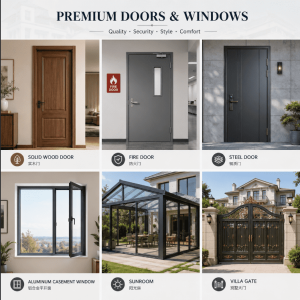
The criteria above describe what a capable supplier should offer. As a manufacturer of solid wood doors, thermal-break aluminum doors and windows, and custom villa door systems, our approach is straightforward: we meet these standards because our business model depends on repeat orders from contractors and distributors.
Direct Factory Supply for B2B Pricing
We supply directly from our factory in China. There is no trading company in the chain, which means the price you receive is the production cost plus a manufacturing margin — not a price inflated by multiple distribution layers. For volume orders, this translates to predictable unit costs and better project budgeting.
Customization and Manufacturing Capability
Our production lines handle thermal-break aluminum, solid wood, and aluminum alloy entrance systems. We support both OEM and ODM projects with full customization on size, color, glass, and hardware accessories. If your project requires a specific RAL color or a custom profile configuration to meet local building codes, we can adjust our profile structure and fittings accordingly.
Quality Assurance with Pre-Shipment Inspection
Every order undergoes strict pre-shipment inspection covering air-tightness, water-tightness, and wind resistance. We provide test reports and accommodate third-party inspections. Our goal is to ensure that what arrives at your site matches what was approved in the sample — no surprises, no site rejection costs.
Export Logistics and Documentation
We manage both FCL and LCL shipments with direct delivery from our factory. Our export experience covers packing lists, proforma invoices, and full customs documentation, so your import clearance proceeds without avoidable delays.
Questions to Ask Before Ordering
Use this checklist when evaluating any glass French door supplier:
- [ ] Confirm the exact Rough Opening (RO) dimensions, not just the door size
- [ ] Specify the glass: Low-E, tempered, laminated, or a combination
- [ ] Request test reports for air, water, and wind performance
- [ ] Clarify the material: thermal break aluminum, wood, or fiberglass
- [ ] Confirm the Incoterms (FOB, CIF, EXW) and shipping method (FCL vs. LCL)
- [ ] Ask about lead time and the pre-shipment inspection date
- [ ] Verify the MOQ for your target product line
- [ ] Request a shop drawing for approval before production
Choose a thermal break aluminum supplier if your project involves exterior doors in a climate with significant temperature swings. Choose a wood door factory if the application is interior and cost is the primary constraint. Choose a fiberglass manufacturer if the project is exterior in a high-humidity or coastal environment.
The best supplier for your project is the one that can demonstrate test data, adapt profiles to local codes, and communicate clearly through the production process. That combination is rarer than it should be — which is why verification before ordering matters more than brand reputation.
References
- EN 14351-1 — Windows and doors. Product standard. European Committee for Standardization. https://standards.cen.eu
- EN 12207 — Windows and doors. Air permeability. Classification. https://standards.cen.eu
- EN 12208 — Windows and doors. Water tightness. Classification. https://standards.cen.eu
- AAMA/WDMA/CSA 101/I.S.2/A440 — North American Fenestration Standard. https://www.aamanet.org
- Efficient Windows Collaborative — U-Factor and SHGC explained. https://www.efficientwindows.org