Content Menu
● 1. Understanding Entry Door and Sidelight Units: Types and Applications
● 2. Material and Construction Options for Entry Door and Sidelight Systems
● 3. Key Technical Specifications to Review Before Sourcing
● 4. Sizing, Customization, and Code Compliance Considerations
● 5. How to Evaluate Entry Door and Sidelight Suppliers
● 6. Production Process: From Raw Material to Finished Sidelight Unit
● 7. Quality Control: Multi-Stage Inspection Process
● 8. Customization and OEM/ODM Options
● 9. Ordering Process: MOQ, Lead Time, and Shipping
● 10. Our Sidelight Manufacturing Capabilities
● 11. Certifications and Industry Standards
11 min read
A distributor in Rotterdam once told me the difference between a good door shipment and a bad one comes down to a single number: the rejection rate on site. When 40 sidelight units arrive with scratched glass or warped frames, the installer walks off the job, and the importer eats the freight cost both ways.
That is why sourcing an entry door and sidelight unit is not the same as buying a standard door slab. This guide walks through what B2B buyers need to verify before committing to a factory order — from material selection to QC protocols to shipping options.
Understanding Entry Door and Sidelight Units: Types and Applications
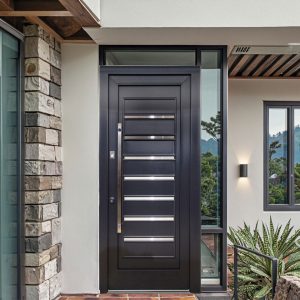
An entry door and sidelight unit consists of one or two operable door panels flanked by fixed glass panels (sidelights) within a single frame system. The sidelights admit natural light, widen the visual appearance of the entrance, and improve the architectural proportions of the facade.
What is an entry door and sidelight? An entry door and sidelight is a pre-assembled door system where fixed glass panels are mounted beside the active door leaf, sharing a common frame and threshold.
Common Configurations in the Market
| Configuration | Description | Typical Application |
|---|---|---|
| Single door + one sidelight | One operable door, one fixed glass panel on either side | Residential front entries, side entrances |
| Single door + double sidelights | One operable door with fixed glass on both sides | Wide residential entries, high-end townhouses |
| Double doors + sidelights | Two operable leaves with fixed glass panels on the outer edges | Commercial entrances, large custom homes |
| Full-light sidelight units | Sidelight panels that run the full height of the door | Modern architectural styles, commercial storefronts |
Residential vs. Commercial Demand
The residential market drives most sidelight demand, where curb appeal directly affects property value. Commercial projects use sidelight units less frequently but order in higher volumes per project. The Middle East market has shown notable growth in aluminum systems, driven by villa construction and the preference for slim-profile frames that maximize glass area.
Material and Construction Options for Entry Door and Sidelight Systems
The choice of frame material determines performance limits, maintenance requirements, and price range.
Thermal-Break Aluminum: The Dominant Choice for Performance
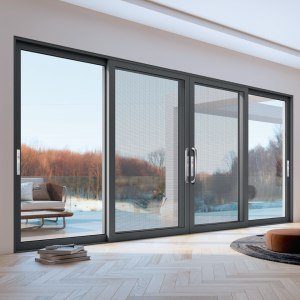
Aluminum entry door and sidelight systems with thermal break construction have become the industry standard for projects requiring energy efficiency and structural rigidity. The thermal break — typically a polyamide strip inserted between the interior and exterior aluminum profiles — reduces heat transfer significantly.
Typical U-values for thermal-break aluminum doors range from 1.4 to 2.2 W/m²K. Non-thermal-break aluminum can reach 5.0 W/m²K or higher. Aluminum’s structural rigidity makes it the preferred choice for tall sidelights; a 3-meter panel maintains dimensional stability, while the same panel in uPVC would require additional reinforcement.
Surface finishing options include:
- Powder coating in RAL colors (typical thickness 60-80 microns)
- Anodizing (natural, bronze, or black finishes)
- Wood-grain foil that mimics timber aesthetics
Solid Wood: The Premium Aesthetic Option
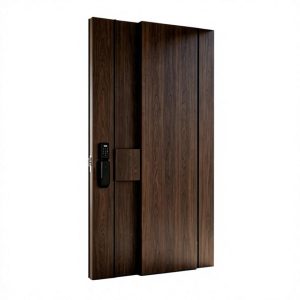
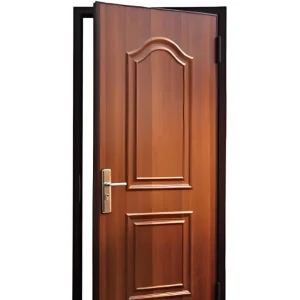
Solid wood entry door and sidelight units remain the first choice for high-end residential and heritage renovation projects. Common species include oak, mahogany, and teak, with engineered wood cores used to improve dimensional stability.
The maintenance requirement is the primary trade-off. Exterior wood doors need re-finishing every 2-3 years. Wood doors also require more careful packaging; moisture content must be controlled during transit to prevent cracking.
Steel and Fiberglass: The Practical Alternatives
Steel doors offer the highest security and lowest cost but suffer from poor thermal performance and susceptibility to dents. Fiberglass doors mimic wood grain appearance while offering better insulation than steel and lower maintenance than wood, achieving U-values between 1.2 and 1.8 W/m²K. However, fiberglass is less common in international trade due to higher manufacturing complexity.
Key Technical Specifications to Review Before Sourcing
Before sending a request for quote, buyers should have a technical specification sheet ready.
Glass and Glazing: The Most Critical Sidelight Component
Sidelight glass must meet safety standards in most jurisdictions. Tempered or laminated glass is typically required for any glazing within 18 inches of a door opening.
What glass options are available for sidelights? Sidelight glazing options include double or triple glazing with low-E coatings, argon gas filling, tempered or laminated safety glass, and decorative options such as obscured, frosted, or patterned glass.
Double glazing with low-E coating is the minimum specification for most residential projects today. For privacy applications, buyers typically specify obscured or frosted glass, decorative grids between panes, or tinted coatings.
Hardware and Multi-Point Locking Systems
The locking mechanism on an entry door and sidelight unit is a structural component. Multi-point locking systems engage at multiple points along the door edge, improving both security and air-tightness.
European markets favor multi-point locks conforming to EN standards, while North American projects typically require ANSI/BHMA-rated hardware. Hinge specification matters equally; heavy doors require three or more hinges rated for the door weight.
Performance Testing: Air, Water, and Wind Load
The three performance tests that matter most are:
- Air-tightness — measures air leakage through the closed assembly
- Water-tightness — measures resistance to water penetration under wind-driven rain
- Wind load resistance — measures structural integrity under wind pressure
Common test standards include ASTM E283, E330, and E547 (North America) or EN 1026, 1027, and 12211 (Europe). Buyers should request test reports before placing a bulk order. A factory that cannot produce test documentation is a red flag.
Sizing, Customization, and Code Compliance Considerations
Entry door and sidelight dimensions vary significantly between markets, and the ability to produce custom sizes is often the deciding factor in supplier selection.
Standard vs. Custom Dimensions
North American standard entry doors are typically 36 inches wide by 80 inches tall, with sidelights ranging from 12 to 18 inches wide. European standards differ, with common widths around 90 to 110 cm and heights of 210 to 230 cm.
Custom sizing becomes necessary for renovation projects with non-standard openings, commercial buildings with unique requirements, and replacement projects. Modular profile systems allow adjustments in 5 mm increments, while fixed-profile systems limit customization.
Regional Building Codes and Climate Zones
Energy efficiency requirements vary dramatically by region. The United States uses ENERGY STAR climate zones, while Europe uses the Energy Performance of Buildings Directive (EPBD). Coastal regions impose additional wind-load requirements; buyers should specify the project location and expected wind-load rating when requesting quotes.
Color, Finish, and Design Customization
Buyers can typically specify RAL colors, custom anodizing colors, wood-grain foil patterns, glass patterns, and hardware finishes. For OEM/ODM buyers, confirm whether the factory applies custom logos or packaging labels as part of the standard service.
How to Evaluate Entry Door and Sidelight Suppliers
Supplier evaluation should follow a structured framework covering technical capability, quality systems, and commercial reliability.
How do you evaluate an entry door and sidelight supplier? Evaluate suppliers on four criteria: manufacturing capability (production lines, equipment), quality control systems (test reports, inspection protocols), export experience (documentation, logistics), and financial stability (order history, payment terms).
Manufacturing Capability Assessment
Ask for specific information about production lines and monthly output, CNC machines and processing equipment, in-house vs. outsourced manufacturing, and the existence of own extrusion or anodizing facilities. A factory that outsources multiple production steps has less control over quality. In-house glass fabrication is particularly important for sidelight units, as it reduces handling damage.
Quality Control System Review
Request and review ISO 9001 certification, test reports for air-tightness, water-tightness, and wind resistance, pre-shipment inspection protocols, and third-party inspection options (SGS, Bureau Veritas, TÜV).
Export Experience and Documentation
Experienced suppliers provide packing lists with accurate weights, proforma invoices, certificates of origin, and full customs declarations.
Red Flags to Avoid
- Suppliers who cannot provide test reports for their own products
- Factories that quote significantly lower prices than market average without explaining cost differences
- Sales representatives who avoid answering technical questions directly
- Suppliers who require full payment before production without a track record
Production Process: From Raw Material to Finished Sidelight Unit
Understanding the production process helps buyers assess lead times and identify potential quality issues.
Step 1: Profile Cutting and Machining
Aluminum profiles are cut to precise lengths using CNC saws, then machined for drainage holes, hardware mounting points, and corner joints. Cutting tolerances typically range from ±0.5 mm to ±1 mm.
Step 2: Surface Treatment
Profiles undergo powder coating (cleaned, pre-treated, coated, and cured at approximately 200°C), anodizing (an electrolytic process creating a protective oxide layer), or wood-grain foil application.
Step 3: Thermal Break Assembly
For thermal-break systems, polyamide strips are inserted between interior and exterior profiles. The assembly passes through a crimping machine that mechanically locks the components together.
Step 4: Glass Fabrication
Sidelight glass is cut, edged, and processed: tempering (heated to approximately 700°C, then rapidly cooled), lamination (two panes bonded with PVB or EVA interlayer), and insulated glass assembly (multiple panes sealed with butyl and polysulfide).
Step 5: Assembly and Hardware Installation
Frame components are assembled with corner brackets, seals, and gaskets. The door leaf is hung, hardware is installed, and the unit undergoes functional testing.
Step 6: Packaging
Finished units are protected with clear film wrapping, corner guards, wooden crates or frames, and foam layering for glass components.
Quality Control: Multi-Stage Inspection Process
A reliable factory should have multiple inspection checkpoints throughout production.
Incoming Material Inspection
Raw materials — aluminum profiles, glass, hardware, seals — should be inspected upon receipt, verifying dimensions, surface finish quality, and specifications.
In-Process Inspection
Inspectors should check cutting accuracy, surface treatment quality, assembly alignment, and hardware function.
Pre-Shipment Inspection
Before loading, a final inspection verifies dimensions against approved drawings, glass specifications, hardware operation, packaging quality, and order compliance. For international orders, third-party inspection is recommended for the first few shipments.
Customization and OEM/ODM Options
Buyers fall into two main categories: those with existing designs who need manufacturing capacity (OEM) and those who want the factory to handle design as well (ODM).
OEM: Manufacturing to Buyer Specifications
OEM works best for established brands. The buyer provides detailed technical drawings and specifications; the factory manufactures to order and ships under the buyer’s brand.
Advantages include full control over product design, brand identity maintenance, and retained intellectual property. Considerations include the need for detailed documentation, longer development time, and higher minimum order quantities.
ODM: Factory Designs, Buyer Selects
ODM allows buyers to choose from existing factory designs and customize color, glass, and hardware. This suits distributors entering the market quickly.
Advantages include faster time to market and lower development costs. Considerations include shared designs with other buyers, less differentiation, and limited ability to modify core design elements.
Bulk Supply for Construction Projects
Project-based supply requires phased delivery schedules, volume pricing with payment milestones, on-site support, and replacement units for damaged products. Buyers should confirm the factory’s experience with large-scale projects.
Ordering Process: MOQ, Lead Time, and Shipping
What is the typical lead time for an entry door and sidelight order? Production lead time typically ranges from 30 to 60 days, depending on order volume, customization level, and factory capacity. Shipping adds another 15 to 40 days depending on destination.
Minimum Order Quantities
MOQ varies significantly: standard designs (20 to 50 units), custom sizes with standard profiles (50 to 100 units), and fully custom designs (100+ units). Some factories offer trial orders at higher unit prices.
Shipping: FCL vs. LCL
FCL advantages include lower per-unit cost, reduced handling damage risk, faster transit times, and better scheduling control. LCL advantages include lower total cost for small orders. Sidelight units are oversized and fragile; LCL involves multiple consolidation points, increasing damage risk. For first-time orders, FCL is often worth the extra cost.
Packaging Standards
Packaging must protect glass edges and corners, prevent surface scratches, support unit weight without warping, and allow for forklift handling. Typical packaging includes wooden crates with foam padding, corner guards, and clear film wrapping.
Our Sidelight Manufacturing Capabilities
As a factory-based manufacturer, our approach to entry door and sidelight production addresses each of the sourcing requirements described above.
Direct Factory Supply
We manufacture entry door and sidelight units in our own facility, supplying buyers directly without intermediary markups. Our production lines handle thermal-break aluminum doors, solid wood doors, and system windows.
Customization and Code Compliance
Full customization on size, color, glass, and hardware accessories is standard practice. Our adjustable profile structures and fittings can be modified to match local building codes of target markets, whether shipping to North America, Europe, or the Middle East.
Quality Assurance and Export Support
Every order undergoes strict pre-shipment inspection covering air-tightness, water-tightness, and wind resistance. We provide packing lists, proforma invoices, and full customs documentation with every shipment. We offer both FCL and LCL shipment options with direct delivery from our China factory.
Contact Our Team to discuss your specific requirements.
Certifications and Industry Standards
| Certification | Scope | Relevance |
|---|---|---|
| ISO 9001:2015 | Quality management systems | Basic quality assurance benchmark |
| CE marking | European conformity | Required for EU market entry |
| ENERGY STAR | Energy efficiency | North American residential market |
| Passivhaus certification | Ultra-low energy buildings | High-end European projects |
| ASTM compliance | Material and test standards | North American performance testing |
Buyers should verify that their supplier’s certifications are current and cover the specific products being purchased.
Questions to Ask Before Ordering
- What is the exact U-value of the proposed glazing and frame combination?
- What air-tightness, water-tightness, and wind-load ratings does the product achieve?
- Which test standards were used to verify these ratings?
- What is the MOQ for standard and custom designs?
- What is the production lead time for this specific order?
- What packaging is included, and can packaging be customized?
- What documentation is provided with the shipment?
- Are third-party inspections available, and who arranges them?
- What is the warranty period and what does it cover?
- What happens if units arrive damaged?
Choose a factory with documented test results to prove compliance to building officials. Choose a factory with in-house glass fabrication for large sidelight orders where glass quality is the primary risk. Choose a factory with flexible MOQ and trial order options if you are entering a new market.
References
- International Organization for Standardization. ISO 9001:2015 Quality management systems — Requirements. https://www.iso.org/standard/62085.html
- ASTM International. ASTM E283 Standard Test Method for Determining Rate of Air Leakage Through Exterior Windows, Skylights, Curtain Walls, and Doors. https://www.astm.org/e0283-19.html
- ASTM International. ASTM E330 Standard Test Method for Structural Performance of Exterior Windows, Skylights, Curtain Walls, and Doors by Uniform Static Air Pressure Difference. https://www.astm.org/e0330-21.html
- European Committee for Standardization. EN 1026 Windows and doors — Air permeability — Test method. https://www.en-standard.eu/bs-en-1026-2016-windows-and-doors-air-permeability-test-method/
- European Committee for Standardization. EN 12211 Windows and doors — Resistance to wind load — Test method. https://www.en-standard.eu/bs-en-12211-2016-windows-and-doors-resistance-to-wind-load-test-method/
- U.S. Department of Energy. ENERGY STAR Certified Windows, Doors, and Skylights. https://www.energystar.gov/products/windows_doors_and_skylights