Content Menu
● 1. The Anatomy of a High-Performance Entrance Door with Window
● 2. Customization Options for Your Entrance Door with Window
● 3. The Manufacturing Process: How We Ensure Quality and Durability
● 4. Logistics, Shipping, and Documentation for Global Buyers
● 5. Why Import Directly from the Jusen Factory?
● 6. Why We Recommend a Sample Order Before Bulk Production
12 min read
The last container we loaded had 240 aluminum entrance doors with windows, all bound for a residential developer in the Middle East. Every unit had a different glazing specification — some with low-E coating, some with laminated safety glass for the ground floor units. The client’s procurement manager had been burned before by a trading company that promised customization but delivered standard sizes. He now insists on visiting the production line before signing. Not every buyer does that. But those who do, tend to stay with us for years.
This article is not a brochure. It is a practical walkthrough of how we manufacture entrance doors with windows, what you can customize, and how to avoid the mistakes that cost importers time and money.
—
The Anatomy of a High-Performance Entrance Door with Window
An entrance door with window is not simply a solid door with a hole cut into it. The window changes the structural behavior of the entire unit. The frame must compensate for the reduced rigidity, the glazing must be sealed against three different types of water ingress, and the hardware must be rated for the additional weight.
Frame and Profile Construction: Aluminum vs. Solid Wood
We manufacture both thermal-break aluminum and solid wood entrance doors. The choice is not about which is “better” — it is about matching the product to the building type.
For high-rise residential and commercial projects, we recommend our thermal-break aluminum profiles. The polyamide strips separate the interior and exterior aluminum shells, which reduces heat transfer significantly. In a Dubai summer or a Chicago winter, this matters for the energy bill and for condensation on the interior frame surface.
For luxury villas and heritage-style architecture, our solid wood doors are the right call. We use laminated hardwood — typically oak or mahogany — which resists warping better than single-piece timber. The wood is kiln-dried to 8-12% moisture content before machining, which prevents the cracking that happens when wood adjusts to a different climate after shipping.
Here is an honest caveat: solid wood is not always the cheapest option over the product lifecycle. In high-humidity regions, buyers should prioritize moisture resistance over appearance. If your project site is within 5 kilometers of the coast, the salt air will attack unprotected wood finishes. Our technical team will tell you this during the quotation stage, not after the doors arrive.
Glazing Options: Balancing Light, Privacy, and Insulation
The glass is where most of the thermal performance and security either succeeds or fails. We offer:
- Double glazing (standard for most export markets): two panes with an argon-filled cavity. U-value around 1.1-1.3 W/m²K depending on the coating.
- Tempered glass: required by code in most countries for any glazing within 1 meter of the floor. We temper all glass above 900mm width.
- Low-E coating: reflects infrared radiation. In hot climates, this keeps the interior cooler; in cold climates, it keeps heat inside.
- Laminated glass: two panes bonded with a PVB interlayer. If broken, it stays intact — a security feature that matters for ground-floor entrance doors.
The window size affects both energy efficiency and structural integrity. A door with a full-height sidelight window has a different load path than a door with a small upper transom window. Our engineering team calculates the wind load for your project’s location and adjusts the frame profile wall thickness accordingly. This is not a one-size-fits-all calculation.
Hardware and Sealing Systems
The most common field failure we see on imported doors is not the frame or glass — it is the hardware and sealing. Multi-point locking systems are non-negotiable for an entrance door. A single-point lock can be forced with a screwdriver in under two minutes. Our standard configuration uses a multi-point lock with at least three locking points along the strike side, plus anti-lift pins on the hinge side.
Weather stripping is equally critical. We use EPDM seals — not the cheaper PVC alternatives — because EPDM maintains elasticity across a wider temperature range. In our pre-shipment inspection, every door undergoes an air-tightness test and a water-tightness test. We simulate heavy rain conditions with a calibrated water spray system. If a door leaks during testing, it does not ship.
—
Customization Options for Your Entrance Door with Window
If you are ordering a standard size from a catalog, you do not need a factory — you need a warehouse. The reason buyers work directly with us is that every project has different requirements.
Sizes, Configurations, and Opening Styles
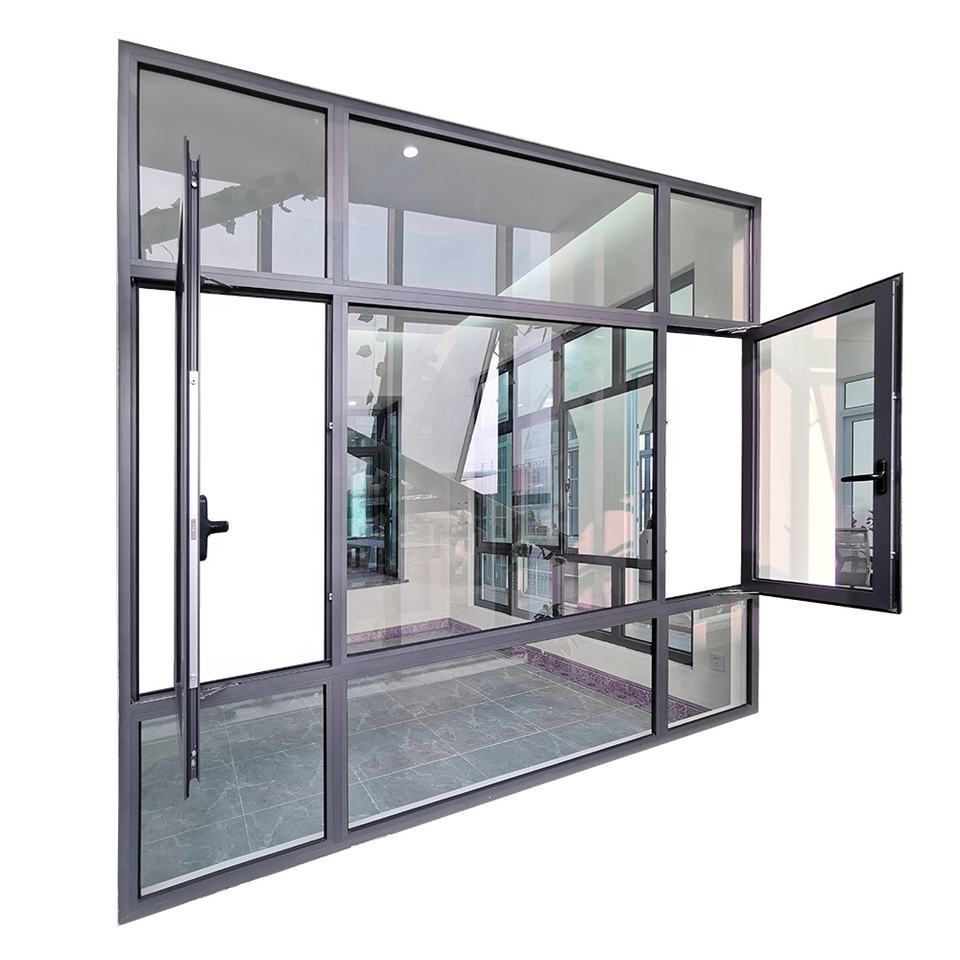
We do not restrict clients to standard sizes. Our production line is set up for full customization on size. Single doors, double doors, doors with sidelights, doors with transom windows above — all are manufactured to your rough opening dimensions.
The largest entrance door we have produced to date was 1,800mm wide and 2,600mm tall, with a pair of active door leaves and fixed sidelights on both sides. That door required a reinforced header because the glass weight exceeded 120 kilograms. Our engineering team calculated the deflection under wind load and specified a steel reinforcement insert inside the aluminum profile. It shipped to a private residence in Perth and was installed without issues.
Color Finishes and Surface Textures
Aluminum doors use powder coating, which is durable and available in any RAL color. We keep 30 standard RAL colors in stock, and custom colors take approximately 10 additional days in production. The powder coating is applied in our own finishing line — we do not outsource this step. Controlling the finishing line means we control color consistency across large volume orders. For a 300-unit development, that consistency is what your architect cares about.
For solid wood doors, we offer veneer finishes in a range of wood species and stains. We can match a sample you provide — send us a piece of the original wood or a color chip, and our finishing team will match it.
OEM and ODM Manufacturing for Your Brand
Many of our clients are not end-users. They are importers or distributors who sell under their own brand names. We provide OEM manufacturing — we build the door to your drawings, apply your logo on the hardware, and pack it in your branded packaging.
ODM goes further. If you have a concept but no detailed drawings, our engineering team designs the product with you. We have developed exclusive profile systems for clients in Southeast Asia and South America, where the local building codes required different thermal performance than the European standards we typically follow. The profile tooling is owned by the client, and we manufacture exclusively for them.
This is how you build a proprietary product line without investing in a factory.
—
The Manufacturing Process: How We Ensure Quality and Durability
Quality is not an inspection step at the end. It is built into the process at every stage.
From Raw Material to Precision Cutting
Aluminum profiles arrive from the extrusion mill as 6-meter lengths. We check the alloy composition — we use 6063-T5 or 6063-T6 alloy depending on the structural requirements. The profiles are then cut with a double-head cutting saw that holds tolerances of ±0.1mm. A frame that is cut with sloppy tolerances will show gaps at the corners, and no amount of sealing will fix that.
For solid wood doors, the lumber is finger-jointed and laminated before cutting. This eliminates the natural defects — knots and checks — that would otherwise appear after the door has been shipped and installed.
Advanced Assembly and Glazing Techniques
The frame assembly uses either corner crimping (for aluminum) or dowel and glue construction (for wood). The glazing is installed with a dry-glaze system — the glass sits on setting blocks, is held in place with glazing beads, and the entire perimeter is sealed with structural silicone.
The critical detail is the drainage system. A door with a window will get water on the glass surface. That water must be channeled to the outside through weep holes in the frame — not into the building. Our thermal-break profiles have an internal drainage channel that is designed into the extrusion, not added as an afterthought.
Pre-Shipment Inspection and Testing
Every order, regardless of size, goes through the same inspection protocol. We test for:
- Air-tightness: measured in cubic meters per hour per square meter at a reference pressure.
- Water-tightness: measured under simulated rainfall at increasing pressure levels.
- Wind resistance: tested to ensure the frame and glass assembly can withstand the design wind load for the project location.
These tests are not performed on a sample unit. They are performed on the actual units you receive. If a batch fails, we rework it before shipping. That is why our clients rarely report installation issues.
—
Logistics, Shipping, and Documentation for Global Buyers
Getting the product right is half the job. Getting it to your site without damage or customs delays is the other half.
Packaging for International Transit
Doors with glass require export-grade packaging. We wrap each door in a protective film, then use wooden crates with foam corner protectors. The glass is separated from the frame by cardboard spacers to prevent contact during transit. For container loading, we use steel strapping to secure the crates — a door that shifts inside a container will arrive damaged, no matter how well it was packed.
FCL and LCL Shipping Options
We ship both Full Container Load (FCL) and Less than Container Load (LCL). For FCL, we load the container at our factory. For LCL, we coordinate with a consolidation warehouse near the port.
The choice depends on your order volume and timeline. FCL is more cost-effective per unit for orders above approximately 60-70 doors. LCL is viable for sample orders or initial test batches. We will calculate both options for you and recommend the more economical choice.
Streamlined Documentation and Customs Clearance
Importing doors into a new market involves paperwork. We provide the complete set of shipping documents with every order:
- Commercial invoice
- Packing list (with itemized weights and dimensions)
- Bill of lading
- Certificate of origin (if required)
- Any additional certifications your customs broker requests
Our export team has handled shipments to 40+ countries. We know which documents are needed for different destination ports and we prepare them in advance. This is the practical value of our experience in foreign trade — you are not learning the process by trial and error.
—
Why Import Directly from the Jusen Factory?
You have two options when sourcing entrance doors with windows from China: work with a trading company, or work directly with a factory. The difference is not just the price.
Eliminating the Middleman to Maximize Your Margins
A trading company does not own a production line. They source from factories, add a markup, and pass the order to you. When there is a quality issue, you are dealing with an intermediary who must then negotiate with the factory. The communication chain adds time and friction.
As a direct factory, we offer a competitive price without middleman markup. The savings are typically 15-25% compared to trading company prices for the same product specification. For a 200-unit project, that difference is significant.
Meeting Local Building Codes and Standards
Building codes vary significantly between countries. A door that complies with European standards may not meet the energy rating requirements in Australia, or the wind load requirements in the Caribbean.
Our adjustable profile structure and fittings allow us to modify the door to match local building codes of your target market. We work with you to understand the requirements — thermal transmittance (U-value), air infiltration rate, water penetration resistance, and safety glazing standards — and adjust the product specification accordingly.
This is not a sales pitch. It is a practical discussion we have with every client before quoting. Send us your local code requirements, and our team will confirm whether our standard product meets them or what adjustments are needed.
—
Why We Recommend a Sample Order Before Bulk Production
This is the advice we give to every new client, even though it slows down our sales cycle. Order one door first. Test it on your site. Install it in the actual environment where the rest will go. If there is a problem — a seal that does not perform, a color that does not match, a hardware issue — it is far cheaper to fix one door than 200.
Most of our long-term clients started with a sample order. The ones who skipped this step and ordered a full container immediately often regretted it, not because the product was bad, but because they had not anticipated how their local conditions would interact with the product.
—
Frequently Asked Questions
What is the minimum order quantity for custom entrance doors?
Our MOQ is 10 units for customized production. For standard sizes and colors, we can accommodate smaller orders, but the per-unit cost will be higher due to setup and logistics. For OEM projects with exclusive tooling, the MOQ depends on the tooling investment and is discussed on a case-by-case basis.
Can you match specific RAL colors for the aluminum frames?
Yes. We stock 30 standard RAL colors and can match any custom RAL color with approximately 10 additional days in production. We recommend ordering a color sample before full production to verify the match.
What type of glass is best for an entrance door in a hot climate?
For hot climates, we recommend double glazing with low-E coating. The low-E coating reflects infrared radiation, reducing solar heat gain through the glass. In very hot regions, such as the Middle East or parts of Australia, a triple glazing option is available but adds weight and cost. We will calculate the payback period based on your local energy prices.
How do you ensure the door is water-tight during heavy rain?
The door frame is designed with an internal drainage system that channels water to the outside through weep holes. The glazing is sealed with structural silicone, and the perimeter weather stripping uses EPDM seals. Every door undergoes a water-tightness test before shipping, which simulates heavy rain conditions at increasing pressure levels.
What documentation do you provide for customs clearance?
We provide a commercial invoice, packing list, bill of lading, and certificate of origin. If required by your destination country, we can also arrange for additional certifications such as CE marking documentation or SGS inspection reports.
—
Decision Guide
Choose a thermal-break aluminum entrance door with window if:
- Your project is a high-rise or commercial building
- Your local building code requires specific thermal performance
- You need large glass areas with structural rigidity
- The building is in a coastal or high-humidity environment
Choose a solid wood entrance door with window if:
- Your project is a luxury villa or heritage-style building
- Aesthetic warmth is a priority over minimal maintenance
- The building is in a dry climate with low humidity variation
- You are willing to accept periodic maintenance (refinishing)
Choose our OEM/ODM service if:
- You want to sell under your own brand name
- You need a unique design that is not available from competitors
- You want exclusive rights to a profile system in your market
—
Every project starts with a conversation. Tell us about your project location, the building type, and the local code requirements. Our team will come back with a specification, a price, and an honest assessment of what will work — and what will not.
—
References
[1] European Aluminium Association. “Thermal Break Technology for Aluminum Profiles.” https://www.european-aluminium.eu/
[2] National Fenestration Rating Council. “Understanding U-Factor and SHGC Ratings.” https://www.nfrc.org/
[3] Glass for Europe. “Low-E Coatings Explained.” https://glassforeurope.com/
[4] ASTM International. “Standard Test Methods for Water Penetration of Exterior Windows.” https://www.astm.org/
[5] International Code Council. “International Building Code — Glazing Requirements.” https://www.iccsafe.org/